.svg)


%201.svg)
.avif)
Key Takeaways
- Slash Fields to Spike Conversions: Reducing form fields from 11+ to a concise 4–6 can boost completion rates by up to 120% by lowering cognitive load and perceived effort.
- Psychology Over Technology: Abandonment is often driven by psychological friction—such as privacy concerns or unclear value—rather than technical failure; trust signals and clear benefits are the antidote.
- Mobile-First is Mandatory: With mobile dominating Australian traffic, forms must be designed for "fat fingers" and unstable connections, utilising appropriate keypads and larger tap targets.
- Multi-Step Momentum: Breaking complex forms into digestible chunks with clear progress indicators can improve completion by 30–50% by leveraging the psychological principle of commitment.
- Continuous Testing Wins: Systematically A/B testing high-impact elements like field count and layout is the only way to separate assumption from revenue-generating reality.
Form abandonment is a silent revenue killer that costs Australian businesses billions of dollars annually. When a potential customer navigates to your quote request, newsletter signup, or checkout page, they are expressing clear intent. Yet, poor design often forces them away at the final hurdle. The difference between a converted lead and a bounce often comes down to friction.
Data consistently shows that completion rates improve significantly when forms are reduced through strategic information prioritisation. This isn't just about making things shorter; it is about respecting the user's time and cognitive load. By understanding the psychology behind why users bail—ranging from perceived effort to privacy concerns—businesses can engineer forms that build trust rather than erode it.
Consider the case of a prominent Australian insurance company. Their online quote form required users to answer 32 questions before providing a price estimate. With an abandonment rate exceeding 85%, they were hemorrhaging potential revenue because they assumed comprehensive information was necessary for accuracy. After redesigning the process to ask just six essential questions upfront—providing an immediate estimate and leaving the details for later—abandonment dropped to 34%, and monthly quote requests tripled. They collected the exact same information eventually; they simply stopped asking for marriage proposals on the first date.
This illustrates the fundamental principle of form optimisation: minimise friction between user intent and conversion. According to extensive usability research from the Baymard Institute, the average online checkout flow contains nearly 12 fields, yet optimal conversion typically occurs at just 6–8 fields. Every additional field beyond this creates a measurable drop in completion rates, often between 5% and 10%, leading to massive cumulative losses from unnecessary information requests.
.avif)
Understanding Form Friction and Abandonment Psychology
Effective form optimisation requires a deep understanding of the psychological factors that influence a user's decision to complete a task. It is rarely a technical failure; it is almost always a failure of value proposition.
The decision to complete a form is a subconscious calculation of perceived effort versus perceived value. Users weigh the effort required—measured in fields, time, and cognitive load—against the benefit they expect to receive. If the perceived effort outweighs the value of the product or service, abandonment is inevitable. This explains why users might slog through a 20-field application for a high-value mortgage but will abandon a 3-field newsletter signup if the value isn't immediately obvious.
Privacy and trust are equally critical. In an era of data breaches, asking for sensitive information triggers immediate defensive reactions. A field asking for a phone number can raise fears of spam calls, while requesting a physical address for a digital download prompts users to question your motives. To mitigate these concerns, you must employ "trust signals." This involves explaining exactly why specific data is needed, displaying security badges, and linking clearly to privacy policies.
Cognitive load is another major barrier. Users have limited attention spans and "mental bandwidth." Forms that feature confusing layouts, ambiguous labels, or complex validation rules exhaust this bandwidth quickly. When a user has to pause to interpret what a label means or why their valid input was rejected, they are one step closer to leaving. Reducing this load requires clear, familiar language and an obvious visual hierarchy that guides the user effortlessly from start to finish.
Furthermore, the principle of commitment and consistency plays a massive role in form completion. This psychological concept suggests that once a user starts a process, they feel an internal pressure to finish it. This is why multi-step forms often outperform single-page equivalents. By getting a user to complete a simple first step, you create a "micro-commitment" that encourages them to continue.
Strategic Field Reduction and Information Prioritisation
The single highest-impact strategy for improving form performance is the ruthless elimination of unnecessary fields. This begins with a Necessity Audit. For every single field on your form, you must ask: "Can we complete the business process without this? Can we collect this later? Is this here for the customer's benefit or our own internal convenience?"
Often, fields exist simply because a stakeholder once requested them, or because legacy systems "require" them. Sales teams might want extra data for segmentation, but if that request lowers conversion rates by 15%, the cost is too high. The solution is progressive disclosure. This approach involves collecting information across the entire customer lifecycle rather than demanding it all at once. Initial forms should capture only what is needed to secure the lead or transaction. Additional details can be gathered during onboarding or follow-up, once the relationship is established and value has been proven.
Another powerful tool for reduction is the use of smart defaults. Modern forms should do the heavy lifting for the user. Geolocation can automatically select a country or region; browser detection can pre-fill technical details; and returning user data should auto-populate known fields. Every piece of data the system enters is one less friction point for the user. However, these defaults must be accurate and easy to change, as correcting a wrong default is often more frustrating than typing into a blank field.
You can also reduce perceived friction by clearly distinguishing between optional and required fields. A form with three required fields and two optional ones is psychologically less daunting than a form with five required fields. Furthermore, conditional logic allows you to hide fields until they are relevant. For example, a "Company Name" field should only appear if the user selects "Business" as their customer type. This keeps the interface clean and ensures users are never overwhelmed by irrelevant questions.
Field Design and User Experience Best Practices
Beyond simply reducing the number of fields, the design of the input experience itself is critical. Poorly designed fields cause errors, and errors cause frustration.
Appropriate Input Types are essential for mobile-dominant audiences. Using correct HTML5 input tags triggers the appropriate keyboard on mobile devices. An email field should automatically bring up a keyboard with the "@" symbol, while a telephone field should trigger the numeric keypad. These small technical details dramatically reduce typing errors and keyboard switching, which are major friction points on smartphones.
Labels must be clear, descriptive, and permanently visible. A common design mistake is replacing labels with placeholder text inside the field. While this looks clean, the text disappears as soon as the user starts typing, forcing them to rely on memory to know if they are entering the right information. Placeholders should be used to provide examples of the expected format—such as "0412 345 678" for an Australian mobile number—rather than functioning as the label itself.
Inline validation is another non-negotiable feature for modern forms. Users should not have to wait until they hit "Submit" to find out they made a mistake. Validation messages should appear immediately after a user finishes a field (but not while they are still typing), providing instant feedback. Green ticks for correct inputs and clear, helpful error messages for incorrect ones prevent the frustration of having to hunt for errors after a failed submission.
Regarding layout, single-column forms consistently outperform multi-column designs. A single column creates a clear, vertical path to completion. Multi-column layouts force the user's eye to zigzag, creating ambiguity about the flow—should they go down or across? While multi-column forms save vertical space, the cognitive load they add is rarely worth the trade-off.
Multi-Step Forms and Progress Indicators
For complex processes, breaking a long form into manageable chunks can significantly improve completion rates. Multi-step forms leverage the psychological principle of "chunking," making a large task feel like a series of small, achievable steps.
This approach is best suited for forms that require substantial information, such as insurance quotes, loan applications, or detailed service inquiries. A general rule of thumb is that if a form requires more than 10 fields, it is a candidate for a multi-step approach. Conversely, short forms with fewer than five fields should usually remain on a single page to avoid unnecessary navigation overhead.
When designing multi-step forms, organisation is key. Fields should be grouped logically—personal details in one step, property details in the next. Start with the easiest questions to build momentum (the "sunk cost" effect) before moving to more difficult or sensitive queries.
Crucially, multi-step forms must include clear progress indicators. A visual progress bar or a "Step 2 of 4" label provides orientation and motivation. It reduces anxiety by showing the user exactly where they are in the process and how much is left. This creates a "goal gradient" effect, where users actually accelerate their efforts as they see the finish line approaching.
For longer forms, enabling a "Save and Return" feature is vital. Research from data collection platforms like Formstack indicates that forms allowing users to save their progress and return later can see significantly higher eventual completion rates. This is particularly true for B2B forms or complex applications where a user might need to go and find a document before continuing.
Mobile Form Optimisation Strategies
With mobile devices now accounting for the majority of web traffic in Australia, optimisation for touchscreens is no longer an optional enhancement—it is a requirement.
Mobile screens present unique challenges: typing is slower, accuracy is lower, and patience is shorter. Therefore, mobile forms often require even more aggressive field reduction than their desktop counterparts. If a field is "nice to have" on desktop, it should likely be removed entirely on mobile.
Interaction design on mobile must account for "fat fingers." Tap targets need to be large—at least 44x44 pixels—to prevent users from accidentally hitting the wrong button. Spacing between fields must be generous. Checkboxes and radio buttons, which are notoriously difficult to tap, should have their clickable areas extended via CSS to ensure they are easy to select.
Furthermore, mobile users are often on unstable data connections. According to Google, 53% of mobile site visits are abandoned if a page takes longer than three seconds to load. This makes technical performance—image compression, code minification, and efficient loading—part of your form optimisation strategy.
To assist mobile users further, leverage browser autofill and autocomplete attributes. By properly tagging your fields (e.g., identifying a field specifically as "given-name" or "tel"), you allow the browser to fill in the user's details with a single tap. This can reduce the time to complete a form from minutes to seconds, bypassing the tedious mobile typing experience entirely.
A/B Testing and Continuous Optimisation
Form optimisation is not a "set and forget" project; it is a continuous process of testing and refinement. The only way to separate assumption from reality is through systematic A/B testing.
When planning tests, focus on high-impact elements first. Testing the colour of the submit button might yield a 1% improvement, but testing a 6-field version of your form against a 12-field version could yield a 50% improvement. Formulate clear hypotheses for your tests, such as "Removing the 'State' field (since we capture Postcode) will reduce friction and increase submissions."
It is essential to isolate variables. If you change the headline, the field count, and the button colour all at once, you won't know what worked. Test one major variable at a time, or use multivariate testing if you have the traffic volume to support it.
Qualitative research is the perfect partner to quantitative testing. While analytics tell you what is happening (e.g., 60% of users drop off at the phone number field), tools like session recordings and heatmaps tell you why. You might discover that users are confused by the formatting requirement of the phone field, or that the error message is covered by the mobile keyboard. Combining these insights allows for truly data-driven optimisation.
Form Submission and Confirmation
The user experience doesn't end when the "Submit" button is clicked. The submission moment and the immediate aftermath are critical for confirming success and setting expectations.
The submit button itself demands attention. Avoid generic labels like "Submit." Instead, use action-oriented copy that reinforces the value, such as "Get My Free Quote," "Download the Guide," or "Schedule My Consultation." The button should be visually prominent, using high-contrast colours that stand out from the rest of the page.
Once clicked, the form must provide immediate feedback. A "loading" spinner or progress bar is essential to prevent users from rage-clicking the button multiple times because they think nothing is happening. If an error occurs, the recovery path must be smooth. Never clear the form data; preserve the user's hard work, highlight the error clearly, and provide specific instructions on how to fix it.
Finally, the confirmation page is a valuable piece of real estate. It should clearly confirm that the submission was successful and explain exactly what happens next ("We will email you within 24 hours"). This manages anxiety and sets the tone for the relationship. It is also an excellent opportunity to deepen engagement by suggesting related content or pointing users to your social media channels.
Frequently Asked Questions
What is the ideal number of fields for an Australian lead capture form?While "shorter is better" is a good rule of thumb, context matters. For a simple newsletter signup, 1–2 fields (Email, maybe First Name) is best. For a qualified B2B lead, 4–7 fields is generally the sweet spot, allowing you to capture name, company, email, and phone without overwhelming the user. If you need more data, consider moving non-essential fields to a "Step 2" or collecting them later in the sales process.
Should I use a CAPTCHA on my forms?Use them with extreme caution. Traditional CAPTCHAs (identifying traffic lights or squiggly text) are conversion killers, particularly on mobile. They add significant friction and frustration. Instead, opt for invisible spam protection solutions like reCAPTCHA v3 or honeypot fields, which detect bots in the background without requiring user interaction.
How do I handle asking for a phone number without scaring people off?The phone number field often has the highest abandonment rate. To mitigate this, make the field optional if possible. If it must be required, add a microcopy note explaining why you need it (e.g., "Used only to verify your account" or "So we can text you your quote"). This simple explanation reduces anxiety and builds trust.
Conclusion
Website forms represent the critical pivot point where interest transforms into business. They are the gateway to your revenue, and every unnecessary field or confusing label is a barrier you have placed in front of your customers.
The strategies outlined here—strategic field reduction, psychological friction elimination, mobile-first design, and rigorous testing—provide a systematic approach to turning your forms from obstacles into assets. Australian businesses that implement these changes routinely see significant increases in completion rates. That is a doubling of leads without spending a single extra dollar on advertising.
Are you ready to stop losing leads to friction? We specialise in conversion rate optimisation, comprehensive form analysis, and strategic redesigns that deliver measurable growth.
Let's transform your forms into conversion engines. Visit us at Maven Marketing Co..

Table of contents
read more blogs

Is Google Ads Better Than SEO for My Business
One of the biggest questions business owners ask when they are planning online growth is whether they should invest in Google Ads or SEO. Both are strong marketing plays that help your company show up in Google search results, but they do things in separate lanes. Google Ads gives quicker visibility and can bring in leads fast, whereas SEO more or less focuses on slow, steady organic traffic that tends to grow the longer you keep building it. Picking the right direction depends on what you want to achieve, how much money you can spend, how crowded the market is, and how quickly you need results, like sooner rather than later. The good news is you don’t always have to choose one or the other; it’s not exactly a black-and-white situation. If you take time to understand the strongest points of both, you can put together a more sensible digital marketing plan that supports consistent expansion. In this guide, we’ll compare Google Ads vs SEO, explain the main differences, and help you figure out what option makes the most sense for your business.

When Should I Hire a Digital Marketing Agency
Growing a business today takes more than just having a website or throwing a post on social media; customers usually search around online, compare providers, skim reviews, and basically expect the brand to show up with a solid digital presence before they even think about buying. Many businesses try to run their marketing themselves, but there comes a point when “doing it all in-house” becomes clunky and hard to manage, all at once. Knowing when to hire a digital marketing agency can end up making a big, real difference for your growth. If you’re not getting enough leads, or your online visibility feels stuck, or sales are just not moving, the right agency can bring the know-how, plus a clear plan, to help you get noticeably better outcomes. In this guide, we’ll dig into what a digital marketing agency actually does, the usual signs it’s time to bring one on, and how picking the right marketing partner can help your business move forward at a faster pace.
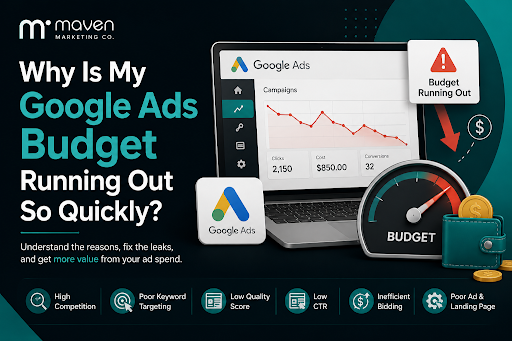
Why Is My Google Ads Budget Running Out So Quickly
Running a successful Google Ads budget isn’t only about throwing more money at it. It’s more like making every dollar, doing a bit extra. A lot of businesses start a Google Ads campaign with big hopes, then find out their daily budget is gone within a few hours, and that feels weird, right? After that, your ads stop showing effectively, new leads slip away, and your return on investment dips. So if your Google Ads budget is running out too fast, don’t stress. It’s a fairly common issue, and in most situations, it can be repaired with the right approach. There are multiple little things that can drain your advertising money quicker than you expected, from costly keywords to audience targeting that just doesn’t quite fit. In this guide, we’ll walk through why your budget disappears so quickly, how to cut wasteful spend, and the most reliable ways to boost your Google Ads ROI, even if your budget stays the same.