.svg)


%201.svg)
.png)
Key Takeaways
- Core Web Vitals have replaced AMP as Google's primary mobile performance signal since 2021, eliminating AMP's previous ranking advantages and making standard HTML optimisation viable for achieving excellent mobile speed scores
- AMP adoption in 2026 makes sense primarily for high-volume publishers requiring guaranteed fast rendering across diverse content types and hosting environments rather than being necessary for typical business websites with modern development practices
- Largest Contentful Paint under 2.5 seconds, Interaction to Next Paint under 200 milliseconds, and Cumulative Layout Shift under 0.1 represent Core Web Vitals thresholds that well-optimised standard HTML achieves without AMP restrictions
- Modern hosting infrastructure including CDNs, image optimisation services, and edge caching enables standard websites to match AMP's speed advantages without sacrificing design flexibility, tracking capabilities, or user experience features that AMP limitations constrain
- Most Australian SMEs achieve better business outcomes through focused Core Web Vitals optimisation of their existing websites rather than AMP migration requiring ongoing dual-version maintenance and accepting AMP's functional constraints
An Australian news publisher with 2 million monthly mobile visitors implemented AMP in 2017 when Google promoted the technology aggressively through Top Stories carousel placement and visible AMP badges in search results. The implementation required maintaining parallel content versions, accepting limited advertising options, forgoing sophisticated tracking implementations, and simplifying design substantially to meet AMP specifications. The trade-offs seemed worthwhile given the clear search visibility advantages AMP provided at that time.
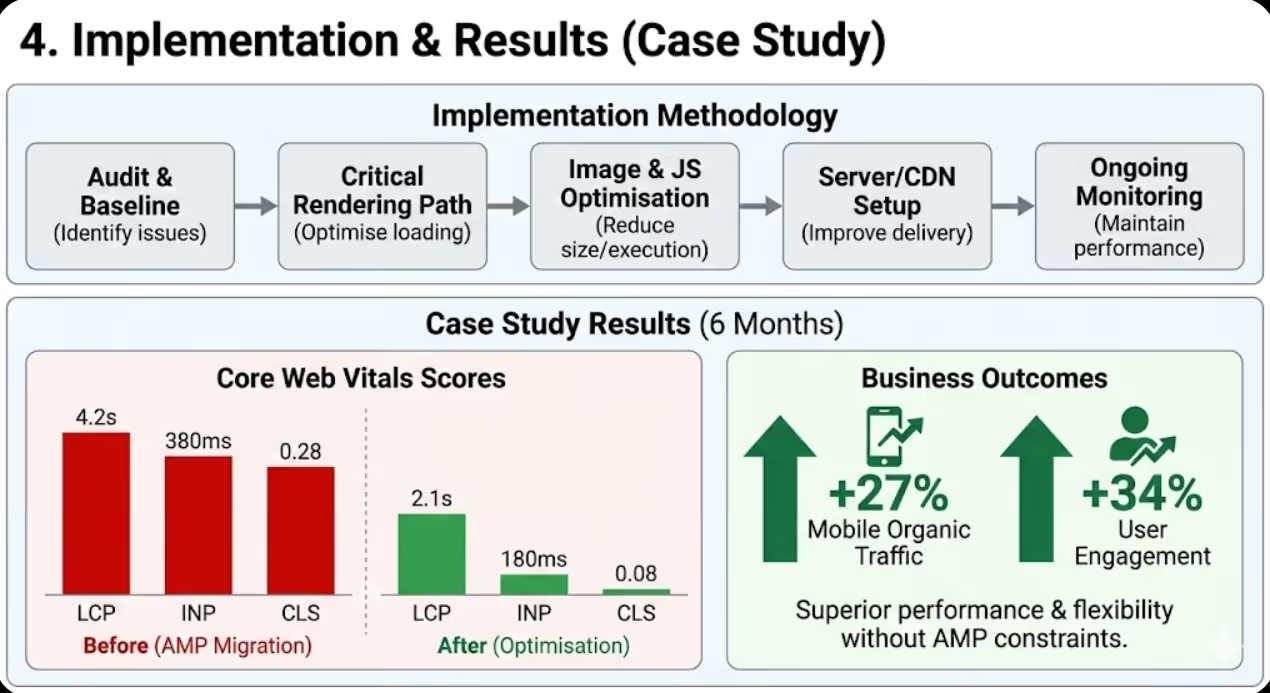
By 2023, the strategic calculus had completely shifted. Google had removed AMP badges from search results, eliminated preferential Top Stories treatment for AMP pages, and introduced Core Web Vitals as the primary page experience ranking factor applying equally to AMP and non-AMP pages. The publisher analysed their Core Web Vitals performance discovering that their standard HTML mobile pages scored poorly with LCP of 4.2 seconds, INP of 380 milliseconds, and CLS of 0.28 due to heavy advertising, unoptimised images, and render-blocking JavaScript accumulated over years without performance focus.
Maven Marketing Co. conducted comparative analysis revealing that investing in Core Web Vitals optimisation of standard HTML pages would achieve equivalent or better performance than AMP whilst eliminating AMP's restrictions and maintenance overhead. Implementation included image optimisation through next-gen formats and lazy loading, JavaScript optimisation through code splitting and deferral, advertising optimisation through asynchronous loading and layout shift prevention, and CDN implementation for edge delivery approaching AMP's caching advantages.
Six months after optimisation, standard HTML mobile pages achieved LCP of 2.1 seconds, INP of 180 milliseconds, and CLS of 0.08 surpassing Core Web Vitals thresholds whilst maintaining full design flexibility, sophisticated analytics, and diverse advertising formats that AMP had constrained. Mobile organic traffic increased 27% as improved page experience contributed to ranking improvements whilst user engagement increased 34% as the unconstrained design delivered better experience than AMP's limitations. The publisher sunset their AMP implementation entirely, eliminating dual-version maintenance costs whilst improving both performance and functionality compared to the AMP version they had maintained for six years.
According to research from HTTP Archive, only 0.1% of mobile pages used AMP in 2024 compared to over 1% in 2019, demonstrating that the web development community has largely abandoned AMP in favour of Core Web Vitals optimisation as Google's mobile strategy priorities shifted.
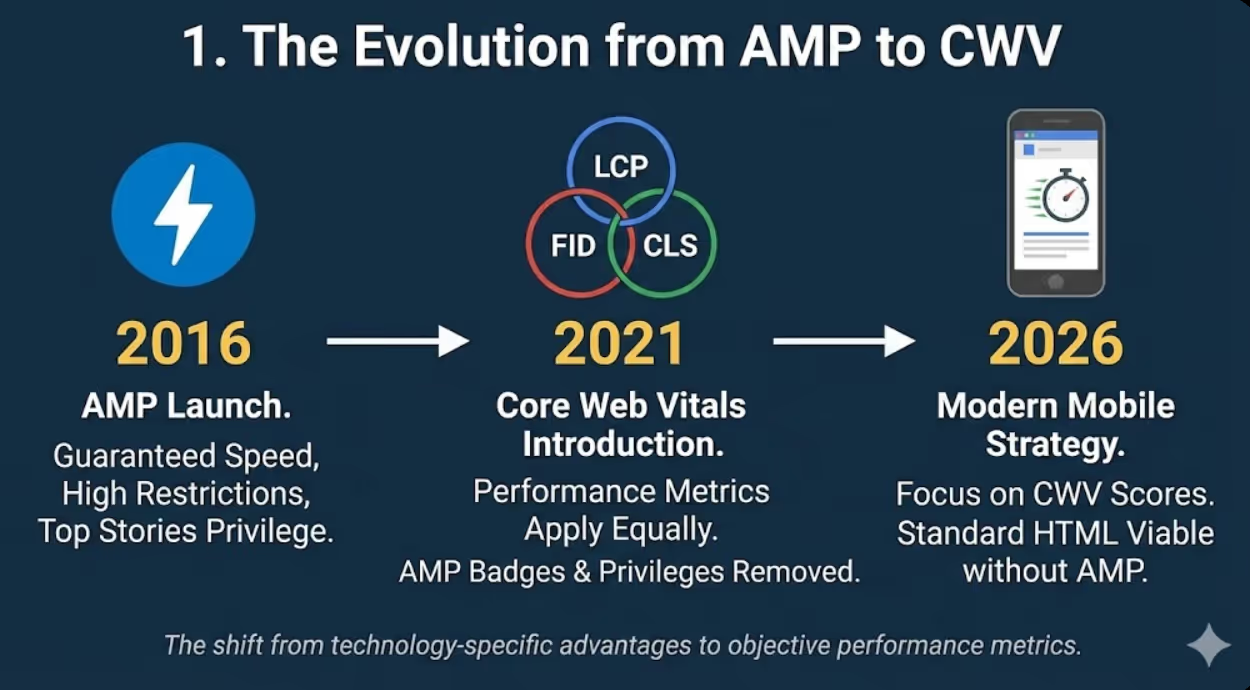
Understanding the Evolution from AMP to Core Web Vitals
The mobile speed optimisation landscape has transformed dramatically from 2016 when AMP launched to 2026 requiring understanding of how and why strategic priorities changed.
AMP original value proposition addressed legitimate 2016 mobile web problems where median mobile page load times exceeded 15 seconds, data costs created user friction, and mobile rendering often failed entirely on limited-capability devices. AMP solved these problems through radical simplification enforcing strict HTML subset, prohibiting most JavaScript including all custom scripts, requiring specific AMP-provided components for common functionality, mandating image size declarations preventing layout shifts, and enabling Google to cache pages on their infrastructure delivering from Google domains rather than origin servers. These restrictions guaranteed fast rendering regardless of publisher implementation quality but at the cost of design flexibility, analytics sophistication, and user experience features that standard HTML enabled.
AMP ranking advantages through 2021 included explicit AMP badges in mobile search results identifying AMP pages to users, preferential placement in Top Stories carousels requiring AMP for inclusion until 2021, slightly faster indexing through AMP cache pre-rendering, and anecdotal ranking improvements that publishers attributed to AMP though Google never confirmed direct ranking benefits. These advantages made AMP adoption strategically compelling despite restrictions because the search visibility benefits exceeded the functional costs for publishers prioritising mobile search traffic.
Core Web Vitals introduction in 2021 fundamentally altered mobile speed strategy by establishing objective performance metrics applying equally to AMP and standard HTML. Largest Contentful Paint measuring primary content rendering, First Input Delay measuring interactivity responsiveness replaced by Interaction to Next Paint in 2024, and Cumulative Layout Shift measuring visual stability collectively defined page experience in ways that standard HTML could achieve without AMP's restrictions. Critically, Google announced that Core Web Vitals would become ranking factors whilst simultaneously removing AMP's preferential search treatment, eliminating the compelling visibility advantage that had driven AMP adoption.
According to Google's official documentation, page experience signals including Core Web Vitals apply equally to all pages regardless of technology used, with no special treatment for AMP pages, confirming that modern mobile optimisation strategy should focus on achieving good Core Web Vitals scores rather than specific implementation approaches.
AMP advantages elimination between 2021 and 2023 removed every search-specific benefit AMP previously provided. Top Stories carousel opened to non-AMP pages in 2021 eliminating the exclusive access that news publishers valued. AMP badges disappeared from search results in 2021 removing the visual distinction that had signalled performance to users. Google began emphasising that page experience signals applied equally regardless of AMP usage, explicitly stating that AMP provided no ranking advantage over well-optimised standard HTML achieving equivalent Core Web Vitals scores. By 2023, AMP retained only its technical performance advantages without any search-specific visibility benefits.
Modern HTML performance capabilities have improved dramatically since 2016 through browser evolution, development tool advancement, and hosting infrastructure improvements that collectively enable standard HTML to achieve performance levels previously requiring AMP's restrictions. Modern image formats including WebP and AVIF provide compression superior to JPEG whilst browsers support lazy loading natively eliminating JavaScript dependency. JavaScript bundling and code splitting enable efficient loading patterns. CDNs and edge computing provide delivery performance approaching AMP cache advantages. These technical advancements mean that skilled developers can achieve AMP-equivalent performance without AMP's limitations, fundamentally changing the trade-off calculation for 2026 strategic decisions.
Current AMP use cases have narrowed substantially from the broad adoption Google originally envisioned to specific scenarios where AMP's guaranteed performance advantages outweigh its limitations. High-volume publishers with diverse content management teams benefit from AMP's performance guardrails preventing implementation mistakes. Publishers with limited technical resources find AMP's simplified requirements easier to maintain than sophisticated standard HTML optimisation. Content syndicators requiring guaranteed performance across unknown hosting environments value AMP's self-contained nature. However, typical business websites, e-commerce platforms, and service company sites rarely benefit from AMP in 2026 given modern alternatives achieving equivalent performance without restrictions.
Core Web Vitals Optimisation Strategy
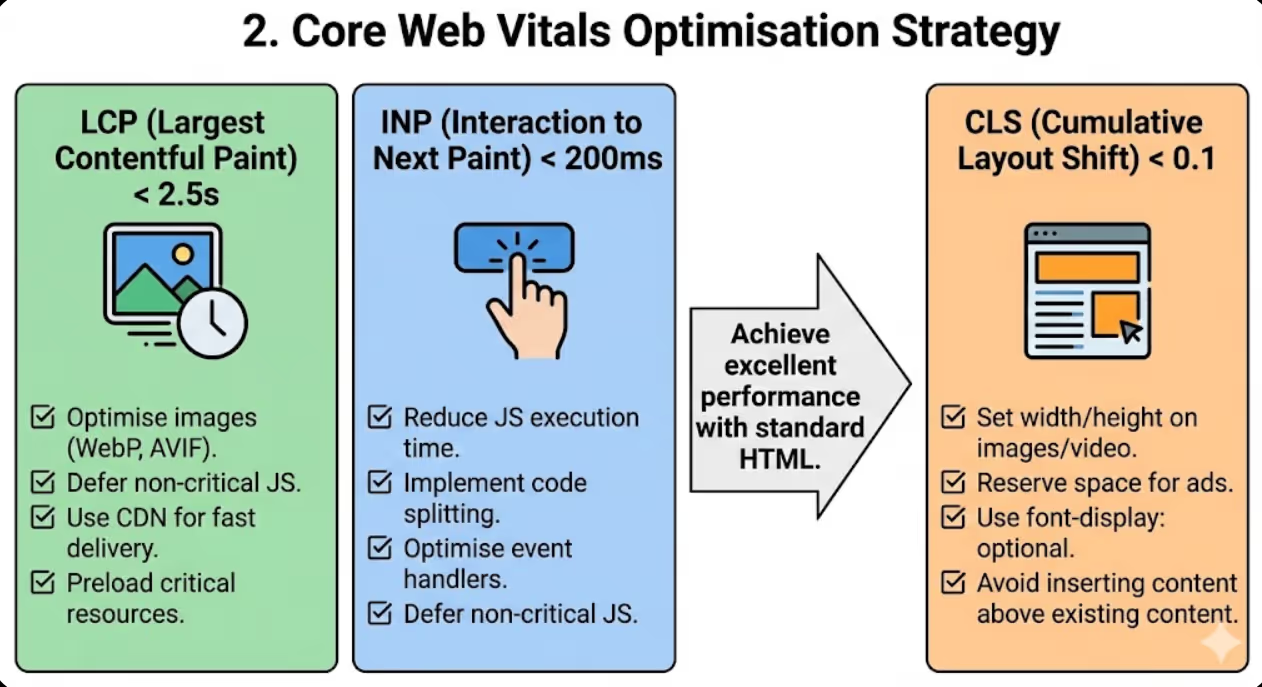
Achieving excellent Core Web Vitals scores with standard HTML enables superior user experience without AMP's limitations through systematic optimisation addressing each metric specifically.
Largest Contentful Paint optimisation focuses on accelerating primary content rendering to achieve the under 2.5 second threshold defining good performance. LCP optimisation strategies include eliminating render-blocking resources through critical CSS inlining and JavaScript deferral, optimising images through next-gen format adoption, appropriate sizing, and lazy loading of below-fold content, implementing CDN delivery reducing server response time to under 200 milliseconds, preloading critical resources that LCP elements depend on, and ensuring server response time stays consistently fast through adequate hosting resources. Australian businesses should prioritise LCP optimisation first because it typically provides the most visible user experience improvement and often requires the most substantial technical changes to achieve threshold performance.
Interaction to Next Paint optimisation ensures responsive interactivity meeting the under 200 millisecond threshold replacing the previous First Input Delay metric in 2024. INP optimisation strategies include reducing JavaScript execution time through code splitting and lazy loading, implementing web workers for computationally intensive tasks preventing main thread blocking, optimising event handlers to execute efficiently without long-running synchronous operations, deferring non-critical JavaScript until after page interactive, and monitoring long tasks exceeding 50 milliseconds that create interactivity delays. INP typically requires less dramatic intervention than LCP for most Australian business websites because interactive delays often result from specific problematic scripts that targeted optimisation resolves rather than requiring architectural changes.
Cumulative Layout Shift optimisation prevents visual instability achieving the under 0.1 threshold through layout stability during page load. CLS optimisation strategies include specifying width and height attributes on all images and video elements preventing reflow when media loads, reserving space for dynamically injected content including advertisements preventing displacement of loaded content, using font-display: optional for web fonts preventing font swap layout shifts, avoiding inserting content above existing content except in response to user interactions, and implementing CSS aspect-ratio for responsive elements maintaining stable layouts across viewport sizes. CLS improvements often provide the quickest wins because they frequently require only markup changes without performance infrastructure investment.
Real User Monitoring implementation tracks actual Core Web Vitals performance from real user devices rather than relying only on synthetic testing. RUM implementation includes using Google Analytics 4's built-in Web Vitals reporting, implementing web-vitals JavaScript library for detailed metric collection, monitoring 75th percentile performance rather than only averages because Google uses 75th percentile for ranking signal thresholds, segmenting performance by device type, connection speed, and geographic location, and establishing performance budgets triggering alerts when metrics degrade beyond acceptable thresholds. Australian businesses should base optimisation priorities on real user data revealing actual customer experience rather than lab testing reflecting only ideal conditions.
Field data versus lab data balance recognises that both perspectives inform complete performance understanding. Field data from real users through Chrome User Experience Report and RUM implementations shows actual performance customers experience including network variability, device diversity, and usage pattern reality. Lab data from tools including Lighthouse, PageSpeed Insights, and WebPageTest provides controlled testing environments enabling precise performance measurement and comparison whilst identifying specific technical issues causing problems. Optimal strategy uses lab testing for development and debugging whilst monitoring field data for production performance validation and prioritisation of optimisation efforts based on issues affecting real users most severely.
Performance monitoring cadence establishes regular review schedules catching performance degradations before they significantly impact user experience or rankings. Weekly automated monitoring through tools including Google Search Console's Core Web Vitals report, Google Analytics Web Vitals dashboard, and third-party monitoring services provides early warning of emerging problems. Monthly detailed analysis including lab testing, user flow performance assessment, and competitive benchmarking ensures comprehensive understanding beyond automated metric collection. Quarterly strategic reviews assess whether performance optimisation priorities should shift based on accumulated data revealing persistent problems or new opportunities. Australian businesses should treat performance as ongoing discipline rather than one-time project because website changes, traffic growth, and content additions continuously affect metrics requiring sustained attention.
When AMP Still Makes Sense in 2026
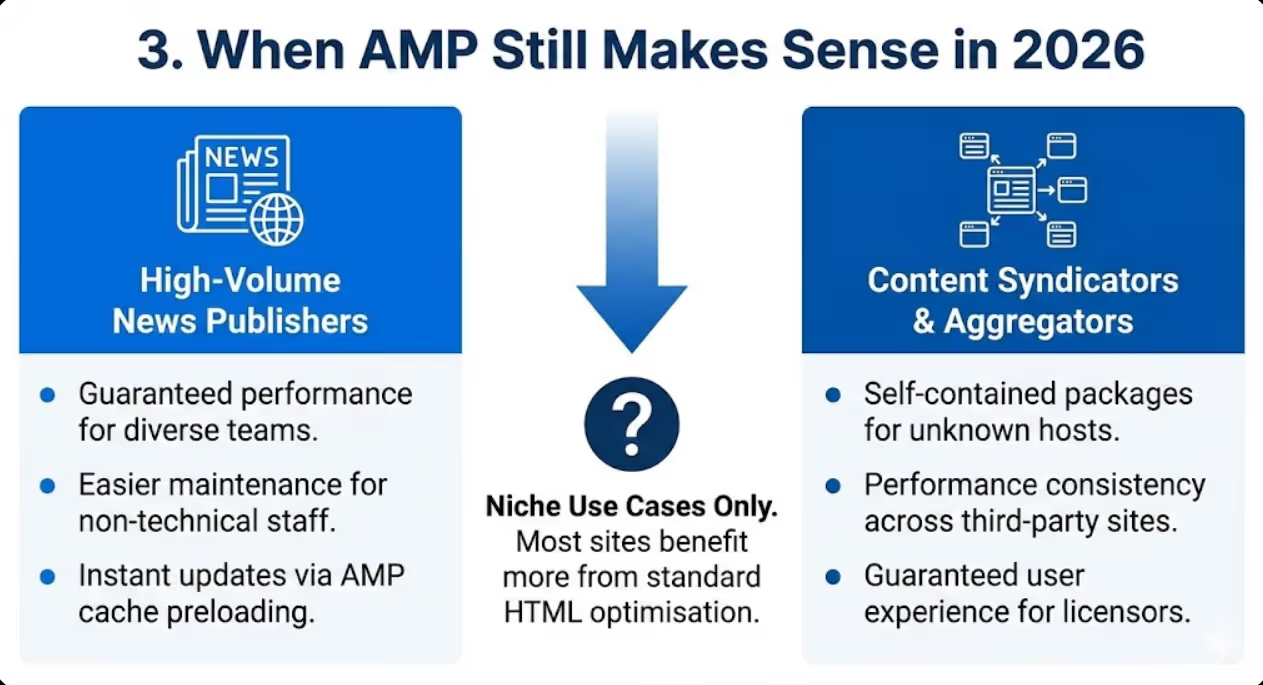
Despite diminished search advantages, specific scenarios continue justifying AMP adoption where its architectural advantages outweigh restrictions.
High-volume news publishers producing hundreds of articles daily with diverse authoring teams benefit from AMP's performance guardrails preventing implementation mistakes that would degrade Core Web Vitals. Publishers where content creation teams lack technical sophistication appreciate AMP's simplified implementation requirements reducing likelihood that poor coding creates performance problems. Organisations publishing breaking news requiring instant updates value AMP cache preloading enabling immediate content availability. Publishers with established AMP infrastructure and institutional knowledge may find maintaining existing AMP implementation easier than migrating to standard HTML optimisation requiring different skills. However, even publishers should honestly assess whether modern CMS platforms with built-in performance optimisation provide equivalent guardrails without AMP's restrictions.
Content syndicators and aggregators distributing content to unknown hosting environments value AMP's self-contained nature guaranteeing performance regardless of destination infrastructure. Syndicators cannot control how recipients implement their content making AMP's restrictions paradoxically beneficial by preventing recipient hosting from degrading performance. Organisations licensing content to third parties find AMP versions provide guaranteed user experience quality whilst standard HTML versions depend entirely on licensee implementation competence. This use case represents legitimate ongoing AMP value distinct from typical website scenarios where hosting environment is controlled.
Limited technical resource organisations without development teams capable of sophisticated Core Web Vitals optimisation might find AMP's simplified requirements more achievable than advanced standard HTML performance optimisation. Very small organisations operating on shared hosting without CDN access potentially benefit from AMP cache delivery providing performance their infrastructure cannot match. However, this justification has weakened substantially as managed WordPress hosting, Shopify, and other platforms increasingly provide excellent baseline performance without requiring technical optimisation expertise that older self-hosted solutions demanded.
Experimental parallel implementation where businesses maintain both AMP and standard HTML versions testing comparative performance represents reasonable exploratory approach. Parallel implementation enables A/B testing whether AMP provides measurable advantages for specific audience segments, competitive analysis comparing AMP versus optimised standard HTML across Core Web Vitals metrics, gradual migration pathways where organisations improve standard HTML whilst maintaining AMP fallback, and hedge strategies during strategic uncertainty about optimal approach. However, parallel implementation doubles maintenance complexity making it sustainable only temporarily during transition periods rather than permanent architecture.
When AMP doesn't make sense encompasses most Australian business websites in 2026 including corporate websites with modest traffic volumes not justifying AMP complexity, e-commerce platforms where AMP's e-commerce limitations including restricted payment integrations and limited product configurators degrade shopping experience, service business websites requiring lead generation forms and tracking implementations that AMP constrains, websites prioritising sophisticated user experience features that AMP specifications don't support, and organisations with competent development resources capable of achieving excellent Core Web Vitals scores without AMP restrictions. Most Australian SMEs fall into categories where Core Web Vitals optimisation of standard HTML delivers superior outcomes compared to AMP adoption.
Implementation Methodology for Core Web Vitals Excellence
Systematic implementation ensures Australian businesses achieve excellent Core Web Vitals scores through proven optimisation sequence addressing foundational issues before refinements.
Performance baseline establishment documents current Core Web Vitals scores establishing starting points for measuring improvement. Baseline assessment includes running PageSpeed Insights for representative pages including homepage, primary category pages, top landing pages, and conversion pages, extracting Core Web Vitals data from Google Search Console coverage report showing site-wide performance distribution, implementing Google Analytics 4 Web Vitals tracking for ongoing monitoring, conducting mobile and desktop performance testing separately because optimisation priorities differ, and competitive benchmarking comparing your performance against key competitors establishing relative positioning. Australian businesses should document detailed baselines rather than general impressions because specific metric measurements enable tracking improvement and validating that optimisation efforts produced intended results.
Critical rendering path optimisation addresses fundamental page loading architecture enabling subsequent optimisations to produce maximum impact. Critical path optimisation includes minimising critical resources required for above-fold rendering, inlining critical CSS for initial viewport display, deferring non-critical JavaScript execution until after initial render, eliminating render-blocking resources or making them asynchronous, and optimising HTML document structure ensuring parser can process efficiently without excessive nesting or complexity. Critical path optimisation provides foundation enabling specific LCP and INP improvements to fully manifest because it removes architectural impediments preventing efficient resource loading and rendering.
Image optimisation implementation typically delivers the largest single Core Web Vitals improvement for most Australian websites because images constitute majority of page weight. Image optimisation includes converting legacy JPEG and PNG images to WebP or AVIF formats reducing file sizes 30% to 50%, implementing responsive images serving appropriately sized versions for different viewport widths, adding width and height attributes preventing CLS from images loading, implementing lazy loading for below-fold images reducing initial page weight, and using CDN delivery for images ensuring fast delivery regardless of user location. Image optimisation tools including Cloudinary, Imgix, and WordPress plugins automate much of this process reducing implementation complexity for businesses without technical image processing expertise.
JavaScript optimisation strategy reduces the blocking and execution time that JavaScript creates affecting both LCP and INP metrics. JavaScript optimisation includes auditing all scripts identifying what's actually necessary versus legacy remnants no longer serving purpose, implementing code splitting delivering only JavaScript required for initial page load, using dynamic imports loading additional JavaScript only when features requiring it are accessed, deferring analytics and marketing tags until after primary content renders, and monitoring third-party scripts including advertising, social widgets, and chat implementations that frequently introduce performance problems. Australian businesses should be ruthless eliminating unnecessary JavaScript because every removed script improves performance without requiring optimisation of what remains.
Server and hosting optimisation ensures infrastructure doesn't limit performance that front-end optimisation achieves. Infrastructure optimisation includes implementing CDN delivery reducing latency through geographic distribution, enabling HTTP/2 or HTTP/3 for efficient resource multiplexing, configuring server-side caching reducing dynamic page generation overhead, optimising database queries that slow server response time, and ensuring adequate hosting resources preventing CPU or memory constraints throttling performance. Australian businesses on shared hosting experiencing poor Time to First Byte should consider managed hosting or VPS upgrades providing performance headroom that optimisation cannot achieve on constrained infrastructure.
Third-party resource management addresses the performance impact that external resources including advertising, analytics, social media widgets, and embedded content create. Third-party management includes implementing tag management systems controlling when third-party scripts load, using facade patterns loading resource-intensive embeds only when users interact with them, implementing privacy-focused analytics like Plausible or Fathom providing functionality with minimal performance impact compared to comprehensive platforms, and negotiating with advertising partners for asynchronous implementations or lightweight ad serving that doesn't degrade Core Web Vitals. Third-party resources represent common performance bottlenecks requiring ongoing management rather than one-time optimisation because providers continuously change implementations affecting performance.
Maven Marketing Co. Mobile Speed Optimisation Services
Professional mobile speed optimisation ensures Australian businesses achieve Core Web Vitals excellence through systematic methodology and ongoing monitoring.
Comprehensive performance audit identifies all factors affecting Core Web Vitals scores across different page types and user scenarios. Audit process includes testing representative pages across device types, network speeds, and user scenarios, analysing technical implementation identifying render-blocking resources, oversized assets, and inefficient code patterns, reviewing hosting infrastructure assessing whether server performance limits optimisation potential, examining third-party integrations quantifying their individual performance impacts, and benchmarking against competitors establishing relative performance positioning. Comprehensive audits provide prioritised optimisation roadmaps addressing highest-impact improvements first rather than requiring businesses to guess where optimisation effort should focus.
Technical optimisation implementation executes specific improvements addressing identified performance problems. Implementation services include image format conversion and lazy loading setup, critical CSS extraction and inline implementation, JavaScript optimisation through code splitting and deferral, server-side caching configuration maximising dynamic content performance, CDN implementation and configuration for optimal delivery, font loading strategy optimisation preventing layout shifts, and third-party resource optimisation minimising external performance impact. Maven Marketing Co. handles technical implementation enabling businesses without internal development resources to achieve excellent Core Web Vitals scores without requiring technical hiring or extensive learning curves.
Ongoing performance monitoring ensures optimisations remain effective as websites evolve and maintains excellent scores over time. Monitoring services include weekly Core Web Vitals tracking through Google Search Console and real user monitoring, automated alerting when metrics degrade beyond defined thresholds, monthly performance reporting showing trends and competitive positioning, quarterly optimisation reviews identifying new improvement opportunities, and continuous third-party resource monitoring catching performance regressions from external provider changes. Ongoing monitoring treats performance as continuous discipline rather than one-time project recognising that website changes and traffic growth continuously affect metrics requiring sustained attention.
AMP migration and sunset services help organisations currently using AMP evaluate whether continued maintenance justifies costs versus transitioning to optimised standard HTML. Migration services include comparative performance analysis benchmarking AMP versus optimised standard HTML across Core Web Vitals metrics, migration planning developing transition roadmaps minimising traffic disruption, technical implementation achieving equivalent or superior performance without AMP restrictions, redirect strategy preserving link equity from AMP URLs to standard equivalents, and monitoring validating that migration improved rather than degraded user experience and rankings. Organisations maintaining AMP implementations from historical decisions benefit from professional evaluation determining whether 2026 strategic context still justifies continued AMP investment.
Frequently Asked Questions
Does Google still give ranking preference to AMP pages over standard HTML pages in 2026, and should Australian businesses implement AMP for SEO benefits?
Google explicitly states that AMP provides no ranking advantage over standard HTML pages achieving equivalent Core Web Vitals scores in 2026. The page experience ranking factor introduced in 2021 applies equally to AMP and non-AMP pages based on Core Web Vitals metrics rather than technology choice. All AMP-specific search advantages including Top Stories carousel preference and AMP badges were eliminated by 2023, making AMP a purely technical implementation choice rather than SEO strategy. Australian businesses should base AMP decisions on whether AMP's technical characteristics suit their specific requirements rather than pursuing non-existent ranking benefits. Most Australian businesses achieve better outcomes through Core Web Vitals optimisation of standard HTML providing equivalent performance without AMP's restrictions on design flexibility, analytics implementation, and user experience features.
How can Australian businesses determine whether their current mobile performance requires optimisation, and what Core Web Vitals scores indicate problems?
Check Google Search Console's Core Web Vitals report showing site-wide performance distribution across mobile and desktop. URLs flagged as "Poor" with red indicators require immediate attention whilst "Needs Improvement" yellow indicators suggest optimisation would benefit user experience and potentially rankings. Specific thresholds defining poor performance include LCP above 4.0 seconds, INP above 500 milliseconds, and CLS above 0.25. Good performance requires LCP under 2.5 seconds, INP under 200 milliseconds, and CLS under 0.1 with grey area between these ranges representing "Needs Improvement" status. Australian businesses should prioritise optimisation when substantial URL percentages fall into poor categories or when competitive analysis reveals competitors achieving better scores. Additionally, monitor organic traffic trends because unexplained declines despite stable rankings sometimes reflect performance degradation affecting user experience signals that gradually reduce visibility.
Should Australian businesses optimise Core Web Vitals for mobile devices first or desktop devices, and do optimisation priorities differ between platforms?
Prioritise mobile optimisation because Google uses mobile-first indexing meaning mobile page performance affects rankings for all searches including desktop. Mobile typically requires more aggressive optimisation because mobile networks provide slower connectivity, mobile devices have less processing power, and mobile viewports require different optimisation strategies than desktop. However, optimisation improving mobile performance typically benefits desktop simultaneously because fundamental optimisations including image compression, JavaScript reduction, and efficient CSS apply to both platforms. Platform-specific considerations include implementing responsive images serving mobile-appropriate sizes, optimising touch interfaces for mobile INP, and ensuring above-fold content prioritises mobile viewport without requiring scrolling. Australian businesses should validate optimisations across both platforms because ranking signals consider both mobile and desktop performance with mobile performance weighted more heavily given mobile-first indexing.
How long does Core Web Vitals optimisation typically take, and when should Australian businesses expect to see ranking improvements from performance optimisation?
Initial optimisation implementation typically requires 4 to 8 weeks for comprehensive improvements addressing image optimisation, JavaScript refinement, hosting upgrades, and third-party resource management across representative page types. Ranking impact from improved Core Web Vitals appears gradually over 2 to 4 months as Google recrawls pages, updates Core Web Vitals assessments based on accumulated real user data, and recalculates rankings incorporating updated page experience signals. Australian businesses should not expect immediate ranking improvements from performance optimisation because Google uses 28-day aggregated field data from Chrome User Experience Report rather than instant lab testing results. Monitor Core Web Vitals metrics through Search Console weekly tracking the percentage of URLs achieving "Good" status whilst organic traffic trends provide eventual confirmation that performance improvements translated to ranking benefits. Sustainable optimisation requires ongoing monitoring beyond initial implementation because website changes and traffic growth continuously affect performance requiring periodic intervention maintaining excellent scores.
Can Australian businesses maintain existing website design and functionality whilst achieving excellent Core Web Vitals scores, or do fundamental redesigns become necessary?
Most Australian businesses achieve excellent Core Web Vitals scores through technical optimisation without requiring fundamental design changes or functionality removal. Optimisation focuses on implementation efficiency rather than content reduction including serving images in modern formats at appropriate sizes, loading JavaScript efficiently through code splitting and deferral, implementing lazy loading for below-fold content, using CDN delivery for fast resource serving, and managing third-party resources preventing performance degradation. However, specific design patterns create inherent performance challenges including carousel sliders loading excessive images, autoplay video backgrounds consuming bandwidth and processing, excessive animation and complex visual effects, modal overlays and popups introducing layout shifts, and above-fold content requiring substantial JavaScript for interactivity. Australian businesses should evaluate whether problematic design elements provide user experience value justifying their performance cost or whether alternatives achieve intended user experience goals with better performance characteristics. Consult with Maven Marketing Co. for design recommendations balancing aesthetic goals with performance requirements rather than assuming optimisation requires abandoning design quality.
What should Australian businesses do if third-party resources including advertising, analytics, or chat widgets prevent achieving good Core Web Vitals scores despite optimising first-party code?
Third-party resource performance management requires negotiation with providers, strategic implementation choices, and sometimes provider switching when performance impact cannot be adequately controlled. Management strategies include using tag manager delayed loading triggering third-party scripts only after primary content renders, implementing facade patterns for resource-intensive widgets loading full implementations only when users interact, using privacy-focused analytics alternatives including Plausible or Fathom providing functionality with minimal performance impact, negotiating with advertising partners for asynchronous implementations that don't block rendering, and conducting A/B testing quantifying whether third-party functionality provides user experience or revenue value justifying its performance cost. Australian businesses whose revenue depends on advertising should specifically test whether faster-loading pages with reduced advertising generate more revenue than slower pages with comprehensive advertising by calculating total revenue across both scenarios rather than assuming maximum advertising always maximises revenue. Some providers offer performance-optimised implementations specifically for customers prioritising Core Web Vitals requiring explicit requests to access rather than being default offerings.
Does implementing a Content Delivery Network guarantee good Core Web Vitals scores, and what other optimisations remain necessary beyond CDN deployment?
CDN implementation provides substantial server response time improvements reducing Time to First Byte and contributing to better LCP, but CDN alone cannot guarantee excellent Core Web Vitals scores because many performance factors exist beyond initial content delivery. CDN benefits include geographic proximity reducing latency for Australian and international visitors, edge caching reducing origin server load, DDoS protection maintaining availability during attacks, and automatic optimisation features some premium CDNs provide including image optimisation and code minification. However, CDNs don't address excessive JavaScript requiring optimisation regardless of delivery speed, unoptimised images needing format conversion and sizing, render-blocking resources requiring restructuring, layout shifts from missing size attributes, or inefficient third-party resources requiring management. Australian businesses should implement CDN as foundation optimisation enabling other improvements to fully manifest rather than as complete solution requiring no additional performance work. Cloudflare, CloudFront, and Australian-focused CDNs including Section.io all provide valuable infrastructure improvements that sophisticated front-end optimisation builds upon rather than replaces.
Modern Mobile Speed Strategy Prioritises Core Web Vitals
Mobile speed optimisation in 2026 requires strategic focus on Core Web Vitals achievement through standard HTML optimisation rather than pursuing AMP adoption that once represented best practice but has become niche solution for specific use cases rather than general recommendation.
The optimisation frameworks outlined in this guide including systematic Core Web Vitals improvement methodology, strategic evaluation of when AMP continues making sense versus standard HTML optimisation, and ongoing monitoring maintaining excellent performance provide comprehensive foundation for Australian businesses to achieve mobile speed excellence serving both user experience and search visibility objectives.
Australian businesses working with Maven Marketing Co. benefit from professional performance audits identifying specific improvement opportunities, technical implementation expertise achieving excellent Core Web Vitals scores without requiring internal development resources, and ongoing monitoring ensuring sustained performance as websites evolve maintaining the search visibility and user experience advantages that mobile speed optimisation delivers.
Ready to optimise your website's mobile performance through modern Core Web Vitals strategy delivering excellent speed without AMP restrictions? Maven Marketing Co. provides comprehensive mobile speed optimisation services including performance audits, technical implementation, ongoing monitoring, and AMP migration assistance ensuring your Australian business achieves the fast mobile experience that customers expect and search engines reward in 2026.

Table of contents
read more blogs

Is Google Ads Better Than SEO for My Business
One of the biggest questions business owners ask when they are planning online growth is whether they should invest in Google Ads or SEO. Both are strong marketing plays that help your company show up in Google search results, but they do things in separate lanes. Google Ads gives quicker visibility and can bring in leads fast, whereas SEO more or less focuses on slow, steady organic traffic that tends to grow the longer you keep building it. Picking the right direction depends on what you want to achieve, how much money you can spend, how crowded the market is, and how quickly you need results, like sooner rather than later. The good news is you don’t always have to choose one or the other; it’s not exactly a black-and-white situation. If you take time to understand the strongest points of both, you can put together a more sensible digital marketing plan that supports consistent expansion. In this guide, we’ll compare Google Ads vs SEO, explain the main differences, and help you figure out what option makes the most sense for your business.

When Should I Hire a Digital Marketing Agency
Growing a business today takes more than just having a website or throwing a post on social media; customers usually search around online, compare providers, skim reviews, and basically expect the brand to show up with a solid digital presence before they even think about buying. Many businesses try to run their marketing themselves, but there comes a point when “doing it all in-house” becomes clunky and hard to manage, all at once. Knowing when to hire a digital marketing agency can end up making a big, real difference for your growth. If you’re not getting enough leads, or your online visibility feels stuck, or sales are just not moving, the right agency can bring the know-how, plus a clear plan, to help you get noticeably better outcomes. In this guide, we’ll dig into what a digital marketing agency actually does, the usual signs it’s time to bring one on, and how picking the right marketing partner can help your business move forward at a faster pace.

Why Is My Google Ads Budget Running Out So Quickly
Running a successful Google Ads budget isn’t only about throwing more money at it. It’s more like making every dollar, doing a bit extra. A lot of businesses start a Google Ads campaign with big hopes, then find out their daily budget is gone within a few hours, and that feels weird, right? After that, your ads stop showing effectively, new leads slip away, and your return on investment dips. So if your Google Ads budget is running out too fast, don’t stress. It’s a fairly common issue, and in most situations, it can be repaired with the right approach. There are multiple little things that can drain your advertising money quicker than you expected, from costly keywords to audience targeting that just doesn’t quite fit. In this guide, we’ll walk through why your budget disappears so quickly, how to cut wasteful spend, and the most reliable ways to boost your Google Ads ROI, even if your budget stays the same.