.svg)


%201.svg)

Key Takeaways
- Search engines struggle with JavaScript rendering: Whilst Google can execute JavaScript, the process is resource-intensive and unreliable compared to traditional HTML rendering, often resulting in incomplete indexing or delayed content discovery
- Server-side rendering (SSR) solves most SEO problems: Frameworks like Next.js for React and Nuxt.js for Vue render HTML on the server before sending to browsers, ensuring search engines receive fully-formed content without JavaScript execution requirements
- Pre-rendering offers middle-ground solution: Services like Prerender.io generate static HTML snapshots of JavaScript applications specifically for search crawlers, balancing development simplicity with search engine compatibility
- Dynamic rendering serves different content: Detecting search engine bots and serving pre-rendered HTML whilst delivering JavaScript applications to users ensures optimal experiences for both audiences without compromising either
- Critical content must render without JavaScript: Essential SEO elements including titles, meta descriptions, headings, and primary content should be present in initial HTML rather than requiring JavaScript execution for visibility
- Structured data requires careful implementation: JSON-LD structured data should be included in initial HTML or rendered server-side rather than injected via JavaScript after page load to ensure search engine recognition
- Client-side routing needs meta tag updates: Single-page applications updating content without page reloads must programmatically update title tags, meta descriptions, and canonical URLs for each route change
- Testing and monitoring prevent regression: Regular audits using tools like Google Search Console, Lighthouse, and Mobile-Friendly Test identify rendering issues before they impact rankings and organic traffic
A e-commerce company rebuilt their site using React, creating a blazing-fast single-page application with smooth transitions and exceptional user experience. Development team celebrated the modern architecture and improved performance metrics.
Three months later, organic traffic had declined 40%. Product pages weren't appearing in search results. Category pages showed snippets with missing descriptions. The Google Search Console coverage report revealed thousands of pages marked as "Discovered - currently not indexed."
The technical issue was clear: search engine crawlers couldn't properly render the JavaScript-heavy pages. Product information, descriptions, and metadata all loaded through JavaScript after initial page render, but search engine bots only saw empty containers and loading placeholders. The beautiful user experience meant nothing for SEO because search engines couldn't access the content.
Implementing server-side rendering through Next.js resolved the issues within weeks. Product pages reappeared in search results. Organic traffic recovered then exceeded previous levels. The site maintained its exceptional user experience whilst becoming fully search-engine accessible.
This scenario plays out repeatedly as businesses adopt modern JavaScript frameworks without considering SEO implications. Understanding and solving these rendering issues separates successful modern web applications from technically impressive sites that fail to attract organic traffic.
.avif)
Understanding How Search Engines Process JavaScript
Search engine JavaScript processing differs fundamentally from browser rendering, creating unique challenges for single-page applications and JavaScript-heavy websites.
Traditional HTML crawling represents search engines' native processing method where crawlers request pages, receive complete HTML documents, parse visible content and links, extract metadata, and move to the next page. This process is fast, efficient, and reliable because the content is immediately available in the HTML response without additional processing requirements.
JavaScript rendering pipeline adds significant complexity requiring search engines to request the page receiving initial HTML, download JavaScript resources, execute JavaScript code, wait for dynamic content to render, then finally parse the rendered content. This multi-step process consumes substantially more resources and time compared to traditional HTML crawling.
Google's rendering process specifically follows a two-wave indexing approach where the first wave processes initial HTML immediately, extracting metadata and content present before JavaScript execution. The second wave executes JavaScript and indexes rendered content, but this happens hours or days later and isn't guaranteed. Critical content that requires JavaScript execution might be indexed significantly later than traditional HTML content, or potentially not at all if resources are constrained. According to Google's JavaScript SEO documentation, this two-phase indexing process means JavaScript-dependent content may be discovered and indexed with a delay compared to content in the initial HTML.
Resource constraints limit JavaScript execution because rendering JavaScript requires significantly more computational resources than parsing HTML. Search engines must prioritise resources across billions of pages, meaning JavaScript-heavy pages receive less frequent and less thorough processing. Pages with excessive JavaScript, slow loading, or complex rendering logic might not get fully processed, resulting in incomplete indexing.
Timeout limitations mean search engines don't wait indefinitely for JavaScript execution and content rendering. If JavaScript takes too long to execute or content takes too long to load, crawlers may time out and index only partially rendered content. Lazy loading, delayed content, and slow APIs can cause search engines to miss content that would eventually load for patient human visitors.
Bot detection and blocking creates additional complications when security systems mistake search engine crawlers for malicious bots, blocking legitimate crawling. JavaScript applications using aggressive bot detection must whitelist known search engine crawlers to prevent accidental blocking.
.avif)
Common JavaScript SEO Issues in React Applications
React's component-based architecture and client-side rendering create specific SEO challenges requiring targeted solutions for search engine visibility.
Client-side rendering problems emerge because default React applications render empty HTML containers then populate content through JavaScript execution. Search engines receiving initial HTML see mostly empty pages with minimal content. Product details, blog post content, navigation links, and other essential elements remain invisible to crawlers that don't execute JavaScript or fail during execution.
Meta tag management challenges arise because React applications often set titles and meta descriptions through JavaScript after page load rather than including them in initial HTML. Search engines may index pages with missing or incorrect metadata, damaging click-through rates from search results. Each route in single-page applications needs unique, properly implemented meta tags that update when routes change.
React Router and client-side navigation complications occur when route changes don't trigger full page reloads, preventing traditional browser navigation events that search engines expect. Links between pages must be properly structured as anchor tags with href attributes rather than onClick handlers to ensure crawlers can discover and follow them.
Content loaded via API calls after initial render creates indexing problems when primary content depends on asynchronous data fetching after JavaScript execution. Search engines may not wait for API responses, missing the actual content. Critical content should be included in initial HTML or rendered server-side rather than loaded exclusively through client-side fetching.
Infinite scroll and pagination issues prevent search engines from accessing content beyond initial viewport when implementations rely on scroll events triggering content loading. Crawlers don't scroll pages, so content only appearing after scrolling remains undiscovered. Traditional pagination with crawlable links ensures all content remains accessible.
React Helmet misconfiguration commonly causes meta tag problems when implemented incorrectly. React Helmet manages meta tags in React applications but requires proper configuration for server-side rendering. Incorrect implementation results in meta tags only appearing after JavaScript execution, too late for search engines to capture during initial indexing.
Build optimisation impacts when improperly configured build processes create massive JavaScript bundles, slow loading times, or broken dependencies that prevent proper rendering. Code splitting, lazy loading, and proper webpack configuration ensure manageable bundle sizes that load and execute efficiently.
Common JavaScript SEO Issues in Vue Applications
Vue.js applications face similar but distinct challenges requiring framework-specific solutions for search engine compatibility.
Vue single-file components and client-side rendering create the same fundamental problem as React where Vue templates render in browsers after JavaScript execution, providing search engines with empty or minimal initial HTML. The Vue instance mounting process happens entirely client-side in default configurations, making content invisible to crawlers that can't or won't execute JavaScript.
Vue Router implementation challenges emerge when route changes update content without full page navigation. Meta tags and titles must update programmatically for each route using Vue Router's navigation guards or Meta mixins. Links between routes require proper anchor tag implementation with href attributes enabling crawler discovery.
Vuex state management and SEO complications arise when applications store critical content in Vuex stores that only populate after JavaScript execution and API calls. Search engines can't access store data, missing content entirely. Server-side rendering must hydrate Vuex stores before sending HTML to ensure content is present in initial response.
Asynchronous components and lazy loading create similar issues to React when components load on-demand through dynamic imports. Search engines may not trigger component loading, missing their content. Critical content components should load eagerly rather than lazily, or the application should implement server-side rendering.
Vue Meta plugin misconfiguration causes meta tag problems when not properly integrated with server-side rendering. Similar to React Helmet, Vue Meta manages meta tags but requires correct setup for tags to appear in initial HTML rather than after JavaScript execution.
Build tool configuration impacts when Vue CLI or Vite configurations create inefficient bundles, split code incorrectly, or fail to optimise assets properly. Proper configuration ensures fast loading, efficient code splitting, and search engine-friendly builds.
.avif)
Server-Side Rendering Implementation
Server-side rendering represents the most comprehensive solution to JavaScript SEO problems by rendering applications on the server before sending complete HTML to browsers and crawlers. Research from Google's Web.dev documentation on rendering patterns demonstrates that server-side rendering provides the fastest Time to First Byte whilst ensuring content is immediately available to search engines without JavaScript execution requirements.
Next.js for React applications provides production-ready server-side rendering with excellent developer experience and performance optimisation. Next.js renders React components on the server for initial page load, sends complete HTML to clients, hydrates with JavaScript for interactivity, and handles routing and data fetching elegantly. Implementation involves installing Next.js, converting React components to Next.js pages, implementing getServerSideProps or getStaticProps for data fetching, and deploying to hosting that supports Node.js applications.
Nuxt.js for Vue applications offers equivalent server-side rendering capabilities with Vue-specific optimisations and conventions. Nuxt.js handles server-side rendering, routing, state management, and build optimisation out of the box. Implementation requires installing Nuxt.js, converting Vue components to Nuxt page structure, using asyncData or fetch hooks for data fetching, and deploying to appropriate hosting infrastructure.
Static site generation provides alternative to full server-side rendering by pre-rendering all pages at build time rather than on each request. Next.js and Nuxt.js both support static generation through getStaticProps/getStaticPaths and nuxt generate commands respectively. Static generation works excellently for content-heavy sites with pages that don't require real-time data but isn't suitable for frequently changing content or user-specific personalisation.
Incremental static regeneration combines static generation benefits with content freshness by regenerating pages periodically or on-demand rather than only at build time. Next.js implements ISR allowing pages to update on schedules whilst serving static versions improving performance. This hybrid approach provides static generation performance with near-real-time content updates.
Hydration process attaches JavaScript functionality to server-rendered HTML enabling interactivity after initial render. Proper hydration ensures server-rendered and client-rendered content match exactly to prevent flickering or broken functionality. Hydration errors indicate mismatches between server and client rendering that need resolution.
Performance considerations require balancing server-side rendering benefits against server resource requirements and response time implications. Caching strategies, CDN usage, and efficient rendering logic ensure SSR doesn't create performance bottlenecks. Some implementations use edge computing or serverless functions for distributed rendering reducing latency.
Pre-Rendering and Dynamic Rendering Solutions
Pre-rendering provides middle-ground solutions between full server-side rendering and client-side rendering, offering improved search engine compatibility with less implementation complexity.
Pre-rendering services like Prerender.io, Rendertron, or Puppeteer-based solutions generate static HTML snapshots of JavaScript applications specifically for search engine crawlers. These services detect crawler user agents, intercept requests, render JavaScript-heavy pages in headless browsers, return fully-rendered HTML snapshots to crawlers, and allow regular users to receive standard JavaScript applications.
Prerender.io implementation involves signing up for service, adding middleware to your application or configuring CDN to route crawler traffic through Prerender, whitelisting URLs for pre-rendering, and monitoring cache freshness. The service handles rendering complexity whilst your application remains unchanged, making it attractive for retrofitting SEO to existing JavaScript applications.
Self-hosted pre-rendering using Rendertron or custom Puppeteer scripts provides control and avoids subscription costs. Implementation requires deploying rendering infrastructure, configuring crawler detection and routing, managing cache invalidation, and ensuring rendering security. Self-hosting suits organisations with technical capabilities and wanting complete control.
Dynamic rendering serves different content to users versus crawlers, detecting search engine user agents and serving pre-rendered HTML whilst delivering JavaScript applications to regular users. This approach ensures optimal experiences for both audiences without compromising either. However, Google technically considers dynamic rendering a workaround rather than long-term solution, recommending server-side rendering when feasible.
Cache invalidation strategies ensure pre-rendered content stays fresh by triggering re-rendering when content changes. Webhook-based invalidation, scheduled re-rendering, and manual cache clearing each serve different update frequency requirements. Stale cached content creates SEO problems when search engines index outdated information.
User agent detection accuracy matters because misidentifying users as bots or vice versa damages experiences. Maintaining updated user agent lists, handling new crawler introductions, and avoiding false positives requires ongoing attention. Some implementations use IP address verification in addition to user agents for improved accuracy.
Technical SEO Implementation for JavaScript Applications
Beyond rendering solutions, proper technical SEO implementation ensures JavaScript applications maximise search visibility through metadata, structured data, and crawlability optimisation.
Title and meta description management requires programmatic updates for every route change in single-page applications. React Helmet and Vue Meta provide declarative APIs for managing meta tags within components. For server-side rendering, ensuring meta tags are present in initial HTML matters more than perfect client-side management. Each page needs unique, optimised titles and descriptions rather than generic placeholders.
Canonical URL implementation prevents duplicate content issues when multiple URLs access same content. Dynamic canonical tags must update for each route, reflecting actual page URLs rather than defaulting to homepage. Server-side rendering ensures canonical tags are present immediately whilst client-side implementations must update tags before search engine indexing occurs.
Open Graph and Twitter Card meta tags improve social sharing appearance but also signal content topics to search engines. Implementing these tags programmatically for each route ensures social shares display properly whilst providing additional semantic signals about content.
Structured data implementation through JSON-LD schema markup should be included in initial HTML or rendered server-side rather than injected via JavaScript. Product schema, article schema, breadcrumb schema, and other structured data types help search engines understand content context. Testing structured data with Google's Rich Results Test ensures proper implementation and search engine recognition.
XML sitemap generation for JavaScript applications must include all routes and pages even those generated client-side. Dynamic sitemap generation scripts extract routes from application code, query databases for dynamic content URLs, and generate comprehensive sitemaps including all indexable pages. Submitted sitemaps help search engines discover content that might not be well-linked internally.
Robots.txt configuration ensures search engines can access JavaScript resources whilst blocking non-indexable sections. Disallowing JavaScript files prevents crawling whilst blocking access to rendering resources, so JavaScript files should generally be allowed. Blocking admin panels, user account pages, and duplicate content prevents wasted crawl budget.
Internal linking structure within JavaScript applications must use proper anchor tags with href attributes rather than JavaScript-only navigation. Crawlers follow links through href attributes, so button-only navigation or onClick-only handlers prevent content discovery. Proper link implementation ensures crawlers can navigate entire application structure.
Mobile-first indexing considerations require JavaScript applications to work flawlessly on mobile devices. Responsive design, fast mobile loading, and touch-friendly interfaces ensure positive mobile experiences. Google predominantly uses mobile versions for indexing, making mobile optimisation critical for visibility.
.avif)
Testing and Monitoring JavaScript SEO
Systematic testing and ongoing monitoring prevent JavaScript SEO issues and identify problems before significant organic traffic losses occur.
Google Search Console provides essential visibility into how Google crawls and indexes JavaScript applications. The URL Inspection tool renders pages showing exactly what Googlebot sees, revealing rendering failures and missing content. Coverage reports identify indexed pages and indexing issues requiring attention. Core Web Vitals data shows performance metrics affecting rankings.
Mobile-Friendly Test tool renders pages in mobile context, showing mobile-specific rendering issues. Testing key pages regularly ensures mobile rendering works correctly. Screenshots show exactly what mobile Googlebot perceives, revealing problems invisible in desktop testing.
Rich Results Test validates structured data implementation, showing whether JSON-LD schema markup is properly recognised. Testing confirms product schema, article schema, and other structured data types appear correctly. Errors and warnings guide fixes for improved rich result eligibility.
Lighthouse SEO audits in Chrome DevTools assess technical SEO implementation including meta tags, structured data, crawlability, and performance. Accessibility audits ensure inclusive experiences. Performance audits identify optimisation opportunities affecting both user experience and search rankings.
WebPageTest provides detailed performance analysis showing loading waterfalls, rendering timelines, and content visibility. Testing with JavaScript disabled reveals what content exists in initial HTML versus requiring JavaScript execution. Comparing enabled versus disabled results quantifies JavaScript dependency.
Screaming Frog SEO Spider crawls websites identifying technical issues including broken links, missing meta tags, redirect chains, and duplicate content. Rendering mode toggles between JavaScript-enabled and disabled crawling, revealing discrepancies between traditional and JavaScript crawling. Bulk analysis identifies site-wide issues requiring systematic fixes.
Custom monitoring scripts using Puppeteer or Playwright enable automated testing of rendering behaviour. Scripts visit key pages, wait for JavaScript execution, extract rendered content, and compare against expected results. Automated testing catches regressions before production deployment.
A/B testing SEO implementations compares different rendering approaches measuring organic traffic impact. Testing server-side rendering versus pre-rendering versus pure client-side rendering quantifies relative effectiveness. Data-driven decisions optimise implementations for maximum search visibility.
Performance Optimisation for JavaScript SEO
Page speed and performance significantly impact search rankings and user experience, making optimisation essential for JavaScript application success.
Code splitting divides JavaScript bundles into smaller chunks loading only necessary code for each route. React lazy loading and Vue async components enable dynamic imports reducing initial bundle sizes. Critical path optimisation ensures above-fold content loads quickly whilst deferring non-essential code.
Tree shaking removes unused code from production bundles through build tool configuration. Properly configured webpack or Rollup eliminates dead code reducing bundle sizes significantly. Import analysis identifies which library code actually gets used versus included unnecessarily.
Asset optimisation compresses images, minimises CSS, and removes unused fonts reducing total page weight. WebP image formats provide better compression than JPEG or PNG. Lazy loading images below the fold delays loading until needed. Icon fonts or SVG sprites reduce individual image requests.
Caching strategies including browser caching, CDN caching, and service workers improve repeat visit performance dramatically. Proper cache headers tell browsers how long to store assets. CDN edge caching serves static assets from geographically close locations reducing latency. Service workers enable offline functionality and instant loading.
Critical CSS inlining embeds above-fold styles directly in HTML preventing render-blocking CSS delays. Remaining CSS loads asynchronously after initial render. Automated tools extract critical CSS from larger stylesheets ensuring complete coverage without manual maintenance.
JavaScript execution optimisation through efficient algorithms, debouncing expensive operations, and avoiding unnecessary re-renders improves runtime performance. React memo and Vue computed properties prevent redundant calculations. Profiling tools identify performance bottlenecks warranting optimisation attention.
Core Web Vitals optimisation addresses Google's specific performance metrics including Largest Contentful Paint (LCP), First Input Delay (FID), and Cumulative Layout Shift (CLS). These metrics directly impact search rankings making them optimisation priorities. LCP under 2.5 seconds, FID under 100 milliseconds, and CLS under 0.1 represent good thresholds.
Migrating Existing JavaScript Applications
Converting existing client-side rendered applications to search-engine-friendly architectures requires systematic planning and execution preventing traffic losses during transition.
Audit current state documenting existing SEO performance, identifying rendering issues, cataloguing all routes and pages, and establishing baseline metrics. Understanding current problems and performance provides migration success criteria and helps prioritise fixes.
Choose rendering strategy between server-side rendering, pre-rendering, or dynamic rendering based on technical capabilities, content update frequency, personalisation requirements, and budget constraints. Each approach offers different trade-offs between implementation complexity and SEO benefits.
Phased migration approach implements rendering solutions incrementally rather than all at once, reducing risk and enabling learning. Start with highest-traffic pages or pages with worst rendering issues. Validate fixes before expanding to additional sections. Complete migration methodically avoiding rushed implementations causing new problems.
Redirect management ensures old URLs redirect properly to new versions when URL structures change. Implement 301 redirects preserving link equity and preventing 404 errors. Update internal links to point directly to new URLs rather than relying entirely on redirects.
Testing before launch using staging environments, crawler testing, and validation tools catches issues before production deployment. Comprehensive testing prevents launching improvements that inadvertently create new problems. Stakeholder review ensures business requirements remain met.
Monitoring after launch tracks organic traffic, indexing status, and rankings identifying any negative impacts requiring immediate correction. Daily monitoring during first weeks catches problems early. Comparing performance against baseline metrics quantifies success.
Iteration and optimisation continues after initial migration as monitoring reveals improvement opportunities. JavaScript SEO requires ongoing attention rather than one-time implementation. Regular audits and optimisation compound improvements over time.
Ready to Fix Your JavaScript SEO Issues?
JavaScript frameworks enable building modern, interactive web experiences users love, but SEO compatibility requires technical understanding and proper implementation. The rendering issues, crawling problems, and indexing failures common in React and Vue applications cost businesses significant organic visibility and traffic.
Whether you're building new JavaScript applications or fixing existing implementations, proper technical SEO ensures search engines can access your content whilst users enjoy exceptional experiences. Server-side rendering, pre-rendering, or dynamic rendering combined with proper technical SEO implementation creates applications that succeed both with users and search engines.
Need expert guidance fixing JavaScript SEO issues and optimising your React or Vue application for search visibility? Maven Marketing Co. specialises in technical SEO for modern web applications. Our team combines development expertise with SEO knowledge, implementing solutions that resolve rendering issues, improve crawlability, and restore organic traffic.
We don't just identify problems. We implement fixes including server-side rendering architecture, pre-rendering solutions, technical SEO optimisation, and performance improvements that make JavaScript applications search-engine friendly whilst maintaining exceptional user experiences.
Contact Maven Marketing Co. today for a comprehensive JavaScript SEO audit. We'll analyse your application's rendering behaviour, identify specific issues impacting search visibility, and provide detailed implementation roadmap with prioritised fixes. Let's ensure your modern web application achieves the organic visibility it deserves.
Frequently Asked Questions
Q: Does Google really index JavaScript properly, or should we always implement server-side rendering for critical business applications?
Google has significantly improved JavaScript processing capabilities over the years and can execute JavaScript to render many applications successfully. However, the reliability, speed, and consistency of JavaScript rendering remains substantially lower than traditional HTML processing. Google uses a two-wave indexing process where initial HTML is indexed immediately whilst JavaScript-rendered content is processed in a second wave that can occur hours or days later and isn't guaranteed. This delayed processing creates risks where critical content might be indexed late or potentially not at all if rendering fails. Resource constraints mean Google can't afford to render all JavaScript-heavy pages as thoroughly as static HTML pages, leading to prioritisation that disadvantages JavaScript applications. Beyond Google, other search engines including Bing, DuckDuckGo, and international search engines have even more limited JavaScript processing capabilities, potentially missing your content entirely. For critical business applications where organic search drives significant revenue, implementing server-side rendering, pre-rendering, or dynamic rendering provides insurance against rendering failures and ensures reliable indexing.
The incremental cost and complexity of proper rendering solutions justifies itself through protected organic visibility. For less critical applications, monitoring Google Search Console's URL Inspection tool and coverage reports reveals whether JavaScript rendering succeeds adequately. If Search Console shows your content renders properly and indexing occurs reliably, pure client-side rendering might suffice. However, any signs of indexing problems, missing content, or delayed discovery warrant implementing rendering solutions. Modern frameworks like Next.js and Nuxt.js have made server-side rendering significantly easier to implement than historically, reducing the barrier to proper solutions. The risk of organic traffic losses from rendering failures typically exceeds the cost of implementing server-side rendering, making it recommended default for business-critical applications regardless of Google's improving capabilities. Consider also that server-side rendering provides benefits beyond SEO including faster initial page loads and better performance on slow connections or devices, making it valuable even if SEO weren't a consideration.
Q: What's the practical difference between server-side rendering and pre-rendering, and how should businesses choose between these approaches?
Server-side rendering and pre-rendering both deliver complete HTML to search engines but differ fundamentally in when and how that rendering occurs, with each approach offering distinct advantages and trade-offs. Server-side rendering renders pages on-demand for each request, executing application code on the server when users or crawlers request pages, generating fresh HTML for every request, and enabling real-time personalisation and dynamic content. This approach requires Node.js hosting infrastructure, adds server processing time to response latency, and demands more sophisticated deployment and scaling. Server-side rendering works excellently for applications requiring personalisation, real-time data, user-specific content, or frequent content updates. E-commerce sites with personalised recommendations, news sites with constantly updating content, and applications with user-specific dashboards benefit from server-side rendering's dynamic capabilities. The trade-off is increased infrastructure complexity and costs compared to static hosting.
Pre-rendering generates static HTML snapshots at build time or on-demand, storing those snapshots for repeated use, and serving the same cached HTML for all requests until cache invalidation. Pre-rendering requires less sophisticated hosting, enables CDN deployment reducing latency, and eliminates per-request rendering overhead. However, pre-rendered content becomes stale between regenerations, can't personalise per user, and requires cache invalidation when content changes. Pre-rendering works excellently for content-focused sites with infrequent updates including blogs, marketing websites, documentation, and portfolio sites where content changes daily or less frequently rather than continuously.
The choice between approaches should consider content update frequency, personalisation requirements, technical capabilities, and hosting infrastructure. Sites with predominantly static content should favour pre-rendering for simplicity and performance. Sites requiring personalisation or real-time data need server-side rendering. Hybrid approaches combine both methods, using pre-rendering for static pages and server-side rendering for dynamic sections. Incremental static regeneration in Next.js bridges the gap by regenerating static pages on schedules or on-demand, providing pre-rendering performance with improved content freshness. For businesses uncertain which approach suits their needs, starting with pre-rendering offers simpler implementation whilst maintaining easy migration to server-side rendering later if requirements change. The key is ensuring search engines receive complete HTML regardless of chosen rendering approach, as both methods accomplish that fundamental SEO requirement.
Q: How can we test whether our JavaScript application is properly indexable before launch, and what ongoing monitoring should we implement?
Pre-launch testing prevents JavaScript SEO issues from impacting production sites through systematic validation across multiple tools and perspectives. Start by using Google's URL Inspection tool in Search Console on staging or development URLs, requesting indexing to see exactly what Googlebot perceives when rendering your pages. The rendered HTML view shows whether content appears correctly or if rendering failures prevent content visibility. Screenshots reveal visual rendering, whilst the more technical HTML view shows actual markup. Testing representative pages from each template type and content category ensures comprehensive coverage. Mobile-Friendly Test provides similar rendering validation specifically for mobile Googlebot, critical given Google's mobile-first indexing approach. Rich Results Test validates structured data implementation, confirming JSON-LD schema appears correctly in rendered output. Lighthouse audits in Chrome DevTools assess technical SEO, performance, and accessibility, identifying issues before launch.
Run Lighthouse against key pages in both desktop and mobile modes. WebPageTest with JavaScript disabled reveals what content exists in initial HTML versus requiring JavaScript, quantifying rendering dependency. Compare results with JavaScript enabled versus disabled to identify gaps. Screaming Frog SEO Spider crawls sites in both JavaScript and traditional modes, showing differences in discoverable content, meta tags, and link structures between rendering approaches. Set up Google Analytics and Google Search Console before launch, verifying tracking works correctly and Search Console property is claimed and verified. After launch, ongoing monitoring should include weekly Google Search Console reviews checking coverage reports for indexing issues, URL Inspection tool spot-checks on key pages, performance report review for Core Web Vitals, and enhancement reports for structured data errors. Monthly comprehensive crawls with Screaming Frog identify technical issues including broken links, missing meta tags, and rendering problems that develop over time.
Quarterly Lighthouse audits track performance trends and technical SEO health. Continuous Google Analytics monitoring watches organic traffic trends, landing page performance, and user behaviour metrics that might indicate SEO problems. Set up automated alerts for sudden traffic drops, coverage issues in Search Console, or critical errors in structured data. Custom monitoring scripts using Puppeteer can automatically test key pages daily, rendering JavaScript and validating that expected content appears correctly, sending alerts when rendering fails or content goes missing. This automated testing catches problems immediately rather than waiting for manual audits. Track keyword rankings for priority search terms using rank tracking tools, monitoring whether visibility declines potentially indicating rendering or technical issues. The combination of pre-launch validation and ongoing monitoring ensures JavaScript applications maintain search visibility whilst catching issues early when they're easier to fix.

Table of contents
read more blogs

Is Google Ads Better Than SEO for My Business
One of the biggest questions business owners ask when they are planning online growth is whether they should invest in Google Ads or SEO. Both are strong marketing plays that help your company show up in Google search results, but they do things in separate lanes. Google Ads gives quicker visibility and can bring in leads fast, whereas SEO more or less focuses on slow, steady organic traffic that tends to grow the longer you keep building it. Picking the right direction depends on what you want to achieve, how much money you can spend, how crowded the market is, and how quickly you need results, like sooner rather than later. The good news is you don’t always have to choose one or the other; it’s not exactly a black-and-white situation. If you take time to understand the strongest points of both, you can put together a more sensible digital marketing plan that supports consistent expansion. In this guide, we’ll compare Google Ads vs SEO, explain the main differences, and help you figure out what option makes the most sense for your business.

When Should I Hire a Digital Marketing Agency
Growing a business today takes more than just having a website or throwing a post on social media; customers usually search around online, compare providers, skim reviews, and basically expect the brand to show up with a solid digital presence before they even think about buying. Many businesses try to run their marketing themselves, but there comes a point when “doing it all in-house” becomes clunky and hard to manage, all at once. Knowing when to hire a digital marketing agency can end up making a big, real difference for your growth. If you’re not getting enough leads, or your online visibility feels stuck, or sales are just not moving, the right agency can bring the know-how, plus a clear plan, to help you get noticeably better outcomes. In this guide, we’ll dig into what a digital marketing agency actually does, the usual signs it’s time to bring one on, and how picking the right marketing partner can help your business move forward at a faster pace.
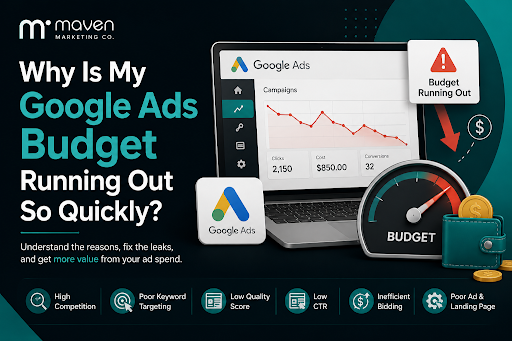
Why Is My Google Ads Budget Running Out So Quickly
Running a successful Google Ads budget isn’t only about throwing more money at it. It’s more like making every dollar, doing a bit extra. A lot of businesses start a Google Ads campaign with big hopes, then find out their daily budget is gone within a few hours, and that feels weird, right? After that, your ads stop showing effectively, new leads slip away, and your return on investment dips. So if your Google Ads budget is running out too fast, don’t stress. It’s a fairly common issue, and in most situations, it can be repaired with the right approach. There are multiple little things that can drain your advertising money quicker than you expected, from costly keywords to audience targeting that just doesn’t quite fit. In this guide, we’ll walk through why your budget disappears so quickly, how to cut wasteful spend, and the most reliable ways to boost your Google Ads ROI, even if your budget stays the same.