.svg)


%201.svg)

Key Takeaways
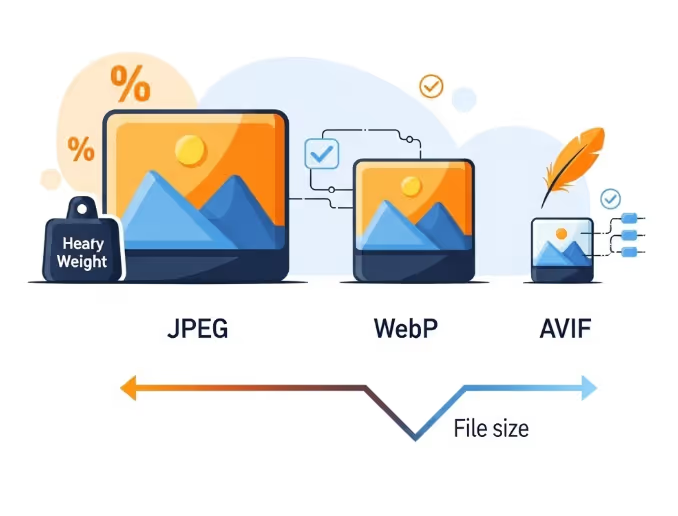
- WebP offers file size reductions of 25 to 35 percent over equivalent JPEG files and around 25 percent over PNG, with no perceptible quality loss at comparable compression settings.
- AVIF offers even greater compression efficiency than WebP, with file size reductions of 50 percent or more over JPEG in many comparisons, but requires more processing power to encode and decode.
- Both formats enjoy broad browser support in 2026, with AVIF now supported by all major browsers including Safari, Chrome, Firefox, and Edge.
- The HTML picture element with multiple source declarations is the recommended implementation approach, allowing browsers to select the best format they support while falling back to JPEG or PNG for any that do not.
- Australian websites with significant image content, particularly ecommerce retailers, travel operators, real estate platforms, and media publishers, stand to gain the most measurable performance improvement from adopting these formats.
- WordPress, Shopify, and most major CMS platforms either natively support WebP and AVIF conversion or have mature plugin solutions that handle the conversion and serving process automatically.
- Implementing next generation image formats is one of the highest return page speed improvements available because images are the largest single contributor to page weight on most commercial websites.
Why Image Format Still Matters in 2026
It might seem that image format is a detail too deep in the technical stack to warrant strategic attention from Australian marketing teams. The reality is that image format decisions have a direct line to outcomes that marketing cares about deeply: search rankings, conversion rates, bounce rates, and the user experience that shapes brand perception.
Google's Core Web Vitals framework, which forms part of its Search ranking signals, includes Largest Contentful Paint as a key metric. LCP measures the time it takes for the largest visible element on a page to render, and for most commercial web pages that largest element is an image. A hero image served in JPEG at 400 kilobytes will produce a meaningfully different LCP score than the same image served in AVIF at 120 kilobytes over the same connection. That difference accumulates across every page of a site and across every user session, and it shows up in both Core Web Vitals reporting and, over time, in search ranking performance.
The bandwidth dimension matters specifically for Australian users. Mobile internet usage in Australia is high, and a significant proportion of users are on connections where page weight has a genuine impact on perceived speed. An ecommerce site that reduces its product image payload by 40 percent through format conversion is not just improving a technical metric. It is removing friction from the purchase journey for real customers on real devices in real conditions.
According to the HTTP Archive's annual Web Almanac, images remain the dominant contributor to page weight on the web and the single largest opportunity for performance improvement on most sites. The report documents the progressive adoption of next generation formats globally and the measurable speed improvements sites are achieving through conversion from JPEG and PNG to WebP and AVIF.
WebP: The Established Next Generation Format
WebP was developed by Google and released in 2010. It supports both lossy and lossless compression, transparency, and animation, making it a practical replacement for JPEG, PNG, and GIF in most web contexts. It has been the default recommendation for next generation image format adoption for several years, and its implementation is well understood and well tooled.
The compression advantage of WebP over JPEG is most visible in photographic content. At equivalent visual quality settings, a WebP file of a product photograph, a landscape image, or a person's portrait will typically be 25 to 35 percent smaller than the JPEG equivalent. For PNG replacements, particularly images with transparency, WebP typically achieves around 25 percent smaller file sizes while maintaining the lossless quality that PNG provides.
WebP supports the full range of image use cases a commercial website requires. Product images, hero photography, logo files with transparency, animated banners, and icons can all be served in WebP without functional compromise. The format has been supported by Chrome since 2011, Firefox since 2019, Safari since 2020, and Edge throughout its modern history. In 2026, the only browser environments where WebP falls short are legacy versions of Internet Explorer and some older mobile browsers, which collectively represent a negligible share of Australian web traffic.
The tooling for WebP conversion is mature. cwebp is the command line conversion tool from Google. ImageMagick supports WebP conversion. Sharp, the Node.js image processing library, handles WebP natively. And every major cloud image delivery service including Cloudinary, Imgix, and Fastly's image optimiser supports automatic WebP conversion and serving.
AVIF: The Higher Compression Option
AVIF stands for AV1 Image File Format and is derived from the AV1 video codec developed by the Alliance for Open Media. It represents a generational improvement over WebP in compression efficiency, consistently achieving file sizes 40 to 60 percent smaller than equivalent JPEG files at comparable visual quality, and meaningfully smaller than WebP in many comparisons.
The compression advantage of AVIF is most dramatic on photographic content with subtle gradients, skin tones, and complex colour transitions. These are precisely the types of images common in ecommerce product photography, travel and hospitality imagery, and content built around portraiture. An Australian online retailer serving product imagery in AVIF rather than JPEG can expect file size reductions that measurably improve page load times, LCP scores, and bandwidth costs at scale.
AVIF also supports HDR (high dynamic range) and wide colour gamut imagery, making it the format best suited to high quality displays and well positioned for the continued improvement of screen technology. For Australian brands with premium visual identities whose image quality standards cannot be compromised, AVIF provides a pathway to maintain that quality while delivering dramatically smaller files.
The practical limitation of AVIF relative to WebP is encoding complexity. AVIF files take significantly longer to encode than JPEG or WebP files of equivalent quality. For websites serving large dynamic catalogs where images are generated or processed on the fly, this encoding overhead can affect server performance if not managed carefully. The solution for most Australian websites is to encode AVIF files ahead of time at build or upload time rather than generating them on demand, or to use a CDN image delivery service that handles AVIF encoding and caching automatically.
Browser support for AVIF in 2026 covers all major browsers. Chrome has supported AVIF since version 85 (2020). Firefox since version 93 (2021). Safari since version 16 (2022). Edge since version 121 (2024). The remaining gap in support is primarily among older browser versions and some specialist environments, which makes the picture element fallback approach important for ensuring all users receive a supported format.
WebP vs AVIF: Choosing Between Them
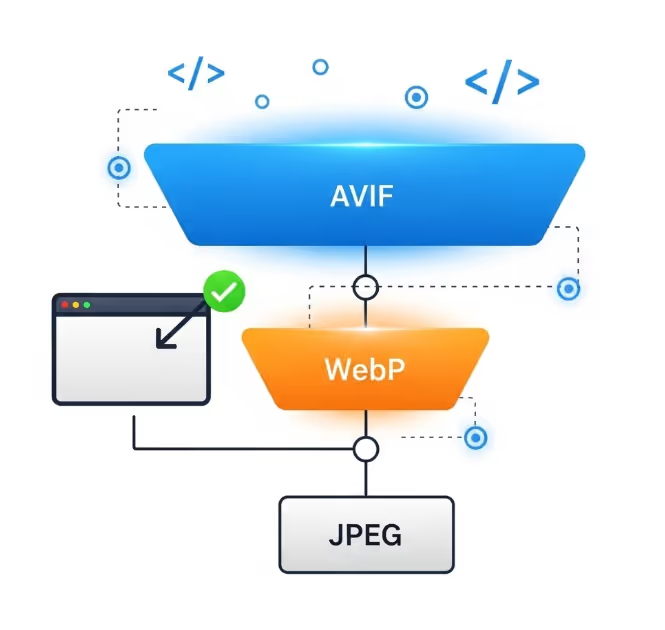
For most Australian websites, the answer to whether to implement WebP, AVIF, or both is the same: implement both, with AVIF as the preferred format for supporting browsers and WebP as the fallback, with JPEG or PNG as the final fallback for browsers that support neither.
This progressive delivery approach, implemented through the HTML picture element, costs nothing in terms of the user experience and ensures every visitor receives the most efficient format their browser can handle. The only cost is the storage and processing required to maintain multiple versions of each image, which is trivially small for most sites and fully automated by modern image management tools.
That said, understanding the relative strengths of each format helps in prioritising implementation effort and making informed decisions about which images to convert first.
WebP is the right choice when encoding speed matters, when the tooling pipeline is simpler, and when broad compatibility across a slightly older browser range is required. For Australian small businesses and organisations managing their own site images without a CDN or image delivery service, WebP is the more accessible starting point.
AVIF is the right choice when compression efficiency is the primary objective, when photographic image quality is central to the brand experience, and when the site has the infrastructure to encode images ahead of time or use a CDN that handles AVIF serving automatically. For Australian ecommerce businesses, hospitality operators, and real estate platforms where product imagery drives conversion, the additional compression gains from AVIF have clear commercial value.
Implementation: The picture Element Approach
The HTML picture element is the recommended approach for serving next generation image formats with appropriate fallback to formats supported by all browsers. The structure is straightforward and can be applied to any image on a website regardless of the platform it is built on.
The picture element allows you to specify multiple source candidates for a single image, each with a type attribute that tells the browser what format the source is in. The browser evaluates the sources in order and selects the first one it supports. An img element at the end of the picture element provides the fallback for browsers that support none of the specified source formats.
A typical implementation for a product image serving AVIF as the primary format, WebP as the secondary, and JPEG as the fallback looks like this:
html
<picture>
  <source srcset="product-image.avif" type="image/avif">
  <source srcset="product-image.webp" type="image/webp">
  <img src="product-image.jpg" alt="Product name" width="800" height="600">
</picture>
The width and height attributes on the img element are important for page layout stability and contribute to the Cumulative Layout Shift score within Core Web Vitals. Including them prevents the browser from reserving an incorrect amount of space for the image before it loads, which causes visible layout movement that degrades user experience and the CLS score.
For responsive images where different sizes are served to different screen widths, the srcset and sizes attributes within each source element handle the responsive delivery alongside the format selection. This does not add meaningful complexity to the implementation once the pattern is understood.
Platform-Specific Implementation Guides
The implementation pathway for next generation image formats varies by platform, and understanding the specific approach for the most commonly used Australian website platforms saves significant time.
WordPress. From WordPress 5.8 onwards, WebP is natively supported as an upload format. From version 6.1, WordPress generates WebP versions of uploaded JPEG images automatically if the server's image processing library supports it. AVIF support is more recent and depends on having a sufficiently current version of the GD or Imagick library on the server. For WordPress sites not yet generating AVIF automatically, the ShortPixel Adaptive Images plugin and the Imagify plugin both handle AVIF and WebP conversion and serving reliably, and are widely used among Australian WordPress developers.
Shopify. Shopify's CDN automatically serves WebP to browsers that support it, converting uploaded images on the fly. AVIF support through Shopify's native CDN is available and being progressively rolled out. For Shopify merchants, the practical recommendation is to upload the highest quality source images possible in JPEG or PNG and allow Shopify's CDN to handle the conversion and format selection. Third party apps from the Shopify app store can provide more granular control over the format conversion process if needed.
Squarespace and Wix. Both platforms handle image format optimisation through their own delivery infrastructure. Squarespace serves WebP automatically to supported browsers. Wix uses its own image serving system that includes format optimisation. For sites on these platforms, the primary recommendation is to upload high quality source files and rely on the platform's delivery optimisation rather than attempting manual format control, which these platforms do not readily expose.
Custom builds. For Australian websites built on custom frameworks or static site generators, the most scalable approach is to integrate image format conversion into the build pipeline using tools like Sharp, Squoosh, or the image processing features of frameworks such as Next.js and Nuxt, which handle WebP and AVIF generation and the picture element markup automatically for images processed through their image components.
CDN and Image Delivery Services
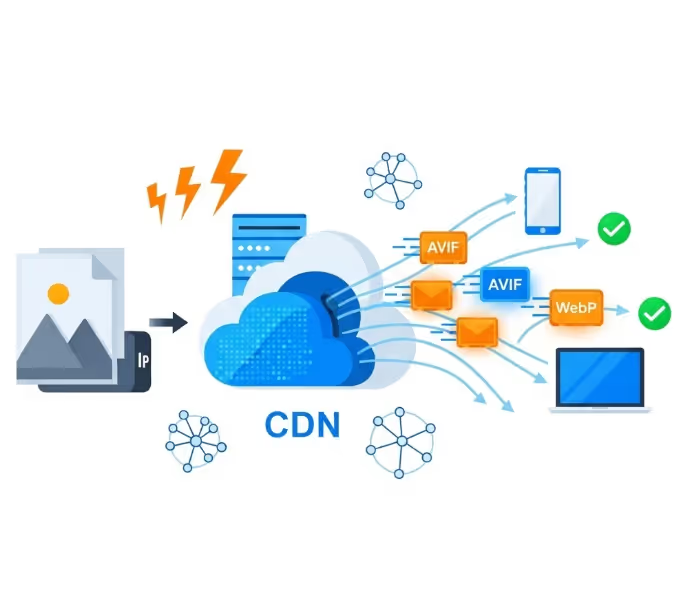
For Australian websites with significant image volume or performance requirements, a CDN with native image optimisation capabilities is the most practical path to automated WebP and AVIF delivery without managing the conversion pipeline manually.
Cloudinary, Imgix, and Fastly Image Optimiser all support automatic format detection and serving, delivering AVIF to browsers that support it, WebP to those that do not, and JPEG or PNG as the final fallback. This format selection happens on every request without any additional markup or management overhead beyond the initial service configuration.
Australian businesses evaluating CDN image delivery services should consider the geographic distribution of the CDN's edge nodes relative to their primary audience. A CDN with Australian edge nodes will deliver images faster to Australian users than one routing traffic through US or European points of presence, regardless of the format being served.
Cloudinary's documentation on automatic format selection and the format-specific performance data it publishes is one of the most useful independent references for understanding the real-world performance impact of AVIF and WebP adoption, and is worth reviewing when building the business case for next generation image format investment.
FAQs
Will switching to WebP or AVIF visually degrade image quality on Australian websites?
Not if the conversion is handled correctly. Both WebP and AVIF support quality settings comparable to JPEG, and at the quality levels appropriate for commercial web use, the visual difference between a correctly converted WebP or AVIF and the original JPEG is not perceptible to most users. The most important factor is starting with the highest quality source image available and converting at an appropriate quality setting rather than applying excessive compression in pursuit of the smallest possible file size. For images where quality cannot be compromised, lossless WebP or AVIF provides file size savings with absolutely no quality degradation compared to the source.
How much improvement in Core Web Vitals can Australian sites realistically expect from implementing next generation image formats?
The improvement varies significantly by site, existing image quality and optimisation, and how much of the page weight is currently carried by images. Sites with unoptimised JPEG hero images and large product image catalogs typically see LCP improvements of one to two seconds on mobile connections after converting to AVIF or WebP, which can move a site from a failing Core Web Vitals score to a passing one. Sites that are already serving thoroughly optimised JPEG images will see smaller but still measurable improvements. The most accurate way to assess the potential gain is to run a Google PageSpeed Insights audit on key pages, which will specifically flag next generation image format opportunities and estimate the potential savings.
Is it worth implementing AVIF if WebP is already in place?
Yes, particularly for ecommerce and sites carrying a heavy image load where the additional compression gains translate into measurable load time improvements. The incremental effort of implementing AVIF alongside WebP using the picture element approach is modest, since the implementation pattern is the same with one additional source element. The file size gains from AVIF over WebP in photographic content are typically in the range of 15 to 30 percent, which is meaningful at scale. For a product catalogue with thousands of images, that incremental reduction in image payload has a real impact on page load times, CDN bandwidth costs, and user experience on mobile connections.
The Format Decision That Pays for Itself
Switching to WebP and AVIF is one of the performance improvements with the clearest and most quantifiable return available to Australian websites in 2026. Faster pages rank better, convert better, and cost less to serve. The tooling is mature, the browser support is broad, and the implementation pathway is well understood across every major platform used by Australian businesses.
Maven Marketing Co helps Australian businesses audit their web performance and implement technical improvements that translate into measurable commercial outcomes.
Talk to the team at Maven Marketing Co →

Table of contents
read more blogs

Why Your Google Ads Campaign Is Not Getting Results: Common Mistakes and Solutions
If your Google Ads campaign is getting impressions or clicks but not producing enough enquiries, sales, or qualified leads, the problem is usually not Google Ads itself. It is more often a strategy, tracking, or conversion issue somewhere in the system.That matters because paid search can look busy without being commercially effective. You can have traffic coming in, a reasonable click-through rate and money leaving the account every day, yet still have very little to show for it if your keywords are weak, your ad copy is misaligned, your landing pages do not convert or your tracking is incomplete.A strong campaign works as one connected chain. Search intent, keyword targeting, ad relevance, bidding, landing-page experience, and conversion tracking all need to support the same commercial outcome. If one link breaks, results usually suffer quickly.This guide explains the most common reasons a Google Ads campaign is not getting results, what those issues normally look like in practice and how to fix them without relying on guesswork. The focus is not on vanity metrics. It is on improving lead quality, conversion rate, and return on spend.

6 Ways Digital Marketing Can Boost B2B Lead Generation
B2B lead generation is not about filling a CRM with as many names as possible. The real objective is to attract businesses that fit your offer, give the right people a reason to engage and create enough confidence for a genuine sales conversation to start.That distinction matters because B2B buying is usually more targeted than consumer marketing and often involves several people influencing the decision. Current LinkedIn lead-generation guidance makes the same point: more leads do not automatically mean better results if only a small proportion are genuinely relevant or likely to progress.Digital marketing helps by creating multiple paths into the business. Search can capture active demand. Paid media can put an offer in front of a tightly defined audience. Content can build authority before a buyer is ready to talk. Social media can keep the brand visible across a long decision cycle. Your website turns interest into action, while email helps nurture that interest over time.The strongest B2B digital marketing strategies do not treat these as six separate activities. They use them as one connected system designed to generate quality B2B leads, support sales and build a more dependable pipeline

How to Build a Brand Positioning Strategy That Sets Your Business Apart
Most businesses can explain what they sell. Far fewer can explain, in a sentence or two, why the right customer should choose them instead of another credible option. That gap is where brand positioning matters.A strong brand positioning strategy gives your business a clear place in the market and a clear place in the customer's mind. It helps your team decide who you are speaking to, what you want to be known for, which benefits deserve the most attention and how your marketing should sound and look across every channel.It is not a slogan exercise and it is not something reserved for large consumer brands. For an Australian service business, e-commerce brand, professional firm, or growing B2B company, positioning can make everyday decisions easier, from website copy and campaign messaging to pricing, sales conversations, and brand identity. The goal is not to look different for the sake of it. The goal is to be meaningfully different in a way the right customers understand and value.