
.svg)


%201.svg)

Key Takeaways
- WebAssembly is a binary instruction format that runs in the browser at speeds approaching native application performance, far exceeding what JavaScript alone can achieve for tasks requiring heavy computation.
- Marketers do not write WebAssembly directly. It is a compilation target for languages such as C, C++, Rust, and Go, meaning existing code written for high performance can be brought to the browser without being rewritten in JavaScript.
- The marketing applications with the most to gain from WebAssembly are those involving computation in real time: product configurators, 3D visualisers, simulation tools, data dashboards, and creative tools running in the browser.
- WebAssembly does not replace JavaScript for standard web development. It complements it by handling the computationally intensive portions of an application while JavaScript manages the user interface and browser integration.
- Australian ecommerce businesses, architecture and property firms, automotive and industrial brands, and marketing platforms built around data are among the categories best positioned to use WebAssembly to differentiate their web experiences.
- Performance improvements from WebAssembly only matter if the experience itself is compelling. The technology is an enabler, not a strategy.
- For most Australian websites, WebAssembly is not yet relevant. Standard web performance optimisation through image compression, lazy loading, Critical CSS, and efficient JavaScript remains the higher priority for the majority of marketing teams.
What WebAssembly Actually Is
WebAssembly, commonly abbreviated as Wasm, is a binary format operating at a low level designed to run in web browsers at speeds that approach the performance of natively compiled applications. It is not a programming language that developers write directly in most cases. It is an output format, a compilation target, that allows code written in languages such as C, C++, Rust, and Go to be compiled into a compact binary that the browser can execute with efficiency approaching native execution.
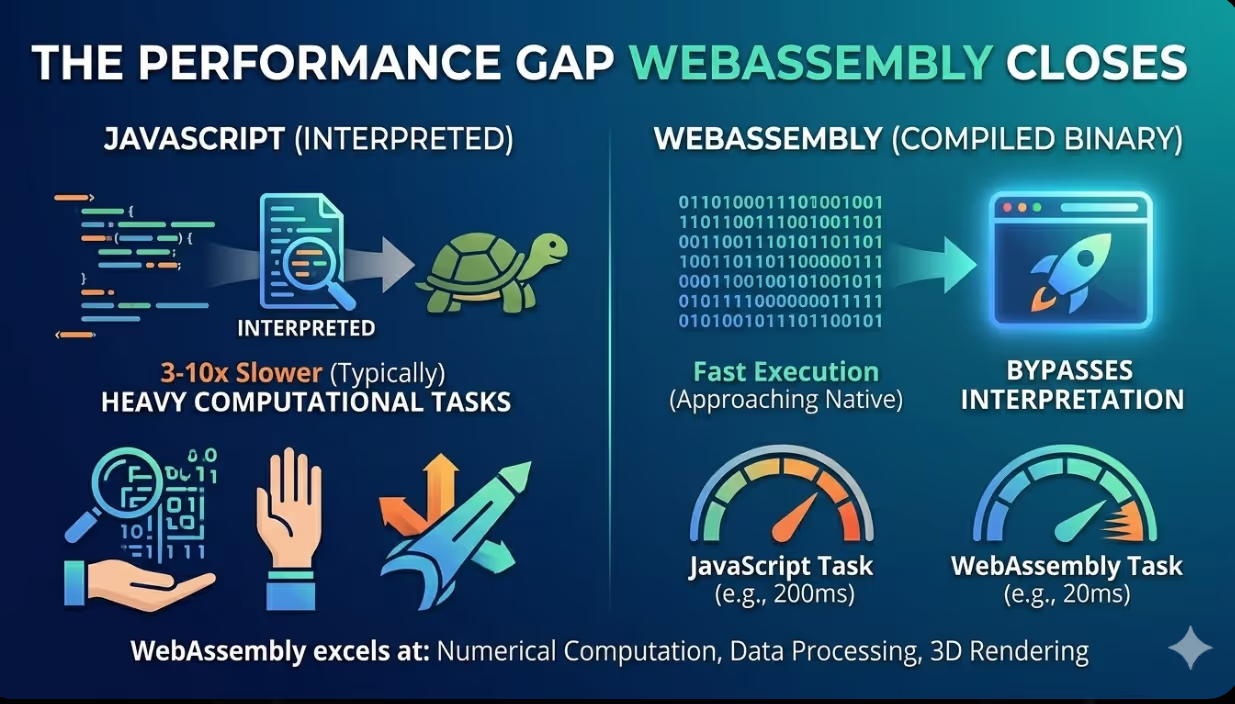
The speed advantage over JavaScript is substantial for tasks requiring heavy computation. JavaScript is an interpreted language: the browser reads and executes it line by line, with various optimisation layers that improve performance but cannot close the gap with compiled code for tasks requiring intensive calculation. WebAssembly bypasses this interpretation step. The browser receives previously compiled binary instructions and executes them directly, producing performance that is typically three to ten times faster than equivalent JavaScript for numerical computation, data processing, and algorithmic tasks.
For the majority of web content, this performance difference is irrelevant. Displaying a paragraph of text, loading a product image, or rendering a contact form does not require processing requiring heavy computation. JavaScript handles these tasks well within the performance margins users expect, and reaching for WebAssembly to improve them would be like using an industrial press to slice bread.
Where WebAssembly becomes relevant is at the boundary of what is currently possible in a browser. Tasks that currently require a native desktop application, a server round trip, or a significant compromise in responsiveness in real time are the tasks that WebAssembly enables at browser speed. For marketing, this boundary is where the most interesting commercial opportunities sit.
The Performance Gap WebAssembly Closes
To understand the marketing relevance of WebAssembly, it helps to understand the specific performance limitations it addresses and why those limitations have mattered for marketing experiences delivered on the web until recently.
Interactive product configuration is one of the clearest examples. A kitchen manufacturer whose website allows customers to configure a custom kitchen in real time, adjusting cabinet dimensions, bench materials, appliance positions, and colour combinations and seeing an accurate rendered preview instantly, needs the browser to perform complex 3D rendering calculations continuously as the user interacts. JavaScript can handle simplified versions of this interaction but struggles to maintain the rendering quality and response speed that makes the experience feel genuinely useful rather than frustratingly slow.
WebAssembly changes this by allowing the rendering engine to run at speeds approaching native execution in the browser. The same calculation that would take JavaScript 200 milliseconds might take WebAssembly 20 milliseconds. In an interactive experience where the user is making changes and expecting immediate visual feedback, this difference is the gap between a tool that feels real and one that feels like a prototype.
The same principle applies to data visualisation running in the browser, audio and video processing, physics simulations, machine learning inference, and complex financial modelling. Each of these use cases involves computation that JavaScript handles poorly at the performance levels users expect from modern software, and each of them has marketing applications for Australian brands in specific industry verticals.
According to the WebAssembly specification documentation maintained by the W3C, the design goals of WebAssembly explicitly include fast execution, compact representation, and integration with the web platform, making it directly applicable to the web experience performance requirements that drive marketing outcomes.
Marketing Applications With Real Commercial Value
The most valuable marketing applications of WebAssembly in the Australian market are concentrated in a handful of industry categories where the performance capabilities Wasm enables translate directly into improved customer engagement and conversion outcomes.
Product configurators and visualisers. For Australian brands selling customisable or configurable products, the quality of the configuration experience is a direct commercial variable. A bathroom fixture company, a furniture manufacturer, or a building materials supplier that can offer a genuinely responsive visualiser running in the browser, one that renders accurately in real time as the customer makes choices, is offering a materially different purchase experience from a competitor relying on static product images or a slow, laggy configurator. WebAssembly makes the difference between a visualiser that feels like a marketing asset and one that feels like a technical liability.
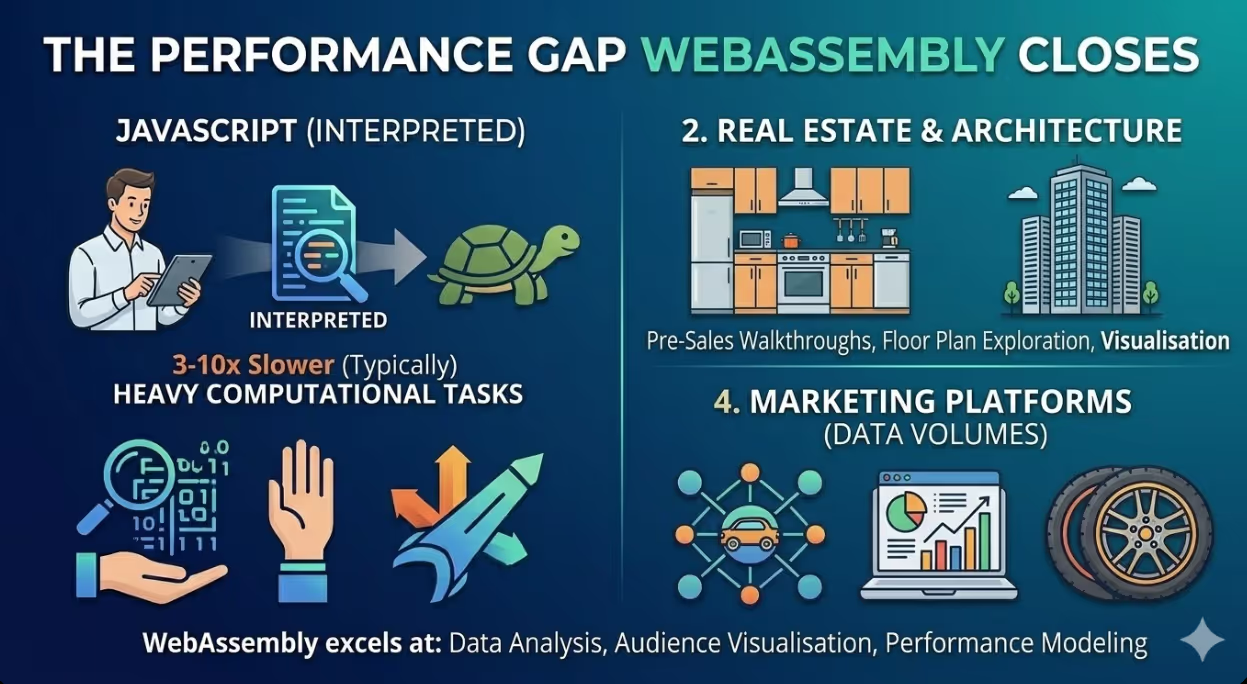
Real estate and architecture. Australian property developers, architectural firms, and real estate platforms are increasingly using 3D visualisation running in the browser for apartment walkthroughs, floor plan exploration, and property customisation. WebAssembly enables these experiences to run at acceptable frame rates in a standard browser without requiring users to download a native application. For a developer selling apartments before construction is complete, a walkthrough tool running in the browser powered by WebAssembly that runs on any device is a significant competitive differentiator in the presales phase.
Automotive and industrial configurators. Car manufacturers, industrial equipment suppliers, and specialised engineering product companies with Australian operations use product configurators as a key part of their digital sales process. The computation required to render accurate 3D models of complex products in real time at multiple scales and with variable specifications is precisely the type of task WebAssembly handles well. Several major automotive brands globally are already using WebAssembly in their configuration tools, and the performance difference compared to implementations relying on JavaScript alone is visible and meaningful to users.
Marketing platforms handling large data volumes. Australian marketers working with platforms that involve data analysis in real time, audience segmentation visualisation, or campaign performance modelling in the browser benefit from WebAssembly when those platforms involve computation that JavaScript makes slow. A marketing analytics tool that previously required processing on the server side for complex segment calculations can perform those calculations in the browser with WebAssembly, enabling faster interaction and reducing server infrastructure costs simultaneously.
WebAssembly and the User Experience Equation
The performance improvements WebAssembly enables are a means to an end, not an end in themselves. Faster computation matters to marketing only when it produces a user experience outcome that influences behaviour.
The user experience value of performance that WebAssembly enables shows up in three ways for marketing applications. First, it removes friction from interactive experiences that users would otherwise abandon. A product configurator that takes three seconds to respond to each input will be abandoned by a significant proportion of visitors regardless of how compelling the product is. A configurator that responds within 50 milliseconds feels like an extension of the user's thinking. The engagement and time on page data for these two experiences are fundamentally different.
Second, it enables experiences that have no equivalent in conventional web applications. A tool running in the browser that genuinely replaces a desktop application, with the accessibility of a URL and the performance of installed software, represents a qualitative step in what a brand can offer through its digital presence. For Australian B2B brands in technical industries, a tool running in the browser with genuine utility is a lead generation and asset that builds authority that a blog post or a whitepaper cannot replicate.
Third, it reduces the hardware and browser requirements that would otherwise limit the audience for an advanced web experience. A 3D product visualiser built in pure JavaScript may run acceptably on a high end desktop but become unusable on a mobile device in the mid range. The same visualiser built with WebAssembly runs closer to its full performance across a broader range of devices, which is directly relevant for Australian consumer brands whose audiences access the web primarily on mobile.
The Practical Path to WebAssembly for Australian Brands
For Australian marketing teams considering whether WebAssembly is relevant to their current or planned web investments, the practical pathway does not involve marketing teams writing code in Rust. It involves understanding when a specific user experience requirement justifies the development investment, and knowing which questions to ask of a development team or agency to evaluate whether WebAssembly is the appropriate technical approach.
The key evaluating question is straightforward: Is the performance limitation of the current or planned experience caused by computation that JavaScript cannot handle fast enough? If the answer is yes, WebAssembly is worth investigating. If the performance limitation is caused by network latency, server response time, image weight, or resources that block rendering, then standard web performance optimisation techniques are the appropriate remedy and WebAssembly will not help.
For Australian brands working with development agencies or development teams within the organisation, the emergence of frameworks and toolchains that simplify WebAssembly development has reduced the barrier to exploring the technology for specific use cases. Rust's Wasm toolchain, Emscripten for C and C++ codebases, and AssemblyScript for TypeScript developers all provide accessible pathways to WebAssembly without requiring expertise in systems programming at a low level.
Several commercial platforms and SaaS products used by Australian marketing teams already run WebAssembly under the surface without requiring any awareness of it from their users. Figma's design tool running in the browser uses WebAssembly for its rendering engine. Google Earth on the web uses it for 3D rendering. Adobe's versions running in the browser of Photoshop and Acrobat use it for image and document processing. The technology is not experimental. It is ready for production and in daily use by millions of people globally.
When WebAssembly Is Not the Answer
Understanding the limits of WebAssembly's relevance prevents wasted investigation into a technology that provides no benefit for a particular application.
Standard content websites, brochure sites, ecommerce storefronts with conventional product pages, and most marketing landing pages have no computational requirements that would benefit from WebAssembly. For these sites, the performance improvements that matter come from image format optimisation, lazy loading, Critical CSS extraction, efficient JavaScript bundling, and CDN configuration. These techniques address the actual performance bottlenecks for sites carrying heavy content loads, and they are appropriate for the vast majority of Australian commercial websites.
WebAssembly also does not help with network latency. If a web application is slow because it is making many round trips to a server to retrieve data, WebAssembly will not make it faster. The solution there is reducing the number of network requests, improving API response times, or moving computation to the edge. WebAssembly is a computation speed tool, not a network performance tool.
The development complexity and cost of WebAssembly implementations is higher than equivalent JavaScript development for most use cases. The build toolchain is more involved, debugging is more complex, and the skill set required is less widely available in the Australian development market. These factors make it important to be specific about whether the performance gain is commercially valuable before committing the development investment.
Mozilla's WebAssembly documentation is the most accessible technical reference for development teams evaluating whether WebAssembly is appropriate for a specific use case, covering the full range of use cases, limitations, and integration patterns in detail.
FAQs
Does WebAssembly improve SEO for Australian websites?
WebAssembly's impact on SEO is indirect and depends on the specific implementation. If a application powered by WebAssembly significantly improves Core Web Vitals scores, particularly Largest Contentful Paint and Interaction to Next Paint, that improvement may contribute positively to search rankings where performance is a ranking factor. However, content within a WebAssembly application is typically not directly readable by search crawlers in the way standard HTML content is, which means information that needs to be indexed for search should be delivered in HTML rather than rendered entirely within a WebAssembly context. For most Australian websites, SEO considerations favour conventional HTML with JavaScript enhancements over content rendered through WebAssembly for any content that needs to be discoverable in search.
How long does it take to implement a marketing application built on WebAssembly?
Development timelines vary significantly depending on the complexity of the application and whether existing code in a compiled language is being ported to the browser or a new application is being built from scratch. Simple WebAssembly integrations that accelerate a specific computation within a larger JavaScript application may take days to weeks. Complex interactive 3D visualisers or product configurators built with WebAssembly as a core component typically require months of development and testing. For Australian brands evaluating WebAssembly for a specific application, obtaining a scoped estimate from a development team with WebAssembly experience is the most reliable way to understand the investment required. The Australian market has a growing number of development agencies with WebAssembly capability, though it remains a specialist skill compared to standard web development.
Are there tools already running WebAssembly internally that Australian marketers can use today without custom development?
Yes, and increasingly so. Several marketing technology platforms and creative tools used by Australian marketers already run WebAssembly internally as part of their browser performance architecture. Figma is one of the most widely used examples. Video editing tools running in the browser, advanced image editors, data visualisation platforms, and interactive presentation tools in the current SaaS landscape increasingly use WebAssembly to deliver performance at desktop class levels in the browser. For Australian marketing teams, the practical implication is that some of the tools they already use are powered by WebAssembly internally, and evaluating new tools in part on the quality of their performance as browser applications is a reasonable criterion that correlates with underlying technical quality.
Performance That Opens New Creative Possibilities
WebAssembly is not a marketing technology. It is a browser performance capability that expands what is possible in a marketing context. For most Australian brands and most marketing applications in 2026, it remains a specialist concern rather than a daily consideration. But for brands in the categories where interactive experiences requiring intensive computation experiences have genuine commercial value, understanding what WebAssembly makes possible is increasingly relevant to the conversations happening between marketing and development teams about what the brand's digital experience should be.
Maven Marketing Co helps Australian businesses bridge the gap between marketing strategy and the technical decisions that determine whether digital experiences perform at the level the strategy requires.
Talk to the team at Maven Marketing Co →

Table of contents
read more blogs

How to Choose the Right Digital Marketing Channels for Your Business
Choosing digital marketing channels is one of the easiest places for businesses to lose clarity. There are more options than ever, every platform promises reach and results, and it is easy to assume that the best strategy is simply to be everywhere. In reality, most businesses do better when they choose channels with intention rather than spreading budget and effort too thinly.The right channel mix depends on where your audience spends time, how they search or discover solutions, what your business is trying to achieve and how much resource you actually have to support execution properly. A channel is only useful if it helps move the right people towards a commercial outcome that matters to the business.This is why strong digital marketing strategy is not really about finding one perfect platform. It is about understanding the role each channel can play across awareness, demand capture, conversion and retention. SEO might build long-term visibility, Google Ads might capture active intent, social media might support familiarity and reach, while email may help nurture prospects and strengthen customer value over time.This guide explains what digital marketing channels are, how to assess them properly and how to build a balanced channel mix for your business. The focus is practical. Rather than chasing every new platform, the goal is to help you choose the channels that fit your audience, goals, budget and internal capability.

How to Build a Customer Journey Map for Your Digital Marketing Strategy
A strong digital marketing strategy is not just about channels, creative or traffic. It is about understanding how real people move from first awareness through to enquiry, purchase and ongoing loyalty. That is exactly why customer journey mapping matters.Without a clear view of the journey, businesses often optimise in fragments. They improve the website without thinking about the ad that drove the visit, produce content without considering where the audience is in the decision process, or judge conversion performance without understanding the friction points that sit earlier in the experience.A customer journey map helps you step back and see the bigger picture. It shows the stages people move through, the touchpoints they interact with, the questions they ask, the barriers they face and the moments where your marketing can either help or lose them.This guide explains how to build a practical customer journey map for your digital marketing strategy, what information to include, how to use the map to improve performance and which common mistakes to avoid. The goal is not to create a pretty workshop artefact that gets forgotten. It is to build a working tool that improves messaging, user experience, channel decisions and conversion outcomes.

Why Your Google Ads Campaign Is Not Getting Results: Common Mistakes and Solutions
If your Google Ads campaign is getting impressions or clicks but not producing enough enquiries, sales, or qualified leads, the problem is usually not Google Ads itself. It is more often a strategy, tracking, or conversion issue somewhere in the system.That matters because paid search can look busy without being commercially effective. You can have traffic coming in, a reasonable click-through rate and money leaving the account every day, yet still have very little to show for it if your keywords are weak, your ad copy is misaligned, your landing pages do not convert or your tracking is incomplete.A strong campaign works as one connected chain. Search intent, keyword targeting, ad relevance, bidding, landing-page experience, and conversion tracking all need to support the same commercial outcome. If one link breaks, results usually suffer quickly.This guide explains the most common reasons a Google Ads campaign is not getting results, what those issues normally look like in practice and how to fix them without relying on guesswork. The focus is not on vanity metrics. It is on improving lead quality, conversion rate, and return on spend.


