
.svg)


%201.svg)
Key Takeaways
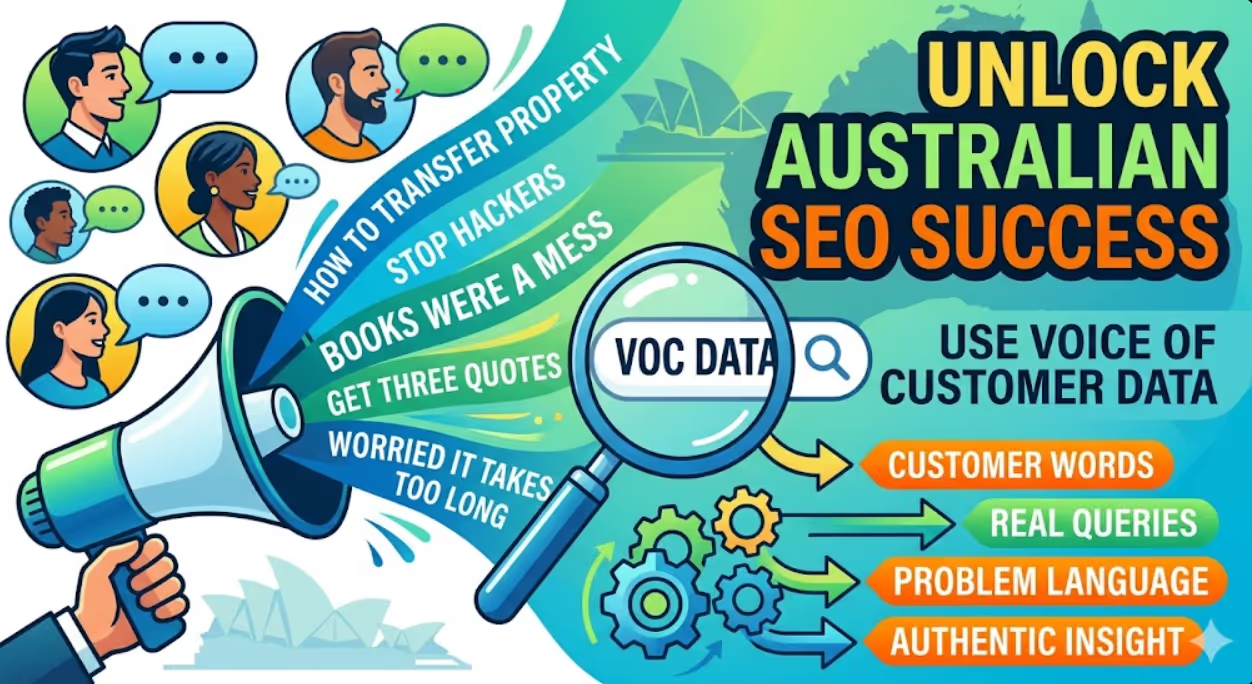
- Voice of customer data is the most authentic source of keyword and content strategy insight available because it captures the exact language real customers use when describing their needs, which often differs significantly from the internal vocabulary the business uses to describe its services.
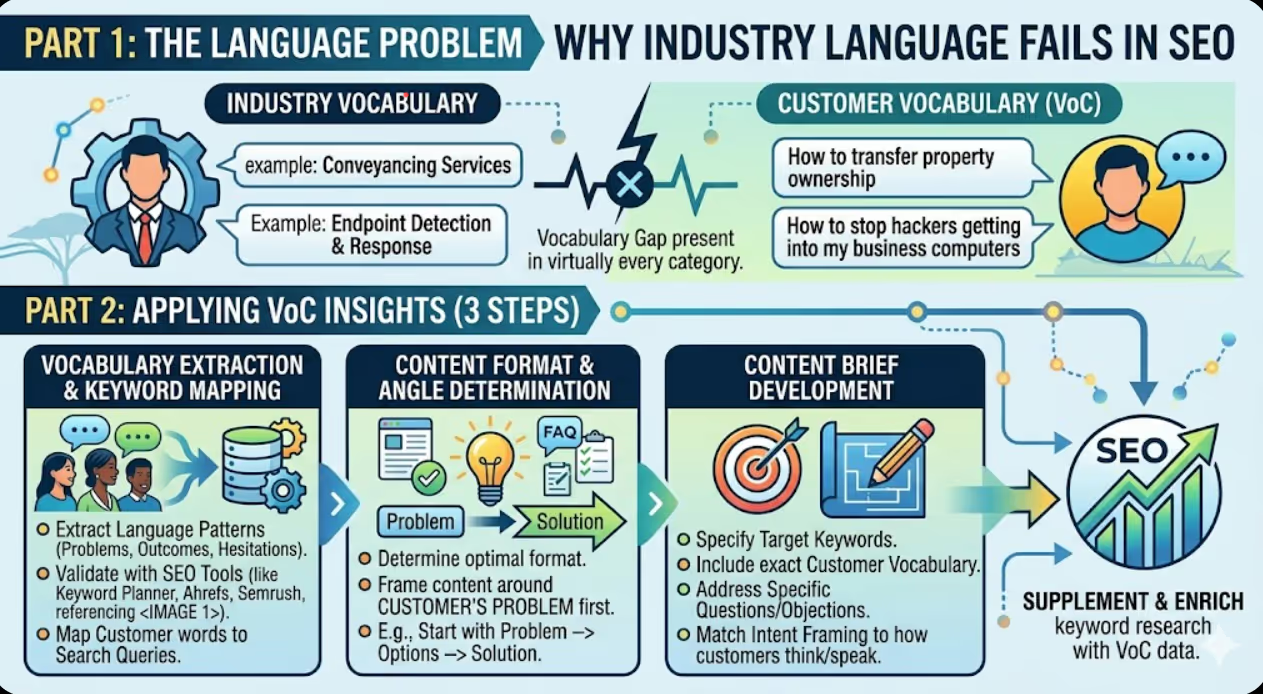
- The primary sources of voice of customer data for Australian businesses are customer reviews, sales call recordings and notes, support tickets and email threads, surveys completed after purchase, and the questions asked during the sales process itself.
- Review mining, the systematic analysis of both your own reviews and competitor reviews, reveals the specific words and phrases customers use to describe problems, outcomes, and decision factors in your category in a form that translates directly into keyword research.
- The most commercially valuable voice of customer insights for SEO are those that reveal what customers searched for before they found the solution, what language they used to describe the problem that prompted their search, and what hesitations or objections they had before making the decision.
- Voice of customer language often surfaces search intents that keyword research tools underestimate because the tools measure query frequency from existing searches rather than the full range of questions people have that they do not yet know how to phrase as a Google search.
- Sales call language and objection patterns are a particularly rich source of content strategy insight because the questions and objections raised in sales conversations are precisely the information gaps that potential customers are trying to close before committing.
- Applying voice of customer insights to an SEO content programme does not replace keyword research with search volume data. It supplements and enriches it by ensuring the vocabulary, question format, and intent framing of the content matches how the target audience actually thinks and speaks rather than how the industry describes itself.
Why Industry Language Fails in SEO
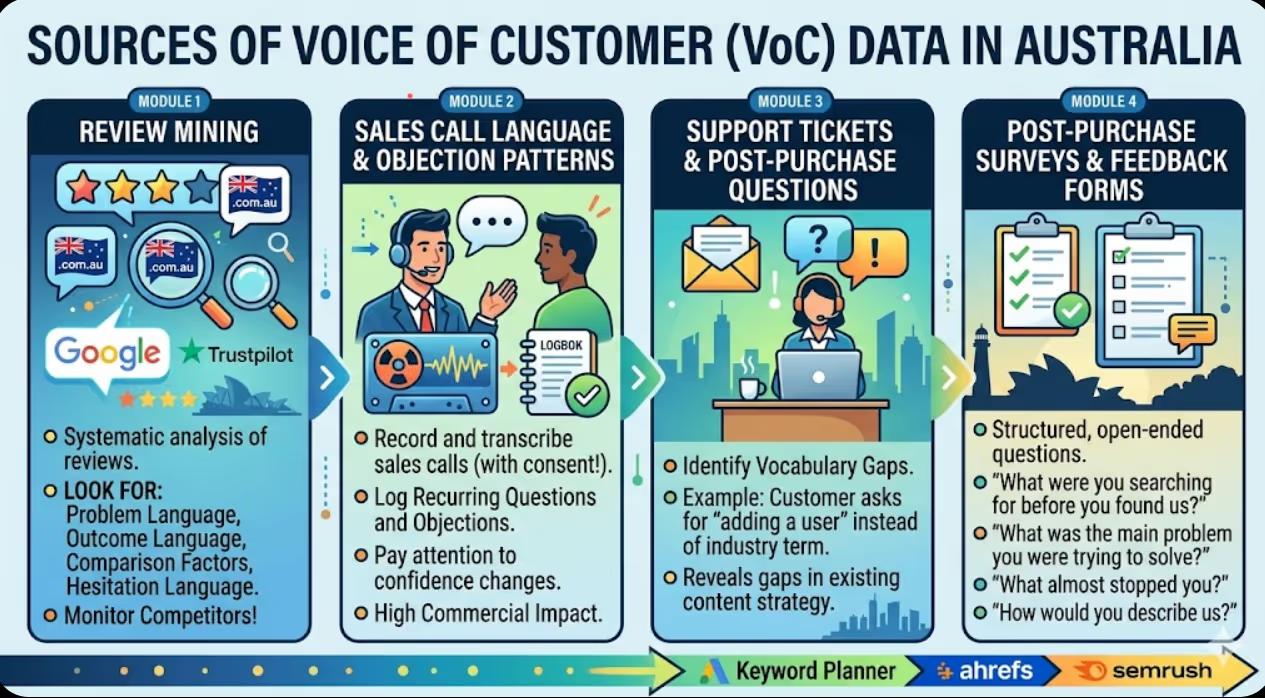
The language problem in marketing content is systematic rather than occasional. Industries develop internal vocabularies for describing their products and services, and these vocabularies become so familiar to practitioners that they feel like natural language rather than specialist terminology. A legal firm talks about "conveyancing services." A homebuyer looking to buy their first property searches for "how to transfer property ownership." A cybersecurity firm offers "endpoint detection and response." A small business owner worried about being hacked searches for "how to stop hackers getting into my business computers."
These are not fringe examples. The vocabulary gap between industry description and customer search is present in virtually every category, and it becomes more pronounced the more technical or specialised the service is. The customer does not know the industry term. They know their problem and their question. Content that uses the industry term and never uses the customer's language ranks for searches the customer never performs, and does not rank for the searches the customer actually performs.
The solution is not to abandon industry terminology entirely. Professional vocabulary matters for credibility, for reaching other industry practitioners, and for demonstrating expertise. The solution is to supplement the industry vocabulary with the customer vocabulary: to understand how customers describe what they are looking for, to use that language in the content alongside the professional terminology, and to structure the content around the questions customers ask rather than only the statements the industry makes.
Voice of customer data is the mechanism for discovering the customer vocabulary systematically rather than guessing at it.
Source 1: Review Mining
Customer reviews are one of the richest and most accessible sources of voice of customer language available to Australian businesses, and one of the least systematically used. A business with 80 Google reviews, 40 Trustpilot reviews, and a set of testimonials on its website is sitting on several hundred individual customer descriptions of what the business does, what problem it solved, what the customer was looking for before they found the business, and what made them confident enough to proceed.
Review mining involves reading every available review, both for the business and for its competitors, and systematically extracting language patterns that reveal keyword and content insights.
What to look for in reviews:
Problem language. The specific words customers use to describe the problem or situation that prompted them to seek the service. "We had water coming through the ceiling," "our books were a complete mess," "we had no idea how to handle the paperwork." These describe the problem the customer was experiencing at the search stage's own words, and a customer in the same situation will often search using exactly this language.
Outcome language. How customers describe the result of using the service. "The kitchen looks completely different," "we saved $4,000 in the first year," "we finally understood what our financial position actually was." Outcome language reveals what customers ultimately care about, which often differs from what businesses assume they care about, and it informs both keyword selection and content framing.
Comparison and decision language. How customers describe the alternatives they considered, the factors they weighed, and what made them choose this business. "We got three quotes," "we had tried another company before," "we weren't sure if we needed a full service or just the basic option." This language reveals the comparison and content for the decision stage that would have reached these customers earlier in their journey.
Hesitation language. The concerns customers mention having before they proceeded. "We were worried it would take too long," "we weren't sure if we could afford it," "we didn't know if it was the right solution for our size of business." Hesitations that are mentioned in positive reviews are almost certainly common objections in the sales process, and they represent content opportunities to address those objections proactively in the SEO content rather than waiting to handle them in a sales conversation.
For Australian businesses, competitor reviews on Google, Trustpilot, ProductReview.com.au, and platforms specific to the industry provide the same language data for the competitive category, not just for the specific business. A competitor's reviews often reveal customer language and problem descriptions that the business's own reviews do not, particularly if the competitor serves a slightly different audience segment.
Source 2: Sales Call Language and Objection Patterns
The questions customers ask during the sales process are among the most direct signals available about the information gaps they are trying to close before making a decision. Every question asked in a sales conversation is a piece of content that the business could have provided before the sales conversation, potentially reducing the friction in the decision process and reaching the customer earlier in their search journey.
For Australian businesses that conduct sales calls, discovery sessions, or consultations, the questions asked in these interactions should be systematically captured and reviewed as a content strategy input. The process involves:
Recording and transcribing sales conversations (with appropriate consent under Australian privacy requirements) and reviewing the transcripts for recurring questions that reveal information gaps. The volume of any specific question across multiple sales conversations is a signal of how widespread that information gap is, which translates directly into the search volume potential for content addressing it.
Maintaining a running log of questions and objections that sales team members encounter regularly. A weekly or monthly review of this log with the content team produces a direct pipeline from sales conversation insights to content topics.
Paying particular attention to questions that are followed by relief or confidence. When a customer asks a question and the answer produces a visible change in their attitude from uncertain to confident, that question and answer represent a content opportunity: the same question is being asked by the same type of customer at a search stage before they have reached the sales conversation.
The language captured from sales interactions is particularly valuable because it represents questions and hesitations at a very specific stage of the decision journey, the stage immediately before purchase, which is also the stage where content has the highest commercial impact.
Source 3: Support Tickets and Post-Purchase Questions
Support tickets, customer service emails, and questions asked after purchase reveal two categories of valuable voice of customer insight.
The first is terminology and vocabulary that the business's own content may not use but that customers use when they have a problem or question. A software business that answers twelve support tickets per month asking "how do I add a new user" is discovering that customers describe this function as "adding a user" rather than using the product's own terminology for the process. Content using the customer's terminology rather than the product's terminology will rank for the searches those customers actually perform.
The second is the specific questions that customers did not find answered in the content produced before purchase, which reveals gaps in the content strategy. Questions raised after purchase about processes, timelines, deliverables, and expectations reveal the information customers needed before purchasing that the current content did not provide. Addressing these gaps in the SEO content serves both the audience searching before purchase for this information and reduces the support burden after purchase.
Source 4: Post-Purchase Surveys and Feedback Forms
A structured survey completed after purchase, with questions that are open ended, produces voice of customer data systematically rather than relying on the organic language that appears in reviews or conversations. The questions that generate the most useful SEO insights are:
"What were you searching for before you found us?" This directly reveals the search terms and phrases real customers used, which may differ significantly from the keywords the business has targeted.
"What was the main problem you were trying to solve?" This reveals the vocabulary from the problem stage that corresponds to search queries earlier in the funnel.
"What almost stopped you from proceeding?" This surfaces the hesitation language that translates into content addressing common objections.
"How would you describe what we do to a friend?" This reveals the natural language description of the service from a customer perspective, which often produces the most vocabulary that aligns with how customers search because it is the language the customer would use when recommending the business to someone with the same problem.
Applying Voice of Customer Insights to Content Strategy
The practical application of voice of customer data to SEO content involves three steps.
Step 1: Vocabulary extraction and keyword mapping. The language patterns identified through review mining, sales conversation analysis, and survey responses are translated into keyword candidates and validated against search volume data in Google Keyword Planner, Ahrefs, or Semrush. Many voice of customer phrases will produce low search volume results, which does not necessarily mean the insight is wrong: it may mean the keyword tool is not capturing niche Australian query patterns accurately, or that the phrase needs to be adapted slightly to match the most common search formulation.
Step 2: Content format and angle determination. Voice of customer data reveals not just what topics to write about but how to frame them. A business that discovers its customers use language that describes the problem first (describing what was wrong before finding the solution) should write content that begins with the problem (beginning with the problem, moving through the options, arriving at the solution) rather than content that leads with the solution with the product or service and adds problem context afterwards.
Step 3: Content brief development. Each voice of customer insight that has been validated as a keyword opportunity is developed into a content brief that specifies the target keyword, the customer vocabulary to include, the specific questions or hesitations to address, and the intent framing that matches how the customer is likely to be thinking when they perform the search. The brief ensures that the content writer produces content that genuinely speaks to the customer's experience rather than defaulting to the industry vocabulary that the voice of customer analysis was designed to supplement.
FAQs
How many reviews does an Australian business need to conduct useful review mining?Useful patterns begin to emerge from as few as twenty to thirty reviews, particularly for identifying recurring problem language and outcome descriptions. A business with fewer than twenty reviews should prioritise expanding its review volume as a foundational activity, both for the SEO and social proof benefits and because a larger review set produces more reliable language patterns. For the most statistically meaningful voice of customer analysis, a set of fifty or more reviews covering the business itself and twenty or more reviews from each of the two or three primary competitors produces robust language patterns across the category. Australian businesses in B2B or professional services categories where total review volumes are lower can supplement their own review data with sales call notes and client email language to produce an equivalent body of voice of customer language for analysis.
How does voice of customer SEO complement rather than replace traditional keyword research?Traditional keyword research tells you how many people are searching for a given term and how difficult it is to rank for it. Voice of customer research tells you whether the language you are using in your content matches the language those searchers are actually using, and reveals additional terms and questions that the keyword tools may not surface because they are not yet searched with sufficient frequency to register in the tool's database. The two processes are complementary: keyword research provides the quantitative framework for understanding search opportunity, and voice of customer research provides the qualitative vocabulary layer that ensures the content ranks for searches the target audience actually performs rather than searches the industry assumes they perform. Australian businesses that conduct both systematically and synthesise the results build content strategies that are both volumetrically validated and linguistically authentic.
What is the most common mistake Australian businesses make when trying to apply voice of customer insights to SEO content?The most common mistake is treating voice of customer insights as exact keyword targets rather than as vocabulary and framing guidance. A customer review that says "we couldn't figure out how to deal with the GST on our invoices" is not a keyword target in that exact form. It is a vocabulary signal that reveals the customer's language for a problem involving GST and invoice management, which may translate into content targeting "how to handle GST on invoices," "GST invoicing for small businesses," or "invoice GST requirements Australia" depending on which formulation has measurable search volume. The voice of customer insight tells you what the customer was experiencing. The keyword research step tells you how to phrase the content so that the customer in that situation can find it through Google. Treating voice of customer language as literal keywords without the validation and adaptation step produces content that is linguistically authentic but poorly optimised, and treating keyword research without voice of customer context produces content that is well optimised but sounds nothing like how customers actually think and speak.
Your Customers Are Already Telling You What to Write
Every support conversation, every sales call, every review, and every survey response is a customer telling the business something about how they think about their problem, what they searched for, and what information they needed before they were ready to act. Australian businesses that collect this language systematically and use it to inform their SEO content strategy build a content programme that is genuinely aligned with the way their audience thinks and searches, rather than the way the industry talks about itself. The gap between the two is where most of the rankable opportunity lives.
Maven Marketing Co integrates voice of customer analysis into its SEO content strategy engagements for Australian businesses, using review mining, sales conversation analysis, and survey data to build content briefs that produce rankings and resonance simultaneously.
Talk to the team at Maven Marketing Co →

Table of contents
read more blogs
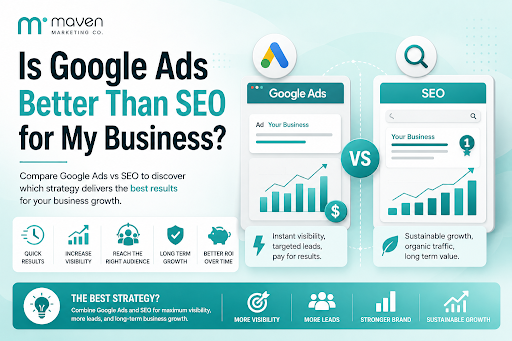
Is Google Ads Better Than SEO for My Business
One of the biggest questions business owners ask when they are planning online growth is whether they should invest in Google Ads or SEO. Both are strong marketing plays that help your company show up in Google search results, but they do things in separate lanes. Google Ads gives quicker visibility and can bring in leads fast, whereas SEO more or less focuses on slow, steady organic traffic that tends to grow the longer you keep building it. Picking the right direction depends on what you want to achieve, how much money you can spend, how crowded the market is, and how quickly you need results, like sooner rather than later. The good news is you don’t always have to choose one or the other; it’s not exactly a black-and-white situation. If you take time to understand the strongest points of both, you can put together a more sensible digital marketing plan that supports consistent expansion. In this guide, we’ll compare Google Ads vs SEO, explain the main differences, and help you figure out what option makes the most sense for your business.

When Should I Hire a Digital Marketing Agency
Growing a business today takes more than just having a website or throwing a post on social media; customers usually search around online, compare providers, skim reviews, and basically expect the brand to show up with a solid digital presence before they even think about buying. Many businesses try to run their marketing themselves, but there comes a point when “doing it all in-house” becomes clunky and hard to manage, all at once. Knowing when to hire a digital marketing agency can end up making a big, real difference for your growth. If you’re not getting enough leads, or your online visibility feels stuck, or sales are just not moving, the right agency can bring the know-how, plus a clear plan, to help you get noticeably better outcomes. In this guide, we’ll dig into what a digital marketing agency actually does, the usual signs it’s time to bring one on, and how picking the right marketing partner can help your business move forward at a faster pace.

Why Is My Google Ads Budget Running Out So Quickly
Running a successful Google Ads budget isn’t only about throwing more money at it. It’s more like making every dollar, doing a bit extra. A lot of businesses start a Google Ads campaign with big hopes, then find out their daily budget is gone within a few hours, and that feels weird, right? After that, your ads stop showing effectively, new leads slip away, and your return on investment dips. So if your Google Ads budget is running out too fast, don’t stress. It’s a fairly common issue, and in most situations, it can be repaired with the right approach. There are multiple little things that can drain your advertising money quicker than you expected, from costly keywords to audience targeting that just doesn’t quite fit. In this guide, we’ll walk through why your budget disappears so quickly, how to cut wasteful spend, and the most reliable ways to boost your Google Ads ROI, even if your budget stays the same.


