.svg)


%201.svg)
Your link building strategy is obsolete, and you probably don't even know it yet.
According to comprehensive industry research, 95% of SEO professionals in 2025 still rank backlinks as critical or very important, yet 72% note that focus has definitively shifted to quality, relevance, and authority over sheer quantity. That gap between perception and reality? It's costing Australian businesses rankings, traffic, and revenue while they execute link building tactics that stopped working two years ago.
Here's the uncomfortable truth. Traditional backlinks haven't died. They've evolved beyond recognition. Google's algorithms no longer simply count links from high domain authority sites. They evaluate the Experience, Expertise, Authoritativeness, and Trustworthiness signals those links represent.
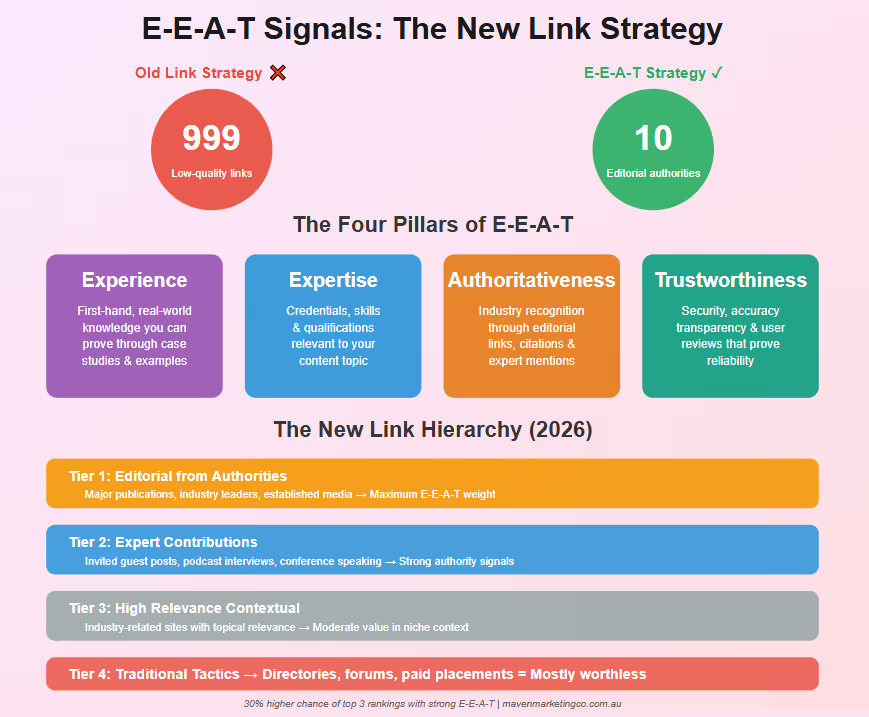
According to 2024 SEMrush research, pages with strong E-E-A-T signals saw 30% higher chance of ranking in top three positions compared to those with weak signals. Meanwhile, businesses stuffing link profiles with mediocre guest posts and directory submissions wonder why rankings declined despite stable or growing backlink counts.
For Australian businesses, this represents the most significant shift in link strategy since Penguin penalized manipulative schemes in 2012. The tactics building your rankings through 2023 are actively harming them in 2026. Understanding how E-E-A-T reshapes link value isn't optional anymore. It's the difference between sustainable authority and algorithmic irrelevance.
What E-E-A-T Actually Means (And Why It Matters More Than Links)
E-E-A-T represents Experience, Expertise, Authoritativeness, and Trustworthiness. Google's Search Quality Rater Guidelines define these as core principles raters use to assess whether search results provide helpful, relevant information to users.
Experience demonstrates first hand, real world knowledge of the subject matter. An article about kitchen renovations written by someone who actually completed renovations carries more weight than one written by someone who only researched online. Google's algorithms look for signals proving the author genuinely experienced what they're discussing.
Expertise refers to knowledge, skills, and credentials relevant to the content topic. A medical article reviewed by a doctor demonstrates expertise. Tax advice from a certified accountant shows expertise. The level required varies by topic, but Google evaluates whether content creators possess appropriate knowledge for their subject matter.
Authoritativeness measures reputation and recognition within your industry or niche. Authority is established through backlinks from reputable websites, mentions in trusted publications, citations in academic papers, and recognition from acknowledged experts. This is where traditional link building intersects with E-E-A-T, but the type and source of links matter exponentially more than volume.
Trustworthiness underpins all other elements. Without trust, experience, expertise, and authority lose impact. Google evaluates trustworthiness through technical security measures like HTTPS, transparency in information presentation, accuracy of content, and signals like clear author bios, citations, fact checked data, and positive user reviews.
Here's why this matters for Australian businesses specifically. Google doesn't provide official E-E-A-T scores, but research has identified over 80 actionable signals Google evaluates to determine quality, trust, and authority across document, domain, and entity levels. Your link building strategy must address these signals, not just accumulate links.

How AI Content Made E-E-A-T Critical
AI generated content flooding the internet forced Google's hand. When anyone can produce 100 articles daily using ChatGPT, traditional ranking factors like keyword optimization and basic backlinks become insufficient quality filters.
In 2025, several factors made E-E-A-T even more important. With AI generated content overwhelming the internet, Google doubled down on identifying content demonstrating genuine human experience and expertise. Growing public concern about misinformation pushed Google to prioritize trustworthy sources, especially for Your Money Your Life topics like health, finance, law, and safety.
Today's users are more discerning, expecting content offering genuine insights rather than rehashed information. As more websites optimize technical SEO elements, E-E-A-T became a key differentiator for ranking success.
For Australian businesses, this means your content must prove it wasn't generated by AI, written by someone with no actual knowledge, or created purely for SEO manipulation. Traditional backlinks from mediocre sites don't prove any of this. E-E-A-T signals do.
The New Link Hierarchy: What Actually Carries Weight in 2026
Not all backlinks carry equal weight anymore. In fact, most carry almost no weight at all. Google's sophisticated algorithms now evaluate links through E-E-A-T lenses, creating a clear hierarchy of link value.
Tier 1: Editorial Links from Established Authorities: Links naturally incorporated within relevant content on recognized authoritative publications. A single editorial link from a trusted industry source now outweighs dozens of manipulative, low quality links that might have moved the needle a decade ago.
These links demonstrate genuine authority recognition. When The Australian, major industry publications, or established sector specific media outlets link to your content editorially, they're vouching for your expertise and trustworthiness. Google's algorithms recognize this endorsement carries exponentially more weight than ten directory links.
Tier 2: Expert Contributions and Collaborations: Guest posts on genuinely authoritative sites where you're invited because of your expertise, not because you paid or pitched. Expert roundups featuring recognized industry leaders. Podcast interviews on established shows. Speaking engagements at industry conferences generating links from event pages.
These placements signal that recognized experts and platforms view you as peer level authority worth featuring. The E-E-A-T signal is clear: you possess expertise others recognize and want to share with their audiences.

Tier 3: High Relevance Contextual Links: Links from sites directly related to your industry, even if not massive authority sites, placed within genuinely relevant content. The page or source must fit the context and offer more information on the topic. A link to a dental practice from a health publication carries far more value than one from general directory or unrelated business.
Relevance has become perhaps the most critical factor when evaluating backlinks in 2026. Contextual linking within topically related content demonstrates your authority within specific subject areas, not just general web presence.
Tier 4: Everything Else (Mostly Worthless): Directory links, forum signatures, blog comment links, low quality guest posts on sites accepting anyone, paid links without proper disclosure, reciprocal link exchanges for SEO purposes, sidebar and footer links existing purely for link value.
These traditional tactics Australian businesses still waste money on provide minimal to zero E-E-A-T signals. They don't demonstrate experience, prove expertise, establish authority, or build trust. Google's algorithms increasingly ignore them or actively discount them as manipulation attempts.
Building E-E-A-T Through Strategic Link Acquisition
The businesses dominating Australian search in 2026 approach link building completely differently than those stuck in 2020 strategies. They build links as natural byproducts of demonstrated expertise rather than as isolated SEO tactics.
Create Original Research and Data: Articles featuring original research receive 2.3 times more backlinks than standard content, signalling their value to both users and Google. Conduct industry surveys. Analyse market trends using proprietary data. Generate statistics journalists and industry publications want to cite.
When you become the primary source for new information, media outlets naturally link to you. These editorial links from news sites and industry publications carry maximum E-E-A-T weight because they demonstrate recognized expertise others reference as authoritative.
Develop Comprehensive Authority Resources: Create definitive guides, frameworks, and resources that genuinely help your audience. Comprehensive whitepapers, detailed how to guides with real world examples, case studies documenting actual results, and tools or calculators providing unique value.
These linkable assets attract backlinks naturally because they're genuinely useful. But more importantly, they demonstrate expertise and experience, strengthening E-E-A-T signals beyond the links themselves.
Build Visible Expertise Through Media: Seek opportunities where your expertise gets recognized publicly. HARO responses connecting you with journalists seeking expert sources. Podcast interviews on established shows in your industry. Speaking engagements at conferences generating links from event pages. Expert commentary in news articles about industry trends.
These placements build authoritativeness by demonstrating other recognized authorities view you as expert peer. The links matter, but the public recognition of expertise matters more for E-E-A-T evaluation.
Establish Author Authority: Transparent author profiles with credentials, LinkedIn links, and verified expertise strengthen content credibility. Include detailed author boxes showing qualifications, experience, and expertise signals. Build author entity recognition through consistent bylines across publications.
Google's algorithms increasingly evaluate content at author level, not just domain level. An article by recognized expert on mediocre site can outrank generic content on high authority site if author E-E-A-T signals are stronger.
The Technical E-E-A-T Signals Australian Businesses Miss
Beyond backlinks, technical signals communicate E-E-A-T to search algorithms. Most Australian businesses implementing these signals see ranking improvements without building single new link.
Implement Comprehensive Schema Markup: Use Organization schema defining your business entity, author identity, and relationships. Article schema including author, publication date, and modification date. Review schema enabling star ratings display. FAQPage schema for structured question answers.
Schema markup explicitly tells Google about your expertise and authority rather than forcing algorithms to infer these signals from unstructured content.
Optimize About and Author Pages: Create detailed About pages explaining your business, team, qualifications, and track record. Author bio pages for every content contributor showing credentials, experience, expertise, and contact information. Clear explanations of your methodologies and quality processes.
These transparency signals build trustworthiness by demonstrating you have nothing to hide and real qualifications backing your content.
Display Trust Signals Prominently: Customer reviews and testimonials with specific details. Industry certifications and awards. Security badges and payment processing certifications. Clear privacy policies and terms of service. Professional design and error free user experience.
These elements signal reliability to both users and search engines, strengthening trustworthiness evaluation.
Maintain Content Accuracy and Freshness: Regular content audits ensuring information remains current. Clear publication and update dates. Citations to authoritative sources. Corrections posted prominently when errors discovered.
Trustworthiness requires ongoing maintenance, not one time optimization. Outdated incorrect content destroys trust regardless of link profile strength.

Measuring E-E-A-T Success Beyond Link Metrics
Traditional link building metrics like domain rating and raw backlink count tell incomplete stories for E-E-A-T evaluation. Track these signals revealing true authority building progress.
Brand Mention Volume: Monitor unlinked brand mentions across news, social media, forums, and industry publications. These mentions demonstrate authority recognition even without formal backlinks. Tools like Brand24, Mention, or Google Alerts track brand visibility.
Author Entity Recognition: Search for content authors by name. Do they appear in knowledge panels? Do other authoritative sites mention them as experts? Growing author recognition strengthens content E-E-A-T regardless of where it's published.
Featured Snippet and Knowledge Panel Ownership: Track how often your content or brand appears in featured snippets, knowledge panels, and People Also Ask sections. These placements represent Google's highest confidence in your authority.
Editorial Link Ratio: Calculate what percentage of backlinks come from genuine editorial placements versus directories, reciprocal exchanges, or low quality guest posts. Growing editorial percentage indicates strengthening E-E-A-T signals.
YMYL Content Performance: If you create Your Money Your Life content, monitor rankings specifically for these sensitive topics. YMYL rankings require strongest E-E-A-T signals, making them sensitive indicators of authority strength.
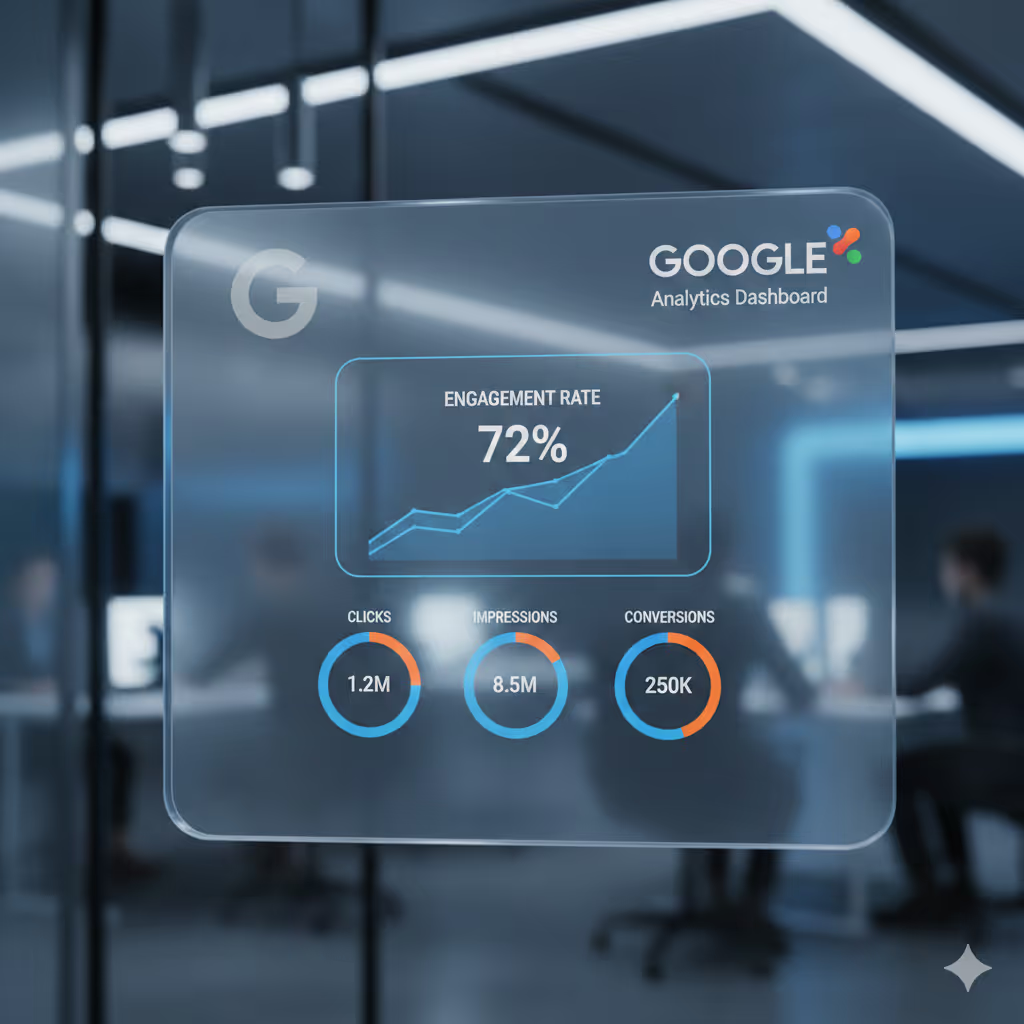
User Engagement Signals: Time on page, pages per session, and return visitor rates reveal whether content satisfies user intent. Google evaluates these engagement metrics as trust signals confirming content quality.
The Australian E-E-A-T Opportunity
Most Australian businesses haven't adapted link strategies to E-E-A-T realities. They're still chasing quantity over quality, paying for mediocre guest posts, and wondering why rankings stagnate despite growing backlink counts.
This creates massive opportunity for businesses understanding the shift. While competitors waste budgets on worthless links, you build genuine authority through demonstrated expertise. While they stuff portfolios with directory links, you earn editorial placements from recognized publications.
Australian markets present unique E-E-A-T advantages. Local expert positioning in smaller markets is easier than competing globally. Australian specific credentials, qualifications, and recognition carry weight in local search algorithms that international competitors can't replicate.
The businesses dominating Australian search in 2026 won't be those with most backlinks. They'll be those with strongest E-E-A-T signals proving genuine expertise, earning authoritative recognition, and building measurable trust.
The Bottom Line
Traditional backlinks aren't dead, but your approach to building them probably should be. Accumulating links from mediocre sources hoping domain authority translates to rankings represents obsolete thinking in algorithms evaluating E-E-A-T.
The best backlinks aren't built, they're earned through undeniable value. They come from recognized authorities vouching for your expertise. They demonstrate experience others want to reference. They signal trust users and algorithms both recognize.
For Australian businesses, adapting to E-E-A-T driven link strategy means completely rethinking how you build authority. Stop chasing link counts. Start building recognized expertise. Stop buying guest post placements. Start earning editorial mentions. Stop focusing on domain authority. Start demonstrating genuine trustworthiness.
Your competitors are either figuring this out or watching rankings decline despite stable link metrics. The gap between businesses building E-E-A-T signals and those accumulating worthless links isn't closing. It's widening monthly as algorithms become more sophisticated.
Which side will your Australian business choose? The one building sustainable authority through proven expertise, or the one wondering why link building stopped delivering results?
Build Authority That Actually Ranks
Stop wasting budget on links that don't move rankings. At Maven Marketing Co., we help Australian businesses build E-E-A-T driven authority through strategic content, genuine expertise demonstration, and editorial relationship building that algorithms actually reward.
Our approach combines original research development, expert positioning strategies, authoritative media placement, comprehensive technical optimization, and E-E-A-T signal tracking ensuring your authority building delivers measurable ranking improvements.
We don't sell directory links or mediocre guest posts. We build recognized expertise, earn editorial placements, and establish genuine authority search algorithms trust in 2026.
Contact Maven Marketing Co. today for an E-E-A-T authority audit revealing exactly how your current signals measure up, which expertise demonstrations would strengthen your position, and the strategic roadmap building authority that actually ranks in 2026's E-E-A-T driven algorithms.

Table of contents
read more blogs
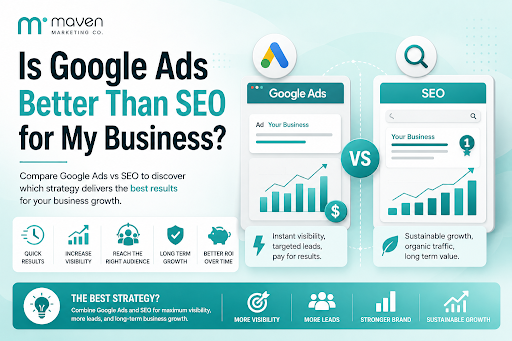
Is Google Ads Better Than SEO for My Business
One of the biggest questions business owners ask when they are planning online growth is whether they should invest in Google Ads or SEO. Both are strong marketing plays that help your company show up in Google search results, but they do things in separate lanes. Google Ads gives quicker visibility and can bring in leads fast, whereas SEO more or less focuses on slow, steady organic traffic that tends to grow the longer you keep building it. Picking the right direction depends on what you want to achieve, how much money you can spend, how crowded the market is, and how quickly you need results, like sooner rather than later. The good news is you don’t always have to choose one or the other; it’s not exactly a black-and-white situation. If you take time to understand the strongest points of both, you can put together a more sensible digital marketing plan that supports consistent expansion. In this guide, we’ll compare Google Ads vs SEO, explain the main differences, and help you figure out what option makes the most sense for your business.

When Should I Hire a Digital Marketing Agency
Growing a business today takes more than just having a website or throwing a post on social media; customers usually search around online, compare providers, skim reviews, and basically expect the brand to show up with a solid digital presence before they even think about buying. Many businesses try to run their marketing themselves, but there comes a point when “doing it all in-house” becomes clunky and hard to manage, all at once. Knowing when to hire a digital marketing agency can end up making a big, real difference for your growth. If you’re not getting enough leads, or your online visibility feels stuck, or sales are just not moving, the right agency can bring the know-how, plus a clear plan, to help you get noticeably better outcomes. In this guide, we’ll dig into what a digital marketing agency actually does, the usual signs it’s time to bring one on, and how picking the right marketing partner can help your business move forward at a faster pace.
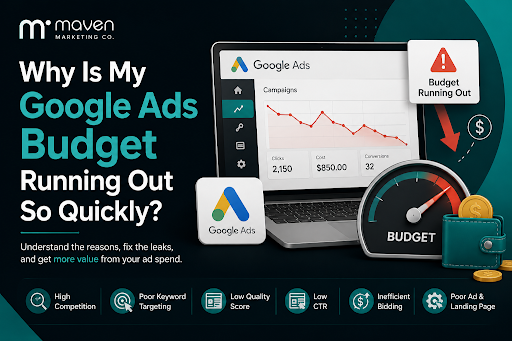
Why Is My Google Ads Budget Running Out So Quickly
Running a successful Google Ads budget isn’t only about throwing more money at it. It’s more like making every dollar, doing a bit extra. A lot of businesses start a Google Ads campaign with big hopes, then find out their daily budget is gone within a few hours, and that feels weird, right? After that, your ads stop showing effectively, new leads slip away, and your return on investment dips. So if your Google Ads budget is running out too fast, don’t stress. It’s a fairly common issue, and in most situations, it can be repaired with the right approach. There are multiple little things that can drain your advertising money quicker than you expected, from costly keywords to audience targeting that just doesn’t quite fit. In this guide, we’ll walk through why your budget disappears so quickly, how to cut wasteful spend, and the most reliable ways to boost your Google Ads ROI, even if your budget stays the same.