.svg)


%201.svg)
Key Takeaways
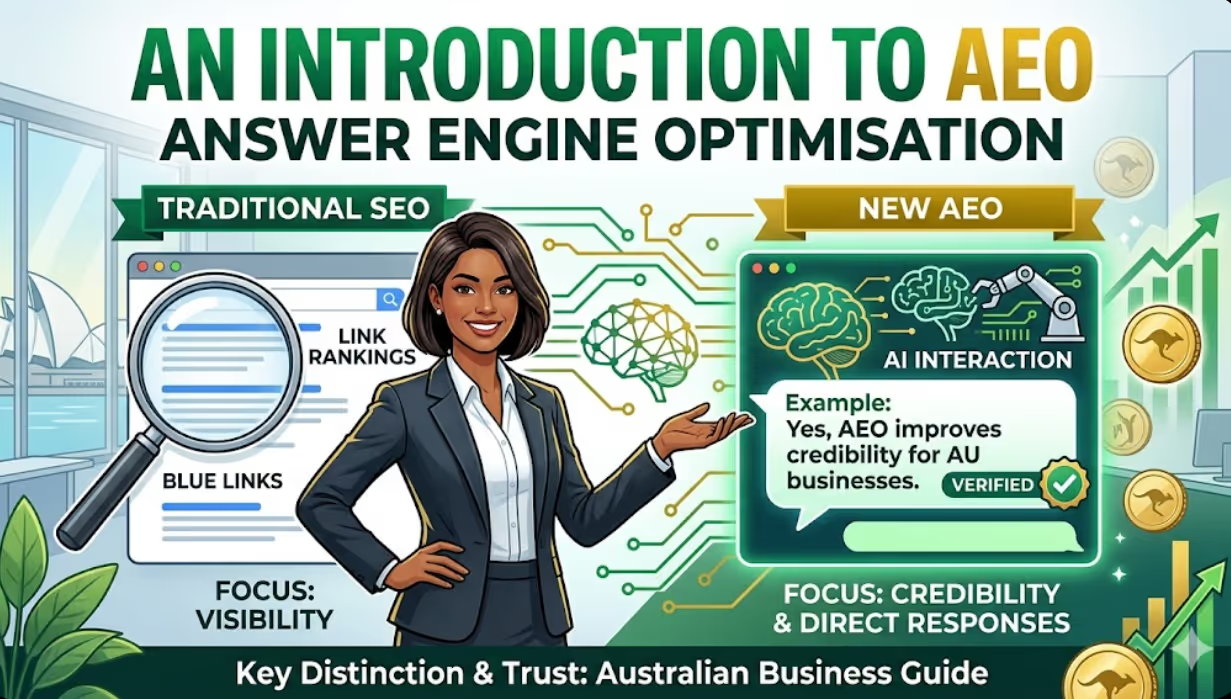
- Answer engine optimisation (AEO) is the practice of structuring content, credibility signals, and business information specifically to appear in AI-generated answers rather than only in traditional search results. It is a distinct but closely related discipline to traditional SEO.
- ChatGPT cites sources when it has web access and when the information it retrieves is clearly attributable to a specific authoritative source. The format of the content and the authority of the source page both influence whether a citation appears.
- Gemini draws heavily from sources already established as credible within Google's ecosystem, including websites that are well indexed with structured data, Google Business Profiles, Google reviews, and content that has earned editorial links. Strong Google presence is a prerequisite for Gemini citation.
- Google AI Summaries (formerly AI Overviews) are most likely to cite sources with specific, direct answers to the query, structured data that helps the system identify the content accurately, and strong topical authority signals from existing organic rankings.
- The content format most likely to be cited by AI answer engines is structured, specific, and direct: clear headings that match common question phrasing, factual statements that can be excerpted without distortion, and a writing style that answers the question before elaborating on the context.
- Schema markup, particularly FAQ, HowTo, Article, and LocalBusiness schema, is one of the most direct technical signals that an answer engine can use to identify content as relevant to a specific type of query. Businesses without schema markup are harder for answer engines to classify and cite accurately.
- AI citation is a credibility cascade: the businesses most likely to be cited are those already cited by other credible sources, because AI systems treat citation from a third party as a signal that the information is reliable enough to pass on.
Understanding How Each Platform Selects Sources
The mechanics of how each major AI platform selects the sources it draws from and cites differ in important ways that require tailored optimisation approaches.
ChatGPT
ChatGPT in its base form (without web access) draws on its training data and has no citation mechanism. ChatGPT with web browsing, available in paid tiers, actively retrieves web content at query time and cites the sources it draws from. The retrieval mechanism is similar to a search: it finds pages that are relevant to the query, extracts information from them, and attributes the information in the response.
For an Australian business to be cited by ChatGPT with web access, the relevant pages must be indexable by web crawlers (ChatGPT uses its own crawler, GPTBot, to retrieve content), the content must directly and clearly answer the type of question the user is asking, and the source page must have enough authority signals for ChatGPT's system to treat it as a reliable source rather than passing it over in favour of higher-authority alternatives.
Key implication: Blocking GPTBot in the robots.txt file (which some sites do inadvertently when blocking other bots) prevents ChatGPT from retrieving and citing the site's content. For businesses that want ChatGPT citation, GPTBot should be allowed in the robots.txt configuration.
Gemini
Google's Gemini draws primarily from Google's own ecosystem and index. For Australian businesses, this means that the signals that produce Gemini citations are substantially the same signals that produce strong Google Search rankings, but with additional weight on specific content formats, structured data implementation, and the business's Google presence more broadly.
Gemini is particularly attentive to content that is well structured and factually specific, and supported by corroborating signals from the broader web (links from credible sources, mentions in credible publications, and positive review signals from Google's own review system). A business that ranks well in Google Search for relevant queries and has a fully optimised Google Business Profile is significantly better positioned for Gemini citation than one that does not.
Key implication: For Australian businesses, Gemini optimisation is largely an extension of existing Google Search optimisation: strong content on the page itself, complete structured data, a Google Business Profile that is well maintained, and earned links from credible Australian sources.
Google AI Summaries
Google AI Summaries (previously branded as AI Overviews) appear at the top of search results for a growing range of queries, particularly informational queries where Google's system determines that a synthesised answer is more useful than a list of links. They draw from pages in Google's index that are relevant to the query, giving weight to pages with high topical authority, specific and direct answers, and structured data that helps the system identify the content type accurately.
The sources cited in AI Summaries are typically the same authoritative pages that appear in the organic results for the same query, but the content selection within those pages is driven by how directly and specifically the content answers the exact question. A page that ranks second in organic results but has a clearly phrased, directly answer-structured section is more likely to be cited in the AI Summary than the page ranking first whose content is excellent but written in a less extractable format.
Key implication: AI Summaries favour directly phrased, structured answers. Content written in a conversational question and answer structure, with clear subheadings that echo common query phrasing and factual paragraphs that answer questions without requiring the reader to infer the answer from context, is more extractable and therefore more likely to be cited.
The Content Structure That Gets Cited
Across all three platforms, the content format most likely to be cited shares a set of structural characteristics that distinguish it from content written for human reading alone.
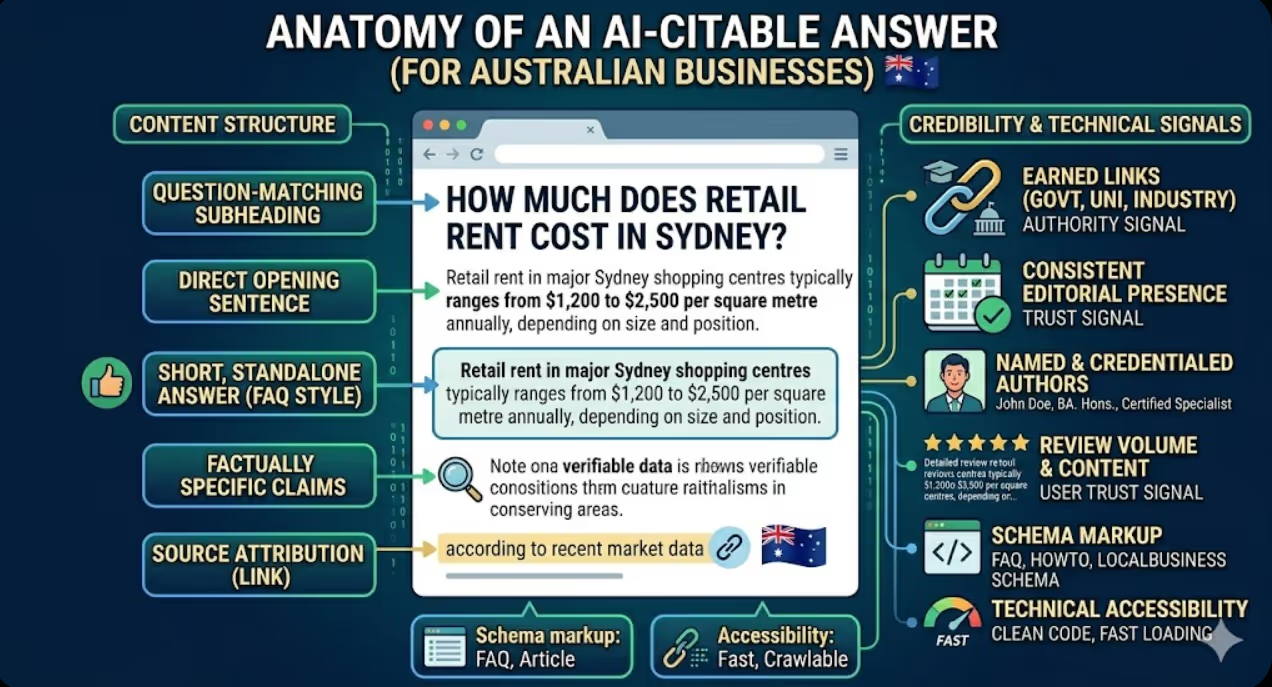
Direct opening sentences. The first sentence of a section or paragraph should state the main point directly, without preamble. "Small Australian businesses typically pay between $50 and $150 per month for accounting software hosted in the cloud" is a citable opening sentence. "When it comes to the complex landscape of accounting software options available in Australia, there are many factors to consider" is not, because it cannot be excerpted as a useful answer without the context that follows.
Question-matching subheadings. Subheadings that mirror the phrasing of common queries ("How much does commercial cleaning cost in Sydney?" "What is the difference between a financial adviser and a financial planner?") help AI systems identify which section of the content is relevant to which specific query. This does not mean writing content that is robotically structured around search queries. It means structuring the content so that a person reading the heading understands exactly what the section answers, which also happens to be the format AI systems can most reliably use.
Factually specific claims. AI systems prefer content with specific, verifiable claims over content with vague generalisations. "Companies that complete onboarding within 7 days have a 40 percent higher 90-day retention rate" is more citable than "Companies that onboard new customers quickly tend to retain them at a higher rate." The specific, evidenced claim is excerptable. The generalisation is not.
Attribution of sources. Content that cites the sources for its specific claims is more trustworthy to AI systems because the cited claims can be verified. A page that states a statistic and links to the original research is more reliable than a page that states the same statistic without attribution. AI systems that are designed to produce accurate, reliable information give weight to content that demonstrates its own reliability through appropriate sourcing.
Short, complete answers to specific questions. AI summary systems extract short excerpts from longer pages. The most citable format is one where a specific question is answered in two to four sentences that stand alone as a complete, accurate response. The reader does not need to read the surrounding context to understand the answer. This format is also the format of a good FAQ: a question, then a standalone answer that stands on its own.
The Technical Requirements for AI Citation
Beyond content structure, several technical elements of the website and its configuration directly affect whether AI systems can identify, retrieve, and cite the content accurately.
Schema markup. The most important schema types for AI citation are FAQ (for content in question and answer format that directly answers common queries), HowTo (for instructional content), Article (for editorial and adjacent editorial content), LocalBusiness (for business identification and location information), and Service or Product schema for businesses with specific service or product offerings. Schema markup tells AI systems what type of content they are reading and what specific attributes it contains, making accurate extraction and citation significantly more reliable.
Robots.txt and crawler access. Ensure that the website's robots.txt file does not inadvertently block the crawlers used by major AI platforms. ChatGPT uses GPTBot. Google's Gemini and AI Summaries use Googlebot and associated crawlers. Perplexity uses PerplexityBot. Reviewing the robots.txt file to confirm that none of these crawlers are blocked is a straightforward but often overlooked technical step.
Page load speed and accessibility. Pages that load slowly or that present content in formats difficult for crawlers to parse (content rendered by JavaScript that is not rendered before being sent from the server, content inside iframes, or content requiring user interaction to reveal) are harder for AI crawlers to retrieve and cite reliably. A fast, cleanly coded page with content rendered before delivery is significantly more accessible to crawlers than a complex JavaScript application that renders dynamically at query time.
Canonical URLs and duplicate content. AI systems that encounter multiple versions of the same content across different URLs will attribute the content to the canonical URL. Ensuring canonical tags are correctly configured prevents citation authority from being split across duplicate pages.
Building the Credibility Signals AI Systems Trust
Content quality and technical accessibility are necessary but not sufficient for consistent AI citation. The credibility signals that AI systems use to decide whose information is reliable enough to cite are built through sustained effort over time.
Earned links from authoritative Australian sources. A link from a university, a government agency, an industry association, a major news publication, or a trade publication with strong standing is a strong credibility signal that AI systems weight heavily. These links are harder to earn than directory listings but produce disproportionate citation impact.
Consistent editorial presence. Regular publication of content that is well researched, specific, and attributed demonstrates topical expertise over time. AI systems that repeatedly encounter a website as a credible source for a specific topic category develop a stronger association between that source and that topic, which improves citation probability for new queries in the same category.
Review volume and content on credible platforms. Google reviews, Trustpilot reviews, and platform-specific reviews (for software businesses: G2, Capterra; for hospitality: TripAdvisor) contribute to the overall credibility portrait that AI systems build for a business. Review content that uses the same language the business uses to describe its services helps AI systems understand and accurately represent what the business does.
Named authorship and author credentials. Content attributed to named authors with demonstrable expertise (a lawyer writing about legal topics, an accountant writing about financial topics, a certified specialist writing in their area of certification) carries more credibility weight than anonymous or generically attributed content. AI systems that are designed to assess expertise, authoritativeness, and trustworthiness treat named, credentialed authorship as a positive indicator.
FAQs
Is there a way to submit a business directly to ChatGPT or Gemini to be included in their responses?There is no direct submission mechanism for either ChatGPT or Gemini comparable to Google's business listing submission. ChatGPT with web access discovers content through its crawler (GPTBot) and through the searches it conducts at query time. Gemini discovers content through Google's existing index. The path to appearing in both is producing content that these systems retrieve when relevant queries are asked, having the credibility signals that cause these systems to treat the content as reliable, and ensuring the technical configuration of the site allows these systems to access and parse the content. The closest thing to a direct submission path is ensuring the Google Business Profile is complete and verified (which feeds into Gemini's knowledge of the business) and ensuring GPTBot is not blocked (which enables ChatGPT to retrieve the site's content).
How should Australian businesses approach writing content specifically for AI citation without making the content feel robotic or written to stuff in keywords for human readers??The content formats that AI systems prefer are also the content formats that are genuinely most readable and useful for human audiences: direct answers, clear structure, specific claims, and attributed sources. The only risk of writing for AI citation producing robotic content is when the writer places too much emphasis on subheadings matched to query phrasing at the expense of natural prose flow, or when every paragraph is structured as a bare answer without any of the explanation or context that makes the content genuinely informative. The correct approach is to write content that is genuinely excellent for a human reader who wants a direct, specific, and properly sourced answer to their question, and to structure that content with clear subheadings and answer paragraphs that stand alone. This format serves both audiences simultaneously, because both audiences have the same underlying need: a direct, accurate, useful answer to a specific question.
How can an Australian business measure whether its content is being cited by AI tools?Direct measurement is difficult because AI tools do not report citation statistics the way Google Search Console reports organic impressions and clicks. The most practical monitoring approach for Australian businesses is to conduct regular manual tests: ask the major AI platforms (ChatGPT, Gemini, Perplexity) the questions most relevant to the business's category and record which sources are cited over time. Third-party tools including Profound, Otterly, and Share of Voice AI trackers are emerging specifically to monitor AI citation rates across platforms, and some established SEO platforms are adding AI citation monitoring features. For Google AI Summaries specifically, Google Search Console's Performance report shows whether the site's pages are receiving impressions from AI Overviews queries, providing the most direct measurement of AI Summary citation impact available through first-party data.
The Businesses Cited in AI Answers Are Becoming the Businesses People Trust Most
In the traditional search model, appearing on the first page of results is the threshold for commercial relevance. In the answer engine model, being cited as a source in the generated answer is the new threshold. A business cited in a ChatGPT response, a Gemini summary, or a Google AI Summary is being presented to the user as a credible, expert source rather than simply as one of many results to evaluate. The authority transfer from citation in an AI answer is arguably stronger than from a search result click, because the AI system is implicitly endorsing the source by using it. Australian businesses that build the content quality, credibility signals, and technical foundations described in this article will be positioned to capture that endorsement as answer engine usage continues to grow.
Maven Marketing Co develops answer engine optimisation strategies for Australian businesses, including content restructuring for AI citation, schema markup implementation, crawler access auditing, and credibility signal development programmes.
Talk to the team at Maven Marketing Co →

Table of contents
read more blogs
Is Google Ads Better Than SEO for My Business
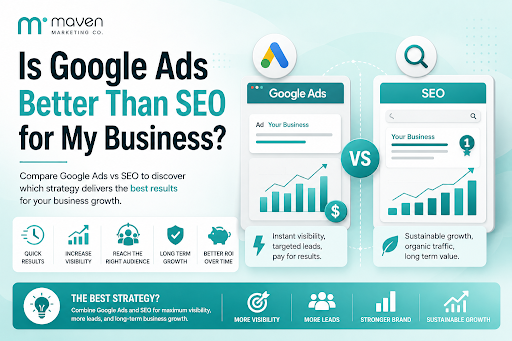
One of the biggest questions business owners ask when they are planning online growth is whether they should invest in Google Ads or SEO. Both are strong marketing plays that help your company show up in Google search results, but they do things in separate lanes. Google Ads gives quicker visibility and can bring in leads fast, whereas SEO more or less focuses on slow, steady organic traffic that tends to grow the longer you keep building it. Picking the right direction depends on what you want to achieve, how much money you can spend, how crowded the market is, and how quickly you need results, like sooner rather than later. The good news is you don’t always have to choose one or the other; it’s not exactly a black-and-white situation. If you take time to understand the strongest points of both, you can put together a more sensible digital marketing plan that supports consistent expansion. In this guide, we’ll compare Google Ads vs SEO, explain the main differences, and help you figure out what option makes the most sense for your business.

When Should I Hire a Digital Marketing Agency
Growing a business today takes more than just having a website or throwing a post on social media; customers usually search around online, compare providers, skim reviews, and basically expect the brand to show up with a solid digital presence before they even think about buying. Many businesses try to run their marketing themselves, but there comes a point when “doing it all in-house” becomes clunky and hard to manage, all at once. Knowing when to hire a digital marketing agency can end up making a big, real difference for your growth. If you’re not getting enough leads, or your online visibility feels stuck, or sales are just not moving, the right agency can bring the know-how, plus a clear plan, to help you get noticeably better outcomes. In this guide, we’ll dig into what a digital marketing agency actually does, the usual signs it’s time to bring one on, and how picking the right marketing partner can help your business move forward at a faster pace.
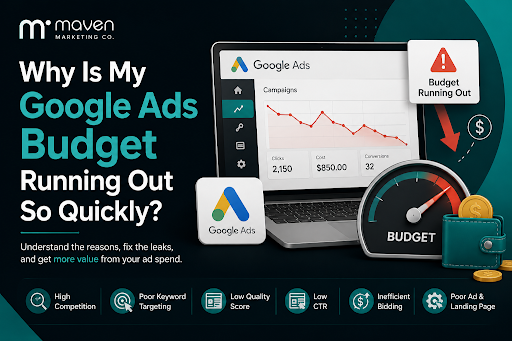
Why Is My Google Ads Budget Running Out So Quickly
Running a successful Google Ads budget isn’t only about throwing more money at it. It’s more like making every dollar, doing a bit extra. A lot of businesses start a Google Ads campaign with big hopes, then find out their daily budget is gone within a few hours, and that feels weird, right? After that, your ads stop showing effectively, new leads slip away, and your return on investment dips. So if your Google Ads budget is running out too fast, don’t stress. It’s a fairly common issue, and in most situations, it can be repaired with the right approach. There are multiple little things that can drain your advertising money quicker than you expected, from costly keywords to audience targeting that just doesn’t quite fit. In this guide, we’ll walk through why your budget disappears so quickly, how to cut wasteful spend, and the most reliable ways to boost your Google Ads ROI, even if your budget stays the same.