.svg)


%201.svg)

Quick Answers
What is the AI Doom Index and what does it measure?
The AI Doom Index is a measurement framework tracking public anxiety about artificial intelligence across five critical categories: Control and Regulation concerns about whether AI development is properly governed, Data and Privacy fears regarding personal information protection, Bias and Ethics worries about fairness and discrimination, Misinformation and Trust issues around AI-generated content reliability, and Job Displacement anxiety about employment security. Research conducted throughout 2025 shows Control and Regulation topped anxiety categories with an average relative interest of 27, followed closely by Data and Privacy at 26. The index uses search behaviour as a proxy for collective sentiment, revealing that whilst AI anxiety has intensified, it reflects growing sophistication rather than blind panic. People are not rejecting AI outright. They are demanding responsible implementation.
Why has AI anxiety increased whilst AI optimism has also grown?
This apparent paradox reflects the nuanced reality of technological transformation. AI anxiety among Americans quadrupled between 2023 and 2024 as people gained direct experience with AI tools and recognised legitimate risks including job displacement, privacy concerns, and potential misuse. Simultaneously, global AI optimism increased from 50% in 2022 to 57% in 2024 because that same hands-on experience demonstrated practical benefits. People using AI for email drafting, research assistance, and productivity enhancement see tangible value. The coexistence of anxiety and optimism is psychologically healthy. It indicates populations are neither blindly adopting nor reflexively rejecting AI, but instead thoughtfully evaluating both benefits and risks. For Australian businesses, this means successful AI implementation requires acknowledging legitimate concerns whilst demonstrating concrete value, not choosing between pessimism and optimism but addressing both simultaneously.
Your finance team just asked whether AI will replace their jobs. Your marketing director wonders if AI-generated content is trustworthy. Your operations manager questions whether AI systems make fair decisions.
These are not hypothetical anxieties. These are the questions Australian business leaders field daily as artificial intelligence reshapes every industry simultaneously.
The data reveals something fascinating. Humanity is experiencing both surging anxiety and growing optimism about AI at the exact same time. This is not confusion. This is the natural psychological response to genuinely transformative technology.

The Numbers Tell a Paradoxical Story
AI anxiety in America has exploded. The percentage of consumers worried about AI quadrupled between August 2023 and July 2024. That is not gradual concern building over years. That is rapid escalation within twelve months.
Yet simultaneously, global excitement about AI potential now exceeds concerns at 57% versus 43%, up from an even 50-50 split previously. The shift represents millions of people moving from ambivalence to cautious optimism.
Even more striking, global AI usage jumped ten percentage points to reach 48% of the population. People are not just talking about AI. They are actively using it despite their anxieties.
Australian sentiment mirrors global patterns whilst exhibiting unique characteristics. Australians rank among the more anxious populations globally, sharing concern levels with Americans and Italians, whilst populations in South Korea and India demonstrate significantly greater optimism.
Unpacking the Five Pillars of AI Anxiety
The Cybernews AI Anxiety Index, which tracked American search behaviour throughout 2025, reveals which specific AI concerns dominate public consciousness.
Control and Regulation Anxiety
Control and Regulation emerged as the top anxiety category with an average relative interest of 27, encompassing searches for terms like "is ai legal", "ai regulations", and "ai laws". This reflects growing awareness that Australia, like the United States, lacks comprehensive federal AI regulation comparable to the EU AI Act.
The regulatory vacuum creates genuine uncertainty for businesses and consumers alike. What uses of AI are permissible? What responsibilities do companies have when deploying AI systems? What recourse exists when AI causes harm? These unanswered questions fuel anxiety that transcends simple technophobia.
For Australian businesses, this regulatory uncertainty cuts both ways. It provides flexibility to innovate without onerous compliance requirements. Simultaneously, it creates liability concerns and reputational risks when AI implementations go wrong without clear legal frameworks.
Data and Privacy Concerns
Data and Privacy ranked second with an average relative interest of 26, just narrowly behind Control and Regulation, covering searches like "ai privacy", "is ai private", and "ai and privacy". Australians are particularly sensitive to privacy given strong data protection consciousness and high-profile data breaches affecting major organisations.
AI systems require vast data to function effectively. That data often includes personal information, behavioural patterns, and sensitive business intelligence. The tension between AI capability requiring data access and privacy protection demanding data restriction creates inherent conflict that no amount of reassurance fully resolves.
Australian businesses deploying AI must navigate the Privacy Act whilst anticipating stronger regulations likely emerging as public concern intensifies. The organisations building trust now through transparent data practices and genuine privacy protection will hold competitive advantages as regulatory frameworks inevitably tighten.

Bias, Ethics, and Fairness Worries
AI bias is not theoretical. It is documented, measurable, and actively causing harm. Facial recognition systems that perform poorly on darker skin tones. Hiring algorithms that discriminate against women. Credit scoring models that perpetuate historical disadvantages.
These failures stem from training data reflecting existing societal biases, algorithmic design choices prioritising certain outcomes, and inadequate testing across diverse populations. The result is AI systems that automate and amplify discrimination whilst cloaking bias behind mathematical objectivity.
Australian workplaces face particular challenges given strong anti-discrimination legislation and cultural expectations around fairness. Deploying AI tools that demonstrably disadvantage protected groups creates legal liability and reputational damage that far exceeds any efficiency gains.
Misinformation and Trust Erosion
AI-generated deepfakes cost one multinational company $26 million in a single incident. That headline captures why misinformation anxiety ranks prominently in public consciousness.
When AI can convincingly impersonate voices, faces, and writing styles, how do we trust anything digital? When ChatGPT occasionally generates plausible-sounding falsehoods presented with confident authority, how do we verify information? When AI-powered bots flood social media with coordinated messaging, how do we distinguish genuine opinion from manufactured consensus?
These questions lack satisfying answers. The technology enabling misinformation advances faster than detection methods. Australian businesses relying on digital communication, online transactions, or social media presence must grapple with eroding baseline trust in digital information.

Job Displacement: The Existential Anxiety
Nothing drives AI anxiety quite like employment fears. The data shows the concern is widespread and intensifying.
Nearly half of current workers view AI as a threat to their jobs, with 61% considering upskilling or reskilling in response. Even amongst technology workers who presumably understand AI capabilities best, 70% agree their industry lacks sufficient AI expertise.
The psychological impact extends beyond those immediately threatened. Research demonstrates that feelings of uncertainty, lack of control, and cognitive overload triggered by continuous AI integration can facilitate anxiety development or intensify pre-existing symptoms. The technostress resulting from rapid AI implementation correlates with higher psychological tension and emotional instability.
Australian businesses face workforces experiencing genuine anxiety about employment security. Dismissing these concerns as irrational or advising employees to simply "adapt" ignores the legitimate disruption AI represents whilst damaging trust and morale.
The Optimism Counterbalance: Why People Still Embrace AI
Despite mounting anxieties, AI adoption continues accelerating because people experience tangible benefits that outweigh abstract fears.
The practical value is undeniable. AI helps draft emails, summarise documents, generate creative ideas, analyse data patterns, and automate repetitive tasks. These productivity gains save hours weekly for individual users and create competitive advantages for businesses deploying AI effectively.
Healthcare applications particularly drive optimism. Medical breakthroughs topped the list globally of important AI applications at 45%, followed by better security at 42%. When AI promises earlier cancer detection, personalised treatment plans, and drug discovery acceleration, people are willing to accept significant risks.
The optimism varies significantly by demographics and geography. Younger users, particularly Gen Z, demonstrate greater comfort with AI integration into daily life. Emerging economies show higher optimism than developed nations, possibly reflecting greater faith in technology solving development challenges.
Australian attitudes reflect developed-nation caution tempered by pragmatic recognition of AI benefits. The population is neither blindly embracing AI like some Asian markets nor reflexively rejecting it like the most anxious European populations. This measured approach creates opportunities for businesses communicating transparently about both benefits and limitations.
The Workplace Psychology: Bloomers, Gloomers, Zoomers, and Doomers
McKinsey research reveals that employee AI sentiment clusters into four distinct archetypes, each requiring different engagement approaches.
Bloomers represent 39% of employees. These AI optimists want to collaborate with their companies to create responsible AI solutions. They see potential, acknowledge risks, and seek involvement in implementation decisions. For Australian businesses, Bloomers are natural AI champions who can drive adoption when given appropriate support and agency.
Gloomers constitute 37% of the workforce. These sceptics want extensive top-down AI regulations before broad deployment. They are not opposed to AI fundamentally but demand guardrails protecting against potential harms. Importantly, 94% of Gloomers have some familiarity with AI tools, and approximately 80% say they are comfortable using AI at work despite their concerns.
Zoomers make up 20% of employees. They want AI deployed quickly with minimal regulatory constraints, prioritising speed and innovation over caution. These early adopters often frustrate compliance teams whilst pushing organisations toward competitive AI capabilities.
Doomers represent just 4% of workers. They hold fundamentally negative views about AI, though even amongst this group, 71% have some familiarity with AI tools and about half say they are comfortable using AI at work.
The distribution suggests Australian businesses face workforces that are neither uniformly enthusiastic nor uniformly resistant. The largest segments, Bloomers and Gloomers together comprising 76% of employees, want thoughtful AI implementation balancing innovation against responsibility.

The Mental Health Dimension: When Technology Becomes Toxic
The psychological toll of rapid AI integration extends beyond workplace anxiety into broader mental health impacts that Australian businesses cannot ignore.
Technostress resulting from AI implementation manifests as feelings of being overwhelmed by constant change, lack of control over work processes, cognitive overload from learning new systems, and anxiety about keeping pace with technological advancement. These are not character weaknesses. They are natural human responses to genuinely disruptive change happening faster than adaptation typically occurs.
Research shows correlations between AI-driven work environments and both anxiety and depressive disorders. The loss of human agency when algorithms make decisions, perceived algorithmic bias undermining fairness beliefs, and constant digital connectivity preventing recovery time all contribute to psychological strain.
Australian businesses implementing AI whilst ignoring mental health impacts face productivity losses, increased absenteeism, higher turnover, and potential legal liability under workplace health and safety obligations. The organisations succeeding long-term are those treating employee psychological wellbeing as integral to AI strategy, not an afterthought.
Why Anxiety and Optimism Coexist: The Psychology of Transformative Change
The paradox of simultaneous rising anxiety and growing optimism is not actually paradoxical. It is the natural human response to genuinely transformative technology.
Throughout history, major technological shifts have triggered similar dual responses. The industrial revolution generated both excitement about productivity gains and genuine anxiety about displacement of artisan workers. The internet created both enthusiasm about connectivity and real concerns about privacy and information overload.
AI follows this pattern at unprecedented speed. The technology advances so rapidly that adaptation struggles to keep pace. People experience both the concrete benefits of AI assistance and the abstract threats of AI displacement within compressed timeframes, creating psychological whiplash.
The coexistence of anxiety and optimism is actually healthier than either extreme alone. Blind optimism ignores legitimate risks and prevents necessary guardrails. Paralyzing pessimism rejects genuine benefits and ensures competitive disadvantage. The thoughtful middle ground acknowledging both opportunities and risks enables societies to harness benefits whilst mitigating harms.
Australian businesses navigating this psychology must resist simplistic messaging. Telling anxious employees that AI is nothing to worry about dismisses legitimate concerns and erodes trust. Equally, catastrophising about AI risks creates panic that prevents rational decision making. The path forward requires acknowledging complexity.
Strategic Implications for Australian Businesses
Understanding the AI Doom Index and the psychology driving it creates strategic imperatives for Australian organisations deploying AI.
Transparency Over Reassurance
Employees experiencing AI anxiety do not need empty reassurance that everything will be fine. They need honest communication about what AI will change, which roles face genuine disruption, what support the organisation will provide, and how decisions about AI deployment will be made.
Transparency builds trust even when the message includes difficult truths. Attempted reassurance through minimising legitimate concerns destroys trust when reality eventually contradicts the messaging.
Upskilling as Risk Mitigation
The 61% of workers considering upskilling in response to AI anxiety are not overreacting. They are correctly identifying that AI literacy becomes essential across all roles, not just technical positions.
Australian businesses that invest proactively in employee AI education achieve multiple benefits. They reduce anxiety by providing agency and capability. They improve AI implementation effectiveness by developing internal expertise. They retain talent by demonstrating commitment to employee growth rather than replacement.

Ethical Frameworks as Competitive Advantage
As public concern about AI ethics intensifies, organisations demonstrating genuine commitment to responsible AI deployment will differentiate themselves. This is not corporate social responsibility theatre. This is strategic positioning for markets increasingly demanding ethical technology practices.
Australian businesses establishing clear AI ethics policies, conducting algorithmic audits for bias, implementing transparency in AI decision making, and providing human oversight of consequential AI outputs position themselves advantageously as regulatory frameworks inevitably emerge.
Psychological Safety in AI Adoption
Successful AI implementation requires psychological safety where employees can express concerns, ask questions, report problems, and suggest improvements without fear of negative consequences.
Organisations punishing scepticism or resistance drive concerns underground where they fester and sabotage implementation. Organisations welcoming honest dialogue create environments where legitimate issues surface early when they remain manageable.
The Global Context: Learning from International Patterns
AI sentiment varies dramatically across countries, offering lessons for Australian businesses.
Nations like India and South Korea demonstrate high AI optimism, possibly reflecting cultural factors valuing technological progress, less entrenched employment in sectors facing disruption, and government policies actively promoting AI adoption.
Countries like the United States and European nations show greater anxiety, potentially stemming from stronger privacy traditions, historical scepticism about corporate technology deployment, and media coverage emphasising AI risks over benefits.
Australia occupies interesting middle ground. The population demonstrates developed-nation caution about privacy and employment impacts whilst maintaining pragmatic openness to technological adoption. This creates opportunities for businesses that can thread the needle between innovation and responsibility.
The Road Ahead: Navigating Uncertainty with Clarity

The AI Doom Index will continue fluctuating as technology capabilities advance, regulatory frameworks emerge, and public understanding deepens. Australian businesses cannot wait for sentiment to stabilise before acting. The competitive landscape demands movement despite uncertainty.
The organisations thriving in this environment will be those that acknowledge complexity rather than pretending it does not exist, address legitimate anxieties whilst capturing genuine opportunities, invest in employee capability development rather than viewing humans as costs to eliminate, and establish ethical frameworks before external pressure forces reactionary responses.
AI anxiety is not going away. Neither is AI optimism. Both reflect legitimate aspects of genuinely transformative technology. The question is not which sentiment will win. The question is how Australian businesses will navigate the tension between them.
Your Strategic Response
You cannot control public sentiment about AI. You can control how your organisation responds to employee concerns, implements AI capabilities, communicates about technological change, and positions itself in markets increasingly shaped by artificial intelligence.
The data is clear. Anxiety and optimism coexist. Employees want involvement, not imposition. Responsible implementation builds trust whilst reckless deployment destroys it. The organisations succeeding long-term are those treating AI transformation as fundamentally about people, not just technology.
Ready to navigate AI adoption without sacrificing employee trust and psychological wellbeing? The specialists at Maven Marketing Co. help Australian businesses implement AI strategies that balance innovation with responsibility. We do not just recommend tools. We develop comprehensive change management frameworks addressing employee concerns, build AI literacy programmes tailored to your workforce, create ethical AI guidelines aligned with Australian values, and design communication strategies that build trust during transformation. Stop letting anxiety paralyse progress or letting reckless optimism create preventable problems. Contact us today for an AI readiness assessment that identifies your organisation's opportunities and risks whilst creating your roadmap to responsible, effective AI adoption that your employees will support rather than resist.

Table of contents
read more blogs
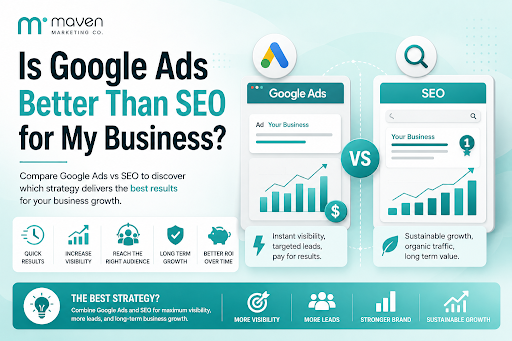
Is Google Ads Better Than SEO for My Business
One of the biggest questions business owners ask when they are planning online growth is whether they should invest in Google Ads or SEO. Both are strong marketing plays that help your company show up in Google search results, but they do things in separate lanes. Google Ads gives quicker visibility and can bring in leads fast, whereas SEO more or less focuses on slow, steady organic traffic that tends to grow the longer you keep building it. Picking the right direction depends on what you want to achieve, how much money you can spend, how crowded the market is, and how quickly you need results, like sooner rather than later. The good news is you don’t always have to choose one or the other; it’s not exactly a black-and-white situation. If you take time to understand the strongest points of both, you can put together a more sensible digital marketing plan that supports consistent expansion. In this guide, we’ll compare Google Ads vs SEO, explain the main differences, and help you figure out what option makes the most sense for your business.

When Should I Hire a Digital Marketing Agency
Growing a business today takes more than just having a website or throwing a post on social media; customers usually search around online, compare providers, skim reviews, and basically expect the brand to show up with a solid digital presence before they even think about buying. Many businesses try to run their marketing themselves, but there comes a point when “doing it all in-house” becomes clunky and hard to manage, all at once. Knowing when to hire a digital marketing agency can end up making a big, real difference for your growth. If you’re not getting enough leads, or your online visibility feels stuck, or sales are just not moving, the right agency can bring the know-how, plus a clear plan, to help you get noticeably better outcomes. In this guide, we’ll dig into what a digital marketing agency actually does, the usual signs it’s time to bring one on, and how picking the right marketing partner can help your business move forward at a faster pace.
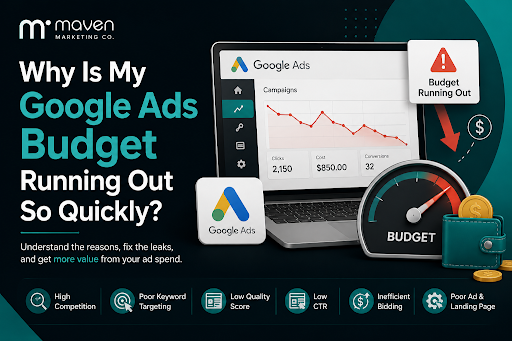
Why Is My Google Ads Budget Running Out So Quickly
Running a successful Google Ads budget isn’t only about throwing more money at it. It’s more like making every dollar, doing a bit extra. A lot of businesses start a Google Ads campaign with big hopes, then find out their daily budget is gone within a few hours, and that feels weird, right? After that, your ads stop showing effectively, new leads slip away, and your return on investment dips. So if your Google Ads budget is running out too fast, don’t stress. It’s a fairly common issue, and in most situations, it can be repaired with the right approach. There are multiple little things that can drain your advertising money quicker than you expected, from costly keywords to audience targeting that just doesn’t quite fit. In this guide, we’ll walk through why your budget disappears so quickly, how to cut wasteful spend, and the most reliable ways to boost your Google Ads ROI, even if your budget stays the same.