.svg)


%201.svg)

Key Takeaways
- Subdomains function as separate websites in Google's eyes requiring independent authority building whilst subfolders inherit main domain authority enabling faster organic visibility for new content sections
- Technical considerations including separate hosting requirements, independent SSL certificates, and distinct analytics properties favour subdomains for operational independence but create implementation complexity versus subfolder simplicity
- Link equity and domain authority flow freely between subfolders and main domains but transfer less efficiently between subdomains requiring intentional cross-linking strategies to share authority
- Content type and business structure determine optimal choices with international sites, distinct brands, and separate applications favouring subdomains whilst blogs, resources, and service pages benefiting from subfolder implementation
- Migrations from subdomains to subfolders or reverse directions require careful technical execution including comprehensive redirects, canonical management, and monitoring to prevent traffic losses during transitions
An Australian SaaS company providing project management software initially structured their digital presence with blog.company.com.au for content marketing, help.company.com.au for documentation, and www.company.com.au for the main product site. The subdomain strategy seemed logical during initial planning providing technical separation between content types, enabling independent hosting and deployment for different teams, and creating clear organisational boundaries that matched internal company structure.
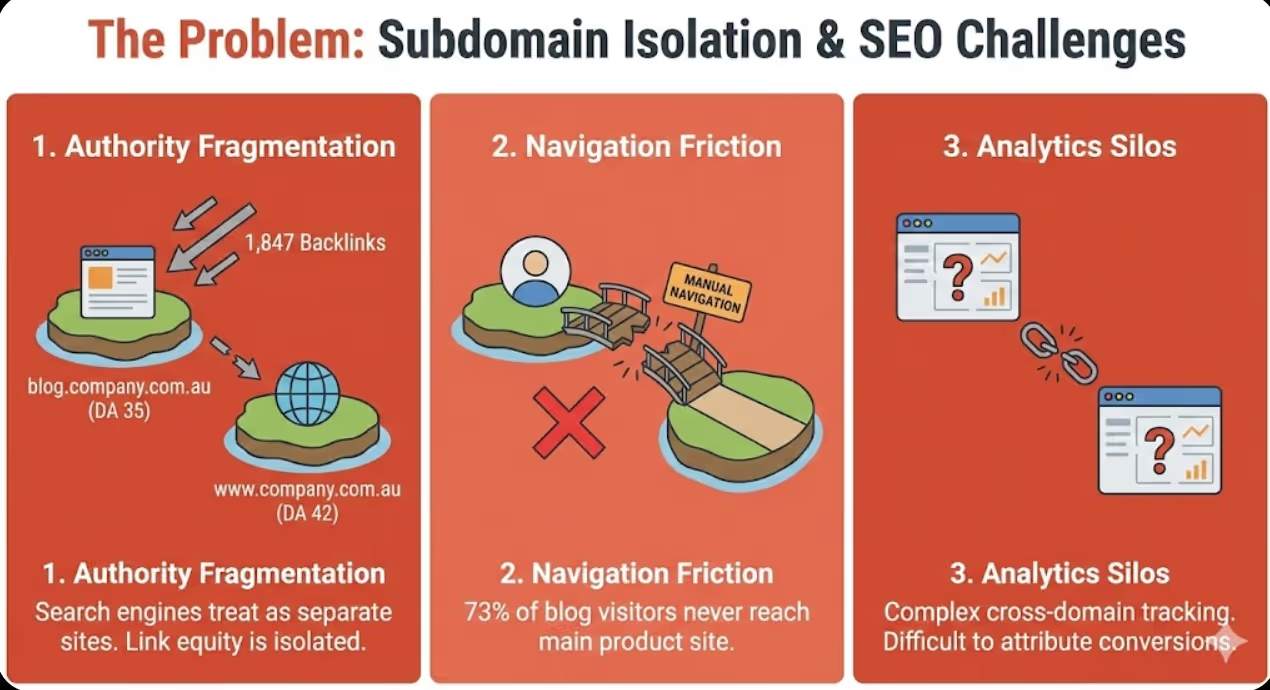
Two years later, organic traffic analysis revealed concerning patterns. The blog subdomain with 400+ articles had acquired substantial backlinks and produced quality content but struggled ranking for competitive keywords despite strong engagement metrics. The main product site ranked well for brand terms but lacked authority for broader industry keywords that blog content targeted. Domain authority metrics showed blog.company.com.au with Domain Authority 35 whilst www.company.com.au achieved only Domain Authority 42 despite being the primary brand presence. Traffic data revealed 73% of blog visitors never navigated to main product site suggesting subdomain separation prevented conversion funnel effectiveness.
Technical SEO audit quantified the subdomain problems. Link equity from 1,847 backlinks pointing to blog subdomain provided minimal benefit to main domain requiring users manually navigating between subdomains rather than authority flowing naturally. Search engines treated each subdomain as distinct website requiring independent authority building rather than consolidated domain strength. Analytics tracking complications prevented comprehensive customer journey analysis across subdomains making attribution and conversion path understanding difficult.
According to Google's John Mueller, whilst Google can understand subdomain relationships, separate subdomains are treated as distinct sites in most ranking considerations, potentially fragmenting authority that consolidated structures maintain.
Maven Marketing Co. developed migration strategy consolidating subdomains to subfolder structure with blog content moving to company.com.au/blog/ and documentation to company.com.au/help/. Implementation included comprehensive 301 redirects from every subdomain URL to equivalent subfolder URL, internal linking updates across all domains pointing to new subfolder URLs, canonical tag verification ensuring proper consolidation, XML sitemap restructuring reflecting new URL hierarchy, and Google Search Console property configuration tracking migration progress.
The migration occurred over staged four-week period to minimise disruption. Week 1 focused on blog migration, week 2 on documentation, week 3 on technical validation and redirect cleanup, and week 4 on monitoring and adjustment. Traffic initially declined 12% during first two weeks as search engines processed redirects but recovered to pre-migration levels by week 5. By week 12, organic traffic exceeded pre-migration baseline by 34% as consolidated domain authority improved rankings for competitive keywords. The company.com.au domain authority increased from 42 to 51 as link equity consolidated whilst individual content sections benefited from shared authority pool rather than isolated subdomain strength.
The transformation demonstrated that subdomain versus subfolder decisions aren't merely technical preferences but strategic choices profoundly affecting organic visibility and business outcomes.
Understanding Subdomain and Subfolder Fundamentals
Effective URL structure decisions require foundational understanding of what subdomains and subfolders represent, how they differ technically, and how search engines interpret each structure.
Subdomain definition and structure creates separate domain extensions preceding the main domain name. Implementation uses format subdomain.example.com.au where "subdomain" represents chosen identifier, "example" is main domain, and "com.au" is top-level domain extension. Common subdomain examples include blog.company.com.au for content marketing, shop.company.com.au for e-commerce, support.company.com.au for help documentation, and regional variations like au.company.com for Australian content. Subdomains function at DNS level as distinct hostnames requiring separate DNS records, potentially separate hosting infrastructure, and independent SSL certificate configuration though wildcard certificates can cover multiple subdomains under single certificate.
Subfolder definition and structure creates hierarchical URL paths within main domain. Implementation uses format example.com.au/subfolder/ where "subfolder" represents section identifier maintaining main domain throughout URL structure. Common subfolder examples include company.com.au/blog/ for content sections, company.com.au/shop/ for e-commerce, company.com.au/support/ for help content, and company.com.au/au/ for regional targeting though country-code top-level domains (ccTLDs) often provide better regional targeting than subfolders. Subfolders function within existing domain structure sharing hosting infrastructure, SSL certificates, and DNS configuration requiring no additional technical setup beyond creating directory structures or routing rules.
Search engine interpretation differences create fundamental SEO implications distinguishing subdomains from subfolders. Google's official guidance indicates that whilst Google can understand relationships between subdomains and main domains, subdomains are generally treated as separate sites for ranking purposes. This means blog.company.com.au builds authority independently from www.company.com.au requiring separate backlink acquisition, content development, and technical optimisation. Conversely, company.com.au/blog/ inherits authority from company.com.au domain enabling new subfolder content to rank more quickly leveraging existing domain strength. Search engines evaluate relevance, authority, and trust signals separately for each subdomain whilst consolidating these signals across all subfolders under unified domain.
Technical implementation differences affect development, hosting, and maintenance complexity. Subdomains enable independent hosting allowing blog.company.com.au on different server than www.company.com.au providing technical isolation useful for separate applications or teams. Subdomains require DNS configuration creating A or CNAME records pointing subdomains to appropriate servers. Subdomains need separate SSL certificates unless wildcard certificates cover subdomain.example.com.au pattern. Subdomains allow different content management systems, programming languages, or technical stacks for each subdomain without affecting others. Subfolders share hosting infrastructure simplifying deployment through single server configuration. Subfolders use existing SSL certificates without additional setup. Subfolders typically share CMS or technical stack though routing can deliver different applications for different subfolder paths. Australian businesses with limited technical resources often find subfolder simplicity advantageous versus subdomain complexity requiring additional configuration and maintenance.
Analytics and tracking implications complicate measurement across subdomains versus straightforward subfolder tracking. Google Analytics treats each subdomain as separate property by default requiring cross-domain tracking configuration to connect user journeys across blog.company.com.au and www.company.com.au. Cross-domain tracking implementation requires careful setup including consistent tracking codes, referral exclusion lists, and cross-domain linker parameters to maintain session continuity as users navigate between subdomains. Attribution analysis becomes complex when conversions occur on main domain after discovery through blog subdomain because default tracking treats these as separate referral sources. Subfolders enable unified tracking within single analytics property automatically capturing complete user journeys without cross-domain configuration. Conversion path analysis, content attribution, and user flow reporting function seamlessly across subfolders whilst requiring intentional cross-domain implementation for subdomains. Australian businesses prioritising comprehensive analytics often find subfolder simplicity outweighs subdomain technical flexibility unless strong operational reasons mandate subdomain separation.
Historical context and evolving best practices reflect changing search engine algorithms and SEO community understanding. Early SEO practices (2000s) treated subdomains and subfolders similarly with minimal practical differences leading many businesses to choose arbitrarily. Google algorithm updates (2010s) increasingly emphasised domain-level signals including domain authority, trust metrics, and historical performance making subdomain separation more significant as distinct sites requiring independent authority building. Modern SEO (2020s) recognises that whilst Google can understand subdomain relationships, the practical reality shows subdomains function as separate sites for most ranking purposes making subfolder default choice unless specific reasons justify subdomain implementation. Australian businesses should base subdomain versus subfolder decisions on current search engine behavior rather than outdated practices from eras when differences were less pronounced.
SEO Implications of Subdomains
Subdomain implementation creates specific SEO advantages and disadvantages requiring careful evaluation before choosing subdomain structure.
Domain authority fragmentation represents the primary subdomain disadvantage where separate subdomains build authority independently rather than consolidating strength. When blog.company.com.au acquires backlinks, authority accumulates primarily to the blog subdomain with limited direct benefit to www.company.com.au main domain. This means businesses essentially operate multiple websites each requiring individual authority building through backlinks, content quality, and technical optimisation. Domain authority metrics from tools including Moz and Ahrefs calculate separately for each subdomain confirming search engine treatment as distinct entities. Australian businesses with limited resources for link building find subdomain fragmentation particularly problematic because effort distributes across multiple subdomains rather than consolidating to unified domain strength that all content sections benefit from.
Link equity distribution challenges emerge when backlinks to one subdomain provide minimal ranking benefit to other subdomains under same root domain. Natural link acquisition typically concentrates on specific content sections like blogs, resources, or tools rather than distributing evenly across subdomains. If blog content acquires majority of backlinks whilst product pages needing rankings reside on separate www subdomain, the link equity remains largely isolated benefiting blog ranking but not product visibility. Intentional cross-linking between subdomains can transfer some authority but requires strategic implementation and doesn't achieve the seamless equity flow that subfolder structure provides automatically. Australian content marketing strategies investing heavily in blog linkable assets often inadvertently build authority for blog subdomains whilst product or service subdomains struggle ranking despite belonging to same brand.
Independent ranking requirements mean each subdomain must establish relevance, authority, and trust separately rather than inheriting these signals from established domains. New blog.company.com.au subdomain starts essentially from zero requiring months of content publication, backlink acquisition, and engagement building before achieving meaningful rankings. This delays content marketing ROI because blog content cannot leverage existing domain authority that main www.company.com.au might possess. Subdomains do benefit somewhat from brand association where strong main domain provides credibility helping subdomain content but this remains weaker signal than direct authority inheritance that subfolders receive. Australian businesses launching content marketing initiatives through new blog subdomains should expect 6-12 month authority building periods before achieving competitive rankings versus faster subfolder timeline.
Technical flexibility advantages represent subdomain benefits including independent hosting enabling blog.company.com.au on separate servers from www.company.com.au providing performance isolation where blog traffic doesn't affect main site. Different technical stacks allow WordPress blog subdomain whilst main site uses custom application or different CMS without technical conflicts. Separate teams can manage different subdomains independently without requiring coordination on deployment schedules or technical decisions. Third-party integrations including hosted solutions like Shopify can operate on subdomains like shop.company.com.au without requiring complex integration into main domain infrastructure. CDN and caching strategies can optimise differently for different subdomains based on their specific performance requirements. Australian businesses with complex technical requirements or distributed teams managing different digital properties may find subdomain technical independence outweighs SEO consolidation benefits that subfolders provide.
Security and performance isolation provides operational advantages where security breach affecting blog subdomain doesn't compromise main www subdomain reducing cross-contamination risk. Performance problems including server overload, database issues, or technical failures affecting one subdomain don't impact others maintaining partial site availability during technical problems. Updates and maintenance can occur on specific subdomains without requiring full site downtime. Testing and development environments can operate on separate subdomains like staging.company.com.au without risk to production environments. Australian businesses with strict security requirements or high-availability needs value subdomain isolation despite SEO fragmentation costs.
Keyword targeting independence enables each subdomain to focus on distinct keyword themes without concern about topical dilution that can affect unified domains. Blog subdomain can target content marketing keywords, www subdomain focuses on product terms, and help subdomain concentrates on support queries without competing internally for the same keyword rankings. This separation can benefit businesses operating in distinct market segments where consolidated domain might confuse topical relevance signals. However, modern search engine understanding of site sections through URL structure, internal linking, and content analysis typically handles topical separation adequately within subfolder implementations making keyword targeting independence weak justification for subdomain complexity in most scenarios.

SEO Implications of Subfolders
Subfolder implementation provides different SEO characteristics generally favouring authority consolidation and simplified management versus subdomain fragmentation.
Authority consolidation advantages represent the primary subfolder benefit where all content sections inherit and contribute to unified domain authority. Backlinks to company.com.au/blog/ improve authority for entire company.com.au domain benefiting all subfolders including /products/, /services/, and /support/ rather than isolating authority to specific sections. This creates compounding effect where content marketing efforts building blog links simultaneously strengthen product page rankings, resource content acquisition supports service page visibility, and any section's link building benefits the complete domain. Australian businesses investing in content marketing find subfolder structure maximises ROI by ensuring blog link acquisition directly improves commercial page rankings rather than building authority for separate blog subdomain.
Faster ranking timeline for new content sections results from subfolder inheritance of existing domain authority. Launching company.com.au/blog/ benefits immediately from www.company.com.au authority enabling blog posts to rank competitively from publication rather than requiring months building subdomain authority from zero. This accelerates content marketing ROI because blog content generates organic traffic quickly rather than serving primarily as future-focused authority building during initial 6-12 month subdomain maturation period. Australian businesses expanding into content marketing should favour subfolder implementation unless compelling technical or organisational reasons mandate subdomain separation because faster ranking timeline directly affects business outcomes.
Simplified technical implementation eliminates subdomain configuration requirements reducing deployment complexity and ongoing maintenance burden. Subfolders require no DNS configuration beyond initial domain setup, share SSL certificates without additional certificate acquisition or renewal, use existing hosting infrastructure without provisioning separate servers, and deploy through existing content management systems without separate CMS installation. This simplification particularly benefits Australian small businesses and startups with limited technical resources where subdomain overhead consumes disproportionate time relative to actual business benefit. Technical simplicity also reduces points of failure because fewer separate configurations mean fewer opportunities for technical problems affecting site accessibility or functionality.
Unified analytics tracking enables comprehensive user journey analysis without cross-domain tracking complexity. Single Google Analytics property tracks user behaviour across company.com.au/blog/, company.com.au/products/, and company.com.au/checkout/ seamlessly measuring content attribution, conversion paths, and multi-touch interactions that cross-domain subdomain tracking complicates. Attribution modelling accurately credits blog content for awareness, product pages for consideration, and conversion pages for final purchase without referral confusion that subdomain transitions create. Enhanced e-commerce tracking, goal funnels, and behaviour flow reports function correctly without cross-domain parameter implementation that subdomains require. Australian businesses prioritising data-driven optimisation benefit substantially from subfolder tracking clarity versus subdomain measurement challenges.
Internal linking efficiency operates seamlessly within unified domain structure enabling natural link equity flow between subfolders. Links from company.com.au/blog/ to company.com.au/products/ pass authority directly without cross-subdomain complications. Breadcrumb navigation, related content suggestions, and navigational menus connecting different site sections automatically share link equity across subfolders. Search engines interpret internal linking within unified domain as strong topical relevance signals whilst cross-subdomain linking appears weaker requiring intentional relationship building. Australian content strategies relying on internal linking for SEO benefit find subfolder structure maximises internal link value versus subdomain structures where internal links function more like external links with reduced equity transfer.
Topical authority building consolidates around unified domain enabling strong topical expertise signals across related content areas. Company.com.au publishing blog content, product information, help documentation, and case studies across multiple subfolders demonstrates comprehensive topical coverage that search engines reward through enhanced topical authority. Subdomain fragmentation can dilute topical signals by distributing related content across separate subdomains rather than consolidating comprehensive coverage under unified domain. Australian businesses targeting competitive knowledge-based keywords benefit from subfolder topical consolidation versus subdomain separation that fragments topical authority across multiple sites.
Migration and restructuring simplicity enables easier site architecture changes within subfolder implementations versus complex subdomain migrations. Moving content from company.com.au/blog/category-a/ to company.com.au/resources/category-a/ requires straightforward 301 redirects within unified domain. Creating new subfolders or restructuring existing ones impacts single domain property rather than requiring coordination across multiple subdomains. URL standardisation and cleanup proves simpler within subfolder structure versus subdomain environments where changes affect multiple distinct properties. Australian businesses anticipating future restructuring should favour subfolder flexibility over subdomain rigidity that complicates architectural evolution.

When Subdomains Make Strategic Sense
Despite general subfolder advantages, specific scenarios justify subdomain implementation where benefits outweigh authority fragmentation costs.
International and regional targeting represents strongest subdomain justification enabling clear geographic separation through structures like au.company.com for Australia, uk.company.com for United Kingdom, and us.company.com for United States. Subdomains combined with proper hreflang implementation signal clear regional targeting to search engines whilst ccTLDs (company.com.au, company.co.uk) often provide superior regional signals. However, when ccTLDs are impractical due to availability, cost, or brand consistency requirements, regional subdomains offer viable alternative. Geotargeting in Google Search Console allows associating subdomains with specific countries enhancing regional search visibility. Australian brands expanding internationally should evaluate whether regional subdomains, ccTLDs, or regional subfolders (company.com/au/) best serve their specific international strategy based on target market priorities, brand consistency needs, and technical capabilities.
Distinct brand or product lines operating under corporate umbrella justify separate subdomains maintaining brand independence whilst leveraging infrastructure. Acquisitions or subsidiary brands like brand-a.parentcompany.com.au and brand-b.parentcompany.com.au preserve distinct identities whilst sharing technical infrastructure. Product lines targeting completely different audiences benefit from subdomain separation preventing topical confusion where blog.enterprise-product.com.au targets IT professionals whilst blog.consumer-product.com.au targets general consumers. Australian businesses managing multiple brands should evaluate whether brand separation benefits outweigh authority consolidation costs that subdomain structure creates versus subdirectory structure maintaining brand association with parent domain.
Separate applications and platforms often require subdomain implementation due to technical architecture constraints. E-commerce stores on hosted platforms like Shopify frequently operate on shop.company.com.au subdomains because Shopify doesn't integrate seamlessly into subfolder structures without complex proxy configurations. Forums, customer communities, or user-generated content platforms may run separate applications requiring subdomain hosting. Documentation platforms, ticketing systems, or other third-party integrations might mandate subdomain implementation as technical requirement rather than strategic choice. Australian businesses using hosted platforms should evaluate whether subdomain technical requirements justify SEO fragmentation versus seeking subfolder-compatible alternatives that maintain authority consolidation.
Operational and team independence benefits subdomain structure when separate teams managing different digital properties require complete autonomy. Marketing team managing blog.company.com.au, product team controlling www.company.com.au, and support team operating help.company.com.au can deploy independently without coordination on shared infrastructure. Different deployment schedules, approval processes, or technical stacks for different teams favour subdomain independence over subfolder coordination requirements. Security boundaries between teams or content types benefit from subdomain isolation preventing one team's errors affecting other properties. Australian enterprises with distributed teams and complex organisational structures might find operational subdomain benefits outweigh SEO costs despite authority fragmentation.
Testing and experimentation environments appropriately use subdomains like test.company.com.au, staging.company.com.au, or beta.company.com.au for non-production purposes. These technical subdomains should be blocked via robots.txt preventing search engine indexing whilst enabling testing without affecting production domains. Temporary campaigns, microsites, or time-limited initiatives might use event-specific subdomains though subfolder alternatives typically prove simpler. Australian businesses should reserve subdomain implementation for testing purposes where production SEO impact doesn't matter rather than using for content that requires organic visibility.
Content networks and aggregation where businesses operate multiple distinct websites under umbrella organisation might consolidate infrastructure through subdomains. Media companies running multiple publications like news-a.media-company.com.au and news-b.media-company.com.au maintain editorial independence whilst sharing technical infrastructure. Content networks benefit from subdomain separation when publications target completely different audiences or topics without overlap. Australian media companies or content operations should evaluate whether maintaining separate ccTLDs for each property versus subdomain consolidation better serves their specific technical and editorial requirements.
Implementation Best Practices and Migration Strategies
Successful subdomain or subfolder implementation requires careful planning, technical execution, and ongoing monitoring regardless of chosen structure.
Initial architecture planning should evaluate subdomain versus subfolder decisions during website planning rather than arbitrary choices later requiring expensive migrations. Planning considerations include long-term content strategy understanding what sections need adding in future, team structure evaluating whether operational independence justifies subdomain complexity, international expansion plans determining whether regional targeting needs require subdomains, technical requirements identifying hosted platform constraints mandating subdomains, and SEO priorities assessing whether authority consolidation outweighs technical flexibility. Australian businesses should document architecture decisions explaining rationale for future reference when expansion or restructuring raises questions about initial choices.
Subdomain to subfolder migration proves common when businesses discover subdomain authority fragmentation harms organic visibility. Migration process includes comprehensive URL inventory cataloguing all subdomain content, 301 redirect mapping creating individual redirects from every subdomain URL to equivalent subfolder URL, internal link updates across all properties pointing to new subfolder URLs, canonical tag verification ensuring proper consolidation signals, XML sitemap restructuring reflecting new URL hierarchy, Google Search Console property configuration tracking migration separately from main domain, analytics implementation ensuring tracking continuity through migration, and monitoring phase lasting 3-6 months tracking traffic, rankings, and indexing during transition. Australian businesses should anticipate temporary traffic decline during migration recovery period before improvements materialise from authority consolidation.
Subfolder to subdomain migration occurs less frequently but proves necessary when technical requirements mandate separation or operational independence becomes priority. Migration process mirrors reverse direction requiring comprehensive redirects, property configuration, and monitoring. Businesses should carefully evaluate whether technical or operational benefits justify SEO costs because subfolder to subdomain migration sacrifices authority consolidation that subfolder structure provides. Australian businesses considering this migration direction should exhaust subfolder technical solutions before accepting subdomain fragmentation because migration costs and ongoing authority building requirements often exceed expected operational benefits.
Staged migration approaches reduce risk by migrating sections incrementally rather than complete site restructuring simultaneously. Staged migration includes selecting low-traffic section for initial migration testing technical implementation and monitoring impact, expanding to medium-traffic sections after validating first phase success, completing with high-traffic sections once confidence in process is established, and maintaining ability to pause or reverse if unexpected problems emerge. Staged approach lengthens total migration timeline but reduces business risk compared to simultaneous migration that could affect complete site visibility if problems occur. Australian businesses with substantial organic traffic should favour staged migration despite longer timelines because risk mitigation justifies extended implementation periods.
Cross-linking strategies help subdomain implementations share authority when subdomain structure remains necessary despite SEO fragmentation. Strategic cross-linking includes prominent navigation links from main domain to subdomains establishing strong relationship signals, contextual content links from blog subdomain articles to main domain product pages, footer or header cross-domain navigation connecting all subdomains, rel="canonical" tags where appropriate indicating preferred versions when content duplicates across domains, and avoiding excessive cross-domain redirects that waste link equity through redirect chains. Australian businesses maintaining subdomain structures should invest in intentional cross-linking rather than assuming subdomain relationships emerge organically.
Hreflang implementation for international subdomains ensures proper regional targeting reducing duplicate content concerns across regional variations. Implementation includes hreflang tags on every page indicating language and regional targeting, alternate tag implementation pointing to equivalent pages in different regions, x-default specification indicating default version for unmatched regions, and XML sitemap hreflang markup providing additional signals. Australian businesses with au.company.com subdomain should implement hreflang connecting to us.company.com, uk.company.com and other regional variations ensuring search engines understand regional relationships rather than treating as competing duplicates.
Monitoring and validation throughout migrations and post-implementation ensures technical changes achieve intended results. Monitoring includes Google Search Console tracking for both old and new properties, organic traffic analysis comparing pre and post migration performance, ranking tracking for important keywords through migration period, indexing status verification confirming old URLs deindex whilst new URLs index, crawl error monitoring identifying technical problems preventing proper migration, and backlink profile tracking ensuring link equity transfers successfully. Australian businesses should maintain intensive monitoring for 3-6 months post-migration before assuming stabilisation and reduced monitoring cadence suffices.

Frequently Asked Questions
Should Australian e-commerce businesses use shop.example.com.au subdomain or example.com.au/shop/ subfolder for their online store?
Subfolder implementation at example.com.au/shop/ provides superior SEO benefits for most Australian e-commerce businesses through authority consolidation, simpler technical implementation, and unified analytics tracking. E-commerce subfolders inherit main domain authority enabling faster product page rankings, benefit from main site backlinks improving product visibility, maintain seamless user journeys from content to products without cross-domain complications, and simplify analytics tracking measuring complete customer journeys from awareness to purchase. Reserve subdomain shop.example.com.au only when technical requirements absolutely mandate separation including hosted e-commerce platforms like Shopify that cannot integrate into subfolder structures without complex configurations, or when operational independence between teams managing main site versus online store justifies authority fragmentation costs. Australian retailers should default to subfolder implementation unless compelling technical constraints force subdomain structure because authority consolidation directly affects product page rankings and organic e-commerce revenue that subdomain fragmentation undermines.
How should Australian businesses with existing blog subdomains evaluate whether migration to subfolder structure justifies the effort and risk?
Systematic evaluation measuring current subdomain performance against subfolder potential determines whether migration justifies investment. Analyse current blog subdomain authority through domain authority metrics, backlink profiles, and keyword rankings establishing baseline performance. Compare blog subdomain authority to main domain authority quantifying how much additional authority blog content could access through subfolder migration. Evaluate traffic potential by identifying target keywords where main domain ranks whilst blog subdomain doesn't revealing authority gap that consolidation could close. Calculate migration costs including technical development, 301 redirect implementation, monitoring resources, and potential temporary traffic declines during transition. Estimate ROI by projecting ranking improvements from authority consolidation translating to traffic and conversion increases justifying migration investment. Australian businesses should migrate when main domain authority substantially exceeds blog subdomain authority, when target keyword rankings show clear authority gaps, when blog content quality warrants better rankings than current subdomain achieves, and when projected traffic gains exceed migration costs and temporary decline risks within reasonable 12-18 month payback period.
What URL structure should Australian businesses targeting multiple countries implement for international SEO?
Country-code top-level domains (ccTLDs) like example.com.au for Australia, example.co.uk for United Kingdom, and example.co.nz for New Zealand provide strongest international targeting signals to search engines indicating clear regional focus. However, ccTLD costs including registration fees, renewal expenses, and management complexity across multiple domains often prove prohibitive for Australian businesses with limited budgets. Regional subdomains like au.example.com, uk.example.com, and nz.example.com offer viable alternative providing clearer regional separation than subfolder structures through distinct hostnames whilst consolidating under unified root domain. Regional subfolders like example.com/au/, example.com/uk/, and example.com/nz/ provide simplest implementation with authority consolidation benefits but weakest regional targeting signals. Optimal choice depends on target market priorities where businesses prioritising few key markets favour ccTLDs, businesses targeting many markets with limited budgets prefer regional subfolders, and businesses requiring operational independence across regions choose regional subdomains. Australian brands expanding internationally should implement proper hreflang annotations regardless of chosen structure ensuring search engines understand regional relationships and serve appropriate versions to searchers in different countries.
How do Australian businesses maintain consistent branding whilst using subdomains that create separate web properties?
Brand consistency across subdomain implementations requires intentional design and content strategy coordination despite technical separation. Implement consistent visual design including logos, colour schemes, typography, and navigation patterns across all subdomains creating unified brand experience. Maintain content voice and messaging consistency through brand guidelines ensuring blog.company.com.au and www.company.com.au feel like connected properties rather than separate websites. Create cross-domain navigation prominently linking subdomains through header or footer navigation enabling users discovering content on blog subdomain to easily access main domain products or services. Implement consistent tracking through cross-domain analytics configuration measuring complete user journeys across subdomain transitions. Use consistent social media profiles and brand mentions referencing unified company rather than promoting subdomains as separate entities. Australian businesses should treat subdomain technical separation as invisible infrastructure rather than creating distinct brand identities that confuse customers about relationships between technically separate but strategically unified properties.
What should Australian businesses do if they've already implemented subdomains but now recognise subfolder advantages?
Evaluate migration feasibility through systematic analysis before committing to potentially disruptive restructuring. First assess current subdomain performance including traffic, rankings, and conversions establishing baseline for measuring post-migration impact. Second calculate potential authority consolidation benefits by comparing subdomain authority metrics to main domain determining realistic improvement expectations. Third inventory all subdomain content creating comprehensive URL mapping for 301 redirects from old subdomain URLs to new subfolder equivalents. Fourth develop staged migration plan testing with low-traffic subdomain first before migrating high-traffic properties. Fifth implement comprehensive 301 redirects ensuring every subdomain URL redirects properly to equivalent subfolder URL. Sixth update all internal links across properties pointing to new subfolder URLs rather than relying solely on redirects. Seventh configure Google Search Console tracking migration progress separately for each migrated subdomain. Eighth monitor intensively for 3-6 months tracking traffic, rankings, and indexing confirming successful migration. Australian businesses should anticipate temporary traffic decline during first 4-8 weeks of migration before consolidation benefits materialise through improved rankings leveraging unified domain authority.
How does subdomain versus subfolder choice affect local SEO for Australian businesses with multiple physical locations?
Location page structure for multi-location Australian businesses should favour subfolders like example.com.au/locations/sydney/ and example.com.au/locations/melbourne/ over location subdomains because local SEO benefits substantially from consolidated domain authority whilst location subdomains fragment authority requiring independent local ranking efforts for each subdomain. Subfolder location pages inherit main domain authority helping individual location pages rank in local search results more effectively than location subdomains starting from zero authority. Unified domain structure enables centralised NAP (name, address, phone) management and schema markup implementation across all location pages. Subfolder simplicity allows consistent location page templates and content strategies without managing multiple subdomain properties. Location subfolders facilitate better internal linking connecting location pages to service pages, blog content, and other site sections strengthening topical relevance. Reserve location subdomains only when distinct brands operate in different locations requiring brand separation, or when locations operate as franchises needing operational independence. Australian businesses with multiple locations should strongly favour subfolder structure for location pages maximising local SEO performance through authority consolidation versus subdomain fragmentation that local search algorithms would treat as separate businesses requiring independent ranking efforts.
What analytics and tracking implications should Australian businesses consider when choosing between subdomains and subfolders?
Analytics complexity increases substantially with subdomain implementation requiring cross-domain tracking configuration versus straightforward subfolder tracking within unified property. Subdomain tracking requires separate Google Analytics properties or careful cross-domain configuration maintaining session continuity as users navigate between blog.company.com.au and www.company.com.au. Cross-domain setup includes implementing consistent tracking codes across all subdomains, configuring referral exclusion lists preventing subdomain transitions from appearing as referral traffic, adding cross-domain linker parameters to links between subdomains maintaining session IDs, and validating tracking through Real-Time reports confirming sessions persist across subdomain navigation. Attribution analysis complicates with subdomains because default tracking treats blog subdomain as referral source for main domain conversions requiring custom attribution modelling properly crediting blog content. Subfolder implementation enables unified tracking within single analytics property automatically measuring complete user journeys without cross-domain complications. Conversion funnels, goal tracking, and e-commerce reporting function seamlessly across subfolders whilst requiring intentional configuration for subdomains. Australian businesses prioritising data-driven optimisation should favour subfolder simplicity unless compelling technical reasons mandate subdomain separation requiring ongoing analytics management investment.
Strategic URL Architecture Supports Business Growth
URL structure decisions between subdomain and subfolder implementations fundamentally affect SEO performance, technical complexity, and analytics capabilities requiring strategic evaluation aligning architecture choices with business objectives rather than arbitrary technical preferences that later prove suboptimal.
The frameworks outlined in this guide including authority consolidation benefits favouring subfolders, technical flexibility advantages sometimes justifying subdomains, international targeting considerations, migration strategies preserving traffic during restructuring, and comprehensive decision criteria provide foundation for Australian businesses to implement optimal URL architecture serving both immediate needs and long-term scalability.
Australian businesses working with Maven Marketing Co. benefit from professional site architecture audits identifying current structure problems and improvement opportunities, strategic guidance evaluating subdomain versus subfolder decisions for specific business contexts, technical migration implementation preserving traffic during restructuring transitions, and ongoing monitoring ensuring URL architecture continues supporting organic visibility as businesses evolve and expand into new markets or content areas.
Ready to optimise URL structure ensuring search engines efficiently crawl, index, and rank your complete website whilst maintaining technical flexibility for business growth? Maven Marketing Co. provides comprehensive technical SEO services including site architecture audits, subdomain versus subfolder strategy development, migration planning and implementation, and ongoing structural optimisation ensuring your URL architecture supports rather than undermines organic search visibility and business objectives.

Table of contents
read more blogs

Is Google Ads Better Than SEO for My Business
One of the biggest questions business owners ask when they are planning online growth is whether they should invest in Google Ads or SEO. Both are strong marketing plays that help your company show up in Google search results, but they do things in separate lanes. Google Ads gives quicker visibility and can bring in leads fast, whereas SEO more or less focuses on slow, steady organic traffic that tends to grow the longer you keep building it. Picking the right direction depends on what you want to achieve, how much money you can spend, how crowded the market is, and how quickly you need results, like sooner rather than later. The good news is you don’t always have to choose one or the other; it’s not exactly a black-and-white situation. If you take time to understand the strongest points of both, you can put together a more sensible digital marketing plan that supports consistent expansion. In this guide, we’ll compare Google Ads vs SEO, explain the main differences, and help you figure out what option makes the most sense for your business.

When Should I Hire a Digital Marketing Agency
Growing a business today takes more than just having a website or throwing a post on social media; customers usually search around online, compare providers, skim reviews, and basically expect the brand to show up with a solid digital presence before they even think about buying. Many businesses try to run their marketing themselves, but there comes a point when “doing it all in-house” becomes clunky and hard to manage, all at once. Knowing when to hire a digital marketing agency can end up making a big, real difference for your growth. If you’re not getting enough leads, or your online visibility feels stuck, or sales are just not moving, the right agency can bring the know-how, plus a clear plan, to help you get noticeably better outcomes. In this guide, we’ll dig into what a digital marketing agency actually does, the usual signs it’s time to bring one on, and how picking the right marketing partner can help your business move forward at a faster pace.

Why Is My Google Ads Budget Running Out So Quickly
Running a successful Google Ads budget isn’t only about throwing more money at it. It’s more like making every dollar, doing a bit extra. A lot of businesses start a Google Ads campaign with big hopes, then find out their daily budget is gone within a few hours, and that feels weird, right? After that, your ads stop showing effectively, new leads slip away, and your return on investment dips. So if your Google Ads budget is running out too fast, don’t stress. It’s a fairly common issue, and in most situations, it can be repaired with the right approach. There are multiple little things that can drain your advertising money quicker than you expected, from costly keywords to audience targeting that just doesn’t quite fit. In this guide, we’ll walk through why your budget disappears so quickly, how to cut wasteful spend, and the most reliable ways to boost your Google Ads ROI, even if your budget stays the same.