.svg)


%201.svg)

Quick Answers
What is structured data schema and why does it matter for Australian businesses in 2026?
Structured data schema is standardized code that helps search engines understand your website content with precision. Think of it as translating your website into a language that Google, Bing, and AI systems can perfectly comprehend. For Australian businesses in 2026, schema markup has become critical because it directly feeds into AI-generated search results, voice assistant responses, and rich snippets that appear above traditional organic listings. Businesses implementing schema are seeing 30-40% higher click-through rates on search results and significantly better visibility in AI chatbot responses. With over 60% of Australian searches now happening on mobile devices and voice search growing exponentially, schema markup ensures your business information appears accurately across all these platforms, giving you a measurable edge over competitors who haven't yet adopted this technology.
Which types of schema markup deliver the biggest ROI for Australian SMEs?
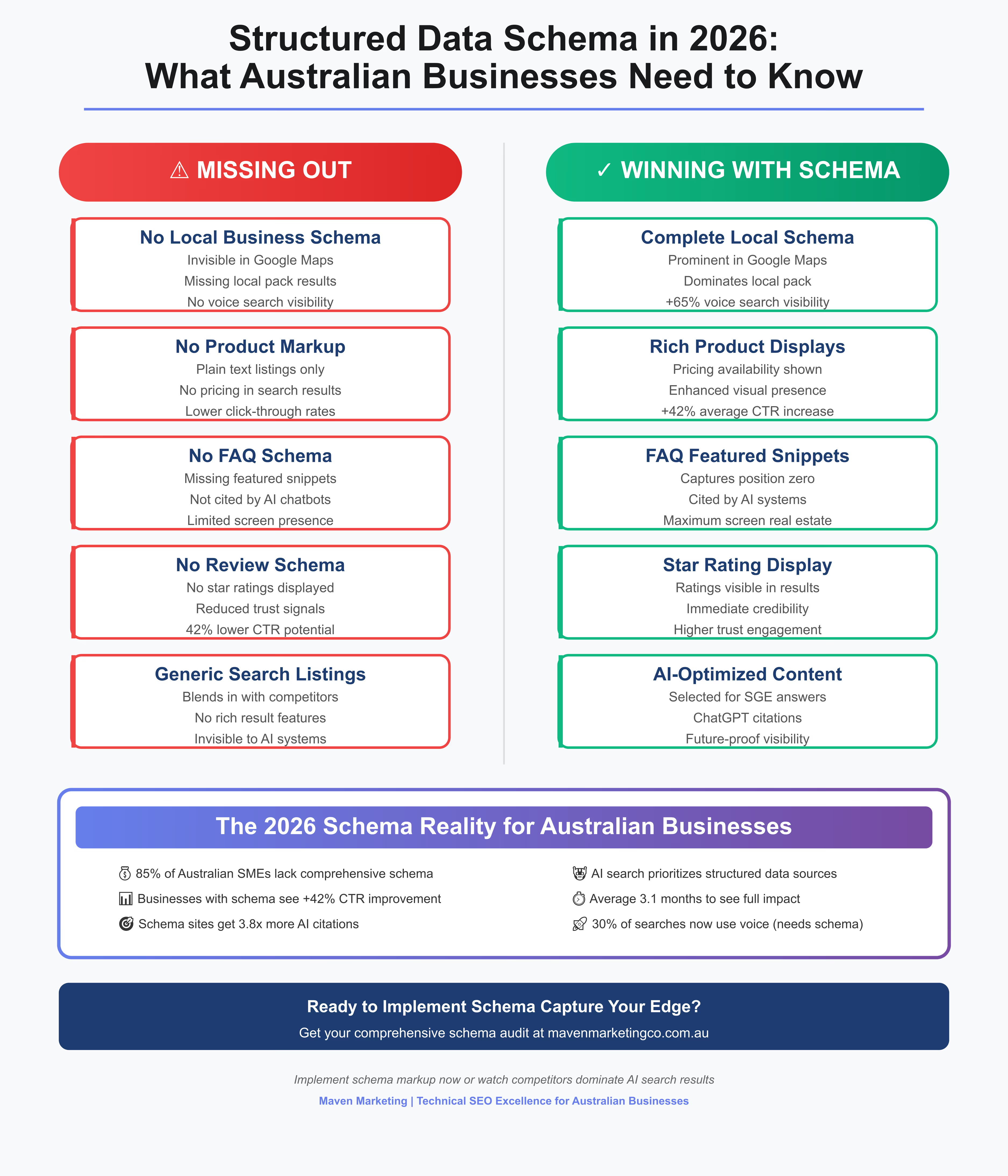
The highest-impact schema types for Australian small and medium businesses are Local Business schema, Product schema, FAQ schema, and Review schema. Local Business schema is absolutely essential for any business with a physical presence, as it ensures accurate display in Google Maps, local pack results, and AI location-based recommendations. Product schema drives rich results with pricing, availability, and ratings directly in search results, crucial for e-commerce businesses competing with major retailers. FAQ schema captures featured snippet positions and feeds AI chatbot responses with your content, establishing authority. Review schema displays star ratings in search results, dramatically improving click-through rates. For service businesses, Service schema helps you appear for specific service searches. The key is implementing multiple schema types together, creating a comprehensive structured data ecosystem that positions your business as the authoritative source across various search contexts.
The Hidden SEO Gap Australian Businesses Are Missing
While Australian businesses pour resources into content marketing, paid advertising, and social media, there's a fundamental gap in most digital strategies: structured data implementation. Recent analysis shows that fewer than 15% of Australian SME websites have comprehensive schema markup deployed, despite it being one of the most cost-effective ways to improve search visibility.
This gap represents an enormous opportunity. As search evolves beyond traditional blue links toward AI-generated answers, rich snippets, and voice responses, structured data has become the bridge between your content and how it's interpreted and displayed by search engines and AI systems.
The businesses capitalizing on this untapped edge aren't necessarily creating more content or spending more on SEO. They're simply speaking the language that search engines and AI systems understand natively.
Why Schema Markup Matters More in 2026 Than Ever Before
The search landscape has transformed dramatically. Google's Search Generative Experience (SGE), ChatGPT integration with Bing, and AI-powered search assistants are fundamentally changing how information is retrieved and presented. In this new environment, structured data isn't just helping search engines understand your content; it's determining whether your business gets cited at all.
When an AI system generates an answer to a user query, it prioritizes content that's clearly structured and easy to parse. Websites with comprehensive schema markup are significantly more likely to be selected as authoritative sources for AI-generated responses. For Australian businesses, this means the difference between appearing in the AI-powered answer or being invisible entirely.
Consider voice search, which now accounts for nearly 30% of all searches in Australia. When someone asks their smart speaker "What's the best Italian restaurant in Melbourne?" or "Who provides emergency plumbing in Sydney?" the response comes directly from structured data. Without proper Local Business and Service schema, your business simply won't be considered for these voice results, regardless of how good your organic rankings might be.

The ROI of Structured Data: Real Numbers from Australian Businesses
The performance difference between websites with and without proper schema implementation is striking. Melbourne-based e-commerce retailer Outdoor Adventure Co. implemented comprehensive Product, Review, and Organization schema across their site in early 2025. Within three months, they saw a 42% increase in organic click-through rates and a 28% increase in organic revenue, without changing any other aspect of their SEO strategy.
Brisbane accounting firm Precision Tax Partners added Service, Local Business, and FAQ schema to their website. Their appearance in local pack results improved from sporadic to consistent, and they began capturing featured snippet positions for high-value queries like "tax deductions for small business Australia." The result was a 55% increase in qualified leads from organic search within six months.
These aren't isolated cases. Google's own data indicates that pages with relevant structured data consistently outperform those without it, with rich results generating significantly higher engagement rates. The investment required is minimal compared to the returns, especially when you consider the long-term compound effect of better visibility.
Essential Schema Types for Australian Businesses

Not all schema markup delivers equal value. For Australian businesses, certain schema types provide disproportionate returns and should be prioritized in your implementation strategy.
Local Business Schema is non-negotiable for any business with a physical presence. This schema type communicates your exact location, operating hours, contact information, accepted payment methods, and service areas to search engines. It's the foundation for appearing in Google Maps results, local pack listings, and location-based AI responses. For multi-location businesses operating across Australian states, implementing location-specific schema for each branch is critical.
Product Schema transforms how your products appear in search results. Instead of a plain text listing, your products can display with pricing, availability status, review ratings, and even promotional information directly in search results. This is particularly powerful for Australian e-commerce businesses competing against international retailers. When potential customers see star ratings and current pricing before even clicking through, conversion rates improve dramatically.
FAQ Schema has become one of the most valuable schema types in 2026. It enables your frequently asked questions to appear as expandable results in Google search, capturing significant screen real estate and establishing authority. More importantly, FAQ schema feeds directly into AI-generated responses. When ChatGPT or Google's AI summarizes information about your industry, properly structured FAQs are prime candidates for citation.
Review and Rating Schema adds star ratings to your search listings, creating visual distinction and social proof that dramatically improves click-through rates. Australian consumers heavily rely on reviews for purchasing decisions, and having those ratings visible in search results provides immediate credibility.
Service Schema is crucial for service-based businesses from plumbers and electricians to consultants and agencies. It helps search engines understand exactly what services you offer, in which locations, and at what price ranges. This schema type is particularly effective for capturing long-tail service-specific searches.
How Google's AI Evolution Makes Schema Critical
Google's integration of AI into search results has fundamentally altered the rules of SEO. The Search Generative Experience doesn't just rank websites; it synthesizes information from multiple sources to generate comprehensive answers. The sources selected for this synthesis are heavily weighted toward content with clear, structured data.
When Google's AI needs to answer a complex query like "What are the requirements for starting a business in Queensland?" it looks for content that's explicitly structured with relevant schema markup, including FAQs, How-To schema, and Article schema. Websites with this markup are significantly more likely to be cited in the AI-generated response, often with attribution and links.
This represents a shift from ranking for keywords to being selected as an authoritative source by AI systems. The currency of this new search environment is structured, semantically clear information. Schema.org vocabulary provides exactly that, creating a standardized way to communicate authority and expertise to AI systems.
For Australian businesses, this means implementing schema isn't just about improving click-through rates on individual listings. It's about becoming a preferred source for AI-generated answers across your entire industry domain.

Implementation Strategy: Where to Start
The prospect of implementing comprehensive schema markup can seem daunting, particularly for businesses without technical resources. However, the implementation process is more accessible than many realize, and the returns justify the investment at every level.
Start with Local Business schema if you serve customers at a physical location. This is the foundation that enables all local search visibility. Include your business name, address, phone number, operating hours, geographic service area, accepted payment methods, and price range. For businesses with multiple locations, implement separate schema for each location with location-specific information.
Next, implement Organization schema at the site-wide level. This establishes your business identity, logo, social media profiles, and corporate structure. It helps search engines understand your brand as a cohesive entity across all online properties.
For e-commerce businesses, Product schema should be the next priority. Implement it across all product pages with comprehensive information including price, availability, condition, SKU, brand, review ratings, and shipping details. The more complete your product schema, the more likely you are to capture rich result positions.
Service businesses should prioritize Service schema, particularly with geographic targeting. Specify each service you offer, the areas you serve, typical pricing, and service delivery methods. This helps you capture service-specific searches across your operating regions.
FAQ schema should be implemented wherever you have educational content or common customer questions. This is one of the easiest schema types to implement and delivers disproportionate returns through featured snippet positions and AI citations.
Technical Implementation and Validation
Schema markup can be implemented in several formats, with JSON-LD being the preferred method for 2026. JSON-LD sits in the <head> section of your HTML and is easy to add, update, and maintain without disrupting your visible content.
Most modern content management systems have plugins or built-in functionality for schema implementation. WordPress users can leverage plugins like Schema Pro or Rank Math, which provide user-friendly interfaces for adding structured data. Shopify users have similar options through apps like Schema Plus for SEO.
For businesses with custom websites or more complex needs, working with a developer to implement structured data markup ensures proper implementation and ongoing maintenance. The initial setup requires attention to detail, but once implemented, schema typically requires only minor updates.
Validation is critical. Google's Rich Results Test and Schema Markup Validator tools allow you to test your implementation and identify errors before deployment. Regular validation ensures your schema remains functional as you update your website content and structure.
Common Mistakes That Undermine Schema Effectiveness
Many Australian businesses attempt schema implementation but make critical mistakes that diminish effectiveness. The most common error is incomplete implementation. Adding Local Business schema without including opening hours, accepted payment methods, or geographic service area misses significant opportunities for enhanced visibility.
Another frequent mistake is implementing schema on only high-priority pages. Search engines evaluate structured data across your entire site, and comprehensive implementation signals authority and thoroughness. Sparse schema implementation suggests incomplete or potentially inaccurate information.
Inconsistent information between your schema markup and visible content is particularly problematic. If your schema claims you're open seven days a week but your page content says you're closed Sundays, search engines will discount or ignore the structured data entirely. Every piece of information in your schema must exactly match your visible content.
Using deprecated or incorrect schema types is another pitfall. Schema.org vocabulary evolves, and using outdated schema types or properties reduces effectiveness. Regular reviews ensure your implementation remains current with schema standards.
The Competitive Advantage for Australian Businesses
The low adoption rate of comprehensive schema markup among Australian SMEs creates an unusual situation where significant competitive advantages are available through relatively simple technical implementation. Unlike content marketing or link building, which require ongoing effort and resources, schema implementation is largely a one-time project with ongoing maintenance.
This represents a rare opportunity to leapfrog competitors through technical optimization rather than outspending them on content or advertising. A Sydney law firm competing against dozens of similar practices can differentiate itself dramatically by implementing comprehensive schema markup while competitors remain invisible in rich results and AI-generated answers.
The compound effect of schema implementation grows over time. As AI-powered search becomes more prevalent and more searches are answered without traditional click-throughs, being selected as an authoritative source becomes increasingly valuable. Early adopters of comprehensive schema markup are establishing themselves as preferred sources before the majority of businesses even recognize the opportunity.
Future-Proofing Your Digital Presence
As we move deeper into 2026 and beyond, the trajectory is clear: search is becoming more semantic, more AI-driven, and more reliant on structured data to deliver accurate results. The businesses thriving in this environment are those that speak the native language of AI systems through comprehensive, accurate structured data implementation.
Schema markup isn't a temporary tactic or an optional enhancement. It's becoming fundamental infrastructure for digital visibility, as essential as having a mobile-responsive website or securing HTTPS encryption. Australian businesses that recognize this shift and implement comprehensive structured data now are positioning themselves for sustained competitive advantage as the search landscape continues evolving.
The question isn't whether structured data will be important for your business, but whether you'll implement it before or after your competitors gain the advantage. The opportunity cost of waiting grows with each passing month as AI-powered search captures larger portions of search traffic.
Take Action: Implement Your Schema Strategy
The untapped edge that structured data schema provides won't remain untapped indefinitely. As more Australian businesses recognize the opportunity and implement comprehensive markup, the competitive advantage diminishes. The time to act is now, while the majority of your competitors remain focused on traditional SEO tactics and overlook this powerful visibility driver.
Ready to capture the structured data advantage for your Australian business? Contact Maven Marketing for a comprehensive schema audit and implementation strategy. We'll identify gaps in your current structured data, prioritize high-impact schema types for your business model, and implement comprehensive markup that positions you for maximum visibility in AI-powered search results. Don't let competitors capture the rich results, AI citations, and voice search opportunities that should be yours. Get in touch today and transform your technical SEO foundation.

Table of contents
read more blogs
Is Google Ads Better Than SEO for My Business
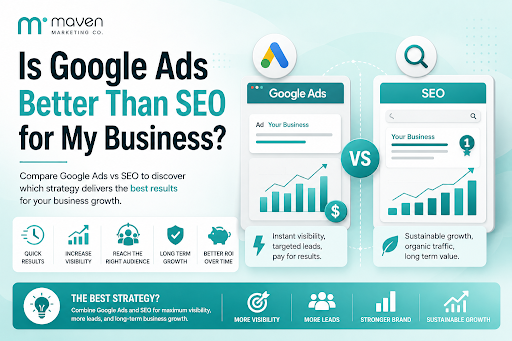
One of the biggest questions business owners ask when they are planning online growth is whether they should invest in Google Ads or SEO. Both are strong marketing plays that help your company show up in Google search results, but they do things in separate lanes. Google Ads gives quicker visibility and can bring in leads fast, whereas SEO more or less focuses on slow, steady organic traffic that tends to grow the longer you keep building it. Picking the right direction depends on what you want to achieve, how much money you can spend, how crowded the market is, and how quickly you need results, like sooner rather than later. The good news is you don’t always have to choose one or the other; it’s not exactly a black-and-white situation. If you take time to understand the strongest points of both, you can put together a more sensible digital marketing plan that supports consistent expansion. In this guide, we’ll compare Google Ads vs SEO, explain the main differences, and help you figure out what option makes the most sense for your business.

When Should I Hire a Digital Marketing Agency
Growing a business today takes more than just having a website or throwing a post on social media; customers usually search around online, compare providers, skim reviews, and basically expect the brand to show up with a solid digital presence before they even think about buying. Many businesses try to run their marketing themselves, but there comes a point when “doing it all in-house” becomes clunky and hard to manage, all at once. Knowing when to hire a digital marketing agency can end up making a big, real difference for your growth. If you’re not getting enough leads, or your online visibility feels stuck, or sales are just not moving, the right agency can bring the know-how, plus a clear plan, to help you get noticeably better outcomes. In this guide, we’ll dig into what a digital marketing agency actually does, the usual signs it’s time to bring one on, and how picking the right marketing partner can help your business move forward at a faster pace.
Why Is My Google Ads Budget Running Out So Quickly
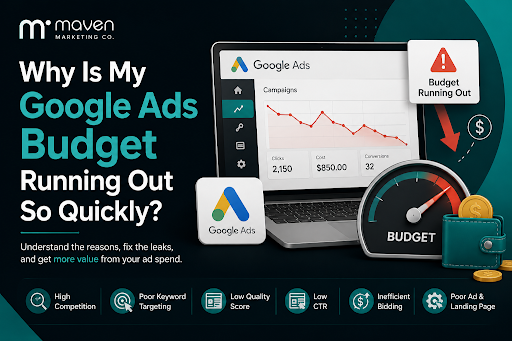
Running a successful Google Ads budget isn’t only about throwing more money at it. It’s more like making every dollar, doing a bit extra. A lot of businesses start a Google Ads campaign with big hopes, then find out their daily budget is gone within a few hours, and that feels weird, right? After that, your ads stop showing effectively, new leads slip away, and your return on investment dips. So if your Google Ads budget is running out too fast, don’t stress. It’s a fairly common issue, and in most situations, it can be repaired with the right approach. There are multiple little things that can drain your advertising money quicker than you expected, from costly keywords to audience targeting that just doesn’t quite fit. In this guide, we’ll walk through why your budget disappears so quickly, how to cut wasteful spend, and the most reliable ways to boost your Google Ads ROI, even if your budget stays the same.