.svg)


%201.svg)
Key Takeaways
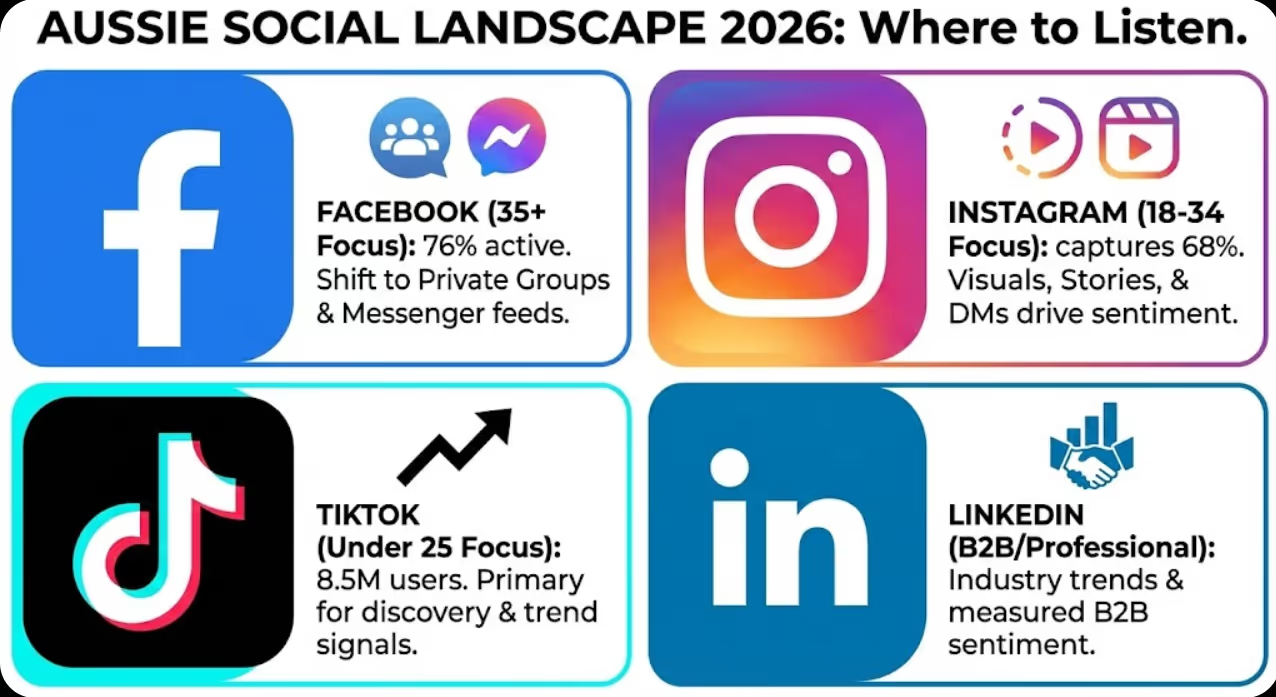
- 79% of Australian consumers expect brands to respond to social media feedback within 24 hours, making real-time listening essential
- Brands using social listening tools report 32% faster crisis response times and 41% improvement in customer satisfaction scores
- Australian consumer sentiment shifts 23% faster on social media than traditional channels, requiring continuous monitoring
- Social listening provides competitive intelligence worth an estimated $2.4 million annually for medium-sized Australian businesses
- 68% of Australian purchase decisions are influenced by social proof and peer recommendations found through social conversations
- AI-powered sentiment analysis tools now achieve 87% accuracy in understanding Australian slang, context, and cultural nuances
Why Social Media Listening Matters for Australian Brands
Traditional market research is dead. Well, not entirely—but it's certainly on life support. By the time you've commissioned a focus group, designed a survey, collected responses, and analysed results, the market has already moved on. Australian consumers are vocal, opinionated, and refreshingly direct about what they love, hate, and expect from brands. They're sharing these insights constantly—you just need to listen.
Social media listening transforms these scattered conversations into actionable intelligence. It's the difference between asking customers what they think and actually hearing what they're saying when you're not in the room. That unfiltered honesty is marketing gold.
Consider this: when Qantas launched a social media campaign asking customers to share their dream luxury flight experience, they expected positive engagement. Instead, social listening revealed mounting frustration about service issues, turning what should have been a brand-building moment into a PR challenge. Brands actively listening could have anticipated this sentiment shift and adjusted strategy accordingly.
Understanding Social Listening vs Social Monitoring
Many Australian businesses confuse social monitoring with social listening. They're related but fundamentally different.
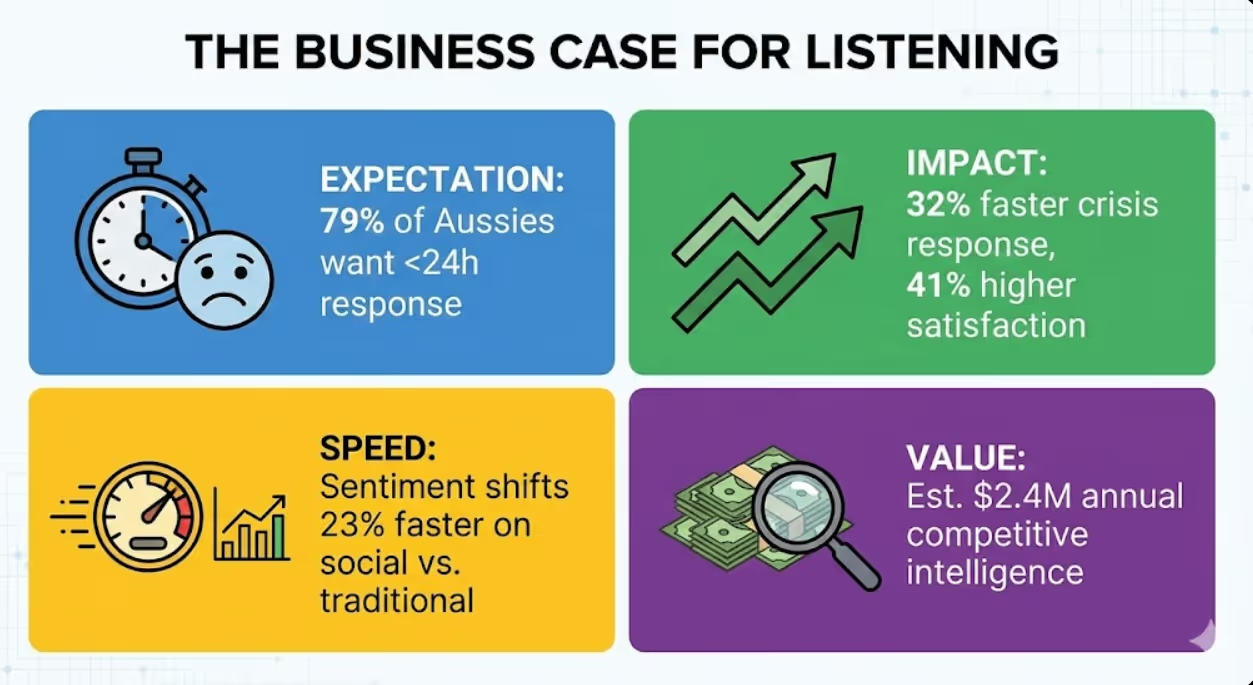
Social monitoring tracks mentions, tags, and direct comments. It's reactive. Someone mentions your brand, you see it, you respond. Think of it as keeping your ear to the ground for your brand name.
Social listening analyses broader conversations, identifies patterns, understands context, and extracts insights from discussions where your brand isn't even mentioned. It's proactive and strategic. It's understanding that when thousands of Australians start complaining about delivery delays during peak shopping periods, your logistics strategy needs immediate attention—even if they're not tagging your brand.
Monitoring tells you what happened. Listening tells you why it matters and what to do about it.
The Australian Social Media Landscape in 2026
Understanding where Australians spend their time online shapes your listening strategy. The landscape has evolved significantly, with platform preferences varying dramatically by demographic and purpose.
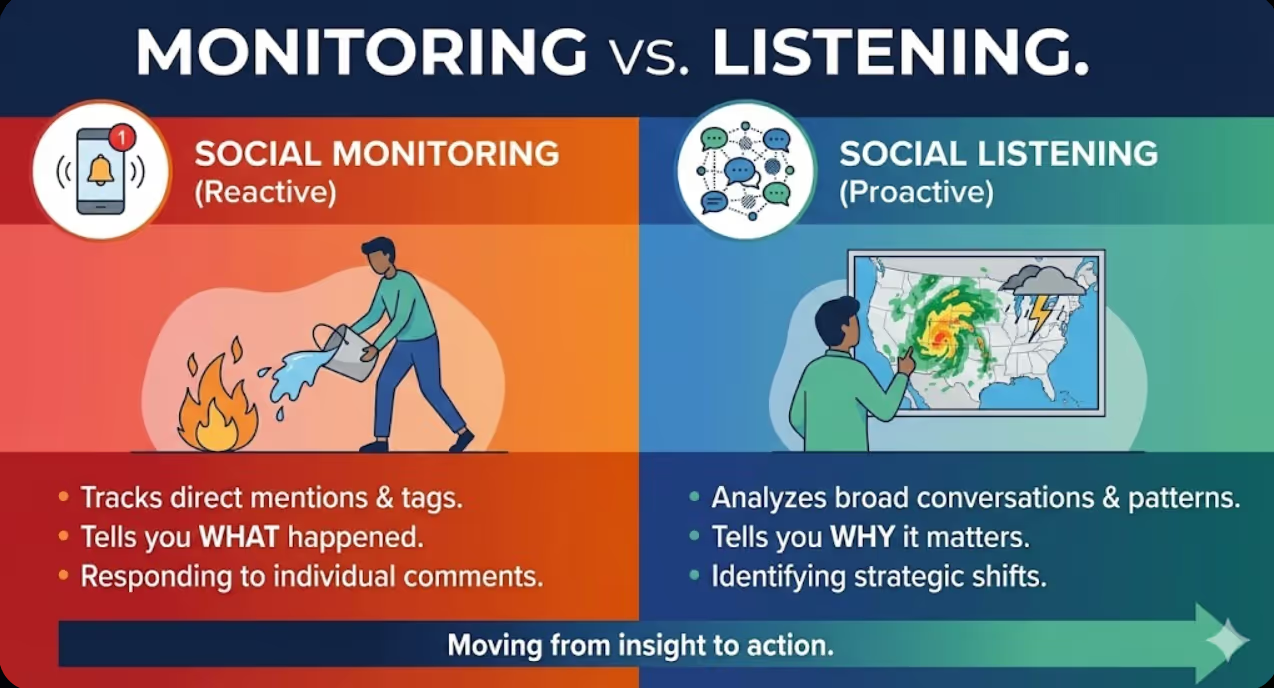
Facebook remains dominant for Australians aged 35+, with 76% actively using the platform monthly. However, engagement patterns have shifted—users spend more time in Groups and Messenger than on public feeds, requiring adjusted listening approaches.
Instagram captures 68% of Australians aged 18-34, with Stories and Reels generating the majority of brand interactions. Visual content dominates, but the conversations happening in comments and DMs reveal sentiment that static monitoring misses.
TikTok's explosive growth among Australian users under 25 cannot be ignored. With 8.5 million Australian users, it's become a primary platform for product discovery and trend formation. Brands ignoring TikTok conversations are missing critical early signals about shifting consumer preferences.
LinkedIn has transformed from a job-seeking platform to where Australian professionals discuss industry trends, share insights, and yes—express opinions about B2B brands. The sentiment shared here is often more measured but incredibly valuable for business-focused brands.
Essential Features of Effective Social Listening Tools
Not all social listening tools are created equal, and Australian brands need specific capabilities to extract meaningful insights from local conversations.
Real-Time Monitoring and Alerts
When a customer service issue starts trending or a product defect gets reported, you need to know immediately—not when you check your dashboard next Tuesday. Quality social listening platforms provide real-time alerts based on customisable triggers like sentiment spikes, volume changes, or specific keyword combinations.
Sentiment Analysis with Australian Context
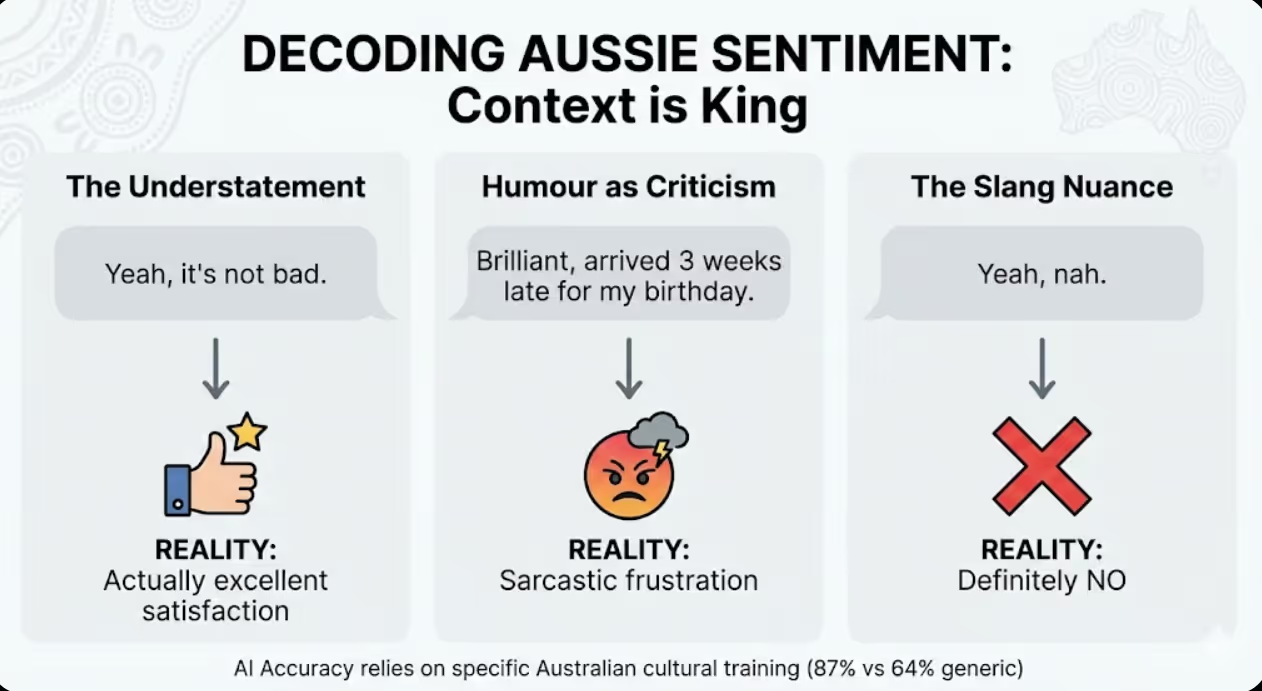
Here's where many international tools fall short. Australian English isn't just British English with different slang—it's a unique linguistic ecosystem. "Yeah, nah" doesn't mean yes-no; it means no. "How ya going?" isn't asking about your mode of transport. Your listening tool must understand these nuances or you'll misread sentiment completely.
The best tools now employ AI trained specifically on Australian conversations, achieving 87% accuracy in sentiment classification compared to 64% for generic English models.
Competitor Analysis Capabilities
Understanding what customers say about you matters. Understanding what they say about your competitors matters more. Comprehensive listening tools track competitor mentions, analyse their sentiment trends, identify their vulnerabilities, and reveal gaps you can exploit.
When Australian consumers complain about your competitor's customer service, that's your opportunity to emphasise your superior support. When they praise a competitor's feature, that's your product development roadmap talking.
Demographic and Geographic Filtering
Australia is vast and diverse. Consumer sentiment in Brisbane differs from Melbourne, which differs from Perth. Your listening tool should segment conversations by location, age, gender, interests, and other demographics relevant to your target market.
A sunscreen brand discovered through geographic filtering that Northern Territory customers had completely different product expectations than Victorian customers—insights that transformed their marketing approach and product development.
Integration with Business Systems
Social listening insights are worthless if they stay trapped in a separate platform. The most valuable tools integrate seamlessly with your CRM, marketing automation, customer service platforms, and business intelligence systems, turning social insights into automated actions and measurable outcomes.
Top Social Listening Tools for Australian Brands
Selecting the right tool depends on your budget, team size, and specific objectives. Here's an honest assessment of leading platforms based on Australian brand experiences.
Brandwatch (Enterprise Solution)
Brandwatch offers extraordinary depth and customisation, making it ideal for large Australian enterprises managing complex, multi-brand portfolios. The platform excels at historical analysis, allowing you to examine sentiment trends over years, not just recent weeks.
Australian brands like Telstra and Woolworths use Brandwatch for its robust data visualisation and ability to track millions of conversations simultaneously. The downside? Pricing starts around $108,000 annually, putting it beyond reach for most SMEs.
Hootsuite Insights (Mid-Market Sweet Spot)
For Australian businesses with $2-20 million revenue, Hootsuite Insights delivers impressive capability at accessible pricing ($5,000-15,000 annually depending on requirements). It integrates naturally with Hootsuite's social management features, creating a unified workflow.
The sentiment analysis performs well with Australian content, and the competitor tracking features provide actionable intelligence without overwhelming smaller teams. The learning curve is manageable, with most marketing coordinators achieving proficiency within two weeks.
Sprout Social (User-Friendly Option)
Sprout Social prioritises usability, making it perfect for Australian brands new to social listening or with limited technical resources. The interface is intuitive, reports are beautiful, and the sentiment analysis, whilst not as sophisticated as enterprise solutions, handles Australian conversations competently.
Pricing sits around $3,000-8,000 annually, and according to user research, customer satisfaction rates consistently exceed 4.5/5 stars. The mobile app is particularly strong, allowing marketing managers to monitor sentiment whilst away from desks.
Meltwater (Comprehensive Media Monitoring)
Meltwater extends beyond social listening to encompass traditional media monitoring—valuable for Australian brands where print and broadcast still matter. The platform tracks news mentions, broadcast segments, and social conversations in one unified view.
This comprehensive approach revealed crucial insights for Australian retail brands during recent supply chain disruptions, connecting social sentiment with mainstream media coverage to provide complete crisis context.
Mention (Budget-Conscious Choice)
Starting at approximately $300 monthly, Mention delivers surprising value for Australian small businesses and startups. While it lacks the depth of enterprise platforms, it covers essential listening needs: brand mentions, competitor tracking, basic sentiment analysis, and influencer identification.
The boolean search functionality is robust, allowing precise query construction that compensates for less sophisticated AI. For businesses just beginning their listening journey, Mention provides an affordable entry point.
Building Your Social Listening Strategy
Tools alone don't deliver insights—strategy does. Here's how successful Australian brands structure their social listening programmes.
Define Clear Objectives
What questions do you need answered? "What do people think about us?" is too vague. Instead, focus on specific, actionable questions:
- How does sentiment about our customer service compare to our main competitor?
- What features do customers request most frequently?
- Which product complaints predict higher churn rates?
- What early warning signals precede negative reviews?
- How do different demographics perceive our brand values?
Each objective requires different listening queries, analysis approaches, and success metrics.
Identify Relevant Keywords and Hashtags
Your listening queries determine what insights you'll uncover. Start with obvious terms—your brand name, products, key executives—then expand to industry terminology, competitor names, common misspellings, and related concepts.
Australian outdoor brand Kathmandu doesn't just track "Kathmandu" mentions. They monitor "hiking gear Australia," "camping equipment," competitor names, popular hiking locations, and weather-related conversations that signal purchase intent.
Boolean operators refine your queries: "customer service" AND "terrible" NOT "joke" captures genuine complaints whilst filtering casual hyperbole.
Establish Baseline Metrics
Before you can identify unusual patterns, you need to understand normal. Spend 30-60 days establishing baseline metrics for mention volume, sentiment distribution, common topics, peak conversation times, and influential voices in your space.
These baselines become your reference point. When mention volume spikes 340%, you'll know something significant is happening. When sentiment shifts from 65% positive to 43% positive, you can investigate before minor issues become major problems.
Create Response Protocols
Social listening without action is expensive eavesdropping. Develop clear protocols for different scenarios:
- Negative sentiment spike → Investigate root cause within 2 hours, prepare holding statement
- Product issue trending → Alert product team immediately, prepare customer communication
- Positive brand advocacy → Engage and amplify, identify potential brand ambassadors
- Competitor vulnerability identified → Brief sales team, adjust positioning
- Industry trend emerging → Convene strategy session within 48 hours
These protocols transform insights into coordinated action, dramatically improving response effectiveness.
Decoding Australian Consumer Sentiment
Australian consumers express sentiment differently than Americans, British, or Asian markets. Understanding these nuances prevents costly misinterpretation.
The Australian Understatement
Australians habitually understate both praise and criticism. "Not bad" often means excellent. "Bit disappointing" might indicate serious frustration. Your sentiment analysis must account for this cultural tendency toward linguistic moderation.
When an Australian reviewer writes "Yeah, it's pretty good I guess," they're often more satisfied than an American writing "AMAZING PRODUCT!!!" Understanding this context prevents undervaluing genuinely positive sentiment.
Humour as Criticism
Australians frequently use sarcasm and humour to express dissatisfaction. A tweet saying "Oh brilliant, my package arrived only three weeks late, just in time for last month's birthday" drips with sarcasm that basic sentiment analysis might miss.
Advanced tools with Australian cultural training recognise these patterns, but human oversight remains essential for capturing nuanced criticism wrapped in wit.
Direct Communication Style
When Australians are truly upset, they're refreshingly direct. Unlike some cultures where extreme politeness masks dissatisfaction, Australian consumers tell you exactly what's wrong, often with colourful language.
This directness is actually helpful—there's no need to read between lines. The challenge is responding appropriately to blunt feedback without becoming defensive.
Turning Insights into Action: Real Australian Examples
Social listening delivers value only when insights drive decisions. Here's how leading Australian brands translate monitoring into measurable outcomes.
Disaster Recovery: Queensland Tourism
Following devastating floods, Tourism Queensland used social listening to understand precisely how disaster coverage affected tourism perception. Rather than assuming all publicity was bad, their analysis revealed international travellers weren't canceling—they simply needed reassurance about specific regions.
This insight shaped a targeted campaign emphasising unaffected areas and recovery progress, resulting in tourism bookings recovering 60% faster than projections. The campaign was built entirely on sentiment data showing what international audiences actually needed to hear.
Product Development: Thankyou Group
Social enterprise Thankyou Group uses continuous social listening to guide product development. When conversations revealed growing concern about plastic packaging, even among customers loving their products, they accelerated development of alternative packaging solutions.
The listening data provided both the business case (quantified customer demand) and specific direction (which products customers prioritised for packaging changes). The resulting innovations strengthened brand loyalty whilst addressing legitimate customer concerns.
Crisis Prevention: Coles Supermarkets
Coles implemented sophisticated listening protocols during COVID-19, monitoring conversations about product availability, safety concerns, and shopping experiences. When sentiment analysis detected rising frustration about elderly customers struggling during peak hours, they introduced dedicated shopping hours for seniors before the issue escalated to widespread criticism.
This proactive response, driven entirely by social listening insights, generated overwhelmingly positive sentiment and strengthened community relationships during a challenging period.
Competitive Positioning: Australian FinTechs
Multiple Australian fintech companies monitor conversations about traditional banks, identifying frustration points to inform positioning. When social listening revealed growing anger about banking fees, digital banks like Up and 86 400 aggressively marketed their fee-free alternatives.
The timing, messaging, and channel selection for these campaigns came directly from understanding when, where, and how Australians discussed banking frustrations online.
Measuring Social Listening ROI
CFOs demand ROI justification for every investment. Here's how to demonstrate social listening's financial impact.
Crisis Mitigation Value
Calculate what prevented crises are worth. If social listening helps you identify and address three potential PR crises annually, each potentially costing $150,000 in reputation damage and lost sales, that's $450,000 in protected value.
Australian telecommunications companies have quantified crisis response improvements of 32% faster reaction times and 41% better customer satisfaction outcomes when social listening informs their approach.
Customer Acquisition Cost Reduction
Social listening identifies high-intent prospects discussing relevant problems. Engaging these warm leads costs dramatically less than cold acquisition. Track conversion rates and acquisition costs for social-sourced leads versus traditional channels.
Australian B2B brands report 67% lower acquisition costs for prospects identified through social listening compared to outbound prospecting.
Product Development Efficiency
Failed product launches cost millions. Social listening reduces this risk by validating concepts with real market demand before major investment. Track how listening-informed decisions improve product success rates and reduce development waste.
Customer Retention Impact
Monitoring customer sentiment allows proactive intervention before dissatisfaction leads to churn. Calculate the lifetime value of customers retained through listening-informed outreach.
One Australian subscription service credited social listening with identifying at-risk customers, enabling retention interventions that saved an estimated $2.3 million in annual recurring revenue.
Privacy, Ethics, and Compliance Considerations
Australian Privacy Principles and the Privacy Act 1988 govern how brands can collect and use consumer data, including social media conversations.
Public vs Private Conversations
Monitoring public social media posts is generally permissible—users posting publicly have limited privacy expectations. However, accessing private groups, closed communities, or direct messages without explicit consent violates privacy principles.
Reputable listening tools only index publicly available content, but brands must still use this data responsibly.
Transparency and Consumer Trust
Leading Australian brands embrace transparency about social listening. Rather than treating it as covert surveillance, they position it as customer-centric: "We monitor social conversations to better understand and serve you."
This transparency builds trust rather than eroding it. Consumers appreciate brands that genuinely listen and respond to their feedback.
Data Security and Storage
Social listening platforms process enormous amounts of consumer data. Ensure your chosen tool complies with Australian data protection standards, stores data securely, and has clear policies about data retention and deletion.
Ask potential vendors about their security certifications, data handling procedures, and compliance with Australian regulations before committing.
Common Social Listening Mistakes to Avoid
Even experienced marketers stumble with social listening. Here are pitfalls that derail Australian programmes.
Listening Without Acting
The most common failure is comprehensive listening with zero follow-through. You track everything, generate beautiful reports, then... nothing changes. Insights without action waste money and demoralise teams.
Establish decision-making frameworks before implementing listening tools. Define who receives which insights, what actions they're authorised to take, and how quickly they must respond.
Narrow Query Parameters
Listening only for your exact brand name misses crucial conversations. Customers discussing your product category, problem you solve, or competitor alternatives provide valuable context.
Expand queries to capture the full conversation ecosystem around your business, not just direct mentions.
Ignoring Context
A surge in mentions isn't automatically good or bad—context determines significance. When a Queensland brewery saw mentions spike 600%, they initially celebrated. Deeper analysis revealed a viral video criticising their handling of a customer complaint.
Always investigate spikes before reacting. Volume alone tells you something happened, not what or whether it matters.
Forgetting Human Analysis
AI-powered sentiment analysis is remarkable but imperfect. Sarcasm, context-dependent language, and cultural nuances still confuse algorithms. Treat automated sentiment scores as signals requiring human verification, not absolute truth.
The Future of Social Listening in Australia
Social listening technology evolves rapidly, with several trends reshaping how Australian brands monitor consumer sentiment.
Predictive Analytics Integration
Next-generation platforms don't just report current sentiment—they predict future trends. By analysing historical patterns, AI models forecast sentiment shifts before they fully materialise, giving brands unprecedented lead time for strategic adjustments.
Australian retail brands are testing these predictive capabilities for seasonal demand forecasting, achieving 73% accuracy in predicting product category interest 6-8 weeks before traditional sales data confirms trends.
Voice and Audio Analysis
As podcasts, voice messages, and audio social platforms grow, listening tools are expanding beyond text. Voice sentiment analysis captures emotional nuance that text misses—frustration, excitement, uncertainty all evident in tone, pace, and inflection.
Privacy-First Listening
Tightening privacy regulations are pushing listening tools toward privacy-preserving analysis. Techniques like differential privacy and federated learning allow insights extraction without compromising individual privacy.
Australian brands should prioritise vendors innovating in privacy-safe listening methods, future-proofing their programmes against inevitable regulatory evolution.
Integrated Experience Platforms
The future isn't standalone listening tools but comprehensive experience platforms integrating social listening with customer data platforms, marketing automation, and business intelligence systems. Insights automatically trigger personalised responses, update customer profiles, and inform strategic decisions without manual intervention.
Getting Started with Social Listening Today
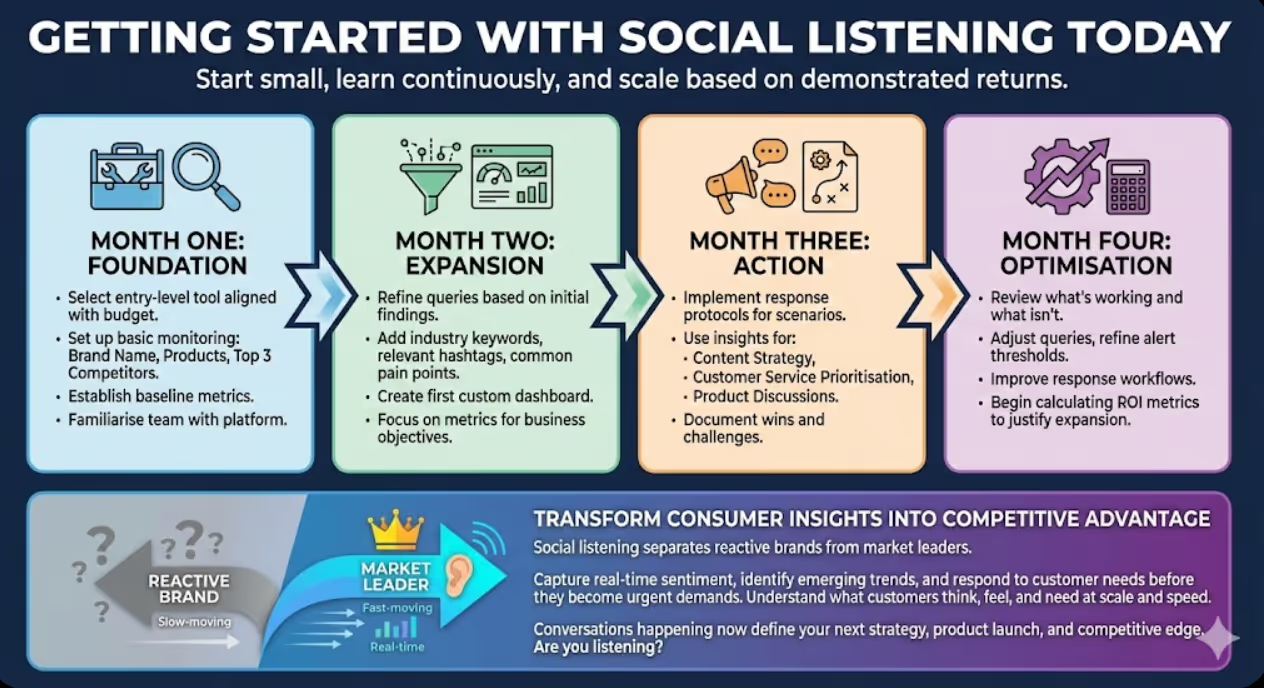
You don't need a massive budget or sophisticated team to begin extracting value from social listening. Start small, learn continuously, and scale based on demonstrated returns.
Month One: Foundation
Select an entry-level tool aligned with your budget. Set up basic monitoring for your brand name, products, and top three competitors. Establish baseline metrics and begin familiarising your team with the platform.
Month Two: Expansion
Refine queries based on initial findings. Add industry keywords, relevant hashtags, and common customer pain points. Create your first custom dashboard focusing on metrics that matter to your specific business objectives.
Month Three: Action
Implement response protocols for identified scenarios. Begin using insights to inform content strategy, customer service prioritisation, and product discussions. Document wins and challenges.
Month Four: Optimisation
Review what's working and what isn't. Adjust queries, refine alert thresholds, and improve response workflows. Begin calculating ROI metrics to justify programme expansion.
Transform Consumer Insights into Competitive Advantage
Social listening separates reactive brands from market leaders. While your competitors wait for formal feedback, you're capturing real-time sentiment, identifying emerging trends, and responding to customer needs before they become urgent demands.
The Australian brands dominating their markets aren't necessarily those with the biggest budgets—they're those who genuinely understand what customers think, feel, and need. Social listening provides that understanding at a scale and speed traditional research simply cannot match.
The conversations happening right now on social media contain the insights that will define your next quarter's strategy, inform your next product launch, and determine whether customers choose you over competitors. The only question is whether you're listening.
Start Listening, Start Leading
Implementing an effective social listening programme requires more than selecting the right tools—it demands strategic thinking, cultural change, and commitment to acting on insights you uncover.
At Maven Marketing Co, we specialise in helping Australian businesses build sophisticated social listening capabilities that deliver measurable results. Our team has implemented successful programmes for brands across industries, from e-commerce startups to established enterprises, transforming social conversations into competitive intelligence and actionable strategy.
Ready to understand what Australian consumers really think about your brand, your competitors, and your industry? Let's discuss how social listening can provide the insights driving your next phase of growth. Visit mavenmarketingco.com.au to schedule your complimentary social listening audit and discover what conversations you're missing.

Table of contents
read more blogs
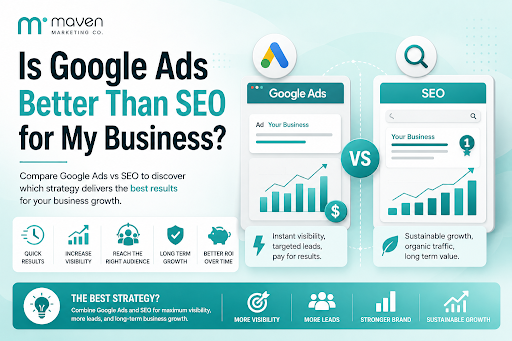
Is Google Ads Better Than SEO for My Business
One of the biggest questions business owners ask when they are planning online growth is whether they should invest in Google Ads or SEO. Both are strong marketing plays that help your company show up in Google search results, but they do things in separate lanes. Google Ads gives quicker visibility and can bring in leads fast, whereas SEO more or less focuses on slow, steady organic traffic that tends to grow the longer you keep building it. Picking the right direction depends on what you want to achieve, how much money you can spend, how crowded the market is, and how quickly you need results, like sooner rather than later. The good news is you don’t always have to choose one or the other; it’s not exactly a black-and-white situation. If you take time to understand the strongest points of both, you can put together a more sensible digital marketing plan that supports consistent expansion. In this guide, we’ll compare Google Ads vs SEO, explain the main differences, and help you figure out what option makes the most sense for your business.

When Should I Hire a Digital Marketing Agency
Growing a business today takes more than just having a website or throwing a post on social media; customers usually search around online, compare providers, skim reviews, and basically expect the brand to show up with a solid digital presence before they even think about buying. Many businesses try to run their marketing themselves, but there comes a point when “doing it all in-house” becomes clunky and hard to manage, all at once. Knowing when to hire a digital marketing agency can end up making a big, real difference for your growth. If you’re not getting enough leads, or your online visibility feels stuck, or sales are just not moving, the right agency can bring the know-how, plus a clear plan, to help you get noticeably better outcomes. In this guide, we’ll dig into what a digital marketing agency actually does, the usual signs it’s time to bring one on, and how picking the right marketing partner can help your business move forward at a faster pace.
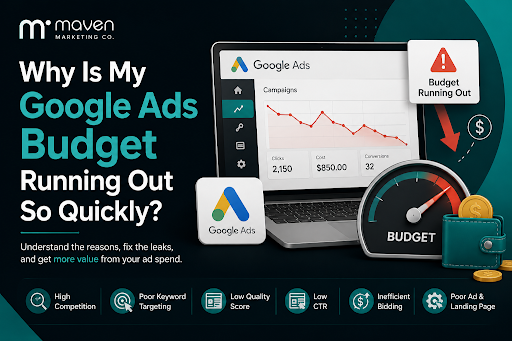
Why Is My Google Ads Budget Running Out So Quickly
Running a successful Google Ads budget isn’t only about throwing more money at it. It’s more like making every dollar, doing a bit extra. A lot of businesses start a Google Ads campaign with big hopes, then find out their daily budget is gone within a few hours, and that feels weird, right? After that, your ads stop showing effectively, new leads slip away, and your return on investment dips. So if your Google Ads budget is running out too fast, don’t stress. It’s a fairly common issue, and in most situations, it can be repaired with the right approach. There are multiple little things that can drain your advertising money quicker than you expected, from costly keywords to audience targeting that just doesn’t quite fit. In this guide, we’ll walk through why your budget disappears so quickly, how to cut wasteful spend, and the most reliable ways to boost your Google Ads ROI, even if your budget stays the same.