.svg)


%201.svg)

Key Takeaways
- Vanity metrics including total followers, raw impression counts, and aggregate likes create illusions of social media effectiveness whilst concealing whether platform activity generates genuine business outcomes worth the investment required
- Meaningful social media metrics reveal audience quality through engagement rates, follower demographic alignment, and content interaction depth that distinguish genuinely valuable audiences from inflated follower counts with minimal commercial relevance
- Conversion attribution connecting social media activity to website traffic, lead generation, and revenue through UTM parameters, GA4 integration, and multi-touch attribution reveals commercial impact invisible in platform-native analytics
- Content performance analysis beyond aggregate metrics identifies which specific content types, topics, formats, and posting patterns generate highest-quality engagement from target audience segments rather than simply maximising total interaction volumes
- Competitive benchmarking contextualises performance against relevant Australian industry peers and direct competitors, revealing whether metrics represent genuine strength or acceptable underperformance relative to accessible alternatives
A Brisbane professional services firm measured social media success through monthly follower growth and total post likes. Both metrics grew consistently. The social media manager presented monthly reports showing upward trends that leadership celebrated as evidence of successful social media investment. After 18 months and approximately $45,000 in social media management costs, the firm's business development director asked a simple question: how many clients had social media activity actually generated?
Investigation was uncomfortable. Website traffic from social media channels represented 3% of total traffic, almost entirely from existing clients and competitors researching the firm rather than genuine prospects. Lead attribution revealed zero confirmed client acquisitions from social media during the 18-month period. Content reached audiences with minimal overlap with the firm's target client profile—manufacturing executives and supply chain managers who weren't meaningfully represented among the primarily consumer-focused social audience the firm had built.
Follower counts and likes had grown impressively whilst generating no measurable commercial contribution. Vanity metrics had provided comfortable evidence of activity whilst concealing complete absence of business impact. Redirecting investment toward content explicitly targeting manufacturing sector audiences, LinkedIn-focused distribution reaching actual decision-makers, and measurement frameworks tracking prospect engagement rather than aggregate likes transformed social media from expensive vanity exercise into genuine business development contribution within six months.
According to research from Sprout Social, 55% of marketers struggle to prove social media ROI to their organisations, with vanity metric reliance being the primary reason genuine commercial contribution remains unmeasured and consequently unjustifiable to financially focused leadership.
Understanding Vanity Metrics and Their Limitations
Identifying which metrics are vanity metrics and understanding why they mislead requires examining what they actually measure versus what they imply.
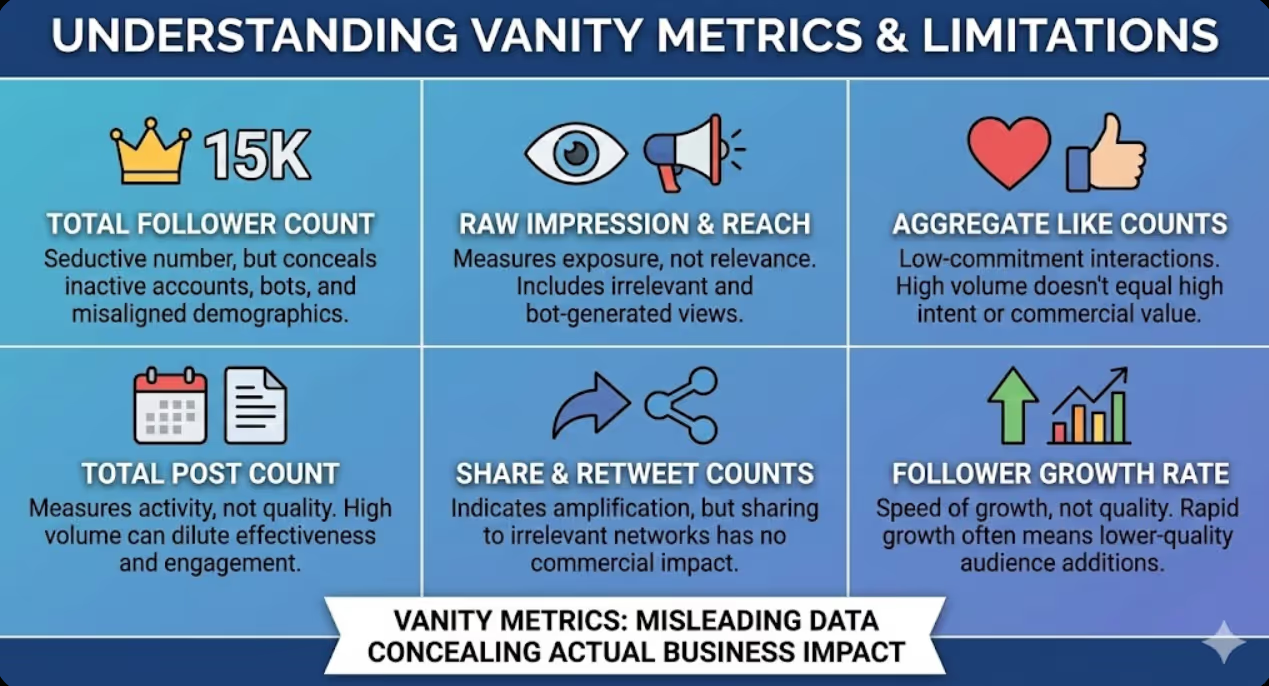
Total follower count represents the most seductive vanity metric—a single impressive number that grows consistently and implies audience development. Follower count problems include accumulation of inactive accounts that never engage with content, bot followers that artificially inflate counts without representing real humans, follower demographics that often don't match target customer profiles, and persistent legacy followers from outdated content strategies who remain subscribed despite complete disengagement. A professional services firm with 15,000 Instagram followers primarily built through lifestyle content contests has a larger following than a competitor with 3,000 highly engaged manufacturing executive followers on LinkedIn—yet the competitor's smaller audience represents incomparably superior commercial value.
Raw impression and reach figures measure content exposure without distinguishing between valuable target audience exposure and irrelevant demographic exposure that generates no commercial value. Ten thousand impressions from target customer demographics represents meaningful market exposure. Ten thousand impressions from geographically irrelevant, demographically misaligned, or bot-generated accounts represents noise disguised as reach. Platform algorithms optimising for total engagement often distribute content to audiences that engage with content format (short-form video) regardless of content relevance—maximising reach metrics whilst minimising commercial relevance.
Aggregate like and reaction counts measure positive sentiment signals without revealing intensity, audience quality, or commercial significance. Likes are extraordinarily low-commitment interactions—requiring minimal attention and generating no reliable purchase intent signal. Content attracting thousands of likes from misaligned audiences generates more impressive-looking metrics than content attracting dozens of thoughtful comments from target customer prospects—whilst delivering far less genuine business value. Like counts also reflect platform algorithm decisions about content distribution as much as genuine audience sentiment, since content distributed to larger audiences naturally accumulates more absolute likes regardless of proportional engagement rate.
Total post count and publishing frequency measure content production activity without revealing content quality, audience relevance, or performance impact. Publishing daily across multiple platforms generates impressive activity metrics whilst potentially diluting quality below the threshold required for meaningful audience engagement. Content volume metrics encourage quantity-over-quality approaches that satisfy reporting requirements whilst degrading content effectiveness—the opposite of optimal social media investment allocation.
Share and retweet counts indicate content distribution amplification but don't distinguish between shares reaching additional target audience members and shares reaching audiences with no commercial relevance. A meme shared by existing audience members to similarly demographically irrelevant networks generates impressive share metrics without meaningful commercial impact. Shares within professional industry networks reaching additional target decision-maker prospects generate modest share counts with substantial commercial value—the same metric measuring fundamentally different outcomes depending entirely on sharing audience characteristics.
Follower growth rate measures audience expansion speed without assessing whether new followers represent genuine audience quality improvement or simply quantitative audience inflation. Rapid follower growth from viral content appealing to broad audiences rather than target segments accelerates vanity metric accumulation whilst potentially degrading audience quality—the proportion of followers matching target customer profiles declines even as total follower counts rise impressively. Sustainable follower growth strategies deliberately sacrifice growth rate for growth quality, producing slower count increases that represent substantially superior commercial audience development.

Meaningful Social Media Metrics Framework
Replacing vanity metrics requires identifying specific measurements that genuinely reveal commercial performance, audience quality, and content effectiveness.
Engagement rate calculates proportional audience interaction rather than absolute interaction volume, dividing total engagements (likes, comments, shares, saves, clicks) by reach or follower count and expressing as percentage. Engagement rate reveals what proportion of reached audience finds content valuable enough to interact with—a more meaningful quality signal than absolute engagement volume that scales with audience size regardless of content quality. Industry benchmark engagement rates vary significantly by platform and sector. According to Rival IQ's social media industry benchmarks, median Instagram engagement rates hover around 0.43%, with LinkedIn typically lower at 0.35% and Facebook lower still at 0.064%—contextualising your rates against industry medians reveals whether performance is strong, average, or weak relative to comparable organisations.
Audience demographic alignment measures the overlap between your social media audience characteristics and your target customer profile. Platform analytics providing age, gender, geographic location, and (on LinkedIn) professional characteristics including job title, industry, and company size enable direct comparison between actual audience composition and ideal customer profile. High demographic alignment indicates content strategy successfully attracting commercially relevant audiences. Poor alignment indicates content or distribution strategies building numerically impressive but commercially irrelevant audiences that generate vanity metrics without prospect development value. Regular demographic alignment assessment catches audience drift—gradual shift away from target demographics through algorithm-driven distribution to engaging but commercially irrelevant audience segments.
Content saves and bookmarks represent highest-quality engagement signals available on most platforms, indicating audiences find content sufficiently valuable to reference later rather than consuming and immediately forgetting. Save rates on Instagram, bookmark rates on Twitter/X, and document save rates on LinkedIn indicate content delivering genuine practical value—the kind of value-demonstrating content that builds authority and generates consideration among target prospects. High save rates relative to reach indicate content quality exceeding passive entertainment threshold into genuine utility territory that drives brand consideration and recall.
Comment quality analysis distinguishes surface-level engagement from genuine audience connection. Automated comment responses ("Great post!"), emoji reactions, and generic acknowledgements indicate algorithmic engagement behaviour rather than meaningful content resonance. Specific, substantive comments engaging with content ideas, asking follow-up questions, sharing related experiences, or initiating genuine dialogue indicate content connecting authentically with audience interests and concerns. Comment quality analysis requires human review rather than automated counting—sentiment tools and AI classifiers provide useful starting points but miss nuance that distinguishes meaningful from formulaic responses.
Link click-through rates measure content success at motivating audience actions beyond passive platform consumption. Click-through rate (link clicks divided by reach or impressions) reveals what proportion of reached audience finds content compelling enough to leave their social media environment and visit your website, landing page, or resource. For commercial social media objectives, link clicks represent the critical bridge between platform engagement and business outcome generation—content generating high impressions and engagement but zero clicks serves brand awareness objectives only rather than driving website-dependent conversion outcomes.
Audience growth quality indicators extend beyond follower count to assess whether audience additions represent target prospect acquisition or irrelevant audience inflation. New follower demographic analysis reveals whether growth reflects target audience development. Follower engagement rates within new cohorts reveal whether recent growth additions are actively engaging or simply inflating counts passively. Follower source analysis (organic search discovery, hashtag exploration, paid promotion, referral from specific content) reveals which audience development mechanisms produce highest-quality followers worth optimising for.
Share of voice measures your brand's presence in relevant social conversations relative to competitors—the proportion of industry discussions, relevant hashtag usage, and category conversations where your brand appears. Share of voice reveals competitive positioning in organic audience conversations rather than just your own channel metrics. Growing share of voice indicates increasing organic brand relevance within target audience conversations. Declining share of voice despite impressive owned channel metrics might indicate competitors winning mindshare in conversations your metrics don't capture.
Platform-Specific Analytics Interpretation
Each major social platform provides distinct analytics requiring platform-specific interpretation frameworks reflecting different audience behaviours, content formats, and measurement methodologies.
LinkedIn analytics serve Australian B2B organisations through professional audience metrics unavailable on consumer platforms. Follower demographics including job titles, industries, seniority levels, and company sizes enable direct assessment of audience relevance to B2B target customer profiles. Post impression-to-click ratios reveal content effectiveness at motivating professional audience action beyond passive consumption. Article view durations indicate whether thought leadership content sustains professional audience reading engagement through full content or generates clicks that immediately abandon. Connection request rates following content publication indicate content effectiveness at motivating network development beyond passive engagement. LinkedIn's relatively small but commercially dense Australian professional audience means modest absolute metrics can represent substantial commercial value—500 clicks from CFOs and finance directors on a tax planning article represents more qualified audience development than 5,000 clicks from demographically irrelevant audiences.
Instagram analytics require distinguishing between business development and brand awareness objectives given platform's primarily consumer-oriented audience demographics. Reach versus impressions ratio reveals content distribution efficiency—high reach relative to impressions indicates content reaching diverse accounts rather than repeatedly serving same accounts. Story completion rates reveal sequential content engagement depth that feed post metrics don't capture. Profile visit rates following post exposure indicate content successfully motivating audience curiosity about your organisation beyond specific content. Link in bio click rates from story swipe-ups and post call-to-action prompts measure commercial action motivation. Shopping tag interaction rates for product-oriented Australian e-commerce businesses reveal direct purchase consideration signals. Instagram's Australian audience skews younger and more consumer-oriented—B2B organisations should assess whether their target decision-making audiences are meaningfully represented before investing heavily in Instagram audience development.
Facebook analytics interpretation requires acknowledging platform's dramatically reduced organic reach for business pages in recent years. Organic reach percentage (organic reach divided by page likes) reveals content effectiveness at penetrating Facebook's algorithmically constrained organic distribution. Video retention rates reveal whether video content sustains engagement or generates auto-play views that immediately scroll past. Event response rates for Australian businesses using Facebook events measure genuine interest expression beyond passive page following. Group engagement rates for businesses maintaining Facebook communities reveal community health through active member participation rates. Facebook's Australian user base remains substantial but skews toward older demographics and consumer rather than professional contexts—audience quality assessment is particularly important given algorithmic content distribution that can inflate impression metrics without meaningful audience relevance.
Twitter/X analytics interpretation in Australian contexts requires acknowledging platform's evolving landscape following ownership changes affecting algorithm transparency and user base composition. Profile visit rates following tweet exposure reveal content effectiveness at motivating genuine brand investigation. Link click rates measure commercial action motivation relative to total impressions. Follower profile analysis reveals whether Twitter/X audience represents valuable professional, media, or industry peer segments for your specific business objectives. Mention sentiment and content quality analysis reveals brand conversation quality beyond mention volume—being mentioned frequently in negative contexts indicates reputation concerns that positive mention count metrics obscure.
TikTok analytics for Australian businesses warrant careful assessment of whether platform's primarily younger Australian demographic represents genuine target audience before significant investment. Average video watch duration and completion rates reveal content effectiveness at sustaining attention through full videos rather than generating auto-play views that immediately scroll. Profile visit and follow rates following video exposure measure content's audience development effectiveness. Sound usage and stitch/duet engagement rates indicate content virality potential beyond initial distribution. For Australian consumer brands with younger target demographics, TikTok analytics can reveal genuine commercial audience engagement—for B2B or older demographic target markets, impressive TikTok metrics frequently represent entertaining content performance rather than commercially relevant audience development.

Conversion Attribution and Commercial Impact Measurement
Connecting social media activity to commercial outcomes requires deliberate attribution infrastructure rather than hoping platform-native analytics reveal business impact.
UTM parameter implementation is the foundational requirement for social media conversion attribution. Append UTM parameters (utm_source, utm_medium, utm_campaign, utm_content) to every link shared from social platforms, enabling GA4 to attribute website sessions, goal completions, and revenue to specific social media sources, campaigns, and content pieces. Consistent UTM parameter conventions across all social platforms enable meaningful cross-platform comparison in GA4—comparing LinkedIn versus Instagram versus Facebook conversion contributions through standardised attribution rather than platform-native metrics that use different methodologies and can't be directly compared. Google's Campaign URL Builder simplifies UTM parameter creation for non-technical social media managers.
GA4 social media channel analysis reveals actual conversion contribution beyond platform-reported traffic figures. GA4's acquisition reporting shows sessions, engaged sessions, conversions, and revenue by social media channel using UTM-attributed data rather than platform self-reporting that frequently overcounts attribution. Social media channels in GA4 often report significantly lower traffic and conversion figures than platform analytics suggest—the discrepancy reflects platform tendency to claim attribution credit that GA4's independent measurement attributes elsewhere. Trusting GA4 over platform self-reporting provides more accurate commercial impact picture, even when that picture is less flattering to social media investment.
Multi-touch attribution modelling acknowledges that social media's commercial contribution frequently appears at journey stages other than final conversion. Prospects who discover your brand through social content might convert weeks later through direct navigation or organic search—last-click attribution assigns conversion credit to the final touchpoint rather than the initial social discovery. GA4's data-driven attribution model distributes conversion credit across multiple touchpoints proportional to their actual influence, revealing social media's contribution to journeys that convert through other channels. Multi-touch attribution consistently shows social media generating more commercial contribution than last-click attribution credits, though rarely as much as platform self-reported attribution claims.
Revenue per follower calculations contextualise social media commercial efficiency across different audience sizes and demographics. Divide total revenue attributed to social media channels by total follower count across relevant platforms. Comparing revenue per follower across platforms reveals where audience quality generates greatest commercial return per follower acquired and maintained. A LinkedIn audience generating $12 revenue per follower annually dramatically outperforms an Instagram audience generating $0.80 revenue per follower—justifying disproportionate LinkedIn investment despite smaller absolute audience size. Revenue per follower calculations should inform audience development strategy prioritisation rather than treating all followers as equivalently valuable regardless of platform or demographic.
Lead quality tracking from social media extends attribution beyond lead volume to lead conversion and revenue generation. Implement lead source tracking in your CRM that captures social media attribution for all leads, then track lead-to-opportunity and opportunity-to-close rates by source. Social media leads frequently convert at different rates than other channels—sometimes dramatically lower (social discovery leads requiring extensive nurturing) and sometimes higher (warm referral leads arriving pre-convinced through extensive social content consumption). Lead quality metrics reveal true commercial value of social media lead generation beyond raw lead volume that misrepresents commercial contribution when conversion rates differ significantly from other channels.
Competitive Benchmarking and Industry Context
Contextualising social media performance against relevant benchmarks transforms raw metrics into meaningful performance assessments.
Competitor analysis provides the most directly relevant performance benchmarks for Australian businesses operating in specific competitive contexts. Analyse competitor engagement rates, content performance patterns, audience growth trajectories, and content strategy approaches using social media analytics tools including Sprout Social, Hootsuite Insights, or Brandwatch. Competitor analysis reveals whether your performance represents genuine strength or relative weakness—a 2% Instagram engagement rate is excellent in industries where competitors average 0.8% but indicates underperformance in industries where competitors achieve 3.5% through superior content strategies. Sprout Social's competitive analysis features enable systematic competitor monitoring across platforms without manual data collection.
Industry benchmark comparison contextualises performance against sector averages rather than only direct competitors. Rival IQ, Socialinsider, and similar platforms publish annual social media benchmark reports segmenting performance data by industry—enabling comparison against broader industry performance distributions rather than the small sample of direct competitors you might monitor individually. Industry benchmarks reveal whether sector-wide patterns explain your performance (e.g., financial services consistently achieving lower engagement rates than lifestyle brands) or whether performance genuinely diverges from sector norms in directions warranting investigation.
Platform algorithm change impact assessment distinguishes genuine performance changes from algorithm-driven variations affecting all accounts equally. When Instagram reduces organic reach for business pages across the board, declining reach metrics reflect platform policy rather than content quality deterioration—benchmarking against competitors and industry averages during the same period reveals whether decline matches sector-wide patterns or indicates unique performance problems. Following social media industry publications (Social Media Examiner, Later Blog, Hootsuite Blog) maintains awareness of algorithm changes enabling accurate performance interpretation rather than misattributing algorithm effects to content quality or strategy changes.
Year-over-year performance comparison controls for seasonal patterns in Australian social media engagement. Australian consumer behaviour shows predictable seasonal patterns including Christmas period engagement spikes, EOFY reduced business attention, school holiday timing effects, and summer holiday content consumption shifts. Month-over-month comparison without seasonal adjustment conflates genuine performance changes with predictable cyclical patterns. Year-over-year comparison for equivalent periods reveals genuine performance trends independent of seasonal variation that month-over-month analysis obscures.
Building a Social Media Analytics Reporting Framework

Systematic reporting connects social media analytics to business decisions rather than producing impressive-looking data summaries that don't inform strategy.
Reporting cadence alignment matches reporting frequency to decision-making requirements rather than defaulting to monthly reporting for all metrics. Weekly tactical reporting monitors content performance and community management quality, identifying high-performing content for amplification and low-performing content for understanding why. Monthly strategic reporting assesses channel performance trends, audience development progress, and conversion contribution—informing content strategy adjustments and budget allocation decisions. Quarterly business impact reporting connects social media investment to commercial outcomes including leads, pipeline contribution, and revenue attribution—informing continued investment justification and strategic prioritisation.
Stakeholder-appropriate metric selection prevents overwhelming business leaders with platform-specific metrics requiring social media expertise to interpret whilst ensuring marketing teams receive operationally useful detail. Executive reporting should present social media commercial contribution through business metrics (leads generated, revenue attributed, customer acquisition contribution) rather than platform metrics (engagement rates, impression volumes) that require social media expertise to contextualise. Marketing team reporting requires platform-level detail enabling tactical optimisation decisions unavailable through business-level summaries.
Trend visualisation communicates performance trajectories more meaningfully than point-in-time metric snapshots. Displaying metrics as time series reveals momentum direction—whether performance is improving, stable, or declining—that individual metric readings obscure. Three-month rolling averages smooth week-to-week variation revealing genuine trend direction rather than noise. Combining metric trends with business context annotations (content strategy changes, algorithm updates, competitive actions) enables informed trend interpretation rather than requiring stakeholders to independently connect metric patterns to causal explanations.
Dashboard integration with broader marketing and business performance monitoring prevents social media analytics from existing in isolation from the commercial context that gives them meaning. Integrating social media metrics into marketing dashboards alongside SEO, paid advertising, and email marketing performance enables cross-channel comparison revealing relative contribution and efficiency. Business performance dashboard integration connecting social media activity to pipeline and revenue metrics demonstrates commercial contribution to financially focused leadership who evaluate all investment through commercial return frameworks rather than platform-specific performance standards.
Frequently Asked Questions
How should Australian businesses determine which social media platforms to measure and invest in when resources don't allow comprehensive presence across all platforms?
Platform selection and measurement investment should follow target audience presence rather than platform popularity or competitor presence. Research where your specific target customer segments actually spend time and consume professionally relevant content—LinkedIn for B2B professional audiences, Instagram for consumer lifestyle categories, Facebook for older Australian demographics and local community engagement, TikTok for younger consumer audiences. Measure platform commercial contribution through UTM-attributed GA4 data for all platforms you currently use before making investment allocation decisions—some platforms that seem commercially irrelevant based on platform metrics generate surprising conversion contribution when properly attributed. Concentrate measurement sophistication on two or three platforms showing genuine commercial contribution rather than maintaining superficial measurement across all platforms where you maintain presence. Abandoning low-contribution platforms entirely is often superior to maintaining presence without adequate investment to generate meaningful performance.
What's the minimum viable social media analytics setup for Australian SMEs with limited time and technical resources for comprehensive measurement?
Minimum viable social media measurement requires three components providing substantially better insight than platform-native vanity metrics alone. First, consistent UTM parameters on every social media link enabling GA4 attribution—this requires creating a simple UTM parameter template used for all social posting, taking approximately five minutes per post to implement correctly. Second, monthly GA4 social media channel review comparing traffic, engagement rates, and goal completions by social source—revealing actual website and conversion contribution rather than relying on platform self-reporting. Third, monthly engagement rate calculation for primary content pieces—dividing total engagements by reach for each post identifying content types consistently outperforming or underperforming average engagement rates. These three components require approximately two hours monthly and reveal dramatically more meaningful performance insight than unlimited time spent reviewing platform-native dashboards dominated by vanity metric presentations that obscure commercial performance.
How should Australian businesses respond when social media analytics reveal that significant investment is generating minimal commercial contribution?
Discovering poor social media commercial contribution through proper analytics is valuable intelligence enabling strategic course correction rather than cause for immediate channel abandonment. Diagnose whether poor commercial contribution reflects audience quality problems (content reaching wrong demographics), content strategy problems (content failing to motivate commercial action despite reaching appropriate audiences), conversion infrastructure problems (social traffic arriving at poor landing pages that don't convert), or attribution problems (commercial contribution occurring but not being measured correctly). Each diagnosis suggests different responses—audience quality problems require content and targeting strategy revision, content strategy problems require messaging and format experimentation, conversion problems require landing page optimisation, and attribution problems require measurement infrastructure improvement. Only after accurate diagnosis and reasonable strategic adjustment should social media channel investment reduction be considered—premature abandonment of channels with measurement problems rather than genuine commercial failure sacrifices potentially valuable investment based on incomplete information.
How do Australian businesses measure social media's contribution to brand awareness and consideration when these outcomes don't produce immediately attributable conversions?
Brand awareness contribution measurement requires different methodologies than conversion attribution because awareness effects manifest through changed perceptions rather than immediate behavioural actions. Brand lift measurement approaches include periodic surveys among target audience members measuring unaided brand awareness, brand consideration, and brand preference—comparing results across periods of varying social media investment reveals correlation between activity levels and awareness metrics. Social listening tracking branded search volume trends alongside social activity reveals whether increased social exposure drives increased branded search—a commercial intent signal suggesting awareness investment is progressing toward consideration. Controlled geographic experiments—increasing social investment in specific Australian markets whilst maintaining baseline in others—enable comparison of awareness metric changes attributable to social activity rather than confounding factors. These measurement approaches require more sophisticated research infrastructure than conversion attribution but provide the only rigorous evidence of awareness contribution for channels where direct conversion attribution understates commercial impact.
What social media analytics tools should Australian businesses use beyond native platform analytics, and how do they justify the additional investment?
Third-party social media analytics tools justify investment through capabilities unavailable in native platform analytics including cross-platform performance comparison, competitive benchmarking, advanced audience analysis, and historical data retention beyond platform limits. Sprout Social (plans from approximately $249 USD monthly) provides comprehensive cross-platform analytics, competitive monitoring, and customisable reporting suitable for mid-market Australian businesses requiring sophisticated measurement. Hootsuite Analytics (plans from approximately $99 USD monthly) offers cross-platform scheduling and basic analytics suitable for smaller teams. Brandwatch and Talkwalker serve enterprise requirements through sophisticated social listening and audience intelligence at premium price points. For Australian SMEs with tighter budgets, combining free tools—native platform analytics, Google Looker Studio with free social media connectors, and Google Analytics 4—provides substantially better measurement than native analytics alone without third-party platform costs. Justify third-party tool investment by calculating time saved through consolidated reporting, revenue identified through better attribution, and strategy improvement value from competitive intelligence—tools paying for themselves through identified optimisation opportunities or time efficiency typically represent sound investments.
How should Australian businesses handle social media analytics during periods of controversy or brand crisis when metrics behave unusually?
Crisis periods require adapted analytics interpretation recognising that normal performance benchmarks and trend expectations don't apply during unusual reputation events. Monitor sentiment ratio (positive versus negative mentions) more closely than engagement rate during crisis periods—high engagement driven by negative commentary represents reputation damage rather than content success despite impressive engagement metrics. Track mention volume trends identifying whether crisis attention is peaking, stabilising, or escalating to calibrate response intensity. Monitor follower change velocity—crisis events sometimes trigger rapid follower loss from audiences choosing to disengage rather than simply reducing engagement. Assess whether crisis engagement is primarily reaching your existing audience (contained impact) or reaching new audiences through algorithmic amplification of controversial content (expanding impact requiring broader response strategy). Document analytics baselines before crisis escalation enabling post-crisis recovery comparison—knowing normal performance levels enables assessing when recovery to baseline has been achieved rather than comparing against the crisis-distorted period as new normal.
Social Media Analytics Reveals Genuine Business Value
Social media analytics interpretation that moves beyond vanity metrics reveals whether platform investment generates genuine commercial contribution or merely produces impressive-looking activity data that satisfies reporting requirements without informing strategic decisions or demonstrating business value.
The frameworks outlined in this guide—meaningful metric identification, conversion attribution infrastructure, platform-specific interpretation, competitive benchmarking, and stakeholder-appropriate reporting—provide comprehensive foundation for social media measurement programmes that accurately reveal commercial contribution and enable evidence-based strategy optimisation.
Australian businesses implementing rigorous social media analytics consistently discover that genuine performance differs significantly from vanity metric impressions—sometimes revealing stronger commercial contribution than credit received through inadequate measurement, and sometimes exposing expensive investment in audience development that generates impressive metrics whilst delivering negligible business outcomes.
Ready to implement social media analytics interpretation that reveals genuine business impact for your Australian organisation? Maven Marketing Co. provides comprehensive social media analytics strategy, measurement framework development, and performance reporting services ensuring your social media investment is evaluated through meaningful commercial metrics rather than vanity indicators that obscure true performance. Let's discover what your social media activity is actually delivering.

Table of contents
read more blogs
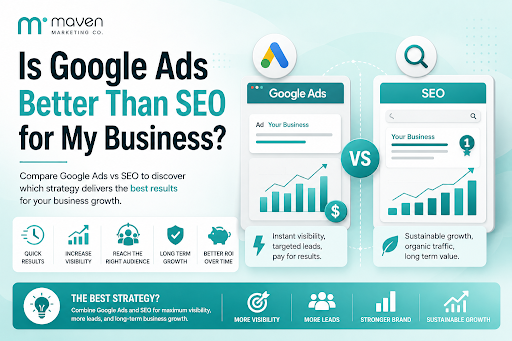
Is Google Ads Better Than SEO for My Business
One of the biggest questions business owners ask when they are planning online growth is whether they should invest in Google Ads or SEO. Both are strong marketing plays that help your company show up in Google search results, but they do things in separate lanes. Google Ads gives quicker visibility and can bring in leads fast, whereas SEO more or less focuses on slow, steady organic traffic that tends to grow the longer you keep building it. Picking the right direction depends on what you want to achieve, how much money you can spend, how crowded the market is, and how quickly you need results, like sooner rather than later. The good news is you don’t always have to choose one or the other; it’s not exactly a black-and-white situation. If you take time to understand the strongest points of both, you can put together a more sensible digital marketing plan that supports consistent expansion. In this guide, we’ll compare Google Ads vs SEO, explain the main differences, and help you figure out what option makes the most sense for your business.

When Should I Hire a Digital Marketing Agency
Growing a business today takes more than just having a website or throwing a post on social media; customers usually search around online, compare providers, skim reviews, and basically expect the brand to show up with a solid digital presence before they even think about buying. Many businesses try to run their marketing themselves, but there comes a point when “doing it all in-house” becomes clunky and hard to manage, all at once. Knowing when to hire a digital marketing agency can end up making a big, real difference for your growth. If you’re not getting enough leads, or your online visibility feels stuck, or sales are just not moving, the right agency can bring the know-how, plus a clear plan, to help you get noticeably better outcomes. In this guide, we’ll dig into what a digital marketing agency actually does, the usual signs it’s time to bring one on, and how picking the right marketing partner can help your business move forward at a faster pace.
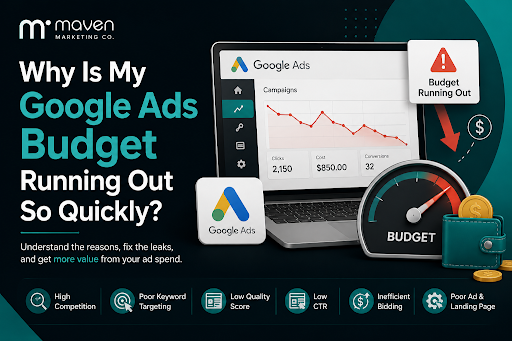
Why Is My Google Ads Budget Running Out So Quickly
Running a successful Google Ads budget isn’t only about throwing more money at it. It’s more like making every dollar, doing a bit extra. A lot of businesses start a Google Ads campaign with big hopes, then find out their daily budget is gone within a few hours, and that feels weird, right? After that, your ads stop showing effectively, new leads slip away, and your return on investment dips. So if your Google Ads budget is running out too fast, don’t stress. It’s a fairly common issue, and in most situations, it can be repaired with the right approach. There are multiple little things that can drain your advertising money quicker than you expected, from costly keywords to audience targeting that just doesn’t quite fit. In this guide, we’ll walk through why your budget disappears so quickly, how to cut wasteful spend, and the most reliable ways to boost your Google Ads ROI, even if your budget stays the same.