.svg)


%201.svg)

Quick Answers
How do I prevent my location pages from competing against each other in search results?
Create genuinely unique content for each location page that goes beyond simply swapping city names. Each page needs distinct local information: specific suburb-level service areas, unique team member bios with local photos, location-specific customer testimonials, local landmark directions, and individualised opening hours or service variations. Use proper schema markup for each location, maintain separate Google Business Profiles, and ensure your internal linking structure doesn't create confusion about which location serves which area. Most importantly, avoid template-based content—Google recognises when you've duplicated text across pages with minor variations, which triggers cannibalisation issues and diminishes trust in your site's authority.
Should I create separate websites for each business location or keep everything on one domain?
Keep all locations on a single domain using a location subdirectory structure (yoursite.com.au/brisbane/, yoursite.com.au/gold-coast/). Separate websites fragment your domain authority, create unnecessary management complexity, and often confuse customers about your brand. A unified domain consolidates all your backlinks, trust signals, and content authority into one powerful asset whilst still allowing you to target multiple geographic areas effectively. The only exception is if you operate genuinely different brands or business models in different locations—but for standard multi-location operations serving the same market with the same services, a single domain with well-structured location pages vastly outperforms multiple separate sites in both search performance and conversion rates.

The Multi-Location SEO Challenge Facing Australian Businesses
You've built a successful business in Brisbane. Your Google rankings are solid, leads flow consistently, and you've mastered local SEO for your home market. Now you're expanding—perhaps opening a Gold Coast office, establishing a presence in Sydney, or offering services across multiple Queensland regions.
This is where most businesses stumble. They duplicate their Brisbane SEO playbook across new locations and watch in dismay as their carefully built rankings start fragmenting. Suddenly, their Brisbane page ranks lower because Google can't determine which location page should appear for broader regional queries. Their new location pages barely rank at all because they're thin copies of existing content. The expansion that should have doubled their visibility has instead halved it.
This phenomenon—called keyword cannibalisation—happens when multiple pages on your site compete for the same search queries. For multi-location businesses, it's particularly insidious because you legitimately need pages for each location, but you risk creating internal competition that dilutes your overall search presence.
The stakes are high. According to recent search behaviour data, 76% of people who search for something nearby on their smartphone visit a related business within a day. When your location pages cannibalise each other, you're not just losing rankings—you're losing real customers who can't figure out which of your locations serves their area.
Here's the truth: multi-location SEO isn't simply about creating more location pages. It requires a fundamentally different strategic approach that balances local relevance with site-wide authority.

Understanding Ranking Cannibalisation in Multi-Location Contexts
Before we solve the problem, let's understand what's actually happening when location pages compete.
Search engines aim to show the most relevant result for each query. When you have multiple pages targeting similar keywords—say "plumber Brisbane northside" and "plumber Brisbane"—Google faces a dilemma. Which page should rank for queries about plumbing in northern Brisbane suburbs?
If your content doesn't clearly differentiate these pages, Google may oscillate between them, test different pages in results, or show neither prominently. Your click-through rates suffer because users see inconsistent results. Your rankings become unstable. Worst of all, you're competing against yourself instead of your actual competitors.
For multi-location businesses, cannibalisation typically manifests in three ways:
First, location overlap issues occur when your service areas aren't clearly defined. If your Brisbane and Gold Coast pages both claim to serve Beenleigh or Logan, you've created ambiguity about which page should rank for those areas.
Second, content duplication problems arise when you copy-paste your Brisbane page content and simply replace "Brisbane" with "Gold Coast" throughout. Google recognises this tactic and may devalue all involved pages because you haven't created genuinely useful, unique content for each location.
Third, internal linking confusion happens when you link to multiple location pages using the same anchor text, or when you haven't structured your site hierarchy to clearly indicate which page serves which geographic area. This dilutes the relevance signals you're sending to search engines about page purpose.
The solution isn't to limit yourself to one location. It's to structure your multi-location presence so strategically that each page strengthens rather than weakens your overall visibility.
Building a Cannibalisation-Proof Location Page Structure
Your site architecture forms the foundation of successful multi-location SEO. Get this wrong, and no amount of content optimisation will save you from ranking conflicts.
Use a clear subdirectory structure that places all location pages at the same hierarchy level under a /locations/ directory. Your URLs should follow this pattern:
- mavenmarketingco.com.au/locations/brisbane/
- mavenmarketingco.com.au/locations/gold-coast/
- mavenmarketingco.com.au/locations/sydney/
This structure immediately signals to search engines that these are distinct locations of equal importance. Avoid deeper nested structures like /locations/queensland/brisbane/ unless you operate at a scale that justifies regional groupings (think 50+ locations).
Create a location finder hub page at /locations/ that serves as the parent for all individual location pages. This hub should include an interactive map, list of all locations with brief descriptions, and clear navigation to each location page. Don't optimise this hub for any specific location keywords—its job is to distribute authority and provide navigation, not to compete with your location-specific pages.
Implement proper internal linking that reinforces your location hierarchy. Your homepage should link to your location hub. Your location hub should link to all individual location pages. Individual location pages should link back to the hub but not directly to each other unless there's a genuine user need (like "Looking for our Gold Coast office instead?").
Service pages present a particular challenge. Should you create separate service pages for each location? Generally, no. Unless services genuinely vary significantly by location, maintain service pages at your root domain level (/services/seo/) and use internal linking to connect them with relevant location pages. This prevents exponential content creation demands whilst still allowing you to target location + service combinations through strategic optimisation.
Crafting Truly Unique Location Page Content

This is where most businesses fail multi-location SEO. They recognise the need for unique content but underestimate what "unique" actually means to search engines in 2025.
Changing "Brisbane" to "Gold Coast" in otherwise identical content doesn't create uniqueness. Rearranging paragraphs doesn't create uniqueness. Even adding a few location-specific sentences to mostly duplicated content doesn't create uniqueness. Google's algorithms—particularly with AI-powered understanding—can recognise when pages serve fundamentally the same purpose with superficial variations.
True uniqueness requires substance. Each location page needs genuinely different information that serves that specific local audience. Here's how to achieve this:
Develop location-specific service information that addresses how your offerings adapt to local needs. A Brisbane-based landscaping company might discuss subtropical plant selection and storm water management specific to Brisbane's climate and council regulations. Their Gold Coast page would address coastal soil conditions, salt-resistant species, and different local council requirements. This isn't just adding fluff—it's providing genuinely more useful information to people in each location.
Feature local team members prominently with real photos taken at that location, substantive bios that mention their local expertise, and community involvement. When someone searches for a service provider in their area, they want to see that real people work from that office who understand their local market. Three team member profiles with 100 words each provides 300 words of genuinely unique, valuable content whilst building local trust.
Include detailed, specific directions and local landmarks that only someone with local knowledge would provide. Don't just embed a Google Map. Explain how to reach your office from major local areas, mention nearby landmarks that locals recognise, describe parking options, and note local public transport connections. This serves both users and search engines by demonstrating deep local knowledge.
Showcase location-specific customer testimonials and case studies that mention local suburbs, local problems you've solved, and results you've achieved for nearby customers. A single detailed case study per location page—300-500 words describing a local client's challenge, your solution, and measurable results—provides unique content whilst powerfully demonstrating local credibility.
Address unique local regulations, conditions, or considerations relevant to your industry. Different Australian councils have different requirements. Different regions face different challenges. If you're a builder, Brisbane's flood mitigation requirements differ from Toowoomba's. If you're a digital marketer, the competitive landscape and target audience behaviours vary between markets. Addressing these differences creates genuinely useful, naturally unique content.
When properly executed, each location page should contain at least 1,000 words of substantially unique content before any templated elements like headers or footers. Yes, this is a significant investment. But it's the difference between multi-location SEO that works and multi-location SEO that cannibalises your existing rankings.
Optimising Title Tags and Meta Descriptions for Multiple Locations

Your page titles and meta descriptions represent your first opportunity to prevent cannibalisation whilst maximising click-through rates from local search results.
Location page title tags should follow this proven formula: Primary Keyword + Location + Brand Name (if space permits). For example: "Digital Marketing Agency Brisbane | Maven Marketing Co" or "Plumbing Services Gold Coast | 24/7 Emergency Repairs". Keep titles under 60 characters to prevent truncation in search results.
The critical mistake is creating overly similar titles across locations. If all your location pages use the formula "Digital Marketing Agency [City]", they become difficult to differentiate both for search engines and users. Instead, vary your approach by highlighting different value propositions or specialties at different locations when appropriate.
Meta descriptions for location pages must accomplish two goals: prevent cannibalisation and drive clicks. Include your location name naturally within the first 120 characters, mention specific suburbs or areas served, and incorporate a compelling value proposition unique to that location. For instance: "Maven Marketing Co's Brisbane office serves businesses throughout the greater Brisbane area including northside, southside, and western suburbs. Award-winning SEO, PPC, and content marketing that delivers measurable growth."
Avoid generic descriptions that could apply to any location. If you can swap out the location name and the description still works perfectly, it's too generic and contributes to cannibalisation risk.
For service pages that aren't location-specific, use titles and descriptions that target the service without geographic qualifiers. Your /services/seo/ page might use "SEO Services Australia | Enterprise & Local SEO Specialists" rather than trying to cram multiple locations into the title, which dilutes relevance for all of them.
Leveraging Schema Markup for Multi-Location Clarity
Schema markup—structured data that helps search engines understand your content—becomes absolutely critical for multi-location businesses. Proper schema prevents cannibalisation by explicitly telling search engines which page represents which location.
Implement LocalBusiness schema on every location page with complete, accurate information: business name, street address, city, state, postcode, phone number, opening hours, and geographic coordinates. Each location page should have its own distinct LocalBusiness schema—never duplicate the same location information across multiple pages.
Include the geo schema property with precise latitude and longitude coordinates for each location. This eliminates any ambiguity about where each office sits and helps search engines match your pages to location-specific queries with pinpoint accuracy.
Add the areaServed property to specify which regions each location serves. For a Brisbane office, you might list: "Brisbane", "Brisbane Northside", "Brisbane Southside", "Greater Brisbane Area", and specific suburbs where you actively provide services. This helps prevent overlap issues when you have multiple nearby locations that might serve some of the same suburbs.
Use the hasMap property linking to the Google Maps URL for each specific location. This provides another strong signal about the physical location each page represents.
For your main location hub page (/locations/), implement Organization schema rather than LocalBusiness schema. This should include all your locations as separate entities using the location property, creating a clear hierarchical relationship that search engines recognise.
Testing your schema is non-negotiable. Use Google's Rich Results Test to verify that your markup is error-free and that Google can properly parse your location information. Schema errors can actually harm your local search performance, so this isn't optional if you're serious about multi-location SEO.
Google Business Profile Strategy for Multiple Locations
Your Google Business Profiles work in concert with your location pages to establish local search dominance. Mismanage these, and you'll undermine all your on-site optimisation efforts.
Create separate, verified Google Business Profiles for every physical location where you have a genuine presence with staff. This is non-negotiable for ranking in local map packs and local search results. Each profile must have a unique business name (if you have multiple locations in the same city, append the suburb or area like "Maven Marketing Co - Brisbane CBD"), unique physical address, unique phone number, and unique opening hours if they differ.
Never create GBPs for locations where you don't have a physical presence or staff. Google has cracked down hard on fake locations and service area businesses creating multiple fake locations. The penalties are severe and can impact all your legitimate locations.
Link each GBP directly to its corresponding location page on your website. This creates a clear association in Google's index between your GBP and the relevant page, reducing cannibalisation risk. Don't link all GBPs to your homepage or to a generic contact page.
Maintain distinct content across profiles just as you do on your location pages. Each profile's description should be unique, highlighting what makes that specific location valuable. Photos should be location-specific, showing the actual office, team members at that location, and completed work in that area. Reviews naturally differ by location, providing further differentiation.
Optimise the GBP categories and services for local relevance. Your primary category should be identical across locations for consistency, but your secondary categories and service listings can be adapted to reflect local specialties or service variations.
Implement a location-specific review generation strategy that encourages customers to leave reviews on the GBP for the location that served them. Reviews are the most powerful local ranking factor, and having them correctly attributed to the right location strengthens that location's individual visibility whilst preventing signals from bleeding across to other locations.
When properly executed, your GBPs and location pages create a reinforcing loop: your location pages support local keyword rankings, while your GBPs dominate the map pack and provide authoritative backlinks to those pages.

Managing Service Area Pages Without Creating Cannibalisation
Many multi-location businesses also serve areas where they don't have physical offices. These service area pages present unique cannibalisation risks that require careful management.
Establish clear boundaries between your physical location pages and your service area pages. Location pages should always be more comprehensive and robust than service area pages, reflecting the fact that you have an actual presence there. This hierarchy helps search engines understand which pages should rank more prominently.
Use different URL structures to differentiate service areas from physical locations. Consider /service-areas/ or /we-serve/ as the parent directory for service areas, keeping /locations/ exclusively for physical offices. This structural difference signals different page purposes to search engines.
Create genuinely useful service area content that explains why you can effectively serve that area despite not having a physical office there. Detail your service approach, travel policies, response times, and any local partnerships. Address the natural concern people have about hiring a company without a local office. Service area pages should be shorter than location pages (500-700 words versus 1,000+ words) and focus heavily on utility rather than trying to appear as comprehensive as location pages.
Avoid creating service area pages for locations where you already have location pages. This is where many businesses create their worst cannibalisation problems. If you have a physical Brisbane office with a location page, don't create a separate "Brisbane service area" page. Your location page already accomplishes both purposes.
Link service area pages to the nearest physical location page to show which office serves that area. This provides users with clarity whilst creating an internal linking structure that reinforces your location hierarchy to search engines.
The guiding principle: service area pages exist to capture searches from areas you serve but don't have offices. They should be transparently different from—and subordinate to—your actual location pages in both content depth and search engine importance signals.
Internal Linking Strategies That Prevent Cannibalisation

Your internal linking architecture either clarifies your site structure for search engines or creates confusion that leads to cannibalisation. Strategic internal linking is particularly critical for multi-location SEO.
Create clear topical silos that separate location pages from service pages from content pages. Service pages should link to relevant location pages with anchor text like "our Brisbane SEO services" or "contact our Gold Coast office", making the relationship between service and location explicit. Location pages should link back to relevant service pages with descriptive anchor text that includes both the service and location.
Avoid creating interconnected location page webs where every location page links to every other location page. This dilutes the distinct identity of each location. Instead, have location pages link back to your main location hub, and let that hub page provide navigation between locations.
Use the main navigation strategically. Rather than listing all locations in your main menu (which creates universal internal links from every page to every location page, potentially confusing their individual purposes), use a dropdown or flyout menu that goes through your location hub. This maintains navigational access whilst creating a clearer hierarchy.
Implement contextual internal links from blog posts and content pages to specific location pages when locally relevant. If you write a blog post about Brisbane market trends, link to your Brisbane location page naturally within the content. This provides relevance signals whilst driving users toward conversion opportunities.
Monitor your internal link distribution using tools like Screaming Frog to ensure you're not accidentally over-linking to certain location pages whilst under-linking to others. Balanced internal linking helps all locations achieve their potential visibility.
The goal is an internal linking structure that search engines can easily crawl and understand, with clear signals about which page serves which purpose and location.
Content Marketing for Multi-Location Visibility
Your content marketing strategy needs to support your multi-location structure rather than undermining it with cannibalisation risks.
Create location-specific blog content that naturally links to and supports your location pages. Write about local industry trends, local events, local case studies, and local market conditions. These posts should live in a centralised blog (not separate blogs per location) but with clear local angles and internal links to the relevant location page.
Develop location-agnostic pillar content for topics where location isn't relevant. These comprehensive guides, industry analysis pieces, and educational resources strengthen your overall domain authority, benefiting all location pages indirectly. Don't force location keywords into content where they don't naturally fit—this creates thin, awkward content that doesn't help anyone.
Implement a content hub strategy where you create clusters of related content around key service themes, with the pillar page providing overview information and cluster content diving deep into specific aspects. These hubs can attract links and authority that flows through internal links to your location pages.
Balance your publication calendar to ensure you're creating content relevant to all markets you serve, not just your original location. A Brisbane-headquartered business that only publishes Brisbane-focused content while neglecting Gold Coast, Sydney, or other markets signals to search engines (and potential customers) that those other locations are less important.
Use local keyword variations naturally in content without forcing them unnaturally or creating keyword-stuffed content that mentions every location you serve. If a blog post is about Gold Coast specifically, focus on Gold Coast. Don't awkwardly shoehorn Brisbane, Sydney, and Melbourne into every post to try capturing all location keywords.
Quality content that serves genuine user needs, published consistently, attracts links and engagement signals that lift your entire domain's authority—including all your location pages.
Link Building for Multi-Location Businesses
Local link building becomes more complex—and more critical—when you operate multiple locations. Your link building strategy needs to build both domain-wide authority and location-specific authority without creating confusion.
Pursue location-specific links for each office: local business directories, chamber of commerce memberships, local industry associations, local sponsorships, and partnerships with other local businesses. These links should point directly to the relevant location page, not your homepage, to reinforce local relevance for that specific page.
Prioritise quality over quantity with local links. One link from a respected local news outlet or government website provides more value than dozens of low-quality directory links. Focus on links that actually send referral traffic and enhance your local reputation.
Coordinate community involvement with your link building strategy. When you sponsor a local sports team, volunteer at community events, or partner with local charities, ensure you're receiving links back to the appropriate location page. These authentic local relationships create powerful ranking signals whilst benefiting your community.
Build authoritative national links that point to your main domain, service pages, or high-quality content pieces. These links boost your overall domain authority, which flows through internal links to benefit all location pages. Don't worry about these national links being "non-local"—they strengthen the foundation that all your location-specific efforts build upon.
Never create fake local citations or duplicate listings in an attempt to game local search algorithms. Google can identify and penalise these manipulative tactics, potentially harming all your locations.
Monitor your link profile regularly to ensure competitor negative SEO or naturally accumulated bad links aren't harming your visibility. Use Google Search Console and backlink analysis tools to identify and disavow genuinely harmful links.
A balanced link profile—combining strong domain-wide authority with clear location-specific local links—gives you the best of both worlds: the power of a unified brand with the local relevance search engines demand for local queries.
Tracking and Measuring Multi-Location SEO Success
You can't optimise what you don't measure. Multi-location SEO requires sophisticated tracking to understand which locations are performing, where cannibalisation might be occurring, and where opportunities exist.
Set up location-specific tracking in Google Search Console by using URL filters to segment performance by location page. Monitor impressions, clicks, average position, and CTR for each location to identify underperforming pages that need attention or overperforming pages whose strategies you should replicate.
Create location-specific goals in Google Analytics that track conversions from each location page. This reveals which locations are not just attracting traffic but actually driving business results. Use UTM parameters consistently in any off-site campaigns to ensure accurate attribution.
Monitor keyword rankings by location using rank tracking tools that let you specify geographic locations for searches. Track both location-specific keywords ("plumber Brisbane") and broader keywords ("plumber") from each location to understand your visibility across different query types.
Watch for cannibalisation indicators in your analytics data: multiple pages showing impressions for the same keywords, ranking position volatility where different pages swap positions for the same query, or declining performance across multiple location pages simultaneously. These patterns suggest cannibalisation issues that need addressing.
Track your Google Business Profile performance separately for each location using the insights provided within each profile. Monitor search queries, views, actions taken, and direction requests. Declining performance in one location's GBP often indicates broader local SEO issues with that location.
Conduct regular content audits of your location pages to ensure they're maintaining their unique value as your business evolves. Update service information, add new team members, refresh case studies, and keep local information current. Stale, outdated location pages lose ranking power over time.
Benchmark against competitors in each local market individually. Your Brisbane SEO might be dominant whilst your Gold Coast presence lags behind competitors. Understanding these market-by-market differences helps you allocate resources effectively.
Scale Your Local Dominance Without Compromise
Multi-location SEO isn't about cutting corners or finding hacks that let you rank everywhere without doing the work. It's about strategically structuring your digital presence so that every location can achieve its full visibility potential whilst contributing to—rather than competing with—your overall search authority.
The businesses that succeed with multi-location SEO treat each location as worthy of the same strategic investment they made in their original market. They recognise that truly unique, locally relevant content isn't optional—it's the price of admission for ranking in an era where search engines prioritise genuine utility over keyword manipulation.
Yes, this requires more investment than creating template-based location pages. But the return—multiple streams of high-quality local search traffic, each driving customers in their specific markets—far exceeds the cost. When properly executed, your fifth location page should perform as strongly as your first, because you've built a scalable system that prevents cannibalisation whilst maximising local relevance.
The strategies outlined here work for businesses with two locations or two hundred, for companies expanding within Brisbane or across Australia. The fundamentals remain consistent: clear structure, genuinely unique content, proper technical implementation, and a commitment to serving each local market with the same excellence you'd demand from a single-location business.
Ready to Dominate Local Search Across Multiple Markets?
Multi-location SEO shouldn't be a compromise between local relevance and operational efficiency. At Maven Marketing Co, we've helped Australian businesses expand their digital presence across multiple locations without cannibalising their hard-won rankings.
Our multi-location SEO strategies combine the technical precision required to prevent ranking conflicts with the content depth needed to genuinely serve each local market. We don't believe in template-based location pages or shortcut tactics that undermine long-term success.
Whether you're opening your second location or scaling to your twentieth, we'll help you structure your expansion for maximum search visibility from day one. Contact Maven Marketing Co today for a comprehensive multi-location SEO audit that identifies cannibalisation risks and opportunities across all your markets.
Your customers are searching for you in every location you serve. Let's make sure they find you—without your locations competing against each other for their attention.

read more blogs
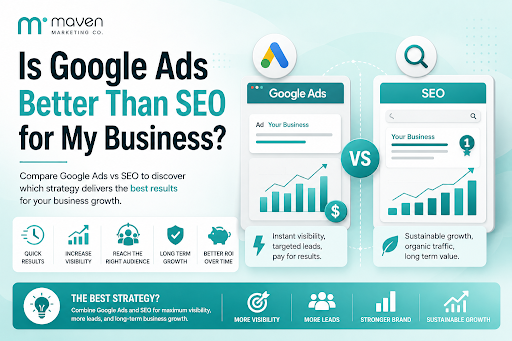
Is Google Ads Better Than SEO for My Business
One of the biggest questions business owners ask when they are planning online growth is whether they should invest in Google Ads or SEO. Both are strong marketing plays that help your company show up in Google search results, but they do things in separate lanes. Google Ads gives quicker visibility and can bring in leads fast, whereas SEO more or less focuses on slow, steady organic traffic that tends to grow the longer you keep building it. Picking the right direction depends on what you want to achieve, how much money you can spend, how crowded the market is, and how quickly you need results, like sooner rather than later. The good news is you don’t always have to choose one or the other; it’s not exactly a black-and-white situation. If you take time to understand the strongest points of both, you can put together a more sensible digital marketing plan that supports consistent expansion. In this guide, we’ll compare Google Ads vs SEO, explain the main differences, and help you figure out what option makes the most sense for your business.

When Should I Hire a Digital Marketing Agency
Growing a business today takes more than just having a website or throwing a post on social media; customers usually search around online, compare providers, skim reviews, and basically expect the brand to show up with a solid digital presence before they even think about buying. Many businesses try to run their marketing themselves, but there comes a point when “doing it all in-house” becomes clunky and hard to manage, all at once. Knowing when to hire a digital marketing agency can end up making a big, real difference for your growth. If you’re not getting enough leads, or your online visibility feels stuck, or sales are just not moving, the right agency can bring the know-how, plus a clear plan, to help you get noticeably better outcomes. In this guide, we’ll dig into what a digital marketing agency actually does, the usual signs it’s time to bring one on, and how picking the right marketing partner can help your business move forward at a faster pace.
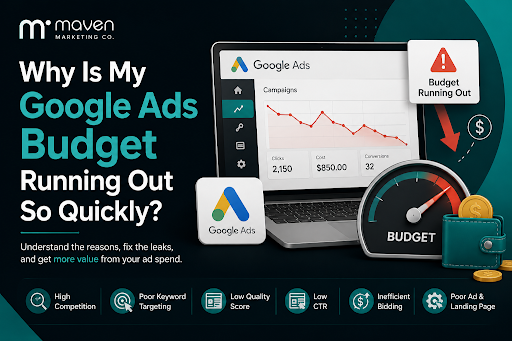
Why Is My Google Ads Budget Running Out So Quickly
Running a successful Google Ads budget isn’t only about throwing more money at it. It’s more like making every dollar, doing a bit extra. A lot of businesses start a Google Ads campaign with big hopes, then find out their daily budget is gone within a few hours, and that feels weird, right? After that, your ads stop showing effectively, new leads slip away, and your return on investment dips. So if your Google Ads budget is running out too fast, don’t stress. It’s a fairly common issue, and in most situations, it can be repaired with the right approach. There are multiple little things that can drain your advertising money quicker than you expected, from costly keywords to audience targeting that just doesn’t quite fit. In this guide, we’ll walk through why your budget disappears so quickly, how to cut wasteful spend, and the most reliable ways to boost your Google Ads ROI, even if your budget stays the same.