.svg)


%201.svg)
Key Takeaways
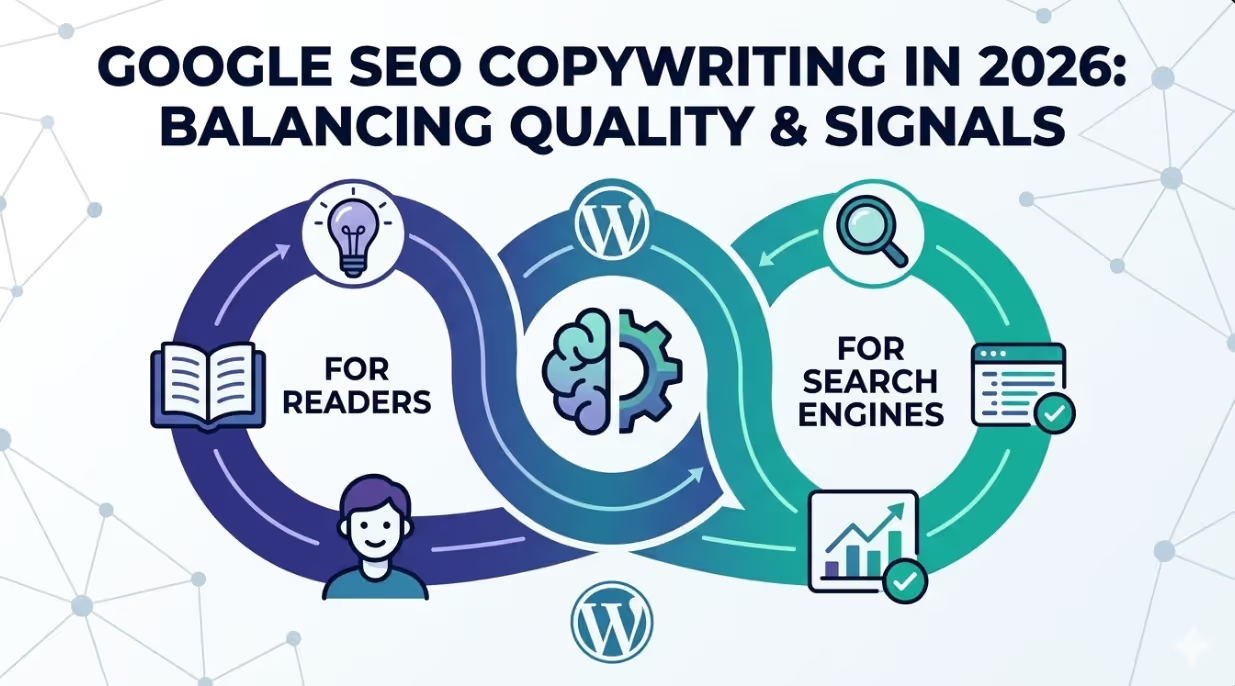
- Google's ranking systems evaluate content quality signals including topical depth, reading comprehension level, entity coverage, and user engagement signals alongside keyword presence, making genuine quality a ranking factor rather than a nice-to-have.
- Search intent is the foundation of effective SEO copywriting. Understanding why a user performs a specific search, not merely what words they use, determines what the content must deliver to satisfy both the reader and the ranking algorithm.
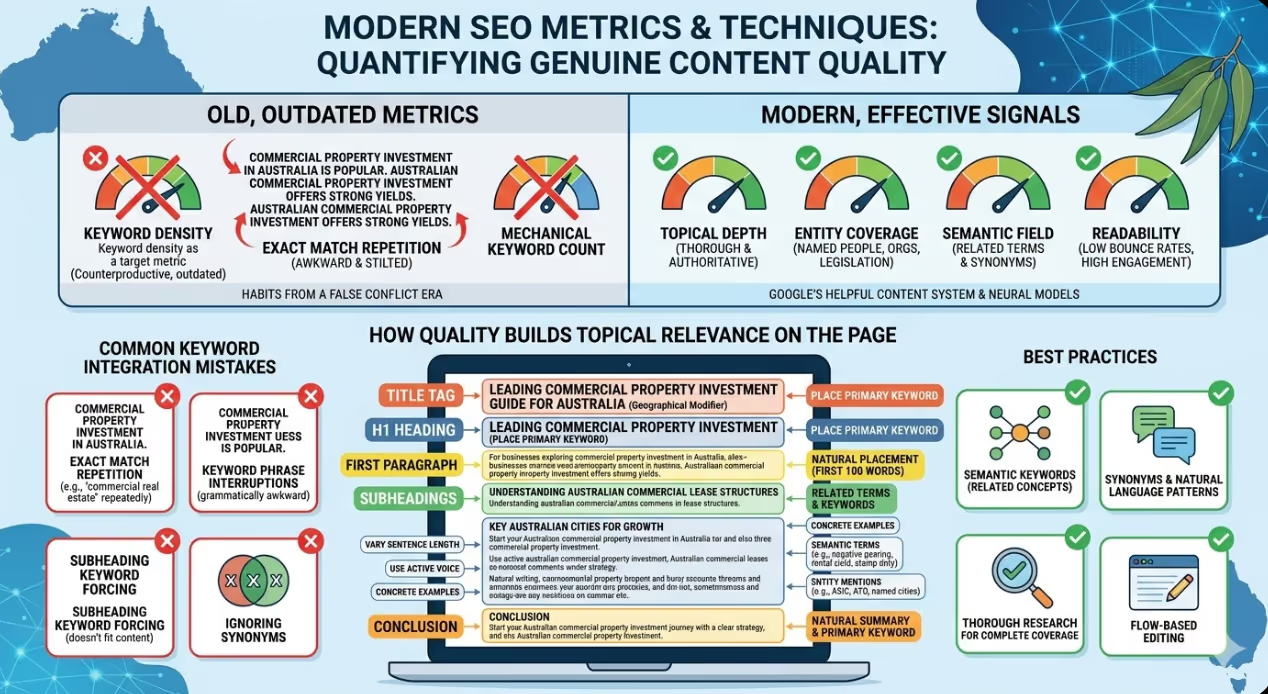
- Keyword density as a target metric is an outdated and counterproductive framework. Modern SEO copywriting focuses on topical completeness, semantic coverage, and natural language patterns rather than achieving a specific keyword frequency.
- Primary keywords belong in the title tag, H1 heading, first paragraph, and at least one subheading. These placement positions carry the strongest ranking signal weight without requiring mechanical repetition throughout the body copy.
- Semantic keywords, related terms, and entity mentions that appear naturally in thorough writing on a topic do more to establish topical relevance than additional repetitions of the exact primary keyword phrase.
- Readability signals including sentence length variation, paragraph structure, active voice, and use of concrete examples correlate with lower bounce rates and higher engagement metrics that feed back into ranking performance over time.
- The editing pass is where SEO copywriting quality is determined. First drafts optimised for keyword presence at the expense of flow should be revised until the content reads naturally, with keywords serving the sentence rather than disrupting it.
Why the Conflict Is a False One
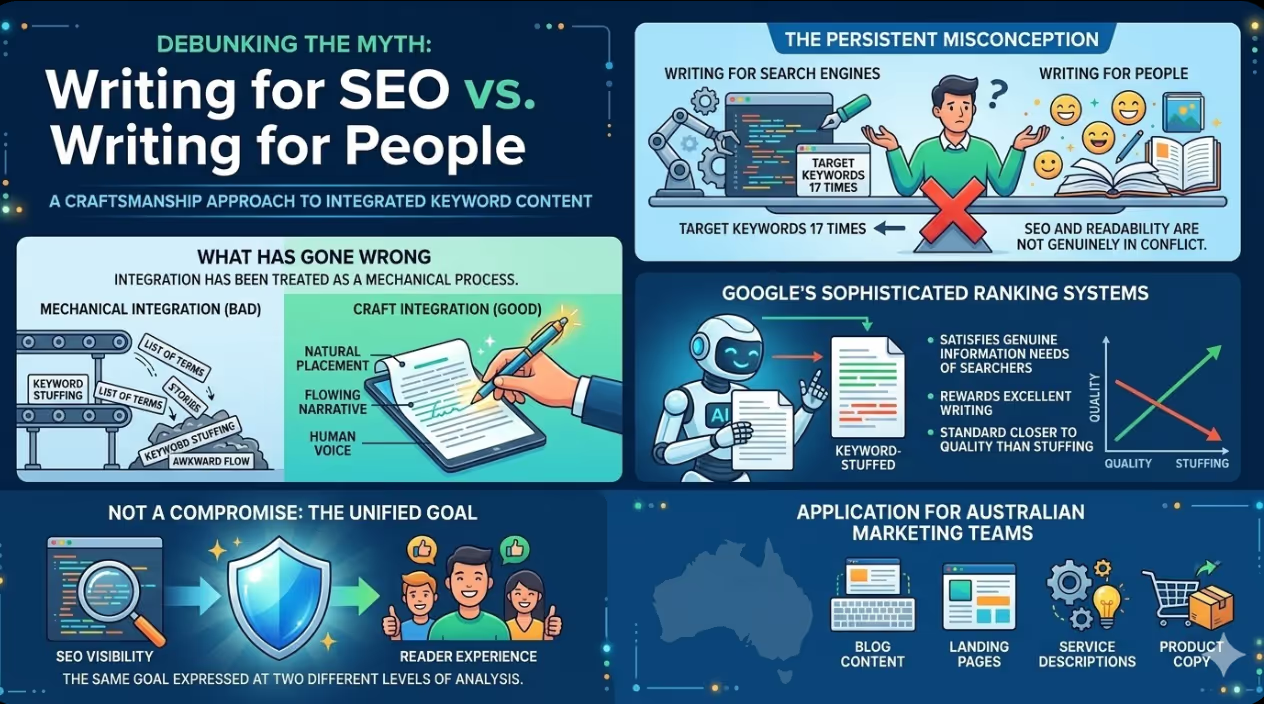
The idea that writing for search engines and writing for people are fundamentally in tension comes from a period in SEO history when they genuinely were. Before Google's understanding of natural language became sophisticated, ranking systems rewarded keyword frequency in ways that incentivised copy that read awkwardly but ranked well. Those techniques worked, and the habits they created persisted long after the systems they exploited were replaced.
Google's current approach to understanding content is substantially different. The Helpful Content system, the integration of neural language models into search quality assessment, and the ongoing refinement of Google's understanding of entities, topics, and relationships between concepts mean that what ranks well in 2026 is, for the most part, content that a knowledgeable human would judge as genuinely useful and genuinely well written on a topic. The ranking signal that best predicts performance is not keyword density. It is the degree to which the content satisfies the full information need of the person performing the search.
This does not mean keyword integration is irrelevant. Keywords remain the primary signal through which searchers communicate their intent, and including them correctly remains essential for ensuring the right content reaches the right searcher. What has changed is the relationship between keywords and quality. Keywords are the starting point for understanding what to write, not the measure of whether the writing is complete.
For Australian marketing teams, the practical implication is that the best SEO copywriting process is also the best general copywriting process, with a structured approach to keyword research and placement added at the beginning and end rather than woven through at the expense of coherence.
Step One: Understand the Search Intent Behind the Keyword
Before a word of copy is written, the search intent behind the target keyword must be understood. This step is frequently skipped or treated as obvious, but it is the foundation of everything that follows. A piece of content that is thoroughly written and clearly structured will not rank well if it addresses the wrong intent for the query it targets.
Search intent is typically categorised into four types: informational, where the searcher wants to learn something; navigational, where the searcher is looking for a specific website or brand; commercial investigation, where the searcher is evaluating options before making a decision; and transactional, where the searcher is ready to take an action such as making a purchase or booking an appointment.
The intent behind a query is revealed by examining the results ranking at the top for that query in Australian search results. The content type (article, product page, comparison, tool, video), the content format (guide explaining how to approach something, list, definition, review), and the content angle (beginner focused, expert level, local, or tied to a specific time period) of the current results are signals from Google about what it has determined satisfies the intent for that query. Writing content that mismatches the intent Google has established for a query is one of the most reliable ways to produce content that ranks poorly regardless of how well it executes everything else.
Step Two: Research the Full Topical Landscape
Once the search intent is understood, the topical landscape around the primary keyword should be researched to understand what the content needs to cover to be considered thorough and authoritative on the subject. This is not an invitation to pad content with irrelevant information. It is an instruction to ensure the content covers the subject completely enough that a reader with a genuine information need comes away satisfied.
The questions in the People Also Ask section in Google's search results for the target keyword reveal the questions that follow naturally searchers have after their initial search. Addressing these questions within the content, where they are genuinely relevant to the primary topic, produces content that satisfies a broader range of searcher needs while naturally incorporating the semantic and related terms that give the content topical depth.
The vocabulary used consistently across the pages ranking at the top for a query represents the semantic field of that topic as Google understands it. If every thorough article about a topic mentions specific concepts, uses particular terminology, and addresses a recognisable set of subtopics, a new article on the same topic that omits those elements is signalling incompleteness. This does not mean copying the structure of competing articles. It means ensuring the content covers the territory that thorough treatment of the topic requires.
For Australian businesses writing about topics specific to their industry, expertise is the most reliable route to genuine topical coverage. A financial planning firm writing about superannuation contribution strategies has access to the depth of knowledge that makes thorough content natural. The research step confirms what that knowledge needs to address to satisfy both the expert reader and the search algorithm.
Step Three: Place Primary Keywords With Purpose
With intent understood and the topical landscape mapped, the primary keyword needs to appear in specific positions within the content structure where it carries the strongest ranking signal weight. These positions are not arbitrary. They reflect how search crawlers prioritise the content of a page during indexing.
Title tag. The title tag is the most important location for the primary keyword and should include it as close to the beginning of the tag as the natural phrasing of the title allows. A title that begins with the primary keyword phrase generally outperforms one where it appears partway through the title. For Australian local queries, including the geographic modifier in the title tag is standard practice.
H1 heading. The H1 heading on the page should contain the primary keyword, typically in the same or closely similar form to the title tag. It does not need to be identical to the title tag, and small variations that improve the readability of the heading on the page are acceptable.
First paragraph. The primary keyword should appear naturally within the first 100 words of the body copy. This confirms to the crawler immediately that the page content matches the intent signalled by the keyword, and it confirms to the reader immediately that they have arrived at the right content.
At least one subheading. The primary keyword, or a close variant, should appear in at least one H2 or H3 subheading within the body of the article. This reinforces the topical signal without requiring the keyword to appear in every paragraph.
Conclusion or closing section. A natural appearance of the primary keyword in the closing section of the content, as part of a genuine summary or call to action, completes the keyword coverage without forcing additional mentions through the body.
These five placement positions are sufficient for strong keyword signalling in most cases. Any additional appearances of the primary keyword in the body copy should arise from the natural requirements of the writing rather than from a target based on a count.
Step Four: Build Semantic Depth Through Natural Writing
The most reliable way to achieve the semantic and related term coverage that supports strong topical relevance is to write thoroughly on the subject. A genuinely comprehensive treatment of a topic will naturally incorporate the vocabulary, concepts, and entities associated with it, because those are the terms a knowledgeable writer uses when explaining the subject completely.
Semantic keywords are related terms and concepts that appear in the context of a topic without being the exact keyword phrase. For an article targeting the keyword "commercial property investment Australia", semantic depth comes from naturally including terms such as rental yield, capital growth, stamp duty, negative gearing, commercial lease structures, and the names of relevant Australian cities and property market segments. These terms do not need to be researched and inserted deliberately in most cases. They appear naturally when the content is written by someone with genuine knowledge of the subject, or when the research phase has equipped a capable writer with the vocabulary of the domain.
Where semantic depth is absent in a draft, the solution is not to insert terms mechanically. It is to identify which aspects of the topic have been underwritten and develop those sections further. The terms will follow the depth, not precede it.
Entity mentions, the names of people, organisations, places, legislation, and other proper nouns relevant to the topic, signal to Google that the content is grounded in the context in the real world of the subject. For Australian content, this means referencing relevant Australian regulatory bodies, legislation such as the Privacy Act or the Corporations Act where applicable, and named Australian organisations and institutions that are genuinely relevant to the topic.
Step Five: Edit for Flow Before Optimising Further
The editing pass is where the quality difference between effective SEO copywriting and content stuffed with keywords is determined. After a first draft is produced, it should be read aloud or reviewed specifically for the moments where keyword placement has disrupted the natural flow of the writing.
Common signs that keyword integration has created readability problems include sentences that feel constructed around a phrase rather than expressing a complete thought, paragraphs where the same phrase appears more than once without a clear reason, transitions that feel abrupt because a keyword needed to appear before the natural conclusion of a thought, and prose that sounds formal or stilted in ways that only occur when specific words have been forced into positions they would not naturally occupy.
Each of these problems is resolved by revising the sentence or paragraph to express the idea naturally, then checking whether the keyword can still appear without forcing it. In most cases, a natural revision either retains the keyword because it fits the content, or reveals that the additional occurrence was not necessary in the first place.
The editorial standard to apply is simple: if a knowledgeable editor who knew nothing about SEO read the copy and flagged a phrase as awkward or a sentence as poorly constructed, that is a readability problem that should be fixed regardless of the keyword implications. Keywords that are well integrated are invisible to the reader. If a keyword placement is noticeable, it is not well integrated.
Common Keyword Integration Mistakes
Several patterns recur in SEO copy that has prioritised keyword presence over readability, and being able to identify them quickly makes editing more efficient.
Exact match repetition. Repeating the exact keyword phrase multiple times in close proximity when a pronoun, synonym, or natural rephrasing would serve better. "Commercial property investment in Australia is popular. Australian commercial property investment offers strong yields. Those interested in commercial property investment in Australia should consider..." Each of these instances may be individually defensible, but together they signal a copy pattern written around a count rather than a thought.
Keyword phrase interruptions. Inserting a keyword phrase in a grammatically awkward position because its natural form does not fit the sentence. "For businesses looking for, in Melbourne, commercial office space" is a forced insertion that disrupts readability for no additional ranking benefit over a naturally phrased sentence that includes the same terms.
Subheading keyword forcing. Writing subheadings that contain the keyword but do not accurately describe the section content, or that read unnaturally because they have been constructed to include a phrase rather than to guide the reader.
Ignoring synonyms. Treating keyword variations and synonyms as if they do not count, and repeating the exact phrase when a natural equivalent would serve the content better and contribute equivalent semantic signal. Google understands that "commercial real estate" and "commercial property" refer to the same concept and does not require exact phrase repetition to make the topical connection.
FAQs
What keyword density should Australian SEO copywriters aim for?
Keyword density as a target metric should be abandoned entirely. There is no universally correct keyword density, and aiming for a specific percentage, whether one percent, two percent, or any other figure, produces copy written to a number rather than to a reader. Google has not published a recommended keyword density, and independent research consistently fails to find a meaningful correlation between specific density values and ranking performance when other quality factors are held constant. The relevant question is not how often the keyword appears but whether it appears in the right positions (title, H1, introduction, at least one subheading) and whether the content is thorough enough on the topic to satisfy the search intent. If those conditions are met, the keyword will appear frequently enough naturally.
How should Australian businesses handle keyword integration for pages targeting specific locations?
Pages targeting specific locations, including suburb and city landing pages for service businesses, require keyword integration that includes the geographic modifier without allowing the location repetition to overwhelm the content. The location term should appear in the title tag, H1, first paragraph, and at least one subheading, in the same way the primary service keyword does. In the body copy, the location can be varied through natural references to the area, local landmarks, specific suburbs, and other geographic context that is genuinely relevant to the content rather than inserted purely as a keyword repetition. A Melbourne plumbing services page that naturally discusses the characteristics of Melbourne's housing stock, the specific plumbing requirements of homes from the Victorian era, and the service areas covered within Melbourne will achieve strong location keyword coverage without the repetitive geographic mentions that make location pages feel formulaic and unconvincing to human readers.
Should SEO copy be written by subject matter experts or professional copywriters with SEO knowledge?
The best outcomes come from either category when the right conditions are met. A subject matter expert with strong writing ability and at least basic SEO knowledge can produce authoritative, naturally optimised content that a professional copywriter would struggle to match on depth alone. A professional copywriter with strong research skills and solid SEO fundamentals can produce thoroughly optimised content across a broad range of topics without needing expertise in each. For highly technical Australian industries including medical, legal, financial, and engineering sectors, subject matter expert involvement at minimum in the research and review stage is strongly recommended, both for content accuracy and for satisfying Google's quality assessment criteria for your money your life content categories. The combination of subject matter expertise and professional editing produces the strongest outcomes for Australian businesses where both resources are available.
Keywords Follow Quality. Quality Does Not Follow Keywords.
The most durable insight in SEO copywriting is that keywords identify what to write about and where to signal it. They do not determine whether the writing is good. The content that ranks consistently over time in competitive Australian search results is content that was written with genuine care for the reader, structured to deliver real value on the topic, and edited to read clearly and naturally. The keyword integration that supports that content is almost invisible, because it was built into thoughtful writing rather than applied to mediocre writing after the fact.
Maven Marketing Co produces professionally written SEO content for Australian businesses, with keyword integration that serves both search visibility and the readers who matter most.
Talk to the team at Maven Marketing Co →

Table of contents
read more blogs

Is Google Ads Better Than SEO for My Business
One of the biggest questions business owners ask when they are planning online growth is whether they should invest in Google Ads or SEO. Both are strong marketing plays that help your company show up in Google search results, but they do things in separate lanes. Google Ads gives quicker visibility and can bring in leads fast, whereas SEO more or less focuses on slow, steady organic traffic that tends to grow the longer you keep building it. Picking the right direction depends on what you want to achieve, how much money you can spend, how crowded the market is, and how quickly you need results, like sooner rather than later. The good news is you don’t always have to choose one or the other; it’s not exactly a black-and-white situation. If you take time to understand the strongest points of both, you can put together a more sensible digital marketing plan that supports consistent expansion. In this guide, we’ll compare Google Ads vs SEO, explain the main differences, and help you figure out what option makes the most sense for your business.

When Should I Hire a Digital Marketing Agency
Growing a business today takes more than just having a website or throwing a post on social media; customers usually search around online, compare providers, skim reviews, and basically expect the brand to show up with a solid digital presence before they even think about buying. Many businesses try to run their marketing themselves, but there comes a point when “doing it all in-house” becomes clunky and hard to manage, all at once. Knowing when to hire a digital marketing agency can end up making a big, real difference for your growth. If you’re not getting enough leads, or your online visibility feels stuck, or sales are just not moving, the right agency can bring the know-how, plus a clear plan, to help you get noticeably better outcomes. In this guide, we’ll dig into what a digital marketing agency actually does, the usual signs it’s time to bring one on, and how picking the right marketing partner can help your business move forward at a faster pace.

Why Is My Google Ads Budget Running Out So Quickly
Running a successful Google Ads budget isn’t only about throwing more money at it. It’s more like making every dollar, doing a bit extra. A lot of businesses start a Google Ads campaign with big hopes, then find out their daily budget is gone within a few hours, and that feels weird, right? After that, your ads stop showing effectively, new leads slip away, and your return on investment dips. So if your Google Ads budget is running out too fast, don’t stress. It’s a fairly common issue, and in most situations, it can be repaired with the right approach. There are multiple little things that can drain your advertising money quicker than you expected, from costly keywords to audience targeting that just doesn’t quite fit. In this guide, we’ll walk through why your budget disappears so quickly, how to cut wasteful spend, and the most reliable ways to boost your Google Ads ROI, even if your budget stays the same.