.svg)


%201.svg)
Key Takeaways
- A competitor that ranks for a keyword you do not is providing proof of concept that the keyword is achievable in your category, which makes competitor keyword data one of the most reliable sources of validated ranking opportunities.
- The competitive set for SEO purposes is not necessarily the same as the competitive set for business strategy purposes. SEO competitors are the sites that rank for the keywords most relevant to your business, which may include specialist content publishers, comparison sites, and information resources alongside direct business competitors.
- Keyword gap tools in platforms such as Ahrefs, Semrush, and Moz allow you to compare your keyword rankings directly against multiple competitors simultaneously, identifying keywords where competitors rank and you do not, and filtering by search volume, intent, and difficulty.
- Content gap analysis is a deeper form of competitive analysis that identifies not just individual missing keywords but entire topic areas, content formats, and audience segments that competitors serve but your site does not address at all.
- The gaps with the highest priority to close are those combining meaningful search volume, commercial intent aligned with the business's conversion goals, competitive feasibility based on the domain authority of the current ranking pages, and a significant presence across multiple competitors, indicating a query category that is well established rather than an anomalous ranking.
- Closing a keyword gap requires more than creating content that targets the missing keyword. It requires understanding why the competitor ranks, what their content does that yours does not, and what the searcher intent behind the keyword actually requires in order to be satisfied.
- Gap analysis should be refreshed regularly, because competitor ranking profiles evolve, new competitors emerge, and search intent shifts over time in ways that create new gaps and close others.
Setting Up the Competitive Analysis Framework
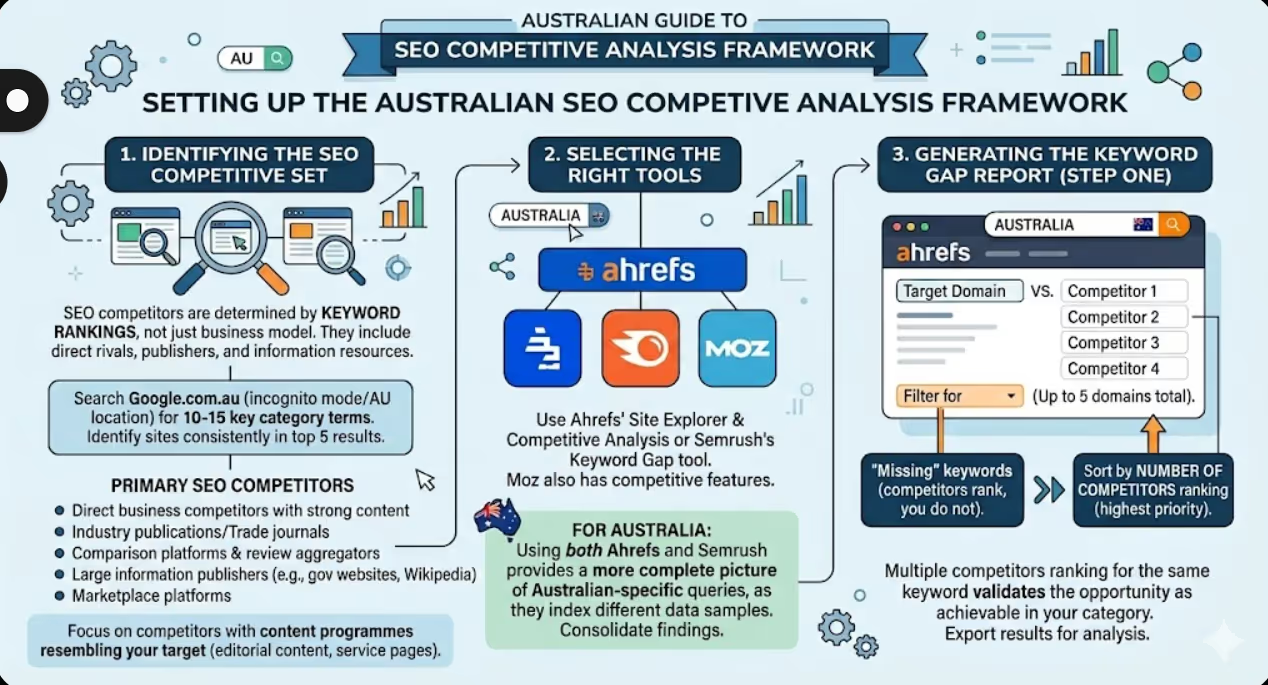
Effective competitive gap analysis requires a defined competitive set and the right tools to compare keyword profiles across that set. Getting both of these right before conducting the analysis prevents the most common failure in this work, which is either analysing the wrong competitors or analysing the right competitors with a tool that produces incomplete or inaccurate keyword data.
Identifying the Right Competitor Set
The competitive set for an SEO gap analysis should be determined by keyword rankings rather than by business model. The direct business competitors are a starting point, but the SEO competitive set frequently includes sites that are not direct competitors commercially but that compete for the same organic search real estate.
The reliable method for identifying SEO competitors is to search Google for the ten to fifteen most important keywords in the category and record all sites that appear in the top five positions across those searches. Sites that appear consistently across multiple important queries in the category are the primary SEO competitors, regardless of whether they are direct business competitors or not.
For Australian businesses, this review should be conducted with Google.com.au as the search engine, using a browser in incognito mode or with location set to Australia to ensure the results reflect the genuine Australian search landscape rather than personalised or results influenced by location.
The resulting competitor list typically includes:
- Direct business competitors with established content programmes
- Industry publication sites or trade journals that cover the topic area
- Comparison platforms and review aggregators
- Large information publishers such as government websites, Wikipedia, or general reference sites
- Marketplace platforms or listing sites in relevant categories
For the purposes of gap analysis, the most valuable competitors to analyse are those whose content programme most closely resembles what the target business is building: businesses producing editorial content and service pages rather than purely product pages or aggregator listings.
Selecting the Right Tools
The three primary tools for keyword gap analysis are Ahrefs, Semrush, and Moz, all of which offer features specifically designed for competitive keyword comparison. The choice between them for Australian analysis is largely a matter of database coverage and accuracy for Australian-specific queries.
Ahrefs' Site Explorer and Competitive Analysis features allow up to five domains to be compared simultaneously, with the ability to filter results to Australian traffic specifically and to show only keywords where competitors rank but the target domain does not. Semrush's Keyword Gap tool provides similar functionality with its own database, and the two tools often surface different keywords from each other's results because they index different samples of the web's link and ranking data.
For Australian businesses, using both Ahrefs and Semrush for gap analysis and consolidating the unique findings from each produces a more complete picture than relying on either tool alone. The effort is higher, but the keyword gaps discovered by one tool and not the other represent genuine opportunities that a single-tool analysis would miss.
Step One: The Keyword Gap Report
With the competitor set identified and the tools selected, the first step is to generate the keyword gap report. This report shows the keywords where one or more competitors rank in the top ten and the target site does not have any ranking position.
In Ahrefs, this is done through Site Explorer → Competitive Analysis, where the target domain and up to four competitor domains are entered. The resulting keyword table is filtered to show keywords where the competitors rank and the target domain does not (the "missing" keyword filter), and the results are sorted by the number of competitors that rank for each keyword rather than by volume alone.
Keywords that appear in the gap report for multiple competitors simultaneously are the items with the highest priority in the analysis for two reasons. First, the fact that multiple competitors rank for the same keyword confirms that it is achievable within the category: one competitor ranking anomalously for an outlier keyword is less reliable signal than three competitors all ranking for the same keyword. Second, keywords that appear across multiple competitor profiles are more likely to represent established query categories with stable search demand rather than transient or emerging queries.
The resulting list should be exported and reviewed in a spreadsheet where additional filtering and analysis can be applied.
Step Two: Filtering and Prioritising the Gap
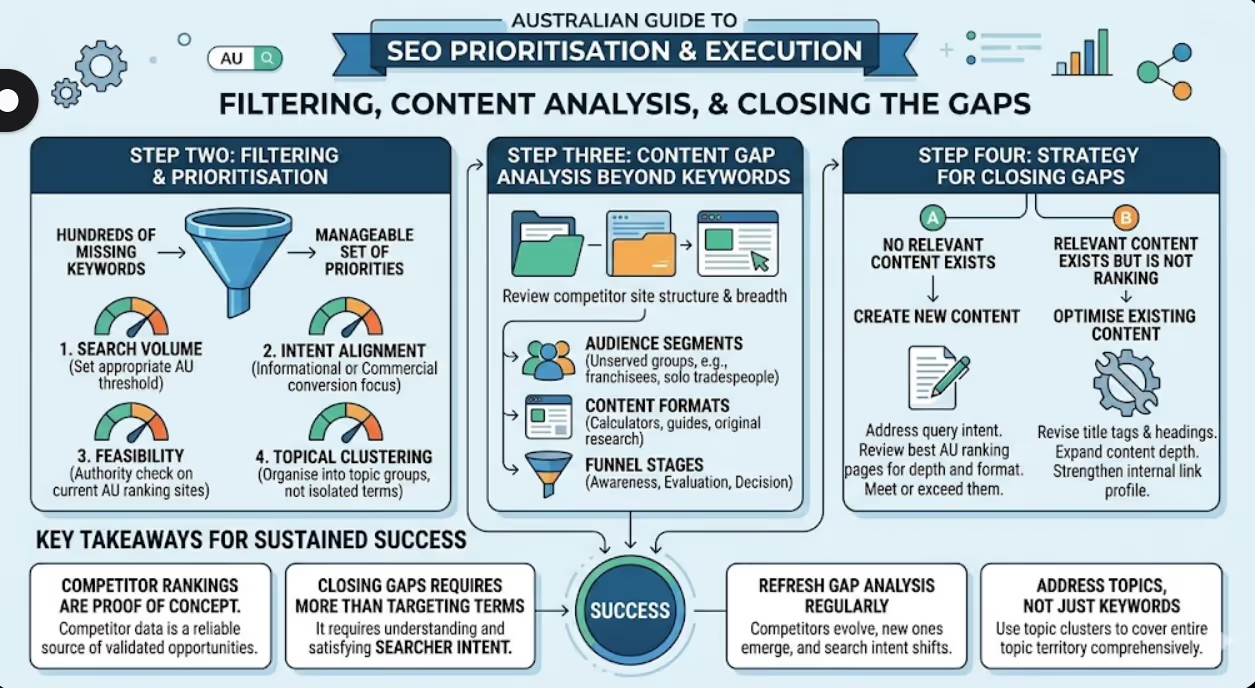
A keyword gap report for an established business in a competitive category will typically return hundreds or thousands of missing keywords. The filtering process reduces this to a manageable set of priorities.
The filtering criteria to apply are:
Search volume. Set a minimum threshold appropriate to the category. For most Australian businesses, keywords with fewer than 50 monthly searches nationally are unlikely to justify the effort of dedicated content unless they are extremely transactional terms with high commercial value. For businesses in niche categories where total query volume is low, the threshold may need to be lower.
Intent alignment. The missing keywords should be classified by intent and filtered to retain those whose intent aligns with the content and conversion infrastructure available on the site. Missing informational keywords are valuable for building topical authority. Missing transactional and commercial investigation keywords are valuable for direct conversion impact. Keywords in the navigational category are generally not worth pursuing.
Feasibility assessment. For each candidate keyword, the pages currently ranking should be reviewed in Google.com.au to assess whether the current ranking sites have authority levels the target domain can reasonably compete with. Keywords where all current ranking pages come from very large national or international publishers are lower priority than those where smaller or similar-authority sites rank alongside larger ones.
Topical clustering. Missing keywords should be grouped by topic so that content addressing the gaps can be planned as topic clusters rather than isolated articles. A cluster of twenty related missing keywords can often be addressed by three to four articles that are well structured and cover the topic territory comprehensively, rather than twenty separate articles each targeting a single keyword that each address a narrow slice in isolation.
Step Three: Content Gap Analysis Beyond Keywords
Keyword gap analysis identifies missing individual queries. Content gap analysis identifies missing topic areas, content formats, and audience segments. The distinction matters because addressing a content gap produces ranking improvements across multiple related keywords simultaneously, while addressing individual keyword gaps one at a time produces incremental improvements that take longer to compound.
Content gap analysis requires reviewing what competitor sites have published broadly, not just the keywords they rank for. Reviewing the site structure, the blog archive, the resources section, the FAQ pages, and the case study libraries of the primary competitors in the set reveals patterns of content investment that the keyword gap report may not fully capture, because some of that content generates rankings across a diffuse set of individually small-volume queries that do not individually appear prominently in the gap report.
Specific content gap patterns worth identifying in competitors include:
Audience segment coverage. A competitor that has produced a series of content specifically for a distinct audience segment, such as content specifically for franchisees, for solo tradespeople, for first home buyers, or for not for profit organisations, is addressing a segment that the target site may have ignored entirely. Producing content that addresses the specific questions, concerns, and vocabulary of an underserved audience segment captures a body of related queries rather than individual keywords.
Content format gaps. If a competitor is producing comparison articles, original research reports, interactive calculators, or comprehensive guides that cover a topic from entry level through to advanced, and the target site is only producing standard articles, the format gap is as significant as the keyword gap. Matching or exceeding the formats that rank well in the category may be as important as covering additional topics.
Funnel stage coverage. Competitors may cover a topic at multiple stages of the audience's decision journey: awareness content for people who have just identified their problem, evaluation content for people who are comparing options, and content for people who are in the decision stage who are ready to act. A site that only covers one stage of this journey has a structural content gap that opens the floor to competitors at every other stage.
Step Four: Closing the Gaps
Identifying the gaps is the analytical work. Closing them is the content and optimisation work that follows.
For keyword gaps where no relevant content exists on the target site, the gap is closed by creating content that addresses the query. The content should be built to satisfy the specific intent behind the gap keyword rather than to simply include the keyword in a generic piece of content. The intent should be assessed by reviewing the current ranking pages in Australian Google results: what they cover, at what depth, in what format, and from what angle. The new content should match the intent and meet or exceed the depth of the best current ranking page.
For keyword gaps where relevant content exists on the site but is not ranking, the issue is one of optimisation rather than creation. The existing content may need its title tag and heading structure revised to better signal relevance for the target query, its depth expanded to cover aspects the competitor content addresses that it does not, its internal link profile strengthened to improve its authority signal, or its page structure improved to better match the intent signal that the query's current results demonstrate.
For content gaps at the topic or audience segment level, the work is typically a content programme rather than a single piece: a planned series of articles, guides, or resources that systematically covers the topic territory where the gap exists.
FAQs
How many competitors should be included in an SEO competitive gap analysis for an Australian business?
The optimal number is between three and five competitors. Fewer than three risks missing keyword gaps that one or two competitors happen not to rank for but that the category broadly rewards. More than five produces a report so large that the filtering and prioritisation work becomes unwieldy, and the incremental value of additional competitors beyond five diminishes significantly because the most important gaps will already have been captured by the primary competitors. The three to five competitors selected should be the sites most consistently ranking in the top five positions across the most commercially important keywords in the category, not necessarily the most recognisable brands in the industry. A less recognisable site that ranks consistently for the right keywords is a more valuable SEO competitor for analysis purposes than a large brand with high name recognition but modest organic content investment.
How long does it take for content produced to close a keyword gap to begin ranking?
New content targeting keywords where the site has no existing ranking typically takes between two and six months to reach a stable ranking position in competitive Australian categories, and between four and twelve weeks in categories with lower competition. The timeline is influenced by the domain's current authority relative to the pages it is competing against, the quality and comprehensiveness of the content compared to existing ranking pages, the speed of indexing and crawling by Googlebot, and whether the new content attracts any inbound links during the initial period. Content that fills a gap where existing ranking pages are thin or dated tends to rank faster than content competing directly against recent, thoroughly produced articles from sites with high authority. The practical implication is that closing keyword gaps requires a sustained publishing programme over a twelve to eighteen month horizon rather than expecting individual pieces to produce ranking improvements within weeks.
Should Australian businesses focus competitive gap analysis on closing gaps against one strong competitor or distributing effort across multiple competitors?
Focusing on the single strongest organic competitor in the category produces the most concentrated set of gaps with high priority, because a competitor with consistent first-page rankings across a broad keyword set represents the most validated proof of what is achievable in the category. The risk of focusing exclusively on one competitor is that it misses gaps that that competitor happens not to have pursued, which may represent opportunities specific to the audience or positioning of the target business. The recommended approach is to use a single primary competitor as the anchor for the analysis, because this produces a coherent, prioritised gap list, and then to run a secondary comparison against two or three additional competitors specifically to identify significant gaps that the primary competitor does not surface. This approach provides both focus and completeness without the unwieldy output of a fully analysis covering many competitors.
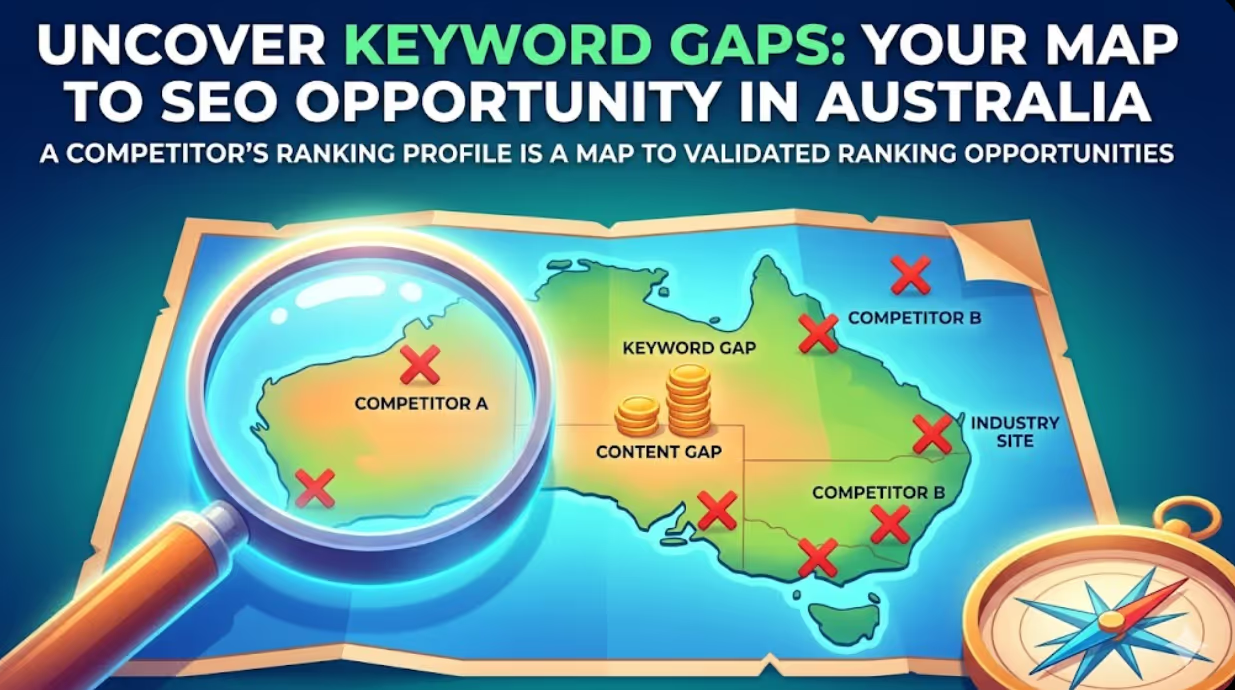
The Map Already Exists. You Just Have to Read It.
A competitor's ranking profile is a map of the keyword opportunities that have been validated in the category. Every keyword a strong competitor ranks for is a keyword that Google has decided belongs in the topic space, that represents genuine search demand, and that can be reached through editorial investment. The gaps in that map, the keywords that multiple competitors rank for and the target site does not, are the most efficiently validated ranking opportunities available, because the research and validation work has already been done by the competitors that got there first. The task for Australian businesses conducting competitive gap analysis is not to generate new opportunity from scratch. It is to read a map that already exists, prioritise the most commercially valuable routes on it, and build the content that closes the distance.
Maven Marketing Co conducts SEO competitive gap analyses for Australian businesses, producing prioritised keyword gap reports, content gap assessments, and twelve month publishing plans that close the most commercially important gaps first.
Talk to the team at Maven Marketing Co →

Table of contents
read more blogs

Is Google Ads Better Than SEO for My Business
One of the biggest questions business owners ask when they are planning online growth is whether they should invest in Google Ads or SEO. Both are strong marketing plays that help your company show up in Google search results, but they do things in separate lanes. Google Ads gives quicker visibility and can bring in leads fast, whereas SEO more or less focuses on slow, steady organic traffic that tends to grow the longer you keep building it. Picking the right direction depends on what you want to achieve, how much money you can spend, how crowded the market is, and how quickly you need results, like sooner rather than later. The good news is you don’t always have to choose one or the other; it’s not exactly a black-and-white situation. If you take time to understand the strongest points of both, you can put together a more sensible digital marketing plan that supports consistent expansion. In this guide, we’ll compare Google Ads vs SEO, explain the main differences, and help you figure out what option makes the most sense for your business.

When Should I Hire a Digital Marketing Agency
Growing a business today takes more than just having a website or throwing a post on social media; customers usually search around online, compare providers, skim reviews, and basically expect the brand to show up with a solid digital presence before they even think about buying. Many businesses try to run their marketing themselves, but there comes a point when “doing it all in-house” becomes clunky and hard to manage, all at once. Knowing when to hire a digital marketing agency can end up making a big, real difference for your growth. If you’re not getting enough leads, or your online visibility feels stuck, or sales are just not moving, the right agency can bring the know-how, plus a clear plan, to help you get noticeably better outcomes. In this guide, we’ll dig into what a digital marketing agency actually does, the usual signs it’s time to bring one on, and how picking the right marketing partner can help your business move forward at a faster pace.
Why Is My Google Ads Budget Running Out So Quickly
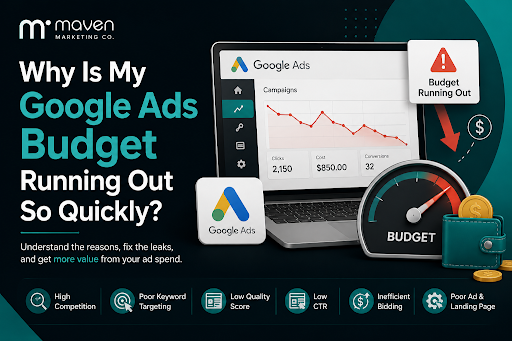
Running a successful Google Ads budget isn’t only about throwing more money at it. It’s more like making every dollar, doing a bit extra. A lot of businesses start a Google Ads campaign with big hopes, then find out their daily budget is gone within a few hours, and that feels weird, right? After that, your ads stop showing effectively, new leads slip away, and your return on investment dips. So if your Google Ads budget is running out too fast, don’t stress. It’s a fairly common issue, and in most situations, it can be repaired with the right approach. There are multiple little things that can drain your advertising money quicker than you expected, from costly keywords to audience targeting that just doesn’t quite fit. In this guide, we’ll walk through why your budget disappears so quickly, how to cut wasteful spend, and the most reliable ways to boost your Google Ads ROI, even if your budget stays the same.