.svg)


%201.svg)
You're still optimizing for "best plumber Sydney" while your competitor ranks for 47 related queries you never thought to target. They appear when customers search "emergency pipe burst help," "water damage prevention," and "licensed drainage specialist near me." How? They stopped chasing keywords and started building semantic authority.
According to comprehensive semantic SEO research, content with semantic optimization ranks for more keywords because it naturally includes related terms around the main topic. This isn't keyword expansion. It's fundamental shift in how search algorithms evaluate content relevance, authority, and value.
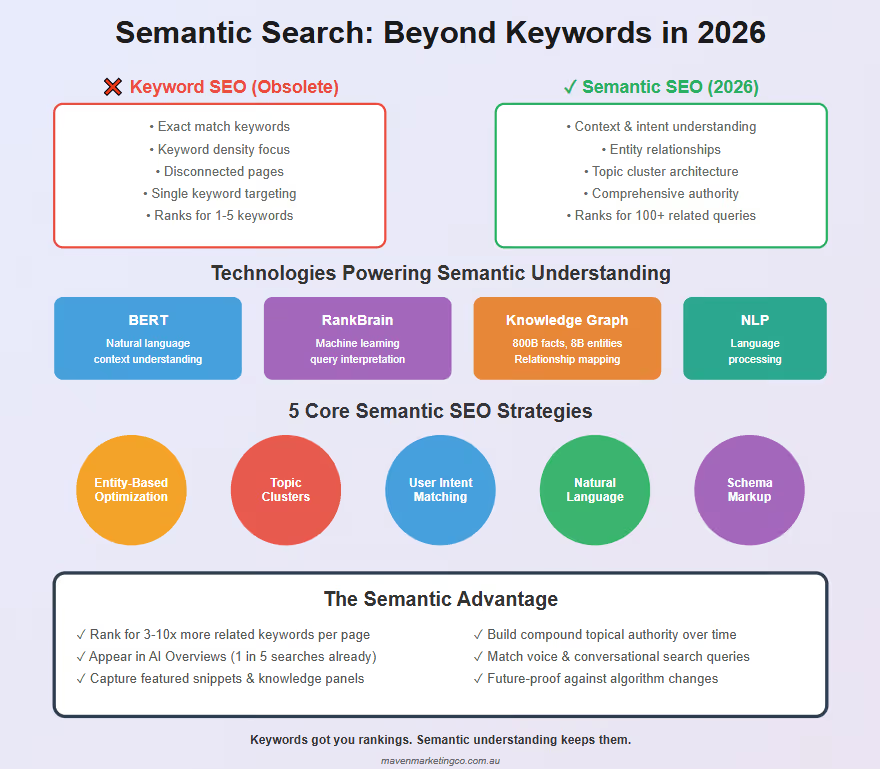
Google's Knowledge Graph expanded from processing 570 million entities to 800 billion facts and 8 billion entities in under 10 years. That evolution represents search engines moving from matching words to understanding concepts, relationships, and context. By mid 2025, AI Overviews were already present for nearly one in five search queries, fundamentally changing what "ranking" even means.
For Australian businesses, this represents the most significant SEO paradigm shift since mobile first indexing. The tactics that built your rankings through 2023 are actively harming them in 2026. Understanding semantic search isn't optional anymore. It's the difference between visibility and irrelevance.
What Semantic Search Actually Means (And Why It Matters Now)
Semantic search focuses on understanding the context and intent behind a user's query instead of just matching keywords. Search engines use natural language processing, machine learning, and artificial intelligence technologies to interpret meaning and phrases in a more human-like manner.
Think about the query "apple." Traditional keyword matching returns results about both the fruit and the technology company with no way to distinguish intent. Semantic search analyses surrounding context: previous searches, location, device type, time of day, and query phrasing to determine whether you want fruit nutrition information or iPhone specs.
This contextual understanding extends far beyond ambiguous single words. When someone searches "best Italian restaurant open now near Brisbane CBD with parking," semantic search algorithms parse multiple intent signals: cuisine preference (Italian), temporal requirement (open now), location specificity (Brisbane CBD), and practical consideration (parking). Traditional keyword SEO targeting "Italian restaurant Brisbane" misses 75% of that intent.
Search engines now aim to deliver precise, actionable answers instead of pages containing keywords. This shift from providing lists of potentially relevant pages to answering questions directly explains why AI Overviews, featured snippets, and knowledge panels increasingly dominate search results above traditional organic listings.
For Australian businesses, semantic search means your content must demonstrate comprehensive understanding of topics, not just keyword inclusion. A Melbourne cafe ranking well doesn't just mention "Melbourne cafe" repeatedly. It answers questions about local coffee culture, discusses suburb specific recommendations, addresses practical concerns like parking and dietary options, and establishes authority through depth and relevance.
The Technology Powering Semantic Understanding
Multiple algorithmic updates and technologies enable search engines to move beyond keyword matching into genuine semantic comprehension.
Google BERT: Introduced in 2019, BERT (Bidirectional Encoder Representations from Transformers) revolutionized how Google understands natural language. It analyses the full context of words in a query by looking at surrounding words in both directions, allowing much more nuanced interpretation. BERT particularly improved understanding of longer, conversational queries and the subtle relationships between words.
RankBrain: Google's machine learning system interprets search queries and content meaning. RankBrain helps Google understand queries it's never seen before by recognizing patterns and relationships between concepts. It evaluates how users interact with search results, learning which content actually satisfies intent even when keyword matches aren't perfect.
Knowledge Graph: Google's vast database mapping relationships between entities, concepts, people, places, and things. The Knowledge Graph enables search engines to understand that "Sydney Opera House" relates to "performing arts," "Jørn Utzon," "Bennelong Point," and "UNESCO World Heritage Site" even when those exact terms don't appear in queries or content.
Natural Language Processing: The foundation enabling machines to understand human language. NLP powers Google's ability to analyse content for entities, keywords, and topics, understand user queries in context, interpret semantic relationships between terms, and generate snippets, knowledge panels, and AI summaries.
These technologies work together creating search experiences far beyond what keyword matching could achieve. They're why identical keywords in two different pieces of content produce dramatically different rankings based on comprehensiveness, entity relationships, and topic authority.
Entity Based SEO: The Foundation of Semantic Strategy

Entities represent the fundamental building blocks of semantic search. An entity is anything that's distinct, unique, and well defined: a person, place, brand, concept, or object.
Traditional SEO optimizes for keywords: "digital marketing agency Sydney." Entity based SEO optimizes for entities and their relationships: [business name] positioned as [digital marketing agency] serving [Sydney] specializing in [content marketing] and [SEO] for [small businesses] in [technology] and [professional services] industries.
Entity based SEO prioritizes context over keywords, helping users find information better. Unlike keyword stuffed content that annoys readers, entity focused content delivers clear value and matches specific search intent.
To implement entity based optimization, start by identifying the entities most relevant to your business. What concepts, brands, locations, people, and services define your expertise? For an Australian accounting firm, core entities might include [accounting], [taxation], [Australian Taxation Office], [business advisory], [GST], [ASIC compliance], [financial reporting], and location entities for each office and service area.
Build your content around entity relationships, not keywords. Show how your business entity connects to service entities, location entities, industry entities, and expertise entities. This semantic network helps search engines understand your topical authority and relevance for queries touching any connected entity.
Use schema markup extensively to explicitly define entities and relationships. LocalBusiness schema tells search engines your business entity. Service schema defines your service entities. Organization schema establishes your brand entity and its properties. This structured data makes entity recognition effortless for algorithms.
Topic Clusters: Organizing Content for Semantic Authority
Topic clusters represent the most efficient way to organize content and boost SEO with semantic keywords. This framework involves a pillar page providing extensive overview as a hub for interconnecting various related topics through cluster content.
Traditional SEO created disconnected pages each targeting different keywords with minimal connection between them. Topic clusters establish clear semantic relationships showing comprehensive topic coverage earning search engine trust and authority.
A pillar page targets a broad topic comprehensively. For "Content Marketing for Australian Businesses," the pillar covers content strategy, types of content, distribution channels, measurement frameworks, and implementation approaches in 3,000 to 5,000 words establishing foundational authority.
Cluster content explores specific subtopics in depth, linking back to the pillar and between related clusters. Individual articles covering "How to Create Buyer Personas for Content Marketing," "Distribution Strategies for Australian Markets," "Content ROI Measurement Frameworks," and "Video Content Production Guide" all link to the pillar and each other where relevant.
This interconnected structure helps search engines determine the connection among multiple content topics and outlines extensive analysis of a topic. Google can see you haven't just written one article about content marketing. You've built comprehensive resource covering the topic from every angle demonstrating genuine expertise.
For Australian businesses, topic clusters provide massive advantages in competitive markets. Instead of competing with established authorities on broad keywords, you establish authority through comprehensive topic coverage they haven't matched. Your interconnected cluster demonstrates expertise individual competing pages can't replicate.
Optimizing for User Intent: The Three Types That Matter

Understanding and optimizing for search intent represents the core of semantic SEO. Every query carries intent search engines want to satisfy. Missing intent alignment means your content doesn't rank regardless of keyword inclusion.
Informational Intent: Users want to learn something, understand a concept, or find specific information. Queries like "how does superannuation work in Australia," "what is semantic search," or "Sydney weather forecast" demonstrate informational intent. Content satisfying this intent provides clear, comprehensive answers without sales pressure.
Navigational Intent: Users want to reach a specific website, page, or location. Searches like "Commonwealth Bank login," "Facebook," or "IKEA Rhodes" show navigational intent. These queries seek specific destinations, not exploratory browsing.
Transactional Intent: Users intend to complete actions: purchase products, book services, sign up for trials, or download resources. Queries including "buy," "order," "book," "download," or specific product names typically signal transactional intent requiring product pages, booking systems, or conversion focused landing pages.
Analyse your target keywords for dominant intent. Create content specifically designed to satisfy that intent type. Don't write informational blog posts targeting transactional keywords or product pages targeting informational queries. Intent misalignment prevents rankings regardless of content quality or technical optimization.
For Australian businesses, understanding local intent variations matters. "Emergency plumber" carries different urgency than "plumbing maintenance tips." "Cafes in Melbourne" requires different content than "best Melbourne cafe for remote work." Semantic search algorithms recognize these subtle intent differences. Your content must too.
Natural Language and Conversational Content
Platforms like Google's BERT and RankBrain decode context, so crafting content in conversational and natural style enhances ranking chances. This doesn't mean casual unprofessional writing. It means matching how real people actually speak and ask questions.
Write how your customers talk, not how SEO guides from 2015 said to write. If customers ask "Which Sydney suburbs have the best schools?" write content answering that question directly using that natural phrasing. Don't awkwardly force "best schools Sydney suburbs" throughout content destroying readability.
Use question formats extensively in headings and content structure. "How do I choose an accountant in Brisbane?" "What should I look for in commercial insurance?" "When is the best time to prune native Australian plants?" These natural questions match how people search, especially using voice search which continues growing.
Include conversational modifiers and natural language patterns. People don't search "plumber." They search "Which plumber should I call for blocked drain emergency at 2am?" Content including these natural, specific, conversational elements aligns perfectly with semantic search algorithms.
Avoid robotic keyword insertion that sounds unnatural. "Looking for Sydney plumber for Sydney plumbing services in Sydney suburbs?" sounds nothing like human speech. "Need a licensed plumber in Sydney's Inner West for emergency repairs?" sounds natural while maintaining semantic relevance.
Schema Markup: Speaking Google's Language Directly

Schema markup strategy enhances visibility in search engines and helps increase user interactions. Because search engines adapt to focus on context and interpretations, structured data is pivotal for semantic SEO.
Schema markup provides explicit information about your content meaning, removing algorithmic guesswork. When you mark up events with Event schema, Google knows exactly when events occur, where they're located, and how to display them. Without markup, algorithms must infer this information from unstructured text with varying success rates.
Implement these critical schema types for Australian businesses:
LocalBusiness Schema: Defines your business entity with name, address, phone, hours, service areas, and business type. Essential for local search visibility and Google Business Profile integration.
FAQ Schema: Marks up frequently asked questions and answers, dramatically improving chances of featured snippet placement and voice search optimization.
Article Schema: Helps search engines understand published content including headline, author, publication date, and modification date. Particularly important for news and blog content.
Product Schema: Defines products with pricing, availability, reviews, and specifications. Critical for ecommerce and service businesses wanting rich snippets.
Review Schema: Enables star ratings display in search results significantly improving click through rates through visual trust signals.
Breadcrumb Schema: Shows your site's hierarchy helping both users and search engines understand content organization and relationships.
Validate all schema using Google's Rich Results Test and Schema Markup Validator. Invalid schema is worse than no schema because it confuses rather than clarifies. Regular audits ensure markup remains accurate as your business and offerings evolve.
Measuring Semantic SEO Success in 2026
Traditional SEO metrics like keyword rankings and organic traffic tell incomplete stories for semantic strategies. Track these metrics revealing true semantic performance.
Keyword Ranking Expansion: Monitor how many total keywords each page ranks for, not just target keywords. Semantic optimized content typically ranks for 3x to 10x more related queries than keyword focused content. This expansion indicates strong semantic relevance.
Featured Snippet Ownership: Track featured snippet appearances for target topics. Featured snippets represent Google's highest confidence that your content best answers queries. Growing snippet ownership signals strong semantic authority.
Entity Mentions and Knowledge Graph Presence: Monitor whether your brand appears in Google's Knowledge Graph and knowledge panels. Entity recognition in Google's databases represents semantic authority achievement.
Topic Cluster Performance: Analyse organic traffic across entire topic clusters rather than individual pages. Cluster traffic growth indicates building topical authority. Internal linking between cluster pages should show strong engagement.
Long Tail Traffic Growth: Semantic strategies dramatically increase long tail keyword traffic as comprehensive content matches diverse specific queries. Monitor percentage of traffic from long tail queries as semantic optimization metric.
AI Overview Citations: Track how often your content gets cited in AI Overviews for target topics. Citation in AI generated answers represents peak semantic relevance recognition.
User Engagement Metrics: Time on page, pages per session, and bounce rates reveal whether content satisfies intent. Semantic focused content typically shows higher engagement as comprehensive coverage keeps users engaged.

The Australian Semantic SEO Opportunity
Most Australian businesses haven't adapted to semantic search realities. They're still chasing exact match keywords, building disconnected pages, and wondering why traffic declines despite stable rankings.
This creates opportunity for businesses understanding semantic principles. While competitors stuff keywords hoping for rankings, you build comprehensive topic authority through interconnected clusters demonstrating genuine expertise. While they chase individual keywords, you rank for hundreds of related queries they never considered.
Australian markets present unique semantic opportunities. Local entities, Australian terminology, regional variations, and market specific concepts create semantic networks competitors overseas can't replicate. An Australian business writing comprehensively about "superannuation planning" establishes entity relationships international content can't match regardless of quality.
The businesses dominating Australian search in 2026 won't be those with biggest budgets or oldest domains. They'll be those understanding semantic search, implementing entity based strategies, building topic clusters, and creating comprehensive authority search algorithms actually reward.
The Bottom Line
Semantic search isn't coming. It's here. It's been here. It's what search has become while businesses still optimized for keyword matching algorithms that stopped existing years ago.
The implication is clear: adapt or get left behind. Ranking in 2026 means more than keywords and backlinks. It means publishing content demonstrating true topical authority, optimizing for clarity and structure, and creating experiences both people and machines understand.
Your competitors are either figuring this out or watching rankings collapse without understanding why. The gap between businesses embracing semantic SEO and those clinging to keyword tactics isn't closing. It's widening every month as semantic algorithms become more sophisticated.
Which side of that gap will your Australian business occupy? The one building sustainable semantic authority, or the one wondering why keyword optimization stopped working?
Master Semantic Search Strategy
Stop watching rankings decline while competitors dominate topics you should own. At Maven Marketing Co., we help Australian businesses transition from outdated keyword strategies to comprehensive semantic SEO approaches delivering sustainable visibility.
Our semantic optimization combines entity based keyword research, strategic topic cluster development, natural language content creation, comprehensive schema implementation, and ongoing performance tracking ensuring your content ranks for topics, not just keywords.
We don't just improve rankings. We build topical authority that compounds over time, establishing your business as the semantic answer to customer questions across entire subject areas.
Contact Maven Marketing Co. today for a semantic SEO audit revealing exactly how your content performs under semantic evaluation, which topic clusters you should build, and the strategic roadmap establishing genuine topical authority search algorithms reward in 2026.

Table of contents
read more blogs
Is Google Ads Better Than SEO for My Business
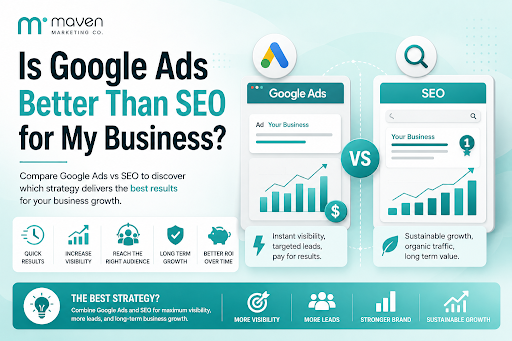
One of the biggest questions business owners ask when they are planning online growth is whether they should invest in Google Ads or SEO. Both are strong marketing plays that help your company show up in Google search results, but they do things in separate lanes. Google Ads gives quicker visibility and can bring in leads fast, whereas SEO more or less focuses on slow, steady organic traffic that tends to grow the longer you keep building it. Picking the right direction depends on what you want to achieve, how much money you can spend, how crowded the market is, and how quickly you need results, like sooner rather than later. The good news is you don’t always have to choose one or the other; it’s not exactly a black-and-white situation. If you take time to understand the strongest points of both, you can put together a more sensible digital marketing plan that supports consistent expansion. In this guide, we’ll compare Google Ads vs SEO, explain the main differences, and help you figure out what option makes the most sense for your business.

When Should I Hire a Digital Marketing Agency
Growing a business today takes more than just having a website or throwing a post on social media; customers usually search around online, compare providers, skim reviews, and basically expect the brand to show up with a solid digital presence before they even think about buying. Many businesses try to run their marketing themselves, but there comes a point when “doing it all in-house” becomes clunky and hard to manage, all at once. Knowing when to hire a digital marketing agency can end up making a big, real difference for your growth. If you’re not getting enough leads, or your online visibility feels stuck, or sales are just not moving, the right agency can bring the know-how, plus a clear plan, to help you get noticeably better outcomes. In this guide, we’ll dig into what a digital marketing agency actually does, the usual signs it’s time to bring one on, and how picking the right marketing partner can help your business move forward at a faster pace.
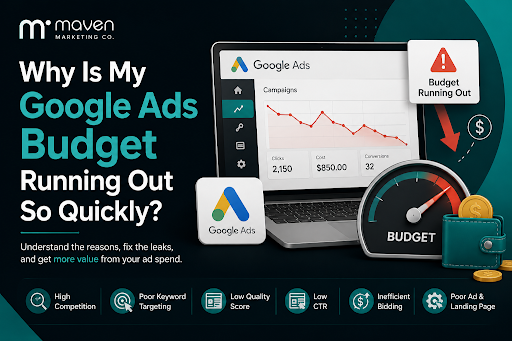
Why Is My Google Ads Budget Running Out So Quickly
Running a successful Google Ads budget isn’t only about throwing more money at it. It’s more like making every dollar, doing a bit extra. A lot of businesses start a Google Ads campaign with big hopes, then find out their daily budget is gone within a few hours, and that feels weird, right? After that, your ads stop showing effectively, new leads slip away, and your return on investment dips. So if your Google Ads budget is running out too fast, don’t stress. It’s a fairly common issue, and in most situations, it can be repaired with the right approach. There are multiple little things that can drain your advertising money quicker than you expected, from costly keywords to audience targeting that just doesn’t quite fit. In this guide, we’ll walk through why your budget disappears so quickly, how to cut wasteful spend, and the most reliable ways to boost your Google Ads ROI, even if your budget stays the same.