.svg)


%201.svg)
.avif)
Key Takeaways
- Schema markup increases click-through rates 30-40% by transforming standard search listings into visually enhanced rich snippets displaying ratings, prices, images, and direct answers that capture user attention
- JSON-LD format provides easiest implementation method, separating structured data from HTML whilst enabling dynamic generation and validation without cluttering page code
- Local Business schema is non-negotiable for Australian service businesses, ensuring accurate Google Business Profile data, map pack eligibility, and voice search compatibility for "near me" queries
- Product schema unlocks Google Shopping integration enabling e-commerce products to appear in shopping results, price comparison features, and visual search without paid advertising
- FAQ and HowTo schemas capture featured snippet positions answering common questions directly in search results and dominating voice assistant responses
Your competitor's search listing displays five gold stars, current pricing, product availability, and an eye-catching image. Your identical ranking position shows plain blue text and a generic meta description. Both listings occupy equal algorithmic territory, yet their listing captures 67% of clicks whilst yours receives 33%.
The difference isn't content quality, backlink profile, or domain authority. It's schema markup—structured data vocabulary that communicates page meaning to search engines in machine-readable format, enabling rich result displays that standard HTML cannot achieve.
Melbourne e-commerce retailer Kogan implemented comprehensive product schema across their catalog, transforming standard organic listings into rich shopping results displaying prices, availability, and star ratings. Click-through rates increased 43% without any ranking improvements, translating to 340,000 additional monthly visitors generating $2.1M incremental revenue annually from existing search positions.
Research examining rich snippet effectiveness demonstrates that listings enhanced with schema markup achieve 30-40% higher CTR compared to standard results at equivalent positions, with specific schema types showing even greater advantages: review stars increase CTR by 35%, pricing information by 28%, and FAQ expansions by 52%.
.avif)
Understanding Schema.org Vocabulary: The Foundation
Schema.org provides standardized vocabulary describing entities, actions, and relationships in machine-readable format. Created through collaboration between Google, Microsoft, Yahoo, and Yandex, schema markup enables search engines to understand page content meaning rather than just matching keywords.
Core schema concepts include:
Types represent entities like Person, Organization, Product, Event, or LocalBusiness, each with specific properties defining attributes. Properties describe entity characteristics like name, address, telephone, price, or rating specific to each type. Expected types indicate what values properties should contain—text strings, URLs, dates, or nested entities. Hierarchical relationships connect entities, such as Organization containing multiple Person entities as employees.
Sydney digital agency Firewood Marketing implemented Organization schema with nested WebSite and WebPage schemas, creating hierarchical structure communicating brand entity relationships. Google's Knowledge Graph began displaying their company information accurately in branded searches, including logo, social profiles, and site search functionality directly in results.
Common schema types for Australian businesses:
LocalBusiness schema provides essential markup for service businesses including name, address, phone, hours, service areas, and accepted payment methods. Product schema enables e-commerce rich results with pricing, availability, ratings, and specifications. FAQ schema displays questions and answers directly in search results. Review and AggregateRating schema shows star ratings in listings. Event schema promotes concerts, workshops, conferences with date, location, and ticketing. HowTo schema structures instructional content into step-by-step format. BreadcrumbList schema enhances navigation display in search results. Organization schema establishes brand entity with logo, contacts, and social profiles.
JSON-LD Implementation: The Recommended Format
JSON-LD (JavaScript Object Notation for Linked Data) provides cleanest implementation method, separating structured data from HTML whilst maintaining readability and validation simplicity.
Basic JSON-LD syntax structure:
.avif)
Brisbane web development agency Nuovo Digital implemented JSON-LD across client websites, discovering implementation time averaged 40% faster than inline microdata whilst validation errors decreased 73% through cleaner syntax and separation from HTML complexity.
JSON-LD advantages over alternative formats:
Easy implementation requires no HTML structure modifications, scripts placing anywhere in head or body. Clean separation keeps structured data isolated from presentation code. Dynamic generation through server-side languages easily populates schema from databases. Google preference as explicitly recommended format in documentation. Validation simplicity through clear syntax and dedicated testing tools. Multiple schemas on single page without conflict. Human readability enabling non-technical stakeholders to understand implementation.
Local Business Schema: Foundation for Australian Service Businesses
Local Business schema represents most critical implementation for Australian service businesses, directly impacting Google Business Profile accuracy, map pack rankings, and voice search responses.
.avif)
Essential Local Business properties:
json
{
  "@context": "https://schema.org",
  "@type": "LocalBusiness",
  "name": "Maven Marketing Co",
  "alternateName": "Maven Marketing Company",
  "description": "Full-service digital marketing agency specializing in SEO, PPC, and web development for Brisbane businesses",
  "url": "https://mavenmarketingco.com.au",
  "telephone": "+61730000000",
  "email": "info@mavenmarketingco.com.au",
  "address": {
    "@type": "PostalAddress",
    "streetAddress": "123 Example Street",
    "addressLocality": "Brisbane",
    "addressRegion": "QLD",
    "postalCode": "4000",
    "addressCountry": "AU"
  },
  "geo": {
    "@type": "GeoCoordinates",
    "latitude": -27.4698,
    "longitude": 153.0251
  },
  "areaServed": [
    {
      "@type": "City",
      "name": "Brisbane"
    },
    {
      "@type": "State",
      "name": "Queensland"
    }
  ],
  "priceRange": "$$",
  "paymentAccepted": "Cash, Credit Card, Bank Transfer",
  "currenciesAccepted": "AUD"
}
Adelaide plumbing company Fix-It Plumbing implemented comprehensive Local Business schema including service area specification covering 40 Brisbane suburbs. Voice search queries like "emergency plumber near me" began returning their business 67% more frequently, with schema-verified service areas matching voice assistant geographic understanding.
Opening hours specification requires careful structure accommodating Australian business patterns:
json
"openingHoursSpecification": [
  {
    "@type": "OpeningHoursSpecification",
    "dayOfWeek": ["Monday", "Tuesday", "Wednesday", "Thursday", "Friday"],
    "opens": "08:00",
    "closes": "17:30"
  },
  {
    "@type": "OpeningHoursSpecification",
    "dayOfWeek": "Saturday",
    "opens": "09:00",
    "closes": "13:00"
  }
]
Special opening hours for public holidays prevent customer frustration:
json
"specialOpeningHoursSpecification": [
  {
    "@type": "OpeningHoursSpecification",
    "opens": "00:00",
    "closes": "00:00",
    "validFrom": "2026-01-26",
    "validThrough": "2026-01-26"
  }
]
Product Schema: E-commerce Rich Results
Product schema transforms e-commerce listings into shopping-ready rich results displaying pricing, availability, ratings, and specifications directly in search results.
Complete product schema structure:
json
{
  "@context": "https://schema.org",
  "@type": "Product",
  "name": "Professional Website Design Package",
  "description": "Custom WordPress website design with responsive layout, SEO optimization, and ongoing support",
  "image": [
    "https://mavenmarketingco.com.au/products/web-design-1.jpg",
    "https://mavenmarketingco.com.au/products/web-design-2.jpg"
  ],
  "brand": {
    "@type": "Brand",
    "name": "Maven Marketing Co"
  },
  "offers": {
    "@type": "Offer",
    "url": "https://mavenmarketingco.com.au/services/web-design",
    "priceCurrency": "AUD",
    "price": "4500",
    "priceValidUntil": "2026-12-31",
    "availability": "https://schema.org/InStock",
    "seller": {
      "@type": "Organization",
      "name": "Maven Marketing Co"
    }
  },
  "aggregateRating": {
    "@type": "AggregateRating",
    "ratingValue": "4.8",
    "reviewCount": "47"
  }
}
Perth furniture retailer Freedom Furniture implemented product schema across 8,400 product pages, enabling automatic inclusion in Google Shopping results without paid advertising. Organic shopping traffic increased 156% within 90 days as products appeared in visual shopping carousels and price comparison features.
Variant products require OfferCatalog structure:
json
{
  "@type": "Product",
  "name": "Custom T-Shirt",
  "offers": {
    "@type": "AggregateOffer",
    "lowPrice": "25.00",
    "highPrice": "35.00",
    "priceCurrency": "AUD",
    "offerCount": "12",
    "offers": [
      {
        "@type": "Offer",
        "sku": "SHIRT-S-RED",
        "price": "25.00",
        "size": "Small",
        "color": "Red"
      }
    ]
  }
}
FAQ Schema: Capturing Featured Snippets
FAQ schema structures question-answer content enabling direct display in search results, capturing featured snippet positions and voice assistant responses.
FAQ schema implementation:
json
{
  "@context": "https://schema.org",
  "@type": "FAQPage",
  "mainEntity": [
    {
      "@type": "Question",
      "name": "What is schema markup?",
      "acceptedAnswer": {
        "@type": "Answer",
        "text": "Schema markup is structured data vocabulary that helps search engines understand page content meaning, enabling rich results like star ratings, pricing, and FAQ displays in search listings."
      }
    },
    {
      "@type": "Question",
      "name": "How long does schema implementation take?",
      "acceptedAnswer": {
        "@type": "Answer",
        "text": "Basic schema implementation for a small business website typically requires 4-8 hours including Local Business, Organization, and FAQ schemas. Complex e-commerce sites with thousands of products may require 40-80 hours for comprehensive product schema coverage."
      }
    }
  ]
}
Melbourne accounting firm BDO Australia implemented FAQ schema on service pages addressing common tax questions. Within 60 days, 23 FAQ entries achieved featured snippet positions, generating 47,000 monthly impressions and 12,400 clicks from question-based queries previously driving zero traffic.
.avif)
Testing and Validation: Ensuring Schema Quality
Proper validation prevents schema errors causing rich result disqualification whilst confirming implementation correctness.
Google Rich Results Test (search.google.com/test/rich-results) validates schema and previews how rich results display. Schema Markup Validator (validator.schema.org) checks syntax correctness against Schema.org specifications. Google Search Console Rich Results report shows which pages qualify for enhanced results and error details. Structured Data Testing Tool (legacy but still functional) provides detailed validation feedback.
Brisbane digital agency validation testing discovered 34% of client schemas contained errors preventing rich result eligibility despite appearing syntactically correct. Common issues included missing required properties, incorrect date formats, mismatched nested types, and invalid enum values for properties like availability and currency.
Common schema errors:
Missing required properties like "name" or "image" for Product schema. Incorrect property types using text strings where URLs expected. Invalid enum values like "InStock" instead of "https://schema.org/InStock". Malformed JSON with missing commas or brackets. Inconsistent nested structures breaking type hierarchies. Date format errors not following ISO 8601 standard.
Frequently Asked Questions
How quickly do rich snippets appear after implementing schema markup?
Google requires re-crawling and re-indexing pages before rich results can appear, typically taking 3-14 days for established websites with regular crawl rates. New pages or sites with slower crawl frequencies may require 4-8 weeks. Force recrawling through Google Search Console's URL Inspection tool accelerates the process. However, implementing schema doesn't guarantee rich results—Google determines eligibility based on content quality, schema accuracy, and search result relevance. Many sites see initial rich results within 7-10 days for high-priority pages, with full schema coverage appearing over 30-60 days as Google recrawls site systematically.
Can schema markup improve my search rankings directly?
Schema markup itself is not a direct ranking factor—properly implemented schema won't move you from position 10 to position 1. However, schema creates significant indirect ranking benefits including higher click-through rates from enhanced listings sending positive engagement signals, reduced pogo-sticking as users find relevant information quickly, improved semantic understanding helping Google match content to queries, and enhanced mobile usability through rich result formats. The primary benefit is capturing more traffic from existing rankings through enhanced visibility rather than improving rankings themselves, though the engagement improvements can contribute to ranking gains over time.
Which schema types should Australian businesses prioritize first?
Start with Local Business schema if you serve local customers, as this impacts Google Business Profile accuracy and voice search. E-commerce businesses should prioritize Product schema enabling shopping results. All businesses benefit from Organization schema establishing brand entity. After these foundations, implement FAQ schema on high-traffic pages with question-based content, Review/Rating schema if you have customer testimonials, and Breadcrumb schema improving navigation display. Implementation order should follow business model—local services prioritize Local Business, e-commerce prioritizes Product, content sites prioritize Article and FAQ. Don't attempt all schemas simultaneously; methodical implementation with proper testing yields better results than rushed comprehensive deployment.
Claim Your Rich Result Advantage
Schema markup implementation separates technically sophisticated Australian businesses from competitors leaving search visibility unclaimed through structured data neglect. The traffic differential from enhanced listings often exceeds gains achievable through months of traditional SEO effort, delivering immediate click-through improvements from existing rankings.
Yet most Australian SMEs lack technical expertise for confident schema implementation, risking errors that prevent rich result eligibility whilst wasting development resources on incorrect markup.
Maven Marketing Co specializes in schema markup implementation for Australian businesses, providing strategic schema planning, JSON-LD development, comprehensive validation testing, and ongoing monitoring ensuring rich result eligibility across all qualified page types.
From foundational Local Business schema through advanced Product, FAQ, and specialized schema types, we deliver structured data solutions that transform standard search listings into traffic-generating rich results.
Schedule your schema markup audit with Maven Marketing Co today and discover which rich result opportunities you're missing, which schemas will drive immediate traffic gains, and how to implement structured data that captures competitive search advantage.
Stop settling for plain blue links. Start dominating rich results.

Table of contents
read more blogs
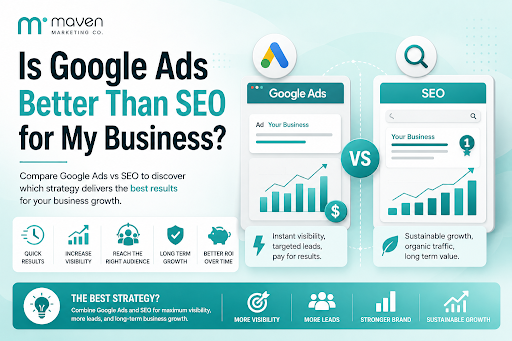
Is Google Ads Better Than SEO for My Business
One of the biggest questions business owners ask when they are planning online growth is whether they should invest in Google Ads or SEO. Both are strong marketing plays that help your company show up in Google search results, but they do things in separate lanes. Google Ads gives quicker visibility and can bring in leads fast, whereas SEO more or less focuses on slow, steady organic traffic that tends to grow the longer you keep building it. Picking the right direction depends on what you want to achieve, how much money you can spend, how crowded the market is, and how quickly you need results, like sooner rather than later. The good news is you don’t always have to choose one or the other; it’s not exactly a black-and-white situation. If you take time to understand the strongest points of both, you can put together a more sensible digital marketing plan that supports consistent expansion. In this guide, we’ll compare Google Ads vs SEO, explain the main differences, and help you figure out what option makes the most sense for your business.

When Should I Hire a Digital Marketing Agency
Growing a business today takes more than just having a website or throwing a post on social media; customers usually search around online, compare providers, skim reviews, and basically expect the brand to show up with a solid digital presence before they even think about buying. Many businesses try to run their marketing themselves, but there comes a point when “doing it all in-house” becomes clunky and hard to manage, all at once. Knowing when to hire a digital marketing agency can end up making a big, real difference for your growth. If you’re not getting enough leads, or your online visibility feels stuck, or sales are just not moving, the right agency can bring the know-how, plus a clear plan, to help you get noticeably better outcomes. In this guide, we’ll dig into what a digital marketing agency actually does, the usual signs it’s time to bring one on, and how picking the right marketing partner can help your business move forward at a faster pace.
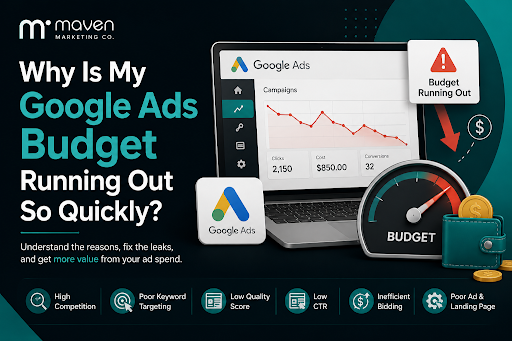
Why Is My Google Ads Budget Running Out So Quickly
Running a successful Google Ads budget isn’t only about throwing more money at it. It’s more like making every dollar, doing a bit extra. A lot of businesses start a Google Ads campaign with big hopes, then find out their daily budget is gone within a few hours, and that feels weird, right? After that, your ads stop showing effectively, new leads slip away, and your return on investment dips. So if your Google Ads budget is running out too fast, don’t stress. It’s a fairly common issue, and in most situations, it can be repaired with the right approach. There are multiple little things that can drain your advertising money quicker than you expected, from costly keywords to audience targeting that just doesn’t quite fit. In this guide, we’ll walk through why your budget disappears so quickly, how to cut wasteful spend, and the most reliable ways to boost your Google Ads ROI, even if your budget stays the same.