.svg)


%201.svg)
.avif)
Key Takeaways
- Behavioural segmentation improves retargeting ROI 300-600% by matching messaging to demonstrated intent, with cart abandoners converting at 8-12% versus 0.5-1.5% for generic website visitor retargeting
- Sequential messaging delivers narrative progression showing different ads based on previous exposure and time elapsed, preventing creative fatigue whilst moving prospects through consideration journey systematically
- Audience exclusions prevent wasted spend by suppressing ads to recent purchasers, unqualified visitors, and those exceeding frequency caps, concentrating budget on genuinely persuadable prospects
- Dynamic product ads achieve 4-8x higher conversion rates than static retargeting through automatically displaying exact products users viewed, creating personalized shopping reminders at scale
- Cross-device tracking captures 25-40% additional conversions by following users from mobile research to desktop purchase, preventing attribution breaks that make mobile retargeting appear less valuable than reality
Your Google Ads retargeting campaign targets "All Website Visitors—Past 30 Days" with single ad variation promoting "20% Off Sitewide Sale." This audience includes cart abandoners 90% toward purchase, product browsers early in consideration, blog readers in research phase, and accidental visitors who bounced immediately. Everyone sees identical messaging regardless of intent or journey stage.
Conversion rate languishes at 1.8% whilst cost per acquisition reaches $67—marginally better than cold traffic but disappointing given these audiences demonstrated interest through visiting your website.
Your competitor segments audiences by behaviour creating distinct campaigns for cart abandoners (15-day window, "Complete Your Purchase—Items Selling Fast"), product viewers (21-day window, "Still Interested in [Product]? 10% Off Today"), blog readers (45-day window, educational content offers), and past purchasers (90-day window, complementary product recommendations). Their segmented approach achieves 7.3% blended conversion rate at $23 CPA through precision targeting matching messaging to demonstrated intent.
The difference between generic retargeting and strategic segmentation often represents the gap between marginally profitable and highly profitable remarketing investment.
Sydney e-commerce platform Catch implemented behavioural segmentation creating eight distinct retargeting audiences based on pages viewed, engagement depth, and recency. Their sophisticated approach improved overall retargeting conversion rate from 2.4% to 6.8% whilst reducing blended CPA from $54 to $19—transforming mediocre remarketing into their highest-ROI marketing channel.
Research on retargeting segmentation effectiveness demonstrates that businesses implementing behavioural audience segmentation achieve 3-6x higher conversion rates than generic "all visitors" retargeting, with greatest improvements coming from high-intent segments like cart abandoners and repeat visitors demonstrating sustained interest.
.avif)
Understanding Retargeting Fundamentals: Beyond All-Visitors Lists
Effective retargeting begins with recognizing that not all website visitors represent equal conversion opportunity, requiring segmentation matching messaging to demonstrated intent and journey stage.
Why generic retargeting underperforms:
Intent variation among visitors ranges from accidental clicks to near-purchase abandonment. Generic messaging can't address diverse audience needs simultaneously—urgency appropriate for cart abandoners annoys early-stage researchers. Frequency issues arise when high-intent audiences need more exposure whilst low-intent visitors require minimal contact. Budget waste occurs from showing expensive ads to unqualified traffic unlikely to convert regardless of messaging. Message fatigue develops when audiences see identical creative repeatedly without progression or variation.
Retargeting audience hierarchy:
High-intent audiences (cart abandoners, product viewers, repeat visitors) demonstrate strong purchase signals warranting aggressive messaging and higher bids. Brisbane furniture retailer prioritized budget toward cart abandonment audiences converting at 12.3% versus 3.1% for general retargeting, concentrating spend where conversion probability justified investment.
Medium-intent audiences (category browsers, multiple-page visitors, email subscribers) show consideration-stage interest requiring nurturing rather than immediate conversion pressure. Melbourne SaaS company created educational content campaigns for these audiences building value perception before introducing conversion offers.
Low-intent audiences (single-page visitors, blog readers, accidental traffic) warrant minimal investment, with awareness-building or content-distribution messaging more appropriate than conversion focus. Adelaide professional services firm excluded visitors spending under 30 seconds onsite, preventing budget waste on accidental clicks whilst focusing on genuinely interested prospects.
Audience qualification thresholds:
Time on site minimum (30-60 seconds) filters accidental clicks and immediate bounces. Page depth requirement (2+ pages) indicates deliberate exploration versus random landing. Specific page views (pricing, product details, about us) demonstrate research behaviour. Form starts without completion show intent hampered by friction. Return visits within window suggest sustained interest warranting targeting.
Platform-specific capabilities:
Google Ads remarketing enables website visitor tracking, customer list uploads, YouTube engagement audiences, and app user targeting. Facebook/Meta retargeting offers website custom audiences, engagement audiences (video viewers, Instagram profile visitors), customer list matching, and lookalike audience creation. LinkedIn retargeting provides website visitors, video viewers, lead gen form openers, and company page engagement audiences. Each platform offers unique segmentation enabling cross-platform strategy leveraging respective strengths.
.avif)
Behavioural Audience Segmentation: Intent-Based Targeting
Behavioural segmentation creates audiences based on specific actions demonstrating varying purchase intent and journey stages.
Cart abandonment audiences:
Highest-intent segment showing users who added products to cart but didn't complete purchase. Short duration window (1-7 days) captures users whilst intent remains fresh. Dynamic product ads showing abandoned cart items create personalized reminders. Urgency messaging emphasizing scarcity or time limits encourages completion. Offer strategies including free shipping thresholds, discount incentives, or risk reversal guarantees. Perth e-commerce retailer created three cart abandonment segments: 0-24 hours (urgency messaging, no discount), 1-3 days (free shipping offer), 4-7 days (10% discount), achieving 15.7% blended recovery rate.
Product page viewers:
Users viewing specific products without adding to cart demonstrate consideration-stage interest. 14-21 day window maintains visibility during research period. Product-specific creative featuring viewed items with supporting benefits. Social proof elements including reviews and ratings addressing hesitation. Comparison content highlighting advantages versus alternatives. Sydney electronics retailer implemented dynamic product retargeting showing exact items viewed alongside "1,200+ Five-Star Reviews" messaging, improving conversion rate from 3.4% to 8.9% through personalization combined with social proof.
Category browsers:
Visitors exploring product categories without drilling into specific products show early consideration. 30-45 day window accommodates longer research cycles. Educational content about product selection criteria. Category-level promotions encouraging exploration. Bestseller showcases reducing decision paralysis. Melbourne fashion retailer retargeted category browsers with "Top 10 Best-Selling Dresses This Week" ads achieving 4.2% conversion versus 1.8% from generic product ads through reducing overwhelming choice to curated selection.
Engagement-based segments:
Time on site thresholds (2+ minutes, 5+ minutes) indicate serious interest warranting retargeting investment. Multiple visit requirements (2+ sessions within 7 days) demonstrate sustained consideration. Scroll depth tracking (75%+ page scroll) shows content engagement beyond superficial glance. Video view completion for businesses using video content as education or demonstration. Brisbane software company retargeted only visitors watching 75%+ of product demo video, achieving 11.3% trial signup conversion from highly qualified audience understanding product capabilities.
High-value prospect identification:
Visitors viewing pricing pages demonstrate purchase evaluation stage. Users accessing comparison pages or versus-competitor content show active decision-making. Multiple product viewers considering various options suggest serious intent. Visitors who downloaded resources or guides enter identifiable nurture sequence. Adelaide B2B company created "high-intent" retargeting audience combining pricing page viewers + comparison page viewers + demo request page visitors, targeting with "Schedule Your Implementation Call" messaging converting 8.7% versus 2.3% generic retargeting.
Sequential Retargeting: Progressive Messaging Strategy
Sequential retargeting delivers different messages based on previous ad exposure and time since website visit, creating narrative progression preventing creative fatigue.
Time-based messaging progression:
Days 0-2 (initial exposure): Gentle reminders without aggressive selling. "Thanks for Visiting—Here's What You Missed" or product showcases without heavy promotion. Brisbane retailer's first-exposure ads featured product benefits and brand values building familiarity without conversion pressure.
Days 3-7 (consideration nurture): Educational content addressing common objections. "See Why 12,000+ Customers Love [Product]" featuring testimonials and social proof. Comparison content highlighting competitive advantages. Melbourne SaaS company's mid-sequence ads provided case studies demonstrating ROI and success stories building confidence.
Days 8-14 (conversion push): Stronger calls-to-action with urgency or incentives. "Limited Stock—Shop Before It's Gone" or "Exclusive 15% Off Ends Friday." Time-limited offers creating decision motivation. Perth homewares company introduced discount offers only in later sequence after value-building earlier messages, achieving 6.8% conversion from sequenced approach versus 3.2% from immediate discount.
Days 15-30 (final touch): Last-chance messaging or alternative pathways. "Last Opportunity—Sale Ends Tomorrow" or "Not Ready to Buy? Get Our Free Guide." Exit strategies acknowledging users may not convert whilst capturing engagement through content. Sydney professional services firm's final sequence offered free consultation as soft conversion alternative to direct engagement, capturing 23% of non-purchasers into consultation pipeline.
Frequency-based sequencing:
First ad impression establishes brand recall through benefit-focused messaging. Second impression introduces social proof elements including reviews, customer counts, or trust signals. Third impression highlights differentiation versus alternatives. Fourth+ impressions rotate creative preventing fatigue through varied imagery and angle emphasis. Adelaide wine retailer created four creative variations rotating after each exposure preventing audience boredom whilst maintaining consistent value proposition across variations.
Cross-channel sequential strategy:
Google Display Network for initial broad awareness reach. Facebook/Instagram for mid-funnel engagement and social proof. YouTube for video demonstrations and testimonials. Email retargeting for high-intent segments already engaged. Melbourne education provider orchestrated cross-channel sequence: Display ads (awareness) → Facebook testimonial videos (consideration) → Email with course details (conversion), achieving 34% higher conversion than single-channel approach through channel-appropriate messaging at each stage.
Creative rotation discipline:
Create 4-6 creative variations per audience segment preventing fatigue. Rotate creatives every 1,000-2,000 impressions per user avoiding repetitive exposure. Test dramatically different approaches not just colour variations—different imagery, value propositions, and formats. Pause underperforming creatives replacing with new variations. Brisbane agency maintains creative library with 8-10 variations per segment, systematically refreshing based on performance preventing audience fatigue through constant novelty.
Dynamic Product Ads: Personalization at Scale
.avif)
Dynamic retargeting automatically shows specific products users viewed, creating personalized shopping experiences without manual creative production for each product.
E-commerce dynamic remarketing setup:
Google Merchant Center feed provides product catalog including IDs, names, prices, images, and availability. Dynamic remarketing campaigns pull product data automatically populating ads with viewed items. Product sets enable grouping items by category, brand, or margin for strategic bidding. Custom labels segment products by business criteria (clearance, bestsellers, high-margin) enabling differentiated treatment. Sydney electronics retailer organized 8,400 products into 23 product sets enabling margin-based bidding prioritizing high-profit items in dynamic campaigns.
Template design optimization:
Clean product imagery on neutral backgrounds maintaining consistency. Price display prominence showing value proposition immediately. Availability indicators ("In Stock," "Low Stock") creating urgency. Brand logo placement maintaining recognition. Call-to-action clarity through "Shop Now," "Learn More," or "Add to Cart" buttons. Melbourne fashion retailer A/B tested dynamic templates discovering clean white-background product images outperformed lifestyle photography by 34% CTR through reducing distraction and highlighting product clearly.
Cross-sell and upsell variations:
Show complementary products alongside viewed items suggesting bundle opportunities. Feature upgraded versions of viewed products encouraging higher-value purchases. Display "frequently bought together" items based on purchase data. Recommend similar items at different price points accommodating budget flexibility. Perth outdoor retailer's dynamic ads showed tent accessories (sleeping bags, camping chairs) to tent viewers, increasing average order value 23% through strategic cross-sell suggestions in retargeting creative.
Personalization elements beyond products:
Include user's name in creative for email-matched audiences (privacy-compliant). Reference specific browsing behaviour ("You viewed 3 dresses yesterday"). Highlight local inventory availability for brick-and-mortar retailers. Show pricing in user's preferred currency for international audiences. Adelaide multi-location retailer incorporated "Available at [Nearest Store]" dynamic text based on user location, improving in-store visit attribution 67% through location-specific relevance.
Dynamic ad performance benchmarks:
Conversion rates typically 4-8x higher than static retargeting through personalization relevance. Click-through rates 2-3x better due to product-specific interest. Cost per acquisition 40-60% lower through improved conversion efficiency. Return on ad spend 3-5x higher reflecting superior economics. Brisbane furniture company achieved 9.2% conversion from dynamic product ads versus 2.1% from static retargeting, validating personalization impact on performance.
Audience Exclusions and Frequency Management
Strategic exclusions prevent wasted spend on unconvertible audiences whilst frequency caps protect user experience and campaign efficiency.
Conversion-based exclusions:
Exclude recent purchasers (30-60 days) preventing annoying satisfied customers with irrelevant ads. Exception: Create separate campaigns targeting past purchasers with complementary products or consumable replenishment. Remove users who submitted lead forms or requested consultations focusing budget on unconverted prospects. Exclude email subscribers if you're nurturing them through owned channels avoiding paid/owned channel redundancy. Melbourne SaaS company excluded trial users from product awareness campaigns whilst targeting them with separate "upgrade to paid" campaigns, preventing message mismatch and budget waste.
Engagement-based exclusions:
Remove visitors spending under 10 seconds onsite indicating accidental clicks or immediate disinterest. Exclude single-page viewers who bounced without exploration showing minimal intent. Filter out bot traffic identified through impossible user behaviours or suspicious patterns. Remove users who clicked "Learn More" but immediately bounced from landing page showing false intent. Sydney e-commerce platform excluded 34% of website visitors through engagement filters, concentrating retargeting budget on 66% demonstrating genuine interest through meaningful engagement.
Frequency capping discipline:
Set daily impression caps (typically 3-5) preventing overexposure to same user single day. Weekly frequency limits (10-20 impressions) maintain visibility without saturation. Monthly caps (40-60 impressions) for long-window campaigns preventing burnout. Platform-specific settings as Google, Facebook, and others enable granular frequency management. Brisbane professional services firm implemented 3 impressions daily / 15 weekly / 45 monthly frequency caps, discovering optimal balance maintaining awareness without annoying audiences through excessive exposure.
Negative audience layering:
Exclude visitors from competitor domains who may be researching alternatives irrelevant to your offering. Remove users from job-seeking pages showing employment interest not customer intent. Filter out known competitors or industry professionals visiting for competitive intelligence. Exclude geographic locations outside service area preventing international traffic waste for local businesses. Adelaide local service business excluded all traffic outside 50km radius, eliminating 28% of retargeting impressions wasted on unconvertible distant prospects.
Suppress by campaign performance:
Pause retargeting to audiences showing zero conversions after 1,000+ clicks indicating fundamental mismatch. Reduce bids dramatically for low-performing segments rather than eliminating entirely allowing small-scale testing. Reallocate budget from underperformers to proven high-converting segments. Perth retailer paused retargeting to blog-only visitors after discovering 0.3% conversion rate from 2,400 clicks, redirecting budget to product viewers converting 6.8%.
Cross-Device and Privacy-Compliant Tracking
.avif)
Cross-device tracking maintains user identity across mobile and desktop enabling attribution accuracy whilst respecting privacy regulations.
Cross-device user journey patterns:
Research on mobile during commute or downtime. Compare options on desktop at work or home. Purchase on preferred device (often desktop for complex checkouts). Return visits across devices during extended consideration. Melbourne furniture company discovered 47% of purchases involved mobile research followed by desktop conversion, with average 8 days between devices—attribution impossible without cross-device tracking revealing mobile's contribution.
Google Ads cross-device tracking:
Requires users signed into Google account enabling cross-device identity matching. Google Signals in Google Analytics 4 enables cross-device reporting. Enhanced conversions using hashed customer emails improves cross-device matching accuracy. Limited to signed-in users (approximately 60-70% of traffic) meaning 30-40% cross-device behaviour remains untrackable. Sydney SaaS company implemented enhanced conversions improving cross-device conversion attribution 23% through email-based matching recovering previously lost attribution.
Facebook cross-device capabilities:
Facebook pixel combined with logged-in Facebook users enables sophisticated cross-device tracking. App and web tracking through Facebook SDK and pixel creates unified user view. Custom audiences based on email or phone matches users across devices. Cross-device attribution reports showing device path to conversion. Brisbane e-commerce retailer discovered through Facebook cross-device reporting that mobile contributed to 56% of conversions either as first touchpoint or research device despite mobile showing only 31% last-click attribution.
Privacy-compliant implementation:
Obtain explicit consent for tracking cookies per Privacy Act and ePrivacy requirements. Provide clear privacy policy explaining tracking purposes and data usage. Enable opt-out mechanisms allowing users to reject tracking. Minimize data collection to business-necessary information avoiding excessive surveillance. Use hashed/anonymized data wherever possible protecting user identity. Adelaide healthcare provider implemented strict privacy controls including cookie consent banner, data minimization, and regular compliance audits ensuring retargeting practices met healthcare privacy standards.
Server-side tracking benefits:
Bypass browser restrictions like Safari ITP and Firefox Enhanced Tracking Protection. Improve data accuracy through reducing client-side blocking. Enable first-party data collection reducing third-party cookie dependency. Maintain tracking capability in cookieless future as industry evolves. Perth financial services company implemented server-side Google Tag Manager recovering 18% of conversions previously lost to browser tracking prevention.
Platform-Specific Advanced Tactics
Each retargeting platform offers unique capabilities enabling strategic differentiation beyond generic cross-platform approaches.
Google Ads advanced audience features:
Customer Match using email lists for precise targeting of known contacts. Similar audiences (lookalikes) finding users resembling converters. In-market audiences combining retargeting with purchase-intent signals. Detailed demographics layering age, gender, household income onto behavioural segments. YouTube viewers retargeting users who watched videos. Melbourne agency combined website visitors + customer match + similar audiences creating "Super Qualified" segment converting 14.2% versus 5.8% website visitors alone.
Facebook/Meta sophisticated segmentation:
Video view percentage audiences targeting 25%, 50%, 75%, 95% viewers differently. Instagram engagement audiences including profile visitors and ad engagers. Lead form openers who started but didn't complete forms. Dynamic ads with broad audience showing catalog automatically to interested users. Canvas ad interactors demonstrating high engagement. Sydney fashion brand created sequential video campaign retargeting 95% video viewers (highest intent) with purchase offers whilst 25-50% viewers received brand education content, optimizing messaging to demonstrated interest level.
LinkedIn retargeting capabilities:
Website visitors filtered by company size, industry, and job function. Lead gen form openers showing high professional intent. Video viewers on LinkedIn showing business context engagement. Company page followers and engagers. Account-based retargeting to specific companies. Brisbane B2B software company used LinkedIn retargeting filtered to IT Directors at companies 100+ employees who viewed pricing pages, creating ultra-qualified audience converting 18.3% to demo requests.
Pinterest retargeting opportunities:
Engaged pinners who saved your pins showing high intent. Visitors to specific product pages matching Pinterest's visual shopping context. Actalike audiences similar to converters. Shopping behavior signals including board creation patterns. Adelaide homewares retailer leveraged Pinterest retargeting discovering platform-specific users showed 3.2x higher average order value than other channels, justifying platform investment despite smaller audience size.
Frequently Asked Questions
How long should retargeting windows be for different audience segments?
Retargeting windows should match purchase consideration timelines varying by product complexity and price. Cart abandoners warrant 3-7 day windows as urgency decreases beyond this timeframe and users likely purchased elsewhere. Product viewers justify 14-21 day windows accommodating research and comparison periods. Category browsers and blog readers support 30-60 day windows as they're early in journey requiring extended nurture. Past purchasers enable 60-180 day windows for replenishment or complementary purchases depending on product consumption rate. B2B services extend to 180-365 days given lengthy enterprise sales cycles. Melbourne retailer tested windows discovering cart abandonment performance dropped 73% between days 7-14 justifying 7-day maximum, whilst product viewers showed consistent performance through day 21 before declining, informing optimal 21-day window. Start conservatively with shorter windows, extending if performance remains strong.
Should I exclude converters immediately or retarget them with different messaging?
Depends on business model and product type. E-commerce should exclude recent one-time purchasers (30-60 days) whilst creating separate "post-purchase" campaigns promoting complementary products or consumable refills. SaaS should exclude trial signups from acquisition campaigns whilst targeting with upgrade/activation messaging. Service businesses should exclude consultation bookers from awareness campaigns whilst nurturing toward contract signing. High-consideration products (cars, real estate) warrant longer exclusions (6-12 months) as repurchase unlikely. Brisbane furniture company excluded purchasers for 90 days then retargeted with "Complete the Room" complementary product ads, achieving 8.2% repeat purchase rate. The key is preventing irrelevant messaging to satisfied customers whilst strategically re-engaging when appropriate with next-purchase opportunities. Never completely abandon past customers—they're your most valuable retargeting audience when approached appropriately.
How do I prevent retargeting audiences from getting too small for effective delivery?
Small audiences (under 1,000 users for Google, under 100 for Facebook) struggle achieving consistent delivery and optimization. Combine related behavioural audiences creating larger targetable pools—merge "pricing page viewers" and "demo request page viewers" into "high-intent prospects." Extend audience windows cautiously if performance remains strong—21 days might become 30 days if conversion rates don't decline. Use Similar/Lookalike audiences expanding reach beyond exact matchers. Implement cross-platform strategy leveraging same audiences across Google, Facebook, LinkedIn maximizing reach from limited pool. Sydney B2B company with only 340 monthly website visitors combined 90-day behavioural audiences across platforms, layered with customer match lookalikes, creating sufficient scale for effective campaigns despite limited direct traffic. If audiences genuinely too small, focus budget on high-intent segments only (cart abandoners, pricing viewers) rather than diluting across numerous micro-segments.
Transform Warm Traffic into Revenue Through Precision Targeting
Advanced retargeting segmentation separates businesses achieving 8-15% retargeting conversion rates from those struggling at 1-3% through generic all-visitors campaigns. The difference isn't budget or platform—it's strategic audience segmentation matching messaging to demonstrated intent, creating relevance that generic retargeting can't achieve.
Australian businesses implementing behavioural segmentation, sequential messaging, and dynamic personalization transform retargeting from marginally profitable afterthought into highest-ROI marketing channel driving 3-5x ROAS consistently.
Yet most Australian SMEs treat retargeting as checkbox tactic creating single "all website visitors" campaign with static creative, leaving 60-80% of potential retargeting value uncaptured through lack of segmentation sophistication.
Maven Marketing Co specializes in advanced retargeting strategy for Australian businesses, providing behavioural audience segmentation frameworks matching messaging to demonstrated intent, sequential messaging strategy creating narrative progression, dynamic product ad implementation enabling personalization at scale, cross-device tracking maximizing attribution accuracy, and privacy-compliant implementation respecting user consent and regulatory requirements.
From initial audience strategy through creative development, campaign implementation, and ongoing optimization, we transform basic retargeting into sophisticated precision marketing achieving maximum ROI from warm audiences.
Schedule your retargeting optimization consultation with Maven Marketing Co today and discover which audience segments will deliver highest conversion rates, what sequential messaging strategy suits your customer journey, and how to implement advanced tactics elevating retargeting from mediocre to exceptional performance.
Stop showing everyone the same ads. Start targeting precisely based on demonstrated intent.

Table of contents
read more blogs
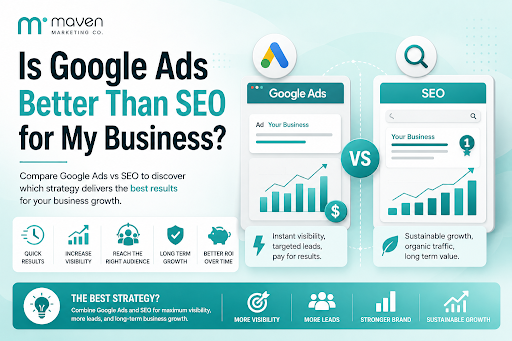
Is Google Ads Better Than SEO for My Business
One of the biggest questions business owners ask when they are planning online growth is whether they should invest in Google Ads or SEO. Both are strong marketing plays that help your company show up in Google search results, but they do things in separate lanes. Google Ads gives quicker visibility and can bring in leads fast, whereas SEO more or less focuses on slow, steady organic traffic that tends to grow the longer you keep building it. Picking the right direction depends on what you want to achieve, how much money you can spend, how crowded the market is, and how quickly you need results, like sooner rather than later. The good news is you don’t always have to choose one or the other; it’s not exactly a black-and-white situation. If you take time to understand the strongest points of both, you can put together a more sensible digital marketing plan that supports consistent expansion. In this guide, we’ll compare Google Ads vs SEO, explain the main differences, and help you figure out what option makes the most sense for your business.

When Should I Hire a Digital Marketing Agency
Growing a business today takes more than just having a website or throwing a post on social media; customers usually search around online, compare providers, skim reviews, and basically expect the brand to show up with a solid digital presence before they even think about buying. Many businesses try to run their marketing themselves, but there comes a point when “doing it all in-house” becomes clunky and hard to manage, all at once. Knowing when to hire a digital marketing agency can end up making a big, real difference for your growth. If you’re not getting enough leads, or your online visibility feels stuck, or sales are just not moving, the right agency can bring the know-how, plus a clear plan, to help you get noticeably better outcomes. In this guide, we’ll dig into what a digital marketing agency actually does, the usual signs it’s time to bring one on, and how picking the right marketing partner can help your business move forward at a faster pace.
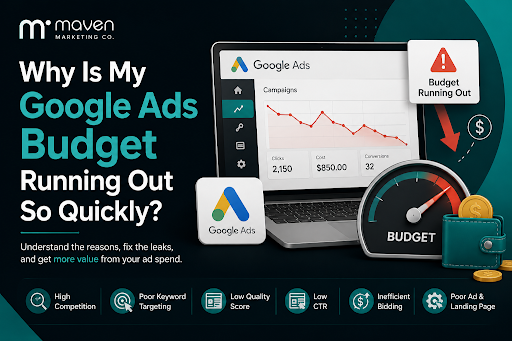
Why Is My Google Ads Budget Running Out So Quickly
Running a successful Google Ads budget isn’t only about throwing more money at it. It’s more like making every dollar, doing a bit extra. A lot of businesses start a Google Ads campaign with big hopes, then find out their daily budget is gone within a few hours, and that feels weird, right? After that, your ads stop showing effectively, new leads slip away, and your return on investment dips. So if your Google Ads budget is running out too fast, don’t stress. It’s a fairly common issue, and in most situations, it can be repaired with the right approach. There are multiple little things that can drain your advertising money quicker than you expected, from costly keywords to audience targeting that just doesn’t quite fit. In this guide, we’ll walk through why your budget disappears so quickly, how to cut wasteful spend, and the most reliable ways to boost your Google Ads ROI, even if your budget stays the same.