.svg)


%201.svg)

Quick Answers
What is generative engine optimisation (GEO) and why does it matter for ecommerce?
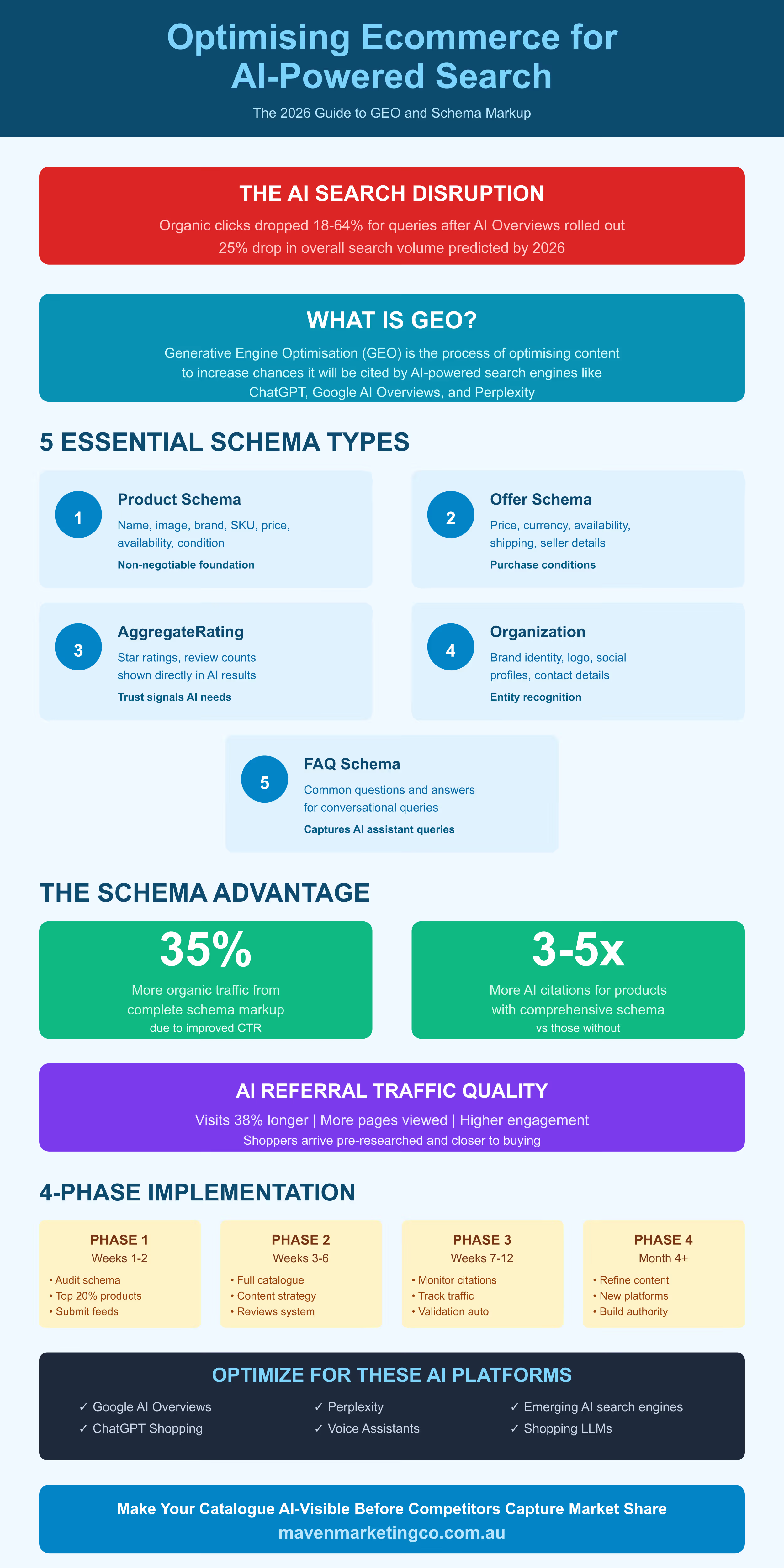
Generative engine optimisation, or GEO, is the process of optimising content and product data to increase the chances it will be selected, summarised, and cited by AI-powered search engines like ChatGPT, Google AI Overviews, and Perplexity. Unlike traditional SEO which focuses on improving search rankings in link-based results, GEO targets how content is interpreted and included in real-time, conversational AI responses. For Australian ecommerce stores, GEO matters because AI search is rapidly becoming how customers discover products. Research shows that organic clicks dropped 18 to 64% for queries after AI Overviews rolled out. The win condition has shifted from ranking for keywords to gaining AI visibility as the trusted source AI quotes when topics come up. Stores with proper schema markup, structured product data, and machine-readable content appear in AI-generated shopping recommendations 3 to 5 times more frequently than those without.
What schema markup types are essential for ecommerce AI visibility?
Five schema types form the foundation of ecommerce AI visibility. Product schema defines items you sell including name, image, brand, SKU, price, and availability. Offer schema specifies pricing details, shipping options, and purchase conditions. AggregateRating schema showcases star ratings and review counts directly in search results and AI responses. Organization schema establishes your brand identity with official name, logo, customer reviews, and social profiles. FAQ schema marks up common questions and answers so AI can include them directly in results. These schema types work together to create structured relationships search engines and AI tools can understand, giving your catalogue a voice in the Knowledge Graph. Australian ecommerce stores implementing comprehensive schema markup see immediate improvements in AI citation rates, with products appearing in conversational search responses and voice assistant recommendations where competitors remain invisible.
Your ecommerce store has brilliant products, competitive pricing, and thousands of pounds invested in traditional SEO. Yet when customers ask ChatGPT for product recommendations or use Google AI Overviews to research purchases, your competitors appear whilst you remain invisible.
The difference is not your product quality. It is your machine readability.
AI-powered search has fundamentally changed product discovery in 2026. Australian ecommerce businesses face a stark choice: adapt to generative engine optimisation now, or watch AI shopping engines systematically redirect your potential customers to better-optimised competitors.

The AI Search Revolution: What Actually Changed
The numbers tell a sobering story for ecommerce businesses built on traditional SEO. Across multiple data sets in 2025, organic clicks dropped as AI Overviews rolled out, with some queries losing 18 to 64 percent of external clicks. This is not gradual erosion. This is structural transformation.
AI search now accounts for just 3.3% of online discovery time in the US, but the trajectory is clear. By 2029, AI search is expected to drive as much US ad revenue as Bing brought in globally in 2024. More critically, Gartner predicts a 25% drop in overall search engine volume by 2026 as users increasingly turn to AI chatbots and virtual agents.
For Australian ecommerce stores, this shift creates winner-takes-most dynamics. AI Overviews usually cite a small set of sources, which means visibility inside AI answers has become the new front line. The pattern in 2026 is simple: you either appear in AI-generated responses, or you become progressively invisible as traditional search volume declines.
The stores capturing this opportunity are not waiting for perfect clarity. They are implementing generative engine optimisation whilst competitors debate whether AI search will stick around.
Understanding GEO: The New Rules of Product Discovery
Generative engine optimisation differs fundamentally from traditional SEO in three critical ways.
First, AI search engines do not browse websites like humans. They scan for structured data patterns that help them understand relationships between different pieces of information. When evaluating products, AI does not see text on a page. With proper schema, it understands price, availability, shipping options, return policy, customer ratings, and product specifications in machine-readable format.
Second, AI systems build knowledge graphs about products, brands, and categories. They connect entities through defined relationships. Your waterproof hiking boots are not just a product page. They are an entity connected to your brand entity, connected to the hiking category, connected to specific features and benefits, connected to customer experiences through reviews.
Third, AI engines prioritise content quality, structure, and trust signals differently than traditional search algorithms. They favour pages that are well organised, clearly attributed, and easy to parse using structured data. Content that directly answers user intent, includes expert insights, and reflects real-world authority gets cited more frequently.
For Australian ecommerce businesses, this means your competitive advantage is not writing more product descriptions. It is making your existing catalogue machine-readable so AI systems can confidently recommend your products when shoppers ask conversational questions.
Schema Markup: Your Machine-Readable Foundation

Schema markup is structured data that tells search engines and AI systems exactly what your content means, not just what it says. Think of it as a translation layer between your website and AI algorithms.
Whilst humans can look at a product page and immediately understand the price, availability, and specifications, AI systems need explicit signals to interpret this information accurately. The shift to AI-powered search has made schema markup exponentially more important than traditional SEO ever did.
Pages with complete schema markup can experience up to 35% more organic traffic due to improved click-through rates. More importantly for 2026, products with comprehensive schema markup appear in AI-generated shopping recommendations 3 to 5 times more frequently than those without.
Product Schema: The Non-Negotiable Foundation
Product schema reflects key product details like name, brand, price, availability, and reviews. For ecommerce businesses, this schema type is non-negotiable. It transforms generic product listings into rich, detailed information that AI systems can confidently recommend.
Implement Product schema with these essential properties: name, image URL, description, brand, SKU or product ID, price and currency, availability status, and condition (new, used, refurbished).
Australian ecommerce stores must ensure pricing reflects GST-inclusive amounts and availability status updates in real-time. AI systems citing outdated information damage trust and credibility.
Offer Schema: Defining Purchase Conditions
Offer schema specifies pricing details, shipping options, purchase conditions, and merchant information. This schema type connects directly to Product schema, creating the relationship AI systems need to understand complete purchasing context.
Critical Offer properties include price, priceCurrency (AUD for Australian stores), availability, url (direct product page link), seller (your organization), and priceValidUntil (prevents AI citing outdated prices).
For Australian businesses shipping nationally, specify shipping costs and delivery timeframes. AI shopping engines increasingly factor shipping details into product recommendations.
AggregateRating Schema: Showcasing Social Proof
Reviews build trust. Using Review or AggregateRating schema allows search engines and AI platforms to showcase star ratings and review counts directly in results.
AggregateRating schema paired with Product schema can show star ratings and review counts directly in search results, dramatically improving click-through rates whilst providing AI systems the trust signals they need to confidently cite your products.
Essential AggregateRating properties include ratingValue (average rating), bestRating (typically 5), worstRating (typically 1), and reviewCount (total number of reviews).
High-quality product reviews that are authentic, descriptive, and recent help reinforce trustworthiness and improve both structured data effectiveness and user experience. Australian consumers particularly value genuine reviews mentioning local context, delivery experiences, and product performance.
Organisation Schema: Establishing Brand Identity
Organisation schema tells AI systems your company name, industry, credentials, and relationship to products you sell. This creates the entity recognition AI needs to distinguish your brand from others.
Include these Organisation properties: name (official business name), logo (high-quality brand logo URL), url (main website URL), sameAs (social media profile URLs), contactPoint (customer service details), and address (physical location for Australian businesses).
Consistency matters enormously here. Your brand name, logo, and contact details must match exactly across schema markup, Google Business Profile, social media, and all other platforms. Inconsistent entity information confuses AI systems and reduces citation confidence.
FAQ Schema: Capturing Conversational Queries
FAQ schema lets you mark up common questions and answers so AI can put them directly into results. This proves especially effective for how-to questions, product usage queries, and purchase decision questions.
Australian ecommerce stores should implement FAQ schema addressing questions like: "Does this ship to regional Australia?", "What is your return policy?", "Is this product covered by Australian Consumer Law guarantees?", "How long does delivery take to Perth/Brisbane/Melbourne?", and "Do you offer Afterpay or other payment plans?".
These questions mirror how shoppers naturally ask AI assistants about products, making FAQ schema particularly effective for capturing conversational search traffic.
Technical Implementation: Making Schema Work
Most modern ecommerce platforms include built-in schema or offer plugins simplifying implementation. Shopify, WooCommerce, BigCommerce, and other major platforms provide schema capabilities, though customisation often requires developer assistance.
JSON-LD: The Preferred Format
Google recommends JSON-LD for flexibility and ease of use. Unlike Microdata or RDFa embedded directly in HTML, JSON-LD sits in your page head, keeping schema separate from visible content.
This separation makes JSON-LD easier to implement, update, and troubleshoot without affecting page design. It also reduces errors since you are not weaving markup through HTML structure.
Validation and Testing
After implementing schema, validate everything using Google's Rich Results Test tool and the Schema.org validator. These tools identify errors, missing required properties, and implementation issues preventing AI systems from properly parsing your data.
Common validation errors include missing required properties (price, availability), incorrect property types (text where URL expected), broken image URLs, and inconsistent data between schema and visible content.
Australian businesses should pay particular attention to currency formatting (AUD not USD), availability status accuracy, and shipping detail completeness during validation.
Ongoing Maintenance
Schema is not set-and-forget. Product availability changes, prices fluctuate, reviews accumulate, and schema standards evolve. When Schema.org retires a property, unupdated markup may stop being read.
Implement systems ensuring schema updates automatically when product information changes. Manual schema maintenance for large catalogues creates inconsistencies that confuse AI systems and reduce citation confidence.
Feeding AI Shopping Engines Directly

Beyond schema markup on your website, AI shopping engines increasingly accept direct product feed submissions similar to Google Shopping feeds.
ChatGPT and other AI platforms now allow businesses to submit structured product catalogues. These feeds provide AI systems comprehensive product data they can reference when answering shopping queries.
For Australian ecommerce stores, submitting feeds to emerging AI shopping platforms takes minutes and dramatically improves the chances these tools recommend your products accurately. The process resembles Google Merchant Center feed submission: structured product data in consistent format, regular updates reflecting inventory changes, and compliance with platform-specific requirements.
Early adoption provides first-mover advantages as these platforms remain less saturated than traditional Google Shopping.
Content Strategy for AI Visibility
Schema provides the structure, but content quality determines whether AI systems trust your information enough to cite it.
Depth Over Volume
AI systems prioritise content demonstrating genuine expertise. Generic product descriptions copied from manufacturers or written entirely by AI tools without human refinement age fast compared to content with true originality.
Australian ecommerce stores should emphasise local context in product descriptions. How does this product perform in Australian conditions? What are common questions from Australian customers? How does it compare to alternatives popular in the Australian market?
Conversational Optimisation
Traditional SEO optimised for keywords. AI search optimises for intent expressed conversationally.
Shoppers no longer type "waterproof hiking boots women size 8". They ask ChatGPT "What are the best waterproof hiking boots for weekend bushwalking in Tasmania for women with wide feet?"
Your content must answer these detailed, contextual queries. That requires moving beyond basic keyword targeting to comprehensive topic coverage addressing real customer needs and questions.
Structure content around common decision-making questions: What problem does this product solve? Who is it best suited for? What alternatives exist and how does this compare? What do customers actually experience using this product? What should buyers know before purchasing?
This question-centric approach aligns perfectly with how AI systems parse content for inclusion in conversational responses.
User-Generated Content: The AI Trust Signal

AI search increasingly prioritises authentic user experiences, making user-generated content (UGC) a powerful ranking factor. UGC helps AI platforms understand real-world usage and sentiment regarding your products.
Customer reviews, Q&A sections, user-submitted photos, and community discussions provide the social proof and contextual detail AI systems need to confidently recommend products.
For Australian ecommerce stores, this means actively encouraging and showcasing customer content. Implement review collection systems, feature customer photos prominently, maintain active Q&A sections, and respond publicly to customer feedback.
The authenticity of UGC provides trust signals no marketing copy can replicate. AI systems recognise this, increasingly weighting genuine customer experiences heavily in citation decisions.
Zero-Click Implications: Rethinking Success Metrics
AI search creates a fundamental tension for ecommerce. When AI provides comprehensive answers directly in search results, users may never click through to your store.
This zero-click phenomenon means traditional success metrics like organic traffic volume become less meaningful. You might show strong "impressions" in AI responses without corresponding traffic increases.
The clicks you do receive, however, often come from users who have already read AI summaries and are closer to buying. Shoppers arriving to retail sites through AI platforms tend to be more engaged, with visits 38% longer and involving viewing more pages.
For Australian ecommerce businesses, this demands rethinking measurement frameworks. Track AI citation frequency, brand mentions in AI responses, assisted conversions where AI provided initial research, and traffic quality from AI sources rather than just volume.
The goal shifts from maximising traffic to maximising qualified traffic from buyers who have already completed initial research through AI assistants.
Local SEO Integration for Australian Stores
Australian ecommerce businesses with physical retail presence must integrate local SEO with AI optimisation strategies.
LocalBusiness schema helps AI systems understand geographic and contextual relationships. When shoppers ask AI "Where can I buy hiking boots near me?", proper local schema ensures your physical stores appear in responses.
Critical LocalBusiness properties include name, address, telephone, geo coordinates (latitude/longitude), openingHours (specify Australian timezone), and priceRange (to set expectations).
Voice search queries like "Hey Google, find outdoor stores near me" rely heavily on structured local data. AI systems excel at understanding geographic context when LocalBusiness schema provides explicit location information.
For Australian businesses, specify state-specific details. A store in Perth serves different geography than one in Melbourne. AI needs this precision to make accurate local recommendations.

Platform-Specific Optimisation Strategies
Different AI platforms prioritise different data sources and structured information types.
Google AI Overviews
Google AI Overviews synthesise responses from multiple sources simultaneously, favouring content that directly answers user intent. Optimise by implementing comprehensive Product, Offer, AggregateRating, and FAQ schema, structuring content with clear headings and logical hierarchy, including expert insights and firsthand product knowledge, and maintaining fresh, accurate product information.
Research shows that Google pulls most AI Overview sources from the top 10 organic results, with about 80% of cited links from the top 3 spots. Traditional SEO remains foundational, but schema determines which top-ranking pages get cited in AI summaries.
ChatGPT and LLM Shopping
ChatGPT users click out to external websites about twice as often as Google users—1.4 links per visit compared with 0.6 from Google. This difference reflects how people use each platform differently.
Optimise for ChatGPT by submitting structured product feeds directly to OpenAI's shopping database, ensuring your website content provides comprehensive product information AI can parse, implementing all relevant schema types, and creating content that answers detailed, specific product questions.
News and media sites account for 9.5% of ChatGPT citations, blogs and content sites account for 8.3%, and ecommerce sites account for 7.6%. This distribution suggests strong potential for businesses creating informative, well-structured product content.
Voice Assistants
Voice search queries demand concise, directly answerable information. Optimise by implementing FAQ schema for common voice queries, structuring product descriptions to answer specific questions, including conversational language matching how people actually speak, and ensuring mobile-friendly, fast-loading pages for voice search follow-through.
Australian ecommerce stores should consider local colloquialisms and terminology in voice optimisation. Australians say "thongs" not "flip-flops", "esky" not "cooler", and "bushwalking" not "hiking". Voice search optimisation requires matching authentic Australian English.
Measuring AI Search Performance
Tracking AI search effectiveness requires new measurement approaches beyond traditional SEO metrics.
AI Citation Tracking
Manually monitor how frequently your brand and products appear in AI search results for relevant queries. Create a testing protocol covering your main product categories and common customer questions, checking responses from Google AI Overviews, ChatGPT, Perplexity, and other AI platforms.
Document which products get cited, how your brand is described, whether information is accurate, and what competitors appear alongside you.
AI Referral Traffic Analysis
Begin tracking the percentage of traffic coming from AI sources and analyse how these visitors interact with your store. According to recent data, AI-referred users demonstrate higher engagement metrics across the board, potentially representing higher-quality traffic.
Set up custom traffic segments in Google Analytics identifying referrals from ChatGPT, Claude, Perplexity, and AI search features. Compare conversion rates, average order value, bounce rates, and engagement depth against traditional search traffic.
Schema Validation Monitoring
Implement automated systems checking that your schema markup remains valid and properly formatted. Schema validation errors can silently prevent AI systems from parsing your product data.
Use monitoring tools alerting you when schema errors appear, products lack required properties, or validation failures occur.
Common Implementation Mistakes to Avoid
Even well-intentioned schema implementation can fail through common errors that damage AI visibility.
Incomplete Implementation
Implementing Product schema whilst omitting Offer, AggregateRating, or Organisation schema creates incomplete entity definitions. AI systems need comprehensive structured data painting complete pictures of products, pricing, availability, and merchant credibility.
Inaccurate Information
Schema markup must match visible page content exactly. Discrepancies between schema price and displayed price, schema availability and actual stock status, or schema reviews and visible reviews confuse AI systems and potentially violate platform policies.
Australian businesses must ensure GST treatment, shipping costs, and return policies in schema match customer-facing information.
Static Schema for Dynamic Content
Product prices change, inventory fluctuates, and reviews accumulate. Static schema markup quickly becomes outdated, providing AI systems incorrect information that damages trust.
Implement dynamic schema generation tied directly to your product database, ensuring schema updates automatically when product information changes.
Ignoring Mobile Experience
AI search happens disproportionately on mobile devices. Schema implementation without mobile optimisation wastes effort, as slow-loading or broken mobile experiences prevent conversions even when AI cites your products.
Overlooking International Considerations
Australian ecommerce stores serving international markets must implement multiple schema versions reflecting different currencies, shipping policies, and availability by region. AI systems need this geographic specificity to make accurate recommendations.
The Competitive Window: Why Timing Matters
The current AI search landscape presents a temporary competitive window that favours early adopters.
More than three-quarters of ecommerce companies now focus on making sure their brand name surfaces in AI-generated search results. However, many remain stuck in analysis paralysis, waiting for perfect clarity before acting.
Australian businesses implementing comprehensive AI optimisation now gain advantages that compound over time. AI systems build confidence in sources through consistent citation history. Early-cited brands become established authorities that newer entrants struggle to displace.
The window remains open but narrowing. As more businesses recognise AI search importance and implement optimisation strategies, competition for AI citations intensifies.
Your Implementation Roadmap
Transform your Australian ecommerce store from AI-invisible to AI-cited through systematic implementation.
Phase One: Foundation (Weeks 1-2)
Audit existing schema implementation identifying gaps and errors. Implement Product, Offer, AggregateRating, Organisation, and FAQ schema for your top 20% of products by revenue. Validate all schema using Google's Rich Results Test and fix errors. Submit product feeds to ChatGPT Shopping and other emerging AI platforms.
Phase Two: Expansion (Weeks 3-6)
Expand schema implementation to remaining product catalogue. Enhance product descriptions with conversational, question-answering content. Implement review collection and showcase systems. Optimise category pages with comprehensive topic coverage. Create FAQ content addressing common AI search queries.
Phase Three: Refinement (Weeks 7-12)
Monitor AI citation frequency and adjust content strategy based on performance. Analyse AI referral traffic quality and optimisation opportunities. Implement automated schema validation monitoring. Develop local SEO integration if operating physical stores. Create measurement dashboards tracking AI visibility metrics.
Phase Four: Optimisation (Month 4+)
Continuously refine content based on AI citation patterns. Expand into emerging AI shopping platforms as they launch. Test new schema types and structured data opportunities. Build topical authority through comprehensive category coverage. Maintain schema accuracy as product information evolves.
The Reality for Australian Ecommerce
AI-powered search is not coming. It is here, reshaping product discovery whilst many Australian businesses remain unprepared.
The stores thriving in 2027 will be those that invested in AI optimisation throughout 2026. They will have established citation history, built AI-recognised brand authority, and created comprehensive structured data ecosystems that newer competitors cannot quickly replicate.
The alternative is progressive invisibility as AI search volume grows and traditional search declines. Your products might be superior, your prices competitive, and your service excellent. But if AI systems cannot parse your product information, none of that matters to the growing percentage of shoppers discovering products through conversational AI.
The technical barrier is not as high as it seems. Schema implementation, whilst requiring attention to detail, is well within reach of any Australian ecommerce business willing to commit resources. The competitive barrier lies in execution speed and comprehensiveness.
Ready to make your ecommerce catalogue AI-visible before competitors capture your market share? The specialists at Maven Marketing Co. implement complete AI search optimisation systems for Australian ecommerce businesses. We do not just add schema tags. We conduct comprehensive product catalogue audits, implement dynamic schema generation tied to your inventory systems, create AI-optimised content strategies, submit your products to emerging AI shopping platforms, and build measurement frameworks tracking AI visibility and citation rates. Stop losing potential customers to competitors AI systems can actually find. Contact us today for an AI readiness assessment that identifies your visibility gaps and creates your roadmap to capturing the AI search opportunity transforming ecommerce in 2026.

Table of contents
read more blogs
Is Google Ads Better Than SEO for My Business
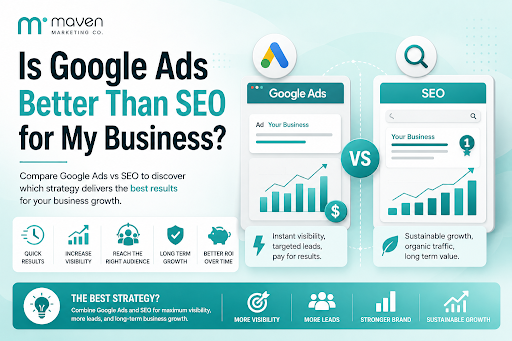
One of the biggest questions business owners ask when they are planning online growth is whether they should invest in Google Ads or SEO. Both are strong marketing plays that help your company show up in Google search results, but they do things in separate lanes. Google Ads gives quicker visibility and can bring in leads fast, whereas SEO more or less focuses on slow, steady organic traffic that tends to grow the longer you keep building it. Picking the right direction depends on what you want to achieve, how much money you can spend, how crowded the market is, and how quickly you need results, like sooner rather than later. The good news is you don’t always have to choose one or the other; it’s not exactly a black-and-white situation. If you take time to understand the strongest points of both, you can put together a more sensible digital marketing plan that supports consistent expansion. In this guide, we’ll compare Google Ads vs SEO, explain the main differences, and help you figure out what option makes the most sense for your business.

When Should I Hire a Digital Marketing Agency
Growing a business today takes more than just having a website or throwing a post on social media; customers usually search around online, compare providers, skim reviews, and basically expect the brand to show up with a solid digital presence before they even think about buying. Many businesses try to run their marketing themselves, but there comes a point when “doing it all in-house” becomes clunky and hard to manage, all at once. Knowing when to hire a digital marketing agency can end up making a big, real difference for your growth. If you’re not getting enough leads, or your online visibility feels stuck, or sales are just not moving, the right agency can bring the know-how, plus a clear plan, to help you get noticeably better outcomes. In this guide, we’ll dig into what a digital marketing agency actually does, the usual signs it’s time to bring one on, and how picking the right marketing partner can help your business move forward at a faster pace.
Why Is My Google Ads Budget Running Out So Quickly
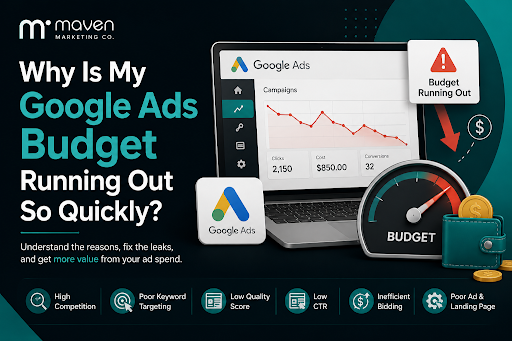
Running a successful Google Ads budget isn’t only about throwing more money at it. It’s more like making every dollar, doing a bit extra. A lot of businesses start a Google Ads campaign with big hopes, then find out their daily budget is gone within a few hours, and that feels weird, right? After that, your ads stop showing effectively, new leads slip away, and your return on investment dips. So if your Google Ads budget is running out too fast, don’t stress. It’s a fairly common issue, and in most situations, it can be repaired with the right approach. There are multiple little things that can drain your advertising money quicker than you expected, from costly keywords to audience targeting that just doesn’t quite fit. In this guide, we’ll walk through why your budget disappears so quickly, how to cut wasteful spend, and the most reliable ways to boost your Google Ads ROI, even if your budget stays the same.