.svg)


%201.svg)
.avif)
Key Takeaways
- Marketing structure decisions involve genuine trade-offs between cost, capability breadth, strategic depth, institutional knowledge, and execution speed—no single model dominates across all dimensions, requiring deliberate choice based on specific organisational priorities
- In-house teams provide strategic alignment, institutional knowledge depth, and brand consistency advantages that agencies can rarely replicate, but require sustained salary investment and face capability gaps in specialist areas that even well-resourced teams can't maintain across all required disciplines
- Agency partnerships provide immediate specialist capability access, scalable execution capacity, and cross-industry perspective that in-house teams develop slowly, but create knowledge transfer limitations, account management overhead, and strategic alignment challenges that purely agency-dependent marketing struggles to overcome
- Hybrid models combining in-house strategic leadership with selective agency specialist partnerships increasingly represent best-practice for Australian mid-market businesses—but require clear capability boundary definition, effective briefing processes, and genuine integration rather than parallel operation that produces neither in-house nor agency advantages
- Marketing structure should evolve as businesses grow—structures appropriate for early-stage businesses become constraints at growth stage, and structures serving growth stage businesses require reinvention for mature market leaders with different competitive requirements
Two Adelaide manufacturing businesses of similar size, revenue, and market position made contrasting marketing structure decisions five years earlier. The first hired three full-time marketing staff—a marketing manager, content creator, and digital specialist. The second engaged a specialist B2B manufacturing marketing agency supplemented by a single in-house marketing coordinator.
Both invested approximately $380,000 annually in their total marketing resource. Five years later, their positions diverged meaningfully.
The in-house team had built deep institutional knowledge of the manufacturing sector, developed genuine understanding of the company's products and customer relationships, produced consistent brand experience, and aligned closely with sales and product development teams. However, they struggled with capability gaps in areas like paid advertising optimisation, marketing technology implementation, and data analytics that required either expensive specialist hiring or accepting underperformance in these disciplines.
The agency-dependent model had accessed strong specialist capabilities across multiple disciplines, benefited from broader B2B marketing perspective, and executed sophisticated campaigns beyond in-house team capability. However, three agency changes over five years had reset institutional knowledge each time, sales team relationships with marketing remained weak, and agency account management absorbed significant time that could have served strategic thinking.
Neither model was wrong. Both involved genuine trade-offs that neither business had fully anticipated. The insights from comparing their experiences over five years informed a hybrid model evaluation that both subsequently conducted—revealing that deliberate structural design outperforms reactive structure accumulation regardless of which specific model is ultimately chosen.
According to research from the In-House Agency Forum, 78% of major brands now operate some form of hybrid marketing model combining in-house capabilities with agency partnerships—demonstrating that sophisticated marketing organisations increasingly recognise that pure in-house or pure agency models involve unnecessary compromises when hybrid structures can capture advantages of both.
.avif)
Understanding the Strategic Marketing Structure Decision
Marketing structure decisions deserve the same strategic rigour applied to other significant organisational design choices—they're not primarily HR or procurement decisions but strategic capability investments with long-term competitive implications.
Capability versus capacity distinction clarifies what marketing structure decisions are actually choosing between. Capacity decisions address how much marketing work gets done—volume of content produced, campaigns executed, channels managed. Capability decisions address what type of marketing work is possible—strategic sophistication, specialist expertise depth, creative quality, analytical capability, technology utilisation. Structure decisions affect both dimensions but in different ways. In-house teams provide capacity predictability and capability depth within hired expertise areas. Agencies provide flexible capacity scaling and broader capability breadth across specialist teams. Hybrid models attempt to optimise both through strategic division.
Institutional knowledge value is frequently underweighted in marketing structure decisions—the accumulated understanding of customers, competitive dynamics, product nuances, and brand history that enables increasingly sophisticated marketing over time. Institutional knowledge builds within in-house teams through sustained organisational exposure that agencies rarely develop to equivalent depth regardless of client tenure length. This knowledge manifests as marketing that speaks authentically about specific customer situations, content that accurately reflects product reality, campaigns that leverage genuine customer relationships, and strategic recommendations that reflect actual competitive dynamics rather than category generalisations. Businesses whose marketing relies heavily on institutional knowledge—complex products, relationship-based selling, specialist markets—face higher costs from institutional knowledge loss than businesses where marketing is more readily transferred.
Strategic alignment proximity describes how closely marketing decision-making aligns with overall business strategy through direct access to business leadership, real-time strategic intelligence, and participation in business decisions that affect marketing direction. In-house marketing leadership achieves the highest strategic alignment through daily organisational proximity. Agency partners achieve strategic alignment proportional to their access to senior client leadership—agencies relegated to tactical execution without strategic access cannot achieve alignment regardless of their strategic capability. Hybrid models with in-house strategic leadership and agency tactical execution achieve strategic alignment at the leadership level whilst maintaining appropriate agency tactical independence.
Speed-to-execution affects marketing competitiveness in dynamic environments where responsiveness to market opportunities and competitive actions matters. In-house teams execute rapidly through direct access to decision-makers, immediate brand knowledge application, and absence of briefing overhead. Agencies execute specialist work rapidly through dedicated specialist teams but require briefing, approval processes, and client-agency communication that add time to otherwise fast execution. Speed requirements vary by business—some Australian businesses operate in environments where marketing responsiveness is critical competitive advantage, whilst others operate in slower-moving markets where execution speed matters less than strategic sophistication.
Cost structure implications extend beyond direct marketing spend to the total cost of marketing capability across all structure types. In-house team costs include salaries, superannuation (minimum 11.5% from July 2024), employment overhead, training investment, recruitment costs, redundancy exposure, management time, and the opportunity cost of roles that underperform. Agency costs include retainer fees, project fees, account management overhead, brief development time, and the cost of knowledge transfer that partially resets with each relationship change. Hybrid costs involve both plus the coordination overhead of managing multiple relationships. True cost comparison requires honest accounting of all components rather than comparing agency fees against salary costs that exclude the employment overhead that makes true in-house costs substantially higher than headline salaries suggest.
In-House Marketing Team Model
In-house teams provide specific advantages that make them the superior structural choice for organisations where those advantages deliver disproportionate competitive value.
Deep product and customer knowledge develops through sustained organisational immersion that creates marketing capability impossible to replicate through external agency relationships however experienced. In-house marketers who work alongside product development teams understand capability nuances that brief-based agency work never captures. Those who participate in customer conversations develop authentic customer understanding that brief-based research approximation substitutes inadequately. Those who attend sales debriefs build competitive intelligence that secondhand reporting from sales teams provides only superficially. This knowledge depth enables marketing that is more accurate, more specific, and more credible than externally produced equivalents—particularly valuable for complex products, specialist markets, and relationship-based selling where authenticity matters.
Brand consistency accumulation benefits from in-house teams who develop intuitive brand understanding through sustained daily application rather than documented brand guidelines that agencies interpret with varying fidelity. In-house teams internalise brand voice, visual standards, messaging frameworks, and appropriate tone across contexts through experience that guidelines can codify only partially. This internalised brand consistency manifests across the many small content and communication decisions that guidelines don't specifically address—the in-house team makes instinctively consistent choices that agency teams make through guideline reference that can't capture all contextual nuance. Brand consistency advantage is most significant for businesses where brand perception drives premium pricing or competitive differentiation.
Sales and product integration enables marketing to contribute actively to revenue generation through tight functional alignment that physical separation from agencies prevents. In-house marketing teams who share office space with sales teams develop informal communication patterns—overhearing customer conversations, participating in sales huddles, building personal relationships with sales representatives—that inform marketing strategy with frontline commercial intelligence. Product team integration enables marketing to influence product development direction based on market feedback, contribute to product naming and positioning from launch, and accurately represent product capability in external communications. These integration benefits compound over time as cross-functional relationships deepen.
Long-term strategic commitment enables in-house teams to pursue sustained marketing programmes—content strategies, SEO investment, community development, brand building—that produce compounding returns over years but require consistent organisational commitment that agency relationships measured by shorter-term performance expectations less consistently provide. In-house teams can invest in activities whose returns aren't immediately measurable because their organisational tenure extends beyond campaign cycle assessment periods. Content programmes, audience development, and brand positioning work all benefit from this long-term commitment orientation that in-house structures enable.
Hiring and retention challenges represent the primary structural limitation of in-house marketing teams in Australian market conditions. Attracting and retaining strong marketing talent in major Australian cities—particularly Sydney, Melbourne, and Brisbane—requires competitive salaries, career development opportunities, and interesting work that smaller in-house teams struggle to consistently provide. In-house marketers working on single-brand programmes sometimes experience the professional limitation of narrow exposure that agency careers providing diverse client experience don't impose. Skill currency maintenance requires sustained training investment in rapidly evolving disciplines like marketing technology, data analytics, and platform advertising that single practitioners struggle to maintain across all relevant areas.
Capability gap reality affects virtually all in-house marketing teams regardless of size—marketing's breadth as a discipline means that no team of realistic size maintains genuine expertise across all required specialisations simultaneously. An in-house team of three might include strong strategic marketing, content, and social media capability but face significant gaps in paid advertising optimisation, marketing technology implementation, video production, graphic design, SEO technical expertise, and data analytics. These gaps either accept underperformance in ungapped disciplines or require agency supplementation that produces a de facto hybrid structure without the deliberate design that makes hybrid models work well.
Appropriate business contexts for predominantly in-house structures include businesses with complex products requiring deep knowledge for credible marketing, businesses where brand voice consistency and authenticity provide significant competitive differentiation, businesses with tight sales-marketing integration requirements, businesses large enough to maintain specialist teams across required disciplines, and businesses in competitive talent markets where in-house marketing roles attract strong candidates seeking the brand depth and strategic influence that in-house positions provide.
.avif)
Agency Partnership Model
Agency partnerships provide specific advantages that make them the superior structural choice for organisations where those advantages deliver disproportionate value.
Specialist expertise access provides immediate capability in disciplines requiring years of focused development—paid advertising optimisation, technical SEO, video production, marketing automation platform expertise, graphic design, public relations, and others that individual in-house practitioners develop slowly and often incompletely. Agencies maintain specialist teams whose entire professional focus develops expertise in specific marketing disciplines—paid search specialists who manage hundreds of accounts develop pattern recognition and optimisation instinct that in-house generalists managing single accounts never achieve at equivalent speed. Specialist expertise access is particularly valuable for technical disciplines like programmatic advertising, marketing technology implementation, and advanced analytics where specialist depth directly affects performance outcomes.
Cross-industry perspective benefits from agencies whose experience across diverse client portfolios provides broader strategic intelligence than in-house teams develop within single-category exposure. Agencies observe what's working across their client roster—which content formats generate engagement, which conversion optimisation approaches improve results, which targeting strategies deliver efficient acquisition—and bring this aggregated learning to each client relationship. Cross-industry perspective is particularly valuable for businesses entering new markets, launching new products, or facing marketing challenges they haven't previously encountered where relevant analogues from other industries provide strategic guidance.
Scalable execution capacity enables agencies to flex resource deployment in response to campaign requirements, product launches, and seasonal peak periods that in-house teams can't efficiently accommodate through fixed headcount. An in-house team sized for steady-state operation lacks capacity for peak demand periods; a team sized for peak demand is chronically underutilised during normal periods. Agency relationships provide capacity scaling without the employment overhead—fixed and variable cost structures—that in-house scaling requires. Capacity flexibility is particularly valuable for businesses with significant seasonal demand variation or periodic large campaigns that exceed normal operational requirements.
Accountability structures in agency relationships provide performance clarity that managing underperforming in-house staff sometimes lacks. Agency contracts with defined deliverables, performance metrics, and renewal decision points create accountability frameworks that employment relationships make more complex. When agency performance is inadequate, switching agencies is more straightforward than managing underperforming in-house staff through HR processes that protect employment regardless of performance. This accountability clarity is sometimes cited as an advantage by business leaders who find agency performance management more straightforward than employment performance management.
Knowledge transfer limitations represent agency partnerships' most significant structural disadvantage—the institutional knowledge that agencies accumulate about client businesses is retained within the agency rather than building within the client organisation, and is partially or fully lost when agency relationships end. Agency personnel changes—account manager departures, team restructuring—reset client knowledge within the agency relationship without the client organisation retaining what was lost. Three agency changes over five years—as experienced by the Adelaide manufacturing example—represent three significant institutional knowledge resets that continuously restart the learning curve that generates sophisticated, knowledge-grounded marketing.
Strategic alignment distance creates the gap between agency recommendations and business strategy that physical and cultural separation from business operations produces. Agencies working from client briefs, attending periodic meetings, and lacking daily access to business conversations make strategic recommendations from necessarily incomplete business understanding. This distance produces occasional strategic misalignment—recommendations that are sophisticated in marketing terms but misaligned with business strategy nuances that brief documentation doesn't adequately convey. Strategic alignment distance is most costly for businesses where marketing strategy requires deep integration with business development, product, and operations functions.
Appropriate business contexts for predominantly agency-dependent structures include early-stage businesses that lack sufficient scale to justify full-time marketing employment, businesses with clearly defined project-based marketing requirements rather than sustained programme needs, businesses requiring specialist technical marketing capability that isn't commercially viable to maintain in-house, businesses in less competitive talent markets where agency relationships provide better quality than available in-house hiring, and businesses whose marketing needs are genuinely variable enough that flexible agency capacity provides economic advantage over fixed in-house headcount.
Hybrid Model Architecture
Hybrid models combining in-house and agency capabilities represent the most strategically sophisticated approach for businesses that have outgrown pure in-house or pure agency models.
Capability boundary definition is the critical design decision determining whether hybrid models deliver genuine advantages or simply accumulate both structures' disadvantages without their benefits. Effective hybrid models define clear capability boundaries assigning specific disciplines to in-house versus agency execution based on strategic logic rather than default. Disciplines best retained in-house typically include strategic marketing leadership (requiring business proximity), brand strategy and voice (requiring institutional knowledge depth), content strategy and planning (requiring audience and product knowledge), customer relationship marketing (requiring CRM and customer data access), and marketing analytics (requiring business context for meaningful interpretation). Disciplines best delegated to agencies typically include specialist technical execution (paid advertising, SEO, marketing technology), creative production (video, photography, complex design), specialist channel management (PR, influencer marketing, programmatic), and capacity overflow for peak periods exceeding in-house bandwidth.
In-house strategic leadership is the foundational requirement for effective hybrid models—without internal strategic direction, agencies operate without the business context that produces strategically aligned marketing regardless of their execution quality. In-house marketing leadership (Marketing Director, CMO, or senior marketing strategist) provides business strategy translation into marketing strategy, agency briefing and direction, performance management across agency partners, and cross-functional integration with sales, product, and operations. Hybrid models without strong in-house strategic leadership typically drift toward agency-led strategy that, whilst often professionally competent, lacks the business alignment that in-house strategic leadership provides.
Agency relationship portfolio management in hybrid models requires deliberate thought about how many agency relationships to maintain, how to prevent capability gaps and overlaps between agencies, and how to manage cross-agency coordination requirements. Most effective hybrid models maintain few, deep agency relationships—one or two specialist partners providing sustained, knowledge-building engagement—rather than many shallow relationships that never develop the client knowledge that improves agency output quality over time. Specialist agency selection should be deliberate—choosing agencies with genuine expertise in specific required disciplines rather than selecting generalist agencies attempting to cover all required disciplines with varying proficiency.
Brief quality investment differentiates hybrid models that work from those that replicate agency model problems within hybrid structure. In-house strategic leaders who invest in developing genuinely excellent briefs—providing strategic context, customer insight, competitive positioning, desired outcomes, and success metrics alongside executional specifications—enable agency partners to produce significantly better work than brief-light approaches that leave agencies inferring strategic context they don't possess. Brief quality is directly proportional to output quality in agency relationships; investment in briefing capability within in-house marketing teams produces better agency outputs that reduce revision cycles and improve overall marketing effectiveness.
Integration protocols ensure that in-house and agency activities reinforce rather than conflict with each other—a common hybrid model failure where in-house and agency streams operate in parallel without genuine integration. Shared content calendars preventing messaging conflicts, regular cross-stream campaign reviews, integrated performance reporting combining in-house and agency metrics, and shared customer insight development between in-house and agency teams all contribute to hybrid model integration quality. Integration requires deliberate design and sustained discipline rather than emerging naturally from parallel operation.
.avif)
Evaluating Structure Fit for Australian Business Contexts
Australian market characteristics create specific considerations affecting marketing structure decisions that generic frameworks don't adequately address.
Australian talent market realities significantly affect in-house marketing team viability across different markets and seniority levels. Senior marketing talent in Sydney and Melbourne commands salaries—$120,000-$200,000+ for experienced marketing directors, $80,000-$130,000 for experienced specialists—that require substantial revenue justification. Regional Australian markets face more challenging talent availability, often choosing between lower-quality local hires and expensive talent attraction and relocation. Smaller Australian cities have more limited marketing specialist talent pools than major metropolitan markets. These market realities affect whether in-house models can consistently access the quality required for competitive marketing programmes.
Australian agency market concentration in specific disciplines affects whether specialist agency capability is readily accessible for hybrid model implementation. Sydney and Melbourne have depth across most marketing disciplines with active agency markets providing genuine choice. Brisbane and Perth have less agency depth in some specialist disciplines—particularly advanced marketing technology, sophisticated analytics, and some creative specialisations. Adelaide, Hobart, and regional markets have more limited local agency options, sometimes requiring engagement with interstate or international agencies whose client service models may not suit all Australian business contexts.
Remote and distributed work enablement has expanded Australian businesses' talent and agency options beyond geographic proximity requirements that previously constrained structure choices. In-house teams can now include specialists from broader geographic talent pools without requiring relocation. Agency relationships with interstate or international specialists have become operationally viable through improved remote collaboration tools. This expansion of viable options increases the quality ceiling for both in-house and agency models whilst requiring more deliberate communication and collaboration design to capture the benefits that co-location previously provided automatically.
Business scale thresholds for different structure viability are particularly relevant in Australia's market size context. Businesses generating under $5 million revenue typically cannot financially justify even a single senior in-house marketing role without significant budget trade-offs. Businesses between $5-20 million revenue can typically support one to three in-house marketing roles, likely requiring agency supplementation for specialist disciplines. Businesses generating $20-100 million revenue are approaching the scale where hybrid models with genuine specialist in-house capability become financially viable. Businesses above $100 million revenue can typically support dedicated in-house specialist teams while retaining agency partners for overflow capacity and niche specialisations.
Building the Business Case for Structure Change
Marketing structure changes require business case development that honestly addresses transition costs alongside expected benefit improvements.
Current state assessment documents existing marketing structure costs, capabilities, and performance gaps that proposed changes address. Honest capability gap identification—where current structure consistently underdelivers required marketing performance—provides the performance improvement rationale. Total cost accounting of current structure—including employment overhead, agency fees, coordination overhead, and performance gap opportunity costs—provides the financial baseline. Cultural and organisational factors affecting structure change feasibility—leadership appetite for change, team dynamics, agency relationship quality—should be assessed alongside financial and capability factors.
Transition cost acknowledgement prevents underestimating the true cost of marketing structure change. In-house team building involves recruitment costs ($15,000-$50,000 per senior hire through agencies), onboarding productivity lag (typically three to six months before new hires reach full effectiveness), and simultaneous agency continuation costs during transition periods. Agency relationship development involves onboarding time before new agencies reach full productivity, parallel costs during transition from previous arrangements, and the institutional knowledge gap during the period before new agencies develop client understanding. Structure change business cases that acknowledge realistic transition costs rather than assuming immediate benefits produce more credible financial projections and more realistic implementation planning.
Performance improvement projection should be conservative rather than optimistic, reflecting that marketing structure change improves the conditions for better marketing performance without guaranteeing it. Structure change creates capability, alignment, and efficiency improvements whose marketing performance benefits depend on how well the new structure is implemented rather than flowing automatically from structural design. Business cases projecting modest, achievable improvements supported by specific reasoning produce more credible investment justification than aspirational projections disconnected from realistic performance trajectories.
Frequently Asked Questions
At what revenue or business size should Australian businesses transition from founder-led marketing to their first dedicated marketing hire, and what role should that first hire be?
The transition from founder-led marketing typically becomes necessary when marketing activity requirements consistently exceed founder capacity to maintain quality—usually occurring between $2-5 million revenue for B2B businesses and $1-3 million for B2C businesses depending on industry and growth rate. The right first hire depends on the current bottleneck: if content production and execution are limiting whilst strategy is clear, a marketing executive or coordinator who executes founder-set strategy is appropriate. If marketing strategy itself is limiting growth and the founder lacks marketing expertise, a senior marketing manager or marketing director who can develop and execute strategy is worth the higher investment despite smaller business scale. Avoid the common Australian mistake of hiring junior execution resources when strategic leadership is actually required—junior hires executing poor strategy produce poor results that create incorrect conclusions about marketing's potential contribution. The first marketing hire should complement founder capabilities rather than replicate them—founders with strong strategic marketing intuition benefit most from execution capability, whilst founders without marketing backgrounds benefit most from strategic marketing leadership.
How should Australian businesses evaluate agency quality when selecting partners for specialist marketing disciplines, and what due diligence process is appropriate?
Agency selection due diligence proportional to the relationship's strategic importance should include several specific assessments beyond portfolio review and reference checks that most Australian businesses conduct. Request detailed case studies for clients genuinely comparable to your business in size, industry, and marketing maturity—agencies with impressive large-brand portfolios may lack the approach, attention, and methodology appropriate for smaller Australian businesses. Ask specifically who will work on your account rather than who presents during the pitch—the personnel difference between pitch team and delivery team is a well-documented agency industry problem that direct questioning can surface before engagement commitment. Request honest discussion of past client relationships that ended—agencies unable to discuss relationship conclusions thoughtfully signal either poor self-awareness or concerning relationship patterns. Assess cultural alignment through extended conversation beyond formal pitch processes—agencies whose values, communication styles, and commercial orientations align with your organisation's produce better collaborative outcomes than technically superior agencies whose working styles create friction. For significant retainer relationships, consider a defined paid discovery or pilot project before committing to extended engagements—the performance difference between pitch promise and delivery reality is most reliably assessed through actual work rather than references and portfolio alone.
What are the warning signs that an existing marketing agency relationship is no longer serving an Australian business's needs, and when should businesses consider ending agency relationships?
Warning signs warranting relationship reassessment include consistent strategic misalignment—agency recommendations that demonstrate poor understanding of business context despite extensive briefing—suggesting that the relationship has reached its learning ceiling without developing the business understanding that briefing should have built. Senior talent attrition from the account—where strong personnel who originally delivered good work are replaced by less experienced team members without relationship value adjustment—is a common agency relationship quality erosion pattern. Declining proactivity—the transition from an agency that brings ideas and opportunities to one that only responds to client requests—signals relationship commoditisation that reduces value below retainer cost justification. Billing disputes, scope creep management failures, and transparency concerns about time allocation all indicate relationship governance problems that correction attempts rarely resolve sustainably. The decision to end agency relationships should balance transition cost reality against continuation cost reality—relationships that have clearly reached their value ceiling often cost more in opportunity cost, management overhead, and suboptimal performance than the transition cost of finding better-fit alternatives.
How should Australian businesses structure the relationship between in-house marketing teams and agency partners to prevent the territorial dynamics that sometimes undermine hybrid model effectiveness?
Territorial dynamics between in-house teams and agency partners typically emerge from unclear role definition, competing performance metrics, and inadequate integration design rather than from inherent structural conflict. Prevention requires explicit capability boundary definition that removes ambiguity about who is responsible for what—territorial friction most commonly occurs in undefined boundary zones where both parties believe they have legitimate claim. Performance metrics for in-house teams and agency partners should measure complementary rather than competitive outcomes—in-house teams measured on overall marketing performance and strategic quality, agency partners measured on specialist discipline performance within their scope. Integration forums—regular cross-stream planning meetings, shared performance reviews, joint problem-solving sessions—create collaborative working relationships that reduce territorial dynamics by building mutual respect and understanding across in-house and agency capabilities. Cultural tone-setting by in-house marketing leaders who model collaborative rather than competitive relationships with agency partners significantly influences how team members at all levels engage with agency counterparts.
How should Australian businesses approach marketing structure decisions when they're growing rapidly and current structure will become inadequate within twelve to eighteen months?
Rapidly growing businesses face the strategic challenge of designing marketing structures appropriate for their near-future state whilst managing current-state requirements—building ahead of need without over-investing in infrastructure current scale doesn't justify. Phased structure planning that defines the target state appropriate for the business in twelve to eighteen months, identifies the highest-priority structure element that delivers most value at current scale, and sequences additional structure development aligned with growth milestones prevents both premature over-investment and reactive under-investment. Hiring decisions during growth phases should prioritise roles that build capability for the next stage rather than only solving current capacity problems—hiring a marketing coordinator when a marketing strategist is the highest value next hire solves the wrong problem. Agency relationship investments during growth phases should explicitly consider whether selected agencies can grow with the business or will require replacement as needs evolve—agencies with track records serving businesses at your target stage provide both current execution value and future relationship continuity.
What governance structures should Australian businesses implement when managing hybrid marketing models to ensure strategic coherence across in-house and agency activities?
Hybrid model governance requires several specific structural elements that informal coordination cannot reliably substitute. A single point of strategic authority—typically the senior in-house marketing leader—should have clear final decision rights over all marketing activities regardless of whether executed in-house or through agency partners, preventing the strategic fragmentation that occurs when multiple parties have independent authority over different marketing streams. Integrated planning processes connecting in-house and agency activity planning should occur at minimum quarterly, ensuring that all marketing activities are planned with cross-stream visibility rather than developing independently and attempting coordination after plans are formed. Unified performance reporting combining in-house and agency metric streams into coherent overall marketing performance visibility enables governance decisions based on complete information rather than separate in-house and agency performance silos. Clear escalation protocols for cross-stream conflicts—when in-house strategic direction conflicts with agency execution recommendations—should be defined before conflicts arise rather than requiring ad hoc resolution processes that inconsistently resolve similar conflicts in different ways.
How do Australian businesses handle the knowledge transfer challenge when transitioning between marketing structures, particularly when ending agency relationships that hold significant institutional marketing knowledge?
Knowledge transfer management during marketing structure transitions requires proactive planning rather than hoping departing agencies voluntarily transfer knowledge they have commercial incentive to retain. Contract terms should include specific knowledge transfer obligations—documented campaign histories, audience insight documentation, platform access transfer, and performance data export—as explicit contractual requirements rather than assumed courtesies. Discovery periods at relationship commencement should be documented thoroughly, creating client-retained records of strategic context, audience insights, and campaign learnings that the client organisation owns rather than only the agency. Regular knowledge transfer practices throughout relationships—monthly campaign documentation shared with client teams, quarterly strategy reviews capturing reasoning behind approaches taken, annual knowledge audit ensuring client teams understand key marketing programmes—reduce transition knowledge loss by distributing institutional knowledge continuously rather than concentrating it in agency systems requiring extraction at relationship end. Post-relationship consultation arrangements—paid knowledge transfer periods where departing agencies support incoming agencies or in-house teams through structured transition—are sometimes negotiable and worth the investment for complex, knowledge-intensive relationships where knowledge transfer risk is high.
Marketing Structure Determines Marketing Trajectory
Marketing team structure decisions shape not just current marketing execution capability but the trajectory of marketing capability development over time—in-house models build institutional knowledge that compounds into increasing marketing sophistication, agency models access specialist capability that internal teams develop slowly, and hybrid models attempt to capture both advantages through deliberate structural design.
The frameworks outlined in this guide—capability versus capacity distinction, genuine advantage assessment for each model, hybrid architecture design principles, Australian market context application, and transition management—provide comprehensive foundation for marketing structure decisions that serve long-term competitive marketing capability rather than solving immediate resource problems at the expense of strategic marketing development.
Australian businesses making deliberate, evidence-based marketing structure decisions consistently outperform those making reactive structure choices—discovering that the right structure for their specific stage, scale, and competitive context provides marketing capability advantages that equivalent investment in the wrong structural model cannot produce.
Ready to evaluate and optimise your marketing team structure for sustainable Australian business growth? Maven Marketing Co. provides comprehensive marketing capability assessments, team structure strategy, and agency partnership guidance ensuring your marketing investment is structured for maximum effectiveness at every stage of your business growth. Let's build marketing capability that scales with your ambitions.

Table of contents
read more blogs
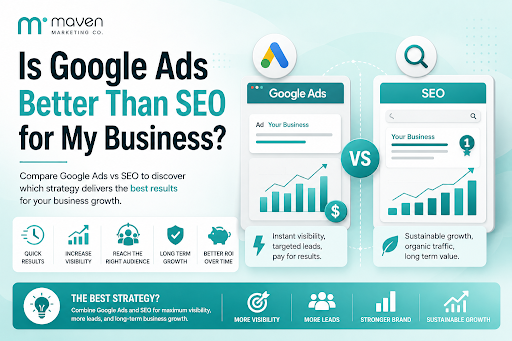
Is Google Ads Better Than SEO for My Business
One of the biggest questions business owners ask when they are planning online growth is whether they should invest in Google Ads or SEO. Both are strong marketing plays that help your company show up in Google search results, but they do things in separate lanes. Google Ads gives quicker visibility and can bring in leads fast, whereas SEO more or less focuses on slow, steady organic traffic that tends to grow the longer you keep building it. Picking the right direction depends on what you want to achieve, how much money you can spend, how crowded the market is, and how quickly you need results, like sooner rather than later. The good news is you don’t always have to choose one or the other; it’s not exactly a black-and-white situation. If you take time to understand the strongest points of both, you can put together a more sensible digital marketing plan that supports consistent expansion. In this guide, we’ll compare Google Ads vs SEO, explain the main differences, and help you figure out what option makes the most sense for your business.

When Should I Hire a Digital Marketing Agency
Growing a business today takes more than just having a website or throwing a post on social media; customers usually search around online, compare providers, skim reviews, and basically expect the brand to show up with a solid digital presence before they even think about buying. Many businesses try to run their marketing themselves, but there comes a point when “doing it all in-house” becomes clunky and hard to manage, all at once. Knowing when to hire a digital marketing agency can end up making a big, real difference for your growth. If you’re not getting enough leads, or your online visibility feels stuck, or sales are just not moving, the right agency can bring the know-how, plus a clear plan, to help you get noticeably better outcomes. In this guide, we’ll dig into what a digital marketing agency actually does, the usual signs it’s time to bring one on, and how picking the right marketing partner can help your business move forward at a faster pace.
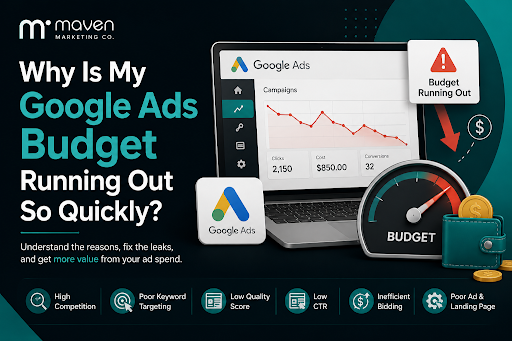
Why Is My Google Ads Budget Running Out So Quickly
Running a successful Google Ads budget isn’t only about throwing more money at it. It’s more like making every dollar, doing a bit extra. A lot of businesses start a Google Ads campaign with big hopes, then find out their daily budget is gone within a few hours, and that feels weird, right? After that, your ads stop showing effectively, new leads slip away, and your return on investment dips. So if your Google Ads budget is running out too fast, don’t stress. It’s a fairly common issue, and in most situations, it can be repaired with the right approach. There are multiple little things that can drain your advertising money quicker than you expected, from costly keywords to audience targeting that just doesn’t quite fit. In this guide, we’ll walk through why your budget disappears so quickly, how to cut wasteful spend, and the most reliable ways to boost your Google Ads ROI, even if your budget stays the same.