.svg)


%201.svg)

Key Takeaways
- Last-click attribution systematically misrepresents channel value by crediting only final touchpoint, undervaluing awareness channels by 40-70% whilst overvaluing branded search and direct traffic
- Australian customers interact with brands across average 6.7 touchpoints over 21 days before purchase, requiring multi-touch attribution capturing complete influence sequence
- Data-driven attribution increases marketing ROI by 23-34% compared to last-click models through revealing true channel contribution
- Attribution windows must match customer consideration timelines: 7-day windows suit FMCG, 30-day windows serve e-commerce, whilst 90-day+ windows accommodate B2B purchases
- Channel contribution varies dramatically by funnel stage with display and social dominating awareness, content driving consideration, and search capturing conversion
Your Google Ads dashboard shows branded search campaigns delivering 340 conversions last month at $23 cost per acquisition. Your Facebook advertising generated only 47 attributed conversions at $87 CPA. The obvious decision: slash Facebook budget and increase branded search investment.
This decision feels data-driven. It's actually catastrophically wrong.
Branded search captures customers already aware of your brand, searching explicitly for your company name after discovering you through other channels. Facebook advertising created that awareness, introduced your brand to previously unaware prospects, and initiated consideration journeys that concluded with branded searches weeks later. Last-click attribution credited search for conversions it captured but didn't create, whilst Facebook received no credit for awareness it generated.
Research examining attribution accuracy reveals that last-click models undervalue top-funnel channels by 40-70% on average, creating marketing budget distortions that optimize for channel efficiency metrics whilst sacrificing overall business growth.
.avif)
The Attribution Challenge: Why Default Models Mislead
Modern purchase paths span multiple devices, channels, and timeframes creating complex attribution challenges. Melbourne furniture retailer Koala mapped actual customer journeys discovering average purchaser interacted with brand 7.3 times over 19 days across 4.2 different channels before buying. Typical journey: Instagram ad (awareness) → Website visit (research) → Email (reminder) → Google search (comparison) → Retargeting ad (reconsideration) → Direct website visit (purchase). Last-click attribution credited only the final direct visit, completely ignoring six preceding touchpoints that created awareness and drove consideration.
Attribution model selection determines credit distribution fundamentally altering perceived channel effectiveness. Last-click attribution assigns 100% credit to final touchpoint, systematically favoring bottom-funnel channels. First-click attribution gives all credit to initial interaction, overvaluing awareness channels whilst ignoring nurture. Linear attribution distributes credit equally across all touchpoints, treating discovery and conversion as equivalent. Time-decay attribution weights recent interactions more heavily, acknowledging recency whilst recognizing earlier touches. Position-based (U-shaped) attribution allocates 40% each to first and last touchpoints with remaining 20% distributed across middle touches. Data-driven attribution uses machine learning analyzing actual conversion patterns to assign credit algorithmically.
Sydney e-commerce retailer THE ICONIC compared attribution models discovering their channel performance rankings shifted significantly. Under last-click attribution, branded search ranked #1, retargeting #2, and email #3. Under data-driven attribution, Instagram advertising ranked #1, content marketing #2, and influencer partnerships #3, with branded search dropping to #5. This revelation drove 34% budget reallocation from capture channels to demand-creation channels, increasing overall revenue 23%.
Last-Click Attribution: Understanding Systematic Biases
Last-click attribution creates predictable distortions fundamentally misrepresenting marketing effectiveness. Bottom-funnel channel overvaluation occurs as branded search, retargeting, and direct traffic capture credit for demand created elsewhere. Top-funnel channel undervaluation systematically discredits awareness channels like display, social, and content despite their critical role initiating journeys. Awareness-stage budget starvation results as channels showing poor last-click performance get defunded despite creating demand captured by others.
Brisbane software company MYOB analyzed their marketing under last-click attribution discovering branded search and email remarketing dominated conversion credit. Budget optimization toward these channels initially improved efficiency metrics but plateaued growth as awareness-stage investment declined. New customer acquisition stagnated as they optimized for harvesting existing demand rather than creating new awareness. Only after implementing multi-touch attribution revealing content marketing and LinkedIn advertising as primary demand creators did they correct budget imbalance and resume growth.
Adelaide retailer Harris Scarfe discovered their "top-performing" channel under last-click was email sent to existing customers who'd browsed products 24-48 hours prior. These emails received conversion credit despite customers already highly likely to purchase based on demonstrated intent. Attribution analysis revealed the emails captured natural purchase intent rather than creating new conversions, with A/B testing confirming 73% of "email conversions" would have occurred without the email.
.avif)
Multi-Touch Attribution: Capturing Complete Journey Contribution
Position-based (U-shaped) attribution allocates 40% credit each to first and last touchpoints with remaining 20% distributed across middle interactions, explicitly valuing journey bookends whilst acknowledging middle touches contribute to consideration. Multi-touch attribution research suggests position-based models work well for businesses with moderate journey complexity (3-7 average touches) selling considered purchases.
Sydney B2B SaaS company Atlassian uses position-based attribution recognizing that webinar registrations and content downloads (first touch) create awareness whilst product demos and free trial signups (last touch) drive conversion. Analysis revealed their content marketing generated 34% of first-touch credit whilst receiving only 8% under last-click, justifying substantial content investment increase that improved new customer acquisition 28%.
Data-driven attribution uses machine learning analyzing thousands of customer journeys to determine which touchpoints actually influence conversion probability algorithmically. Brisbane digital bank Up implemented Google Analytics 4 data-driven attribution analyzing 67,000 customer journeys over 90 days. The algorithm identified that customers who engaged with their financial literacy blog content showed 2.7x higher conversion probability than those who didn't, despite blog visits typically occurring early in journey far from final conversion. This insight justified tripling content budget based on algorithmic validation of influence invisible under rule-based models.
Data-driven attribution research demonstrates businesses implementing algorithmic models achieve 20-30% better marketing ROI compared to rule-based attribution through more accurate channel value assessment enabling optimized budget allocation.
Attribution Windows and Budget Optimization
Attribution windows determine how far back in time to consider touchpoints as influencing conversions. Melbourne property developer Frasers Property analyzed customer journeys discovering average 127 days elapsed between first website visit and apartment purchase inquiry. Their 30-day attribution window captured only final consideration stage, completely missing initial awareness touchpoints. Expanding to 180-day window revealed content marketing and project announcements drove initial engagement that eventually converted months later.
Industry-specific window recommendations: FMCG optimizes with 7-14 day windows, e-commerce benefits from 30-day windows, professional services require 60-90 day windows, B2B software demands 90-180 day windows, and real estate justifies 180-365 day windows.
Adelaide wine retailer Penfolds analyzed channel contribution discovering their wine education content appeared in 67% of converting customer journeys despite receiving only 8% last-click credit. Influenced revenue calculation showed content contributed to $2.3M in purchases annually, dramatically exceeding the $340K direct last-click attribution suggested. This analysis justified tripling content budget from $180K to $540K based on true contribution.
Melbourne fashion retailer Showpo reallocated 28% of marketing budget based on data-driven attribution analysis, increasing Instagram advertising by 45% (revealed as primary awareness driver), expanding influencer partnerships by 60% (mid-funnel consideration influence), whilst reducing branded search by 30% (overcredited under last-click) and decreasing retargeting by 25% (efficient but not creating new demand). Overall marketing ROI improved 34% through reallocation without increasing total budget.
Frequently Asked Questions
Which attribution model should Australian businesses start with?
Position-based (U-shaped) attribution provides excellent starting point balancing awareness and conversion channel value without requiring machine learning infrastructure. Allocating 40% credit each to first and last touchpoints whilst distributing remaining 20% across middle touches acknowledges complete journey without algorithmic complexity. Once comfortable with multi-touch concepts and meeting minimum volume thresholds (400+ monthly conversions), progress to data-driven attribution for more sophisticated analysis.
How do I attribute offline conversions like phone calls and store visits?
Call tracking using dynamic phone numbers tied to marketing sources enables attribution of phone conversions. Store visit tracking through location services or transaction matching connects online advertising to in-store purchases. Promo code tracking assigns unique codes enabling purchase attribution. Sales CRM integration manually logs how customers discovered business. Survey attribution asks customers directly during purchase process.
Can small businesses benefit from attribution modeling?
Attribution analysis delivers value at any scale. Small businesses (under $5,000 monthly marketing spend) benefit from manually reviewing Google Analytics assisted conversions report. Medium businesses ($5,000-$25,000 monthly) should implement position-based attribution through Google Analytics 4 at zero additional cost. Start with free tools and simple models, progressing to sophistication as budget and complexity justify.
Transform Marketing Investment Through Accurate Attribution
Marketing attribution separates businesses that optimize based on actual channel contribution from those misallocating budgets based on convenient measurement. The difference between last-click tunnel vision and multi-touch understanding often represents 20-40% marketing ROI improvement through reallocating investment from overcredited conversion capture toward underfunded demand creation.
Maven Marketing Co specializes in marketing attribution implementation for Australian businesses, providing strategic model selection, technical tracking infrastructure, cross-channel integration, and budget optimization frameworks that transform attribution insights into measurable ROI improvements.
Schedule your marketing attribution audit with Maven Marketing Co today and discover which channels actually drive your sales, which merely capture credit they don't deserve, and how to reallocate budgets maximizing returns through accurate contribution measurement.
Stop optimizing blindly based on last-click distortions. Start investing strategically based on true channel influence.

Table of contents
read more blogs
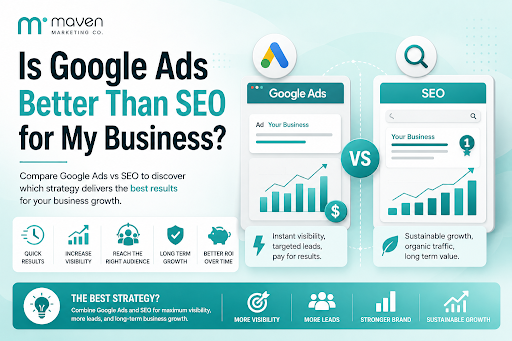
Is Google Ads Better Than SEO for My Business
One of the biggest questions business owners ask when they are planning online growth is whether they should invest in Google Ads or SEO. Both are strong marketing plays that help your company show up in Google search results, but they do things in separate lanes. Google Ads gives quicker visibility and can bring in leads fast, whereas SEO more or less focuses on slow, steady organic traffic that tends to grow the longer you keep building it. Picking the right direction depends on what you want to achieve, how much money you can spend, how crowded the market is, and how quickly you need results, like sooner rather than later. The good news is you don’t always have to choose one or the other; it’s not exactly a black-and-white situation. If you take time to understand the strongest points of both, you can put together a more sensible digital marketing plan that supports consistent expansion. In this guide, we’ll compare Google Ads vs SEO, explain the main differences, and help you figure out what option makes the most sense for your business.

When Should I Hire a Digital Marketing Agency
Growing a business today takes more than just having a website or throwing a post on social media; customers usually search around online, compare providers, skim reviews, and basically expect the brand to show up with a solid digital presence before they even think about buying. Many businesses try to run their marketing themselves, but there comes a point when “doing it all in-house” becomes clunky and hard to manage, all at once. Knowing when to hire a digital marketing agency can end up making a big, real difference for your growth. If you’re not getting enough leads, or your online visibility feels stuck, or sales are just not moving, the right agency can bring the know-how, plus a clear plan, to help you get noticeably better outcomes. In this guide, we’ll dig into what a digital marketing agency actually does, the usual signs it’s time to bring one on, and how picking the right marketing partner can help your business move forward at a faster pace.
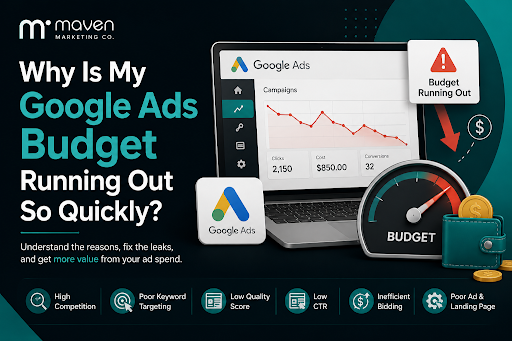
Why Is My Google Ads Budget Running Out So Quickly
Running a successful Google Ads budget isn’t only about throwing more money at it. It’s more like making every dollar, doing a bit extra. A lot of businesses start a Google Ads campaign with big hopes, then find out their daily budget is gone within a few hours, and that feels weird, right? After that, your ads stop showing effectively, new leads slip away, and your return on investment dips. So if your Google Ads budget is running out too fast, don’t stress. It’s a fairly common issue, and in most situations, it can be repaired with the right approach. There are multiple little things that can drain your advertising money quicker than you expected, from costly keywords to audience targeting that just doesn’t quite fit. In this guide, we’ll walk through why your budget disappears so quickly, how to cut wasteful spend, and the most reliable ways to boost your Google Ads ROI, even if your budget stays the same.