.svg)


%201.svg)

The customer walks into your competitor's store, not yours. They called the business listed second in Google Maps, not you. They booked an appointment with someone else while your phone stayed silent.
Here's what happened. They searched on their mobile phone while standing three blocks from your location. They typed "near me" after your service category. Google showed them three businesses in the local map pack. You weren't one of them.

According to comprehensive Australian local SEO data, "near me" searches grew by 500% in just two years, making reliable local SEO strategy not just relevant but absolutely crucial for survival in competitive markets. Even more compelling: 76% of location based mobile searches lead to store visits within 24 hours, and 97% to 98% of Australians use Google to look for local businesses nearby.
The businesses dominating "near me" searches across Sydney, Melbourne, Brisbane, Perth, and Adelaide aren't necessarily the biggest or oldest. They're the ones who understand exactly how local search algorithms work in 2025 and execute proven tactics while competitors guess.
The Brutal Reality of Australian Local Search Competition
Let's establish what you're actually competing against. In competitive Australian markets, the difference between ranking in the local map pack versus fourth position isn't small. It's catastrophic.
The first position on Google in Australia typically captures a click through rate of 39.8%, while second position gets 18.7%. That means position one receives more than twice the clicks of position two. But here's the killer statistic: most "near me" searchers never scroll past the local map pack showing only three results.
If you're not in the top three local results, you're invisible to customers searching with high purchase intent right in your service area. They'll never know you exist. They'll call your competitor. They'll visit your competitor's store. They'll become your competitor's customer.
Mobile searches continue driving this trend, with over 60% of local searches now coming from mobile devices. When someone searches on their phone while out and about, they want immediate answers about businesses they can visit or call right now. The conversion window is measured in minutes, not days.
Australian businesses invested $1.5 billion in SEO services in 2025, representing a 12% increase from 2024. This spending surge reflects growing recognition that local search visibility directly impacts revenue. Small businesses alone invest over $1,200 monthly for SEO specifically to compete with larger, established brands in their local markets.

Understanding the Local Search Algorithm: What Actually Determines Rankings
Google's local search algorithm evaluates three primary factors when deciding which businesses appear for "near me" queries: relevance, distance, and prominence. Understanding exactly how each factor works separates businesses dominating local search from those wondering why they're invisible.
Relevance: How well your Google Business Profile and online presence match what searchers are looking for. If someone searches "emergency electrician," Google evaluates whether your business category, description, services, and content indicate you're an electrician who handles emergencies.
Distance: Physical proximity to the searcher or the location specified in their query. You can't change your physical location, but you can optimize for multiple service areas and ensure Google accurately understands your service radius.
Prominence: How well known your business is based on information Google has about you from across the web. This includes your link profile, citations, reviews, articles mentioning your business, and overall online footprint. Prominent businesses in the real world tend to rank well in local search.
With Google continuously refining its algorithms to prioritize localized results and mobile first experiences, local SEO in Australia has become one of the highest ROI strategies available. The businesses investing strategically in all three ranking factors consistently outperform competitors focusing on just one or two.
Seven Proven Tactics for Dominating "Near Me" Searches
Based on analysis of what actually works across competitive Australian markets, seven tactics consistently deliver measurable local search visibility improvements.
1. Optimize Your Google Business Profile Like Your Revenue Depends on It
Your Google Business Profile represents the single most important local SEO asset you control. Appearing in Google Maps and local search results makes it easier for people to choose you over competitors, yet many Australian businesses leave their profiles incomplete or outdated.
Claim and verify your Google Business Profile immediately if you haven't already. Complete every single section: business name, address, phone number, website, hours, categories, services, attributes, description, photos, and regular posts. Incomplete profiles automatically rank lower than complete ones.
Select the most accurate primary category for your business. This single choice dramatically impacts which searches trigger your listing. Research which categories your top ranking competitors use and test whether more specific categories improve your visibility.
Add high quality photos regularly. Businesses with photos receive 42% more requests for directions on Google Maps and 35% more click throughs to their websites than businesses without photos. Show your premises, products, team, and work in action.
Post weekly updates sharing news, offers, events, and valuable content. Active profiles signal business legitimacy to both algorithms and potential customers. Posts appear in your profile and can improve engagement metrics Google monitors.
Enable and respond to the messaging feature allowing potential customers to contact you directly through your profile. Quick response times improve conversion rates and demonstrate customer service commitment Google rewards.

2. Build Consistent Citations Across Australian Directories
Citations are online mentions of your business name, address, and phone number on other websites. Consistent citations across reputable directories help Google verify your business information and improve local rankings.
Australia has homegrown platforms that significantly influence local SEO efforts. Sites like Localsearch, TrueLocal, Hotfrog, and StartLocal act as crucial local business directories feeding data into search engines and helping validate NAP consistency.
Ensure your business is listed on these major Australian directories with perfectly consistent information: same business name format, exact address match, identical phone number. Even minor discrepancies like "St" versus "Street" or different phone number formats confuse algorithms and dilute ranking power.
Beyond Australian specific directories, build citations on industry specific platforms relevant to your business type. Plumbers should be on plumbing directories. Restaurants should be on food review sites. Lawyers should be on legal directories. These niche citations carry more weight than generic directories.
Use citation building tools or services to scale this process efficiently. Building citations manually across dozens of directories consumes enormous time. Citation management platforms automate much of this work while ensuring consistency.
Monitor your citations regularly for accuracy. Business information changes. Phone numbers get updated. Addresses modify when you move. Old citations with outdated information actively harm your local rankings by creating inconsistency.
3. Generate and Respond to Customer Reviews Strategically
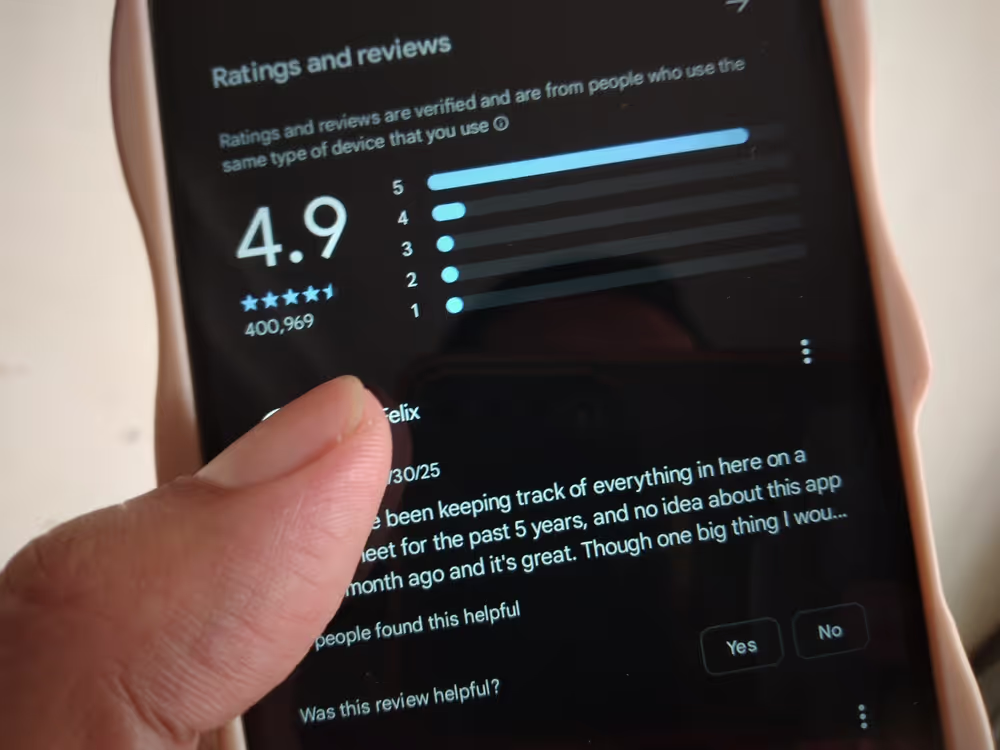
Online reviews heavily influence both local SEO rankings and conversion rates. Every incremental Google review helps businesses appear in 600 additional Google searches, making reviews not just trust signals but powerful visibility drivers.
Implement systematic review generation processes encouraging satisfied customers to leave Google reviews. Ask immediately after successful service delivery when satisfaction is highest. Make it easy by sending direct links to your review page via text message or email.
Respond to every single review, both positive and negative, promptly and professionally. Response rate and speed influence both rankings and consumer trust. Generic responses don't work. Personalize each response showing you actually read and value the feedback.
Negative reviews handled professionally can actually improve your reputation and rankings. Acknowledge the issue, apologize sincerely, explain what you'll do differently, and take the conversation offline to resolve it. Potential customers reading your thoughtful response to criticism often trust you more than businesses with only glowing reviews that ignore complaints.
Reviews influence local rankings through multiple mechanisms. They provide fresh, relevant content containing natural language descriptions of your services. They demonstrate business activity and customer satisfaction. They improve click through rates when searchers see high ratings. They increase dwell time as users read reviews before deciding.
Never buy fake reviews or incentivize positive reviews in ways violating Google's guidelines. The short term ranking boost isn't worth the long term penalty risk when detected. Focus on genuinely earning reviews through excellent service.
4. Create Hyperlocal Content Targeting Suburb Level Searches
Near me searches remained a key driver for local SEO as Australians continued relying on local search to discover everything from restaurants to tradies. Mobile first habits and Google's increasing emphasis on hyperlocal results mean businesses must create content for specific suburbs and neighbourhoods, not just cities.
Develop dedicated landing pages for each suburb or area you serve. "Emergency Plumbing in Bondi" as a comprehensive resource page targeting that specific suburb performs dramatically better than generic "Sydney plumbing" content for Bondi searches.
Include genuine local knowledge demonstrating you understand each area. Mention local landmarks, cross streets, parking considerations, and area specific issues customers in that suburb care about. This local context signals relevance to both Google and readers.
Target long tail conversational phrases incorporating suburb names naturally: "best brunch in Paddington with parking" or "family lawyer in Parramatta specializing in custody." These specific suburb level queries represent exactly how Australians search for local services.
Create suburb specific blog content addressing local issues, events, or news relevant to your business. A Melbourne cafe writing about "Best Parks Near Our Fitzroy Location for Family Picnics" ranks for multiple local search variations while providing genuine value.
Build internal links between your suburb pages and relevant service pages. This internal linking structure helps Google understand your service area comprehensiveness and distributes link equity to important local pages.

5. Optimize for Voice Search and Conversational Queries
Roughly 33% of Australians use voice search daily, primarily for local queries. These voice searches are typically 6 to 10 words long about a brand, product, or service. When people search locally, they ask complete questions like "Where's the best coffee shop near Strathfield, Sydney?"
Structure content around natural questions customers actually ask. Create FAQ sections answering common queries in conversational language. Use question based headings matching how people speak rather than how they type.
Focus on long tail conversational phrases likely to be spoken aloud. "Which Thai restaurant in Melbourne is open now for delivery" versus typed "Thai restaurant Melbourne." Voice queries tend to be longer and more specific than typed searches.
Implement FAQ schema markup telling search engines exactly which questions your content answers. This structured data dramatically improves chances of appearing in voice search results and featured snippets.
Optimize for question words: who, what, where, when, why, how. Voice searchers frame queries as questions. Content directly answering these question patterns ranks better for voice search.
Include temporal and location modifiers naturally in content: "open now," "near me," "available today," "24 hour," specific suburb names. Voice searchers frequently include these modifiers expecting immediate, location specific answers.
6. Implement Technical SEO Best Practices for Mobile
Mobile optimization isn't optional for local search success. Most "near me" searches happen on mobile devices. Google uses mobile versions of websites to determine search inclusion and rankings.
Achieve sub 3 second page load times on mobile devices. Pages ranking well for local searches load 52% faster than average. Compress images aggressively. Minimize code. Use content delivery networks. Every millisecond matters for both rankings and user experience.
Ensure perfect mobile responsiveness. Your site must look great and function flawlessly on every screen size. Google's mobile first indexing means your mobile site IS your site for ranking purposes.
Implement click to call functionality prominently on mobile versions. Local searchers want to call businesses immediately. Make your phone number large, visible, and instantly callable with one tap.
Use location based schema markup helping search engines understand your service areas, business locations, and local relevance. LocalBusiness schema with complete information dramatically improves local search visibility.
Enable AMP (Accelerated Mobile Pages) if appropriate for your site type. AMP pages load nearly instantly on mobile devices, improving user experience and potentially rankings for local searches.
Test your mobile site regularly using actual devices and Google's Mobile Friendly Test tool. What looks perfect on desktop often breaks on mobile. Regular testing catches issues before they cost you rankings and customers.
7. Build Location Specific Backlinks from Local Authority Sites
Backlinks remain important local ranking signals, but quality matters far more than quantity. One link from a high authority Australian site in your geographic area carries more weight than dozens of generic directory links.
Target local news outlets covering your area. Get featured in local news stories, contribute expert commentary, sponsor local events that generate press coverage. These editorial links from trusted local sources significantly boost local search authority.
Partner with other complementary local businesses for mutual linking opportunities. A wedding venue linking to preferred local caterers, photographers, and florists creates legitimate, valuable link networks that benefit all parties.
Sponsor local organizations, sports teams, charities, and community events that maintain websites linking back to sponsors. These authentic local links demonstrate community involvement and local relevance.
Seek links from local chambers of commerce, business associations, and industry groups. Membership often includes directory listings and profile pages on high authority local sites.
Create linkable local content that naturally attracts backlinks. Original local research, comprehensive local guides, local event calendars, and unique local resources earn links from other sites covering your area.
Measuring Local SEO Success: Beyond Vanity Metrics
Traditional metrics like overall website traffic don't tell the complete local SEO story. Track these specific metrics revealing true local search performance.
Local Map Pack Rankings: Monitor where you rank for target "near me" keywords in the local map pack across different suburbs you serve. Track this weekly using local rank tracking tools showing your position from different geographic locations.
Google Business Profile Insights: Analyze discovery metrics showing how customers find your listing, whether through direct search, discovery search, or branded search. Track action metrics showing calls, direction requests, website clicks, and messaging.
Near Me Keyword Rankings: Track rankings specifically for "[service] near me" queries relevant to your business. These rankings directly correlate with "near me" search visibility.
Conversion Metrics by Source: Separate organic traffic by local versus non local sources. Track phone calls, form submissions, and in store visits originating from local search specifically.
Review Velocity and Ratings: Monitor review generation rate, average rating, and review response metrics. Improving these metrics correlates strongly with local ranking improvements.
Citation Consistency Score: Use tools measuring what percentage of your citations contain accurate, consistent business information. Higher consistency scores correlate with better local rankings.
The Australian Competitive Reality
Different Australian markets present unique local SEO challenges. Sydney and Melbourne face intense competition across most industries with hundreds of businesses competing for limited map pack positions. Brisbane, Perth, and Adelaide offer slightly less saturated markets but still require sophisticated local SEO execution.
The businesses winning in competitive Australian markets share common characteristics. They execute all seven tactics consistently, not just one or two. They invest in local SEO as ongoing strategy, not one time project. They monitor competitors and adapt tactics as the landscape evolves.
More importantly, they understand local SEO compounds over time. The business consistently implementing these tactics for twelve months dramatically outperforms the business starting today, even if today's business executes perfectly. Time builds authority Google rewards.
The Bottom Line
"Near me" searches represent customers at the highest possible purchase intent. They're ready to buy, visit, or call right now. They're physically in your area. They're searching for exactly what you offer.
If you're not appearing in those searches, you're invisible to your most valuable potential customers. Your competitors are capturing them instead. Every day you delay implementing proven local SEO tactics is another day losing customers to businesses that figured this out.
The tactics work. The question is whether you'll implement them before competitors lock you out of the local map pack entirely. In competitive Australian markets, the gap between winners and losers isn't closing. It's widening as winners compound their authority advantages month after month.
Which side of that gap will your business occupy?
Dominate Local Search in Your Market
Stop losing customers to competitors appearing in "near me" searches while you remain invisible. At Maven Marketing Co., we help Australian businesses dominate local search across competitive markets from Sydney to Perth.
Our proven local SEO strategies combine Google Business Profile optimization, strategic citation building, review generation systems, hyperlocal content development, and technical optimization delivering measurable local search visibility improvements.
We don't just improve rankings. We deliver more phone calls, more foot traffic, more directions requests, and more customers walking through your door from local searches.
Contact Maven Marketing Co. today for a comprehensive local SEO audit revealing exactly where you rank for "near me" searches in your market, which competitors dominate local map pack positions you should occupy, and the specific tactical roadmap capturing those high intent local searchers currently choosing your competitors.

Table of contents
read more blogs
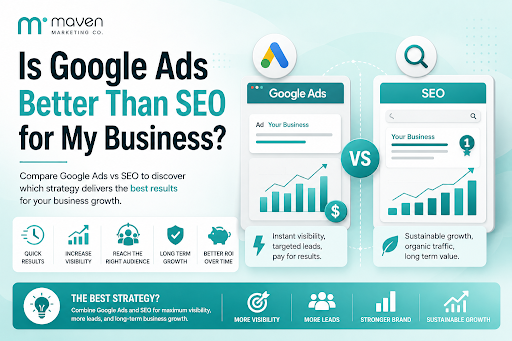
Is Google Ads Better Than SEO for My Business
One of the biggest questions business owners ask when they are planning online growth is whether they should invest in Google Ads or SEO. Both are strong marketing plays that help your company show up in Google search results, but they do things in separate lanes. Google Ads gives quicker visibility and can bring in leads fast, whereas SEO more or less focuses on slow, steady organic traffic that tends to grow the longer you keep building it. Picking the right direction depends on what you want to achieve, how much money you can spend, how crowded the market is, and how quickly you need results, like sooner rather than later. The good news is you don’t always have to choose one or the other; it’s not exactly a black-and-white situation. If you take time to understand the strongest points of both, you can put together a more sensible digital marketing plan that supports consistent expansion. In this guide, we’ll compare Google Ads vs SEO, explain the main differences, and help you figure out what option makes the most sense for your business.

When Should I Hire a Digital Marketing Agency
Growing a business today takes more than just having a website or throwing a post on social media; customers usually search around online, compare providers, skim reviews, and basically expect the brand to show up with a solid digital presence before they even think about buying. Many businesses try to run their marketing themselves, but there comes a point when “doing it all in-house” becomes clunky and hard to manage, all at once. Knowing when to hire a digital marketing agency can end up making a big, real difference for your growth. If you’re not getting enough leads, or your online visibility feels stuck, or sales are just not moving, the right agency can bring the know-how, plus a clear plan, to help you get noticeably better outcomes. In this guide, we’ll dig into what a digital marketing agency actually does, the usual signs it’s time to bring one on, and how picking the right marketing partner can help your business move forward at a faster pace.
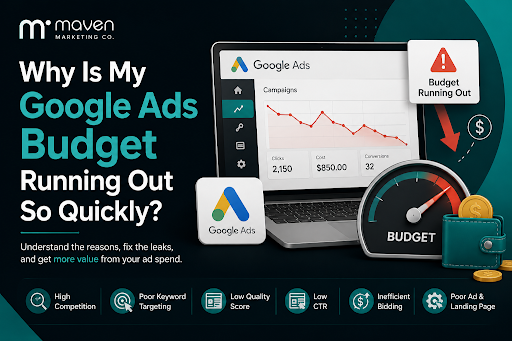
Why Is My Google Ads Budget Running Out So Quickly
Running a successful Google Ads budget isn’t only about throwing more money at it. It’s more like making every dollar, doing a bit extra. A lot of businesses start a Google Ads campaign with big hopes, then find out their daily budget is gone within a few hours, and that feels weird, right? After that, your ads stop showing effectively, new leads slip away, and your return on investment dips. So if your Google Ads budget is running out too fast, don’t stress. It’s a fairly common issue, and in most situations, it can be repaired with the right approach. There are multiple little things that can drain your advertising money quicker than you expected, from costly keywords to audience targeting that just doesn’t quite fit. In this guide, we’ll walk through why your budget disappears so quickly, how to cut wasteful spend, and the most reliable ways to boost your Google Ads ROI, even if your budget stays the same.