.svg)


%201.svg)
Key Takeaways
- Consistent 4-5 weekly posts generate 3-8x more engagement than sporadic publishing through algorithmic rewards for regular activity, with businesses disappearing for weeks suffering 70-85% reach decline requiring months rebuilding visibility
- Content pillars provide strategic structure organizing posts across 3-5 core themes (thought leadership, company culture, industry insights, client success, product education) preventing redundancy whilst ensuring balanced messaging
- Batch content creation maximizes efficiency through dedicating 3-4 hours monthly creating 15-20 posts in single session versus daily ad-hoc creation consuming 20-30 minutes each interrupting workflows
- Employee advocacy amplifies reach 10-25x as team members sharing company content to personal networks extend impressions exponentially beyond company page's limited organic reach
- Lead attribution tracking reveals LinkedIn's hidden value showing platform influences 25-45% of B2B conversions appearing in attribution paths despite receiving only 5-12% last-click credit, validating consistent investment
.avif)
Your LinkedIn company page publishes sporadically: three posts in January discussing new year goals, silence through February as work intensified, random update in March about new hire, then six-week gap until someone remembers to post again. Posts reach 140-280 people (8-15% of your 1,800 followers), generating 12-23 engagements demonstrating minimal business impact justifying time investment.
Your competitor publishes 4-5 weekly posts following systematic calendar: Monday thought leadership articles, Wednesday industry insights, Friday employee spotlights, plus timely company news and client success stories. Their posts reach 2,400-4,800 people (80-160% of their 3,000 followers through algorithmic amplification), generating 180-340 engagements whilst attribution analysis reveals LinkedIn influences 37% of their qualified lead conversions through awareness and consideration touchpoints.
The difference isn't content quality, follower count, or budget—it's systematic consistency through strategic content calendar preventing gaps, ensuring variety, and enabling measurement proving business value.
Melbourne consulting firm Nous Group implemented content calendar planning quarterly themes, weekly posting cadences, and employee advocacy program amplifying reach. Over 12 months, LinkedIn-attributed pipeline increased from $340,000 (6% of total) to $2.1M (34% of total) through consistent presence building thought leadership, demonstrating expertise, and nurturing relationships eventually manifesting as qualified opportunities—value impossible without systematic publishing discipline.
Research on LinkedIn content consistency demonstrates businesses posting 4-5 times weekly achieve 2-3x higher reach and engagement than weekly posters, with sporadic publishers (2-3 monthly) showing 60-80% lower performance due to algorithmic deprioritization and audience disengagement from unreliable sources.
.avif)
Understanding LinkedIn's B2B Value Proposition
LinkedIn uniquely serves B2B marketing through professional context, decision-maker concentration, and content consumption patterns favoring business education over entertainment.
Why LinkedIn matters for Australian B2B:
Professional mindset and context: Users consume content in work mode seeking industry insights, career development, and business knowledge versus entertainment focus on other platforms. Decision-maker density: 61 million senior-level influencers, 40 million decision-makers globally with 4.7 million Australian members including substantial C-suite and manager representation. Content lifespan: Posts remain visible 24+ hours versus Instagram/Facebook's 4-6 hour windows, with engaged audiences actively seeking valuable content rather than passive scrolling. Lead quality: LinkedIn-sourced leads show 2-3x higher qualification rates than other social platforms given professional context and self-selection. Attribution value: LinkedIn typically influences 25-45% of B2B conversion paths appearing early in buyer journeys creating awareness and credibility.
Sydney software company Atlassian tracks source attribution discovering LinkedIn appears in 38% of enterprise deal conversion paths despite receiving only 7% last-click credit—platform's primary value building awareness and credibility during lengthy B2B sales cycles rather than direct conversion generation.
LinkedIn algorithm priorities 2026:
Engagement velocity: Posts generating rapid early engagement (first 60-90 minutes) receive algorithmic amplification to broader audiences. Dwell time: Content keeping users on platform longer (reading articles, watching videos, engaging with comments) signals quality. Relevance signals: Personal connections, shared networks, content similarity to user's previous engagements determine distribution. Content type preferences: Native content (posts, articles, videos uploaded directly) outperforms external links directing users off-platform. Consistency rewards: Regular publishers receive preferential algorithmic treatment versus sporadic posters.
Company page versus personal profiles:
Company pages reach 2-8% of followers organically requiring paid promotion for substantial visibility, establish official brand presence providing credibility and legitimacy, enable showcase pages for products/services creating focused communities, and provide analytics tracking follower demographics and engagement.
Personal profiles reach 15-40% of connections organically through preferential algorithmic treatment, build authentic relationships through individual voices and personalities, enable direct messaging and relationship building impossible through pages, and demonstrate thought leadership positioning individuals as industry experts.
Optimal strategy leverages both: company page for official announcements and brand content, personal profiles for thought leadership and relationship building, with employee advocacy amplifying company content through personal networks extending reach exponentially.
Brisbane accounting firm BDO discovered personal profiles of partners and managers generated 8.2x more engagement than company page posts on identical content—leading to dual-channel strategy where company page publishes content subsequently shared by team members to personal networks achieving combined reach of 40,000-80,000 versus 3,200-5,400 company page alone.
Content Pillar Framework: Strategic Theme Structure
Content pillars organize publishing across consistent themes ensuring balanced messaging, preventing redundancy, and enabling systematic planning.
Defining 3-5 core content pillars:
Thought leadership: Industry trends analysis, future predictions, contrarian viewpoints, original research, expert commentary positioning authority and expertise. Educational content: How-to guides, tutorials, frameworks, templates, tactical advice providing tangible value demonstrating capabilities. Company culture: Team spotlights, behind-scenes glimpses, career opportunities, values demonstration attracting talent and humanizing brand. Client success: Case studies, testimonials, results achieved, problem-solving stories showcasing capabilities through concrete outcomes. Industry insights: News commentary, market analysis, competitive intelligence, data interpretation providing timely relevant perspectives.
Melbourne professional services firm KPMG structures content across five pillars: Monday thought leadership articles (industry future, strategic trends), Tuesday practical tips (implementation advice, tactical guidance), Wednesday company culture (employee stories, initiatives), Thursday client success (anonymized case studies, results), Friday industry news commentary (weekly developments analysis). Structure ensures variety whilst maintaining strategic focus across themes.
Pillar distribution planning:
Allocate posts proportionally based on business objectives: lead generation heavy businesses emphasize thought leadership (40%) and educational content (30%), recruitment-focused companies weight culture content (40%) and thought leadership (30%), whilst established brands might balance evenly across all pillars. Test distributions measuring engagement and conversion impact by pillar adjusting allocation toward highest-performing themes.
Pillar-specific content types:
Thought leadership: Long-form LinkedIn articles (1,200-2,000 words), multi-carousel posts presenting frameworks or models, video commentary on industry developments, data visualization presenting original research. Educational: Step-by-step tutorials, template shares, framework explanations, "how-to" guides, toolkit recommendations. Company culture: Employee interview features, office tour videos, team celebration highlights, company milestone announcements, awards and recognition. Client success: Anonymized case study summaries, metric-driven results presentations, client testimonial videos, before/after transformations. Industry insights: News article commentary, trend analysis, market data interpretation, competitive positioning discussions.
Avoiding redundancy through pillar tracking:
Maintain content log documenting published posts by pillar, topic, and date preventing repetitive coverage. Review 90-day posting history before planning next quarter identifying overemphasized themes requiring reduction. Rotate through pillars systematically ensuring balanced coverage rather than clustering similar content consecutively.
Sydney marketing agency Rocket reviewed six-month content discovering 67% of posts focused on thought leadership and industry insights whilst company culture and client success comprised only 18% combined—insight driving rebalancing toward underrepresented pillars improving follower engagement through variety and humanization.
Quarterly and Monthly Planning Process
.avif)
Strategic planning frameworks establish publishing roadmap preventing reactive scrambling whilst enabling proactive content aligned with business priorities.
Quarterly planning session (2-3 hours):
Review previous quarter performance: Analyze top-performing posts by engagement and attributed conversions, identify underperforming content types requiring elimination or improvement, assess pillar distribution balance and variety, examine follower growth and demographic changes. Identify quarterly themes: Align content with business priorities (product launches, service expansions, seasonal opportunities), incorporate industry events and conferences providing timely hooks, plan campaign integration supporting broader marketing initiatives, establish thought leadership themes positioning expertise areas. Create content pipeline: Generate 40-60 post concepts distributed across pillars and months, assign preliminary publishing dates creating skeleton calendar, identify required assets (videos, graphics, case studies) enabling production planning, delegate content creation responsibilities across team members.
Monthly planning refinement (60-90 minutes):
Break down quarterly concepts into specific weekly posts with defined topics, angles, and formats. Incorporate timely opportunities emerging since quarterly planning (news developments, client wins, employee achievements). Finalize publishing schedule assigning specific dates to drafted concepts. Coordinate with employee advocacy identifying posts suitable for team sharing. Batch content creation scheduling 3-4 hour sessions producing 15-20 posts in advance.
Brisbane software company Xero conducts monthly planning involving marketing, product, and customer success teams: reviews customer feedback identifying common questions worthy of educational content, discusses product roadmap spotlighting upcoming features, shares client success stories achieved previous month, and identifies team members willing to share personal industry insights. Cross-functional approach ensures diverse valuable content reflecting complete business perspective rather than marketing echo chamber.
Content calendar tools and systems:
Spreadsheet calendars: Google Sheets or Excel providing simple free planning enabling column structure (Date, Pillar, Topic, Format, Status, Assigned To, Performance Metrics). Project management tools: Asana, Monday.com, or Trello offering visual boards, task assignments, and deadline tracking. Social media schedulers: Hootsuite, Buffer, Sprout Social enabling content drafting, approval workflows, and scheduled publishing. Specialized LinkedIn tools: LinkedIn native scheduler, Shield Analytics, or Taplio providing LinkedIn-specific features.
Tool selection matters less than consistent usage—simple spreadsheet outperforms sophisticated software when maintained diligently, whilst abandoned expensive tools waste investment regardless of capabilities.
Content Creation Workflow and Batch Production
Systematic creation workflows transform calendar concepts into published posts efficiently through batching, templates, and delegation.
Batch content creation sessions (3-4 hours monthly):
Block dedicated uninterrupted time free from meetings and operational demands. Prepare in advance: gather data/stats, collect client quotes, download images, compile resources. Create 15-20 posts in single session capitalizing on momentum and reducing context-switching overhead. Use templates accelerating formatting: thought leadership template, educational post template, culture spotlight template. Draft posts in Google Docs or Word enabling easy editing and approval before scheduling.
Melbourne consulting firm McKinsey implements monthly "content creation mornings": 9am-12pm first Tuesday monthly where marketing team creates month's LinkedIn content in batch session. Three-hour session produces 18-22 posts (approximately 10 minutes each after template setup and resource preparation) versus estimated 30-40 minutes per post if created individually across month—efficiency gains of 60-70% through batching.
Post formats and templates:
Text-only posts (800-1,300 characters): Opening hook (question, statistic, bold statement), 3-5 key points in short paragraphs, concluding thought or call-to-action. Most accessible format requiring minimal production but increasingly facing algorithmic deprioritization. Image posts: Professional graphic, infographic, or photo with 200-400 character caption summarizing visual content. Balance between visual appeal and low production complexity. Carousel posts (PDF uploads): 6-12 slides presenting frameworks, tips, processes, or data visualizations. Strong engagement through multiple-page swipe interaction encouraging dwell time. Video posts: 60-180 second native videos sharing insights, interviews, or demonstrations. Highest algorithmic priority but requiring more production effort. LinkedIn articles: 800-2,000 word long-form content establishing deep expertise. Published to profile, shared as post to company page and personal networks.
Template structure example (Thought Leadership):
Hook: [Provocative question or contrarian statement]

Context: [2-3 sentence setup explaining topic importance]

Main insight: [Core argument or framework - 3-5 key points]

Supporting evidence: [Data, examples, or logic supporting points]

Conclusion: [Takeaway and application]

CTA: [Question encouraging comments or tag relevant connections]
Delegation and team contribution:
Assign pillar ownership to team members based on expertise: sales leader contributes industry insights, customer success manager provides client stories, HR/culture lead creates employee spotlights, CEO/founders handle thought leadership. Establish contribution deadlines respecting calendar schedule: content due 2 weeks before publishing enabling review and editing. Create simple submission process: Google Form or Slack channel where contributors submit ideas and drafts. Provide feedback loops helping team members improve content quality over time.
Sydney professional services firm PwC distributes content creation across 15 partners and directors: each contributes 1-2 posts quarterly aligning with expertise, marketing team edits for consistency and brand alignment, creates required graphics/visuals, and schedules publishing. Distributed model reduces individual burden whilst providing diverse perspectives impossible from single content creator.
Employee Advocacy Program Implementation
.avif)
Employee advocacy amplifies company content reach through personal networks extending impressions 10-25x beyond company page's organic limitations.
Building advocacy culture:
Communicate program value to employees: extending professional brand, building personal thought leadership, supporting company success benefiting everyone. Start small with willing participants rather than forcing reluctant participation creating resentment. Recognize and celebrate advocates: spotlight top sharers, acknowledge contributions in team meetings, consider gamification with friendly competition. Make sharing effortless through tools and clear instructions preventing friction. Provide content variations so employees can choose what resonates preventing robotic identical shares.
Employee advocacy platforms:
GaggleAMP, EveryoneSocial, Bambu: Dedicated advocacy platforms queuing pre-approved content for easy employee sharing with one-click distribution. Provide analytics showing individual and team reach amplification. Cost $5,000-$15,000+ annually depending on employee count. Slack/Teams channels: Free informal approach posting content to internal channels with "feel free to share" encouragement. Less sophisticated but zero cost suitable for small businesses. LinkedIn native sharing: Simply encourage employees to share company posts directly from company page—simplest approach requiring no tools but lacking analytics.
Brisbane technology company Atlassian implemented GaggleAMP for 200-person Australian team: pre-approves 3-4 weekly posts suitable for employee sharing, employees receive app notifications with one-click LinkedIn posting, tracks participation and reach amplification. Program extends average company post reach from 4,200 (company page alone) to 58,000 (including employee amplification)—14x reach multiplier justifying platform investment.
Content preparation for advocacy:
Not all company content suits personal sharing—employees resist overtly promotional sales-heavy posts damaging personal brand credibility. Focus advocacy on: thought leadership demonstrating industry expertise, educational content providing genuine value to networks, company culture showcasing workplace attracting talent, industry news commentary positioning informed perspective. Avoid heavy advocacy push for: direct sales promotions, job postings (unless recruitment urgent priority), every company announcement (selectivity maintains quality). Provide personalized captions employees customize rather than forcing identical corporate messaging appearing inauthentic.
Incentivizing participation:
Recognition: Monthly spotlight highlighting top advocates, leaderboards showing participation metrics, shoutouts in company meetings. Professional development: Frame advocacy as personal brand building and career development opportunity. Gamification: Points systems, competitions with prizes, team challenges encouraging friendly rivalry. Executive participation: Leadership sharing content creates permission culture encouraging broader team involvement. Minimal obligation: Keep expectations reasonable (share 1-2 monthly) preventing overwhelming participation requests.
Melbourne consulting firm Deloitte runs quarterly advocacy competitions: team with highest average sharing participation wins lunch with leadership and company-sponsored conference attendance. Friendly competition increased participation from 23% to 67% whilst maintaining quality over forced participation.
.avif)
Performance Measurement and Optimization
Systematic measurement reveals content effectiveness, identifies improvement opportunities, and proves LinkedIn's business value beyond vanity metrics.
Key performance metrics:
Reach: Total unique viewers indicating content distribution effectiveness. Compare to follower count (150-300% reach suggests strong algorithmic amplification). Engagement rate: (Likes + Comments + Shares + Clicks) ÷ Impressions showing content resonance. Rates above 2% indicate strong engagement. Click-through rate: Website clicks ÷ Impressions revealing conversion effectiveness. CTRs above 0.5% show compelling calls-to-action. Follower growth: Net new followers month-over-month indicating audience building success. Lead attribution: Conversions where LinkedIn appears in attribution path proving business impact. Content pillar performance: Engagement and conversion rates by pillar revealing strategic priorities.
Sydney marketing agency tracked pillar performance discovering educational content achieved 4.2% engagement rate whilst thought leadership showed 2.8%—insight driving increased educational content allocation capitalizing on superior audience response.
LinkedIn Analytics deep dive:
Access company page analytics through Admin view → Analytics dashboard. Review Visitors tab showing follower demographics: industries, seniority, functions, locations—ensuring audience matches ideal customer profile. Analyze Updates tab revealing individual post performance: impressions, clicks, engagement, follower demographics engaging with each post. Compare time periods (month-over-month, quarter-over-quarter) identifying growth trends and seasonality patterns. Export data for deeper analysis in spreadsheets or business intelligence tools.
Attribution tracking implementation:
Use UTM parameters on all LinkedIn links tracking traffic source in Google Analytics. Configure LinkedIn Insight Tag on website capturing LinkedIn-attributed conversions. Implement multi-touch attribution models (not just last-click) revealing LinkedIn's complete influence across customer journeys. Integrate CRM systems tracking which leads originate from LinkedIn engagement. Survey new clients asking about discovery channels often revealing LinkedIn influence not captured in digital attribution.
Brisbane B2B software company discovered through surveys that 31% of new customers mentioned LinkedIn as discovery or credibility-building channel despite only 8% showing LinkedIn last-click attribution—hidden value validating consistent investment overlooked by simplistic analytics.
Content optimization based on data:
Identify top 10 performing posts analyzing common characteristics: topics, formats, lengths, hooks, calls-to-action. Replicate successful patterns in future content capitalizing on proven approaches. Eliminate consistently underperforming content types preventing wasted effort on ineffective formats. Test variations of strong performers seeking incremental improvements: different headlines, alternative formats, varied CTAs. A/B test posting times comparing morning versus afternoon performance identifying optimal windows.
Quarterly performance reviews:
Analyze 90-day performance trends identifying growth trajectory or stagnation requiring intervention. Compare against previous quarter and same quarter previous year revealing progress and seasonality. Review content pillar distribution assessing balance and adjustments needed. Assess employee advocacy participation and impact determining program health. Calculate LinkedIn-attributed pipeline and revenue justifying continued investment. Document learnings informing next quarter's strategy and content calendar.
Frequently Asked Questions
What's the minimum posting frequency for effective LinkedIn presence?
3-4 posts weekly minimum maintains algorithmic favor and audience engagement without overwhelming smaller businesses, achieving 70-80% of performance gains available from daily posting whilst requiring 60% less content creation effort. Businesses dropping below 2-3 weekly posts experience algorithmic deprioritization reducing reach 40-60% as LinkedIn favors consistent publishers. Daily posting (5-7 weekly) delivers maximum algorithmic advantage but demands substantial content creation capacity often unsustainable for SMEs leading to burnout and abandonment. Melbourne consulting firm tested frequencies: 5 weekly posts (12,400 average reach), 3-4 weekly (9,800 reach), 1-2 weekly (4,200 reach), sporadic monthly (1,800 reach). Data validated 3-4 weekly as optimal balance achieving strong performance without exhausting content capacity or team bandwidth, whilst anything under 3 weekly suffered disproportionate algorithmic penalties preventing momentum building.
Should I focus on company page or personal profiles for B2B LinkedIn marketing?
Both, with strategic division of labor leveraging each platform's strengths. Company pages establish official brand presence, publish company news and culture content, serve as information hub for prospects researching company, and enable paid promotion reaching targeted audiences beyond organic limitations. Personal profiles build authentic relationships and thought leadership, achieve 5-10x higher organic reach than company pages, enable direct messaging for business development, and establish individuals as industry experts. Optimal strategy: Company page publishes 3-4 weekly posts (official brand content, culture, client success) providing consistent presence. Key employees (leadership, subject matter experts, business development) publish 1-2 weekly personal posts (thought leadership, industry insights, educational content) building individual authority. Employee advocacy program amplifies company page content through personal networks achieving combined reach impossible through either approach alone. Sydney professional services firm implemented dual-channel strategy: company page (4,200 reach per post) plus 12 active employee profiles (averaging 3,800 reach each) sharing company content achieved combined reach of 50,000+ per post versus 4,200 company-only approach—12x improvement through strategic multi-profile leverage.
How do I measure LinkedIn's ROI when conversions happen offline or through long sales cycles?
Multi-touch attribution and qualitative tracking reveal LinkedIn's complete value despite attribution complexity. Implement UTM tracking on all LinkedIn links capturing website traffic source in Google Analytics. Configure view-through and assisted conversion reporting showing LinkedIn's role in conversion paths beyond last-click. Survey new clients asking "How did you first hear about us?" and "What channels influenced your decision?"—often reveals LinkedIn's awareness-building role invisible in digital analytics. Track LinkedIn-specific KPIs: profile views, connection requests, direct messages initiated, content engagement from target accounts—early-funnel signals predicting eventual pipeline. Calculate pipeline velocity comparing accounts engaging with LinkedIn content versus those without social touchpoints—LinkedIn-warmed leads typically show 20-40% faster sales cycles. For long sales cycles (6-24 months), track leading indicators: target account engagement, decision-maker connections, content consumption patterns—metrics correlating with eventual conversions even when attribution window exceeds tool capabilities. Brisbane enterprise software company tracked 18-month sales cycles discovering accounts engaging with LinkedIn content showed 73% higher close rates and 35% shorter cycles than no-LinkedIn-engagement accounts—statistical correlation proving value despite attribution challenges.
Build Consistent LinkedIn Presence Driving Measurable Pipeline
LinkedIn content calendars transform sporadic reactive posting into strategic consistent presence generating reliable lead flow, thought leadership positioning, and talent attraction—business outcomes impossible through ad-hoc publishing when inspiration strikes. Australian B2B businesses implementing systematic calendars planning 30-90 days ahead, distributing posts across strategic pillars, and leveraging employee advocacy report 100-400% increases in LinkedIn-attributed pipeline within 6-12 months through consistency, relevance, and amplification previously absent.
Yet most Australian B2B companies treat LinkedIn as afterthought, posting irregularly without strategic planning, tracking only vanity metrics, and concluding platform doesn't work for their business—self-fulfilling prophecy resulting from inadequate investment and systematic approach.
Maven Marketing Co specializes in LinkedIn content calendar implementation for Australian B2B businesses, providing quarterly planning frameworks establishing strategic themes and posting cadence, content pillar development ensuring balanced valuable messaging, content creation workflows enabling efficient batch production, employee advocacy program design amplifying reach through personal networks, and performance measurement frameworks proving LinkedIn's contribution to pipeline and revenue.
From initial LinkedIn strategy through content calendar creation, team training, and ongoing performance optimization, we transform LinkedIn from sporadic time-sink into systematic lead generation channel driving measurable business outcomes.
Schedule your LinkedIn content calendar consultation with Maven Marketing Co today and discover how to plan consistent strategic content, what pillar structure suits your business objectives, and how to measure LinkedIn's complete attribution value proving ROI justifying continued investment.
Stop posting randomly hoping for results. Start executing strategic content calendar driving predictable business outcomes.

Table of contents
read more blogs
Is Google Ads Better Than SEO for My Business
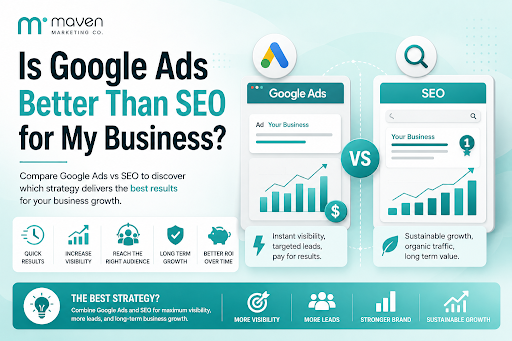
One of the biggest questions business owners ask when they are planning online growth is whether they should invest in Google Ads or SEO. Both are strong marketing plays that help your company show up in Google search results, but they do things in separate lanes. Google Ads gives quicker visibility and can bring in leads fast, whereas SEO more or less focuses on slow, steady organic traffic that tends to grow the longer you keep building it. Picking the right direction depends on what you want to achieve, how much money you can spend, how crowded the market is, and how quickly you need results, like sooner rather than later. The good news is you don’t always have to choose one or the other; it’s not exactly a black-and-white situation. If you take time to understand the strongest points of both, you can put together a more sensible digital marketing plan that supports consistent expansion. In this guide, we’ll compare Google Ads vs SEO, explain the main differences, and help you figure out what option makes the most sense for your business.

When Should I Hire a Digital Marketing Agency
Growing a business today takes more than just having a website or throwing a post on social media; customers usually search around online, compare providers, skim reviews, and basically expect the brand to show up with a solid digital presence before they even think about buying. Many businesses try to run their marketing themselves, but there comes a point when “doing it all in-house” becomes clunky and hard to manage, all at once. Knowing when to hire a digital marketing agency can end up making a big, real difference for your growth. If you’re not getting enough leads, or your online visibility feels stuck, or sales are just not moving, the right agency can bring the know-how, plus a clear plan, to help you get noticeably better outcomes. In this guide, we’ll dig into what a digital marketing agency actually does, the usual signs it’s time to bring one on, and how picking the right marketing partner can help your business move forward at a faster pace.
Why Is My Google Ads Budget Running Out So Quickly
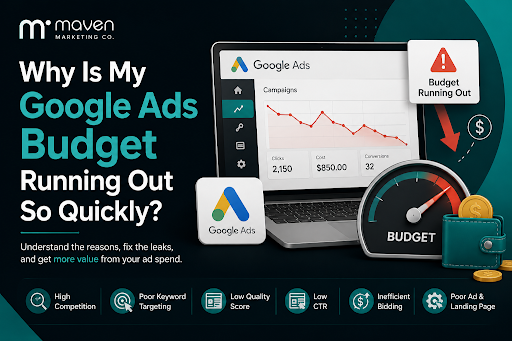
Running a successful Google Ads budget isn’t only about throwing more money at it. It’s more like making every dollar, doing a bit extra. A lot of businesses start a Google Ads campaign with big hopes, then find out their daily budget is gone within a few hours, and that feels weird, right? After that, your ads stop showing effectively, new leads slip away, and your return on investment dips. So if your Google Ads budget is running out too fast, don’t stress. It’s a fairly common issue, and in most situations, it can be repaired with the right approach. There are multiple little things that can drain your advertising money quicker than you expected, from costly keywords to audience targeting that just doesn’t quite fit. In this guide, we’ll walk through why your budget disappears so quickly, how to cut wasteful spend, and the most reliable ways to boost your Google Ads ROI, even if your budget stays the same.