.svg)


%201.svg)

Key Takeaways
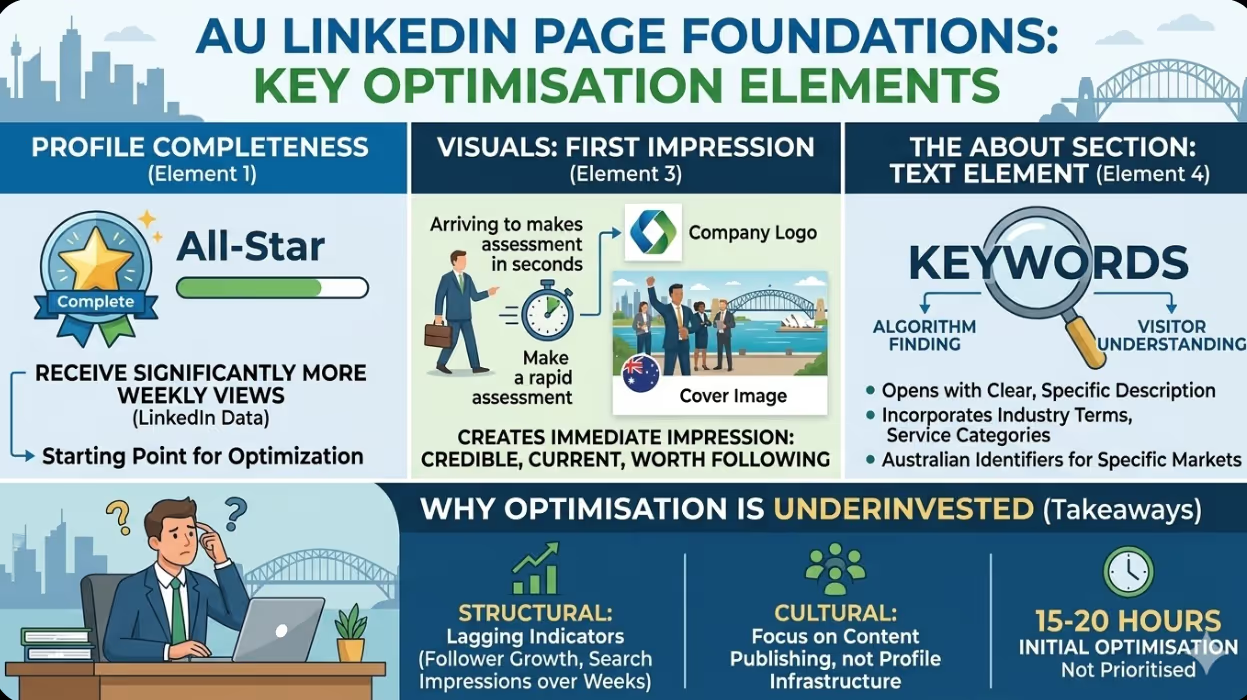
- LinkedIn Company Pages with complete profiles receive significantly more weekly views than those with incomplete profiles, according to LinkedIn's own platform data, making profile completeness the starting point for every optimisation engagement.
- The About section is the most important text element on a LinkedIn Company Page and the primary location where LinkedIn's search algorithm finds the keywords that determine when the page appears in search results.
- A Company Page's visual elements, including the cover image and logo, are assessed by every visitor within the first seconds of arriving at the page and create the immediate impression of whether the brand is credible, current, and worth following.
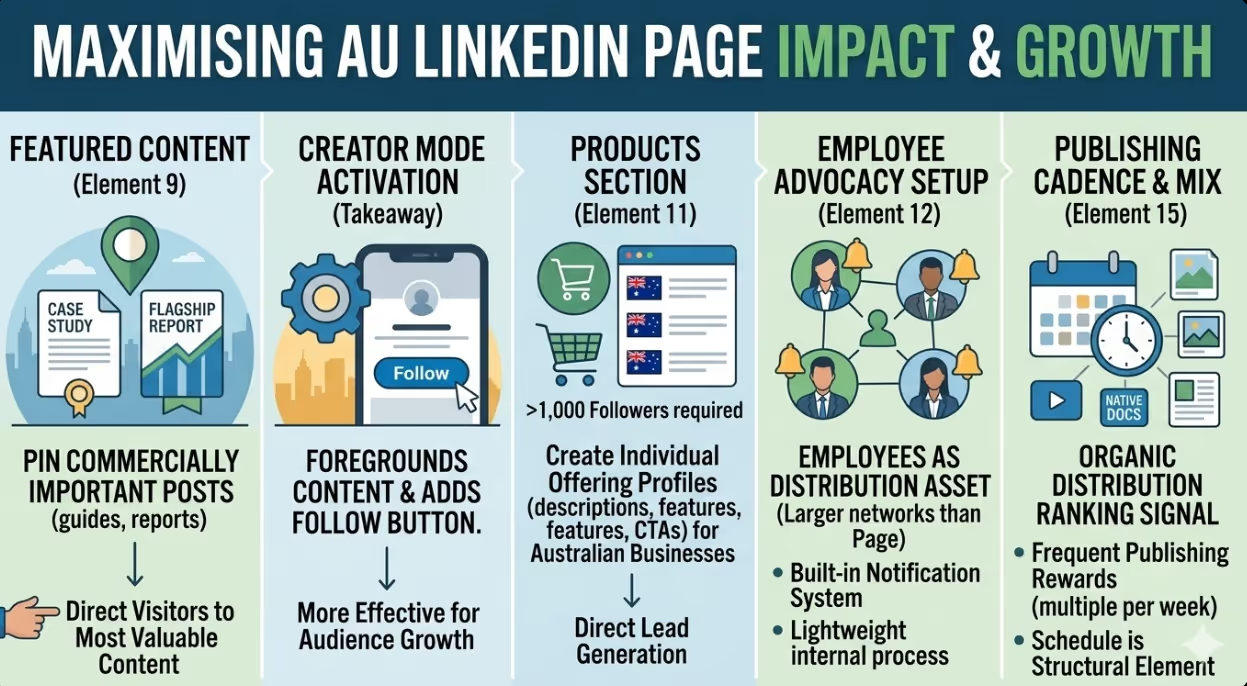
- Featured content on a LinkedIn Company Page allows businesses to pin specific posts, articles, links, or documents to a prominent position on the page, directing visitors to the most commercially important or representative content regardless of when it was published.
- The Products section, available to LinkedIn Pages with over 1,000 followers, allows Australian businesses to create dedicated profiles for individual offerings with descriptions, features, and calls to action that can drive direct lead generation from the Company Page itself.
- LinkedIn's Creator Mode for Company Pages, when activated, reorders the page layout to foreground content and adds a Follow button as the primary action, making it more effective for audience growth than the default layout.
- Consistent, frequent publishing from a Company Page is a ranking signal within LinkedIn's algorithm. Pages that publish multiple times per week are rewarded with greater organic distribution than those that publish sporadically, making a publishing schedule a structural element of page performance rather than a content marketing add-on.
Why LinkedIn Page Optimisation Is Underinvested In
LinkedIn Company Pages are among the most underoptimised owned assets in Australian B2B marketing. The explanation is partly structural: LinkedIn Pages do not have the obvious and immediate feedback loop of a website with analytics attached, a paid advertising account with performance data, or an email programme with open and click rates. The improvements from optimising a LinkedIn Page accumulate in follower growth, search impressions, and profile visit volume over weeks and months rather than appearing immediately in a dashboard.
The underinvestment is also partly cultural. LinkedIn Pages are often managed by whoever is responsible for social media in a marketing team, and that person is typically focused on content publishing rather than profile infrastructure. The page itself is treated as a fixed background rather than an optimisable asset, and the fifteen to twenty hours of initial optimisation work that would meaningfully improve its performance never gets prioritised against the ongoing demands of the content calendar.
The commercial case for addressing the page properly is straightforward. For Australian B2B businesses, LinkedIn is the dominant professional networking platform, and a Company Page that appears credible, complete, and active creates a materially different impression on a prospect evaluating the brand than one that appears incomplete, outdated, or inconsistent. The page is visited by prospective clients, job candidates, potential partners, journalists, and investors, all of whom are making assessments about the brand based on what they find.
Element 1: Profile Completeness Score
LinkedIn provides a profile completeness indicator that identifies which sections of the Company Page have not been filled in. Reaching the "All-Star" completeness level, which requires completing the name, logo, cover image, About section, website URL, industry, company size, and company type fields at minimum, is the first task in any optimisation engagement because incomplete profiles are penalised in LinkedIn's internal search ranking.
Element 2: Name and Tagline
The company name should be entered exactly as it appears in other brand assets, without abbreviations or variations that could create discrepancies across touchpoints. The tagline field beneath the company name is a 120-character opportunity to communicate the core value proposition clearly and immediately. Most Australian business taglines on LinkedIn are either left empty or filled with generic phrases that provide no useful signal to a visitor. A specific, tagline focused on the benefit to the visitor that tells a visitor immediately who the company serves and what it does for them is a small but meaningful differentiator.
Element 3: Logo and Cover Image
The logo should be uploaded at LinkedIn's recommended dimensions and should be the current, correct version of the brand's logo in a format that renders clearly at the sizes LinkedIn uses to display it. A blurred, stretched, or outdated logo is one of the fastest ways to undermine the credibility impression a page creates.
The cover image is the largest visual element on the Company Page and the one with the most impact on the first impression the page makes. It should be produced specifically for LinkedIn at the correct dimensions (1,128 by 191 pixels at the time of writing), convey the brand's positioning clearly, and be updated when it becomes outdated in its representation of the brand's current offering or visual identity.
Element 4: The About Section
The About section is the single most important text field on a LinkedIn Company Page. It is the primary location where LinkedIn's algorithm identifies the keywords relevant to the page and uses them to determine when the page should appear in search results for those terms. It is also the primary text a visitor reads to understand what the company does, who it serves, and why it is relevant to them.
An optimised About section is structured to serve both purposes. It opens with a clear, specific description of what the company does and who it serves, written in language that a visitor unfamiliar with the brand can immediately understand. It incorporates the primary keywords relevant to the business: industry terms, service categories, geographic identifiers for Australian businesses serving specific markets, and the specific problems the company solves for its clients. It should be written in the third person, be between 200 and 2,000 characters in length, and avoid the vague superlatives and generic positioning statements that appear on most Australian LinkedIn pages without distinguishing the brand in any meaningful way.
Element 5: Specialties
The Specialties field accepts up to twenty keyword entries and feeds directly into LinkedIn's search algorithm. Each specialty is a term or phrase that signals to LinkedIn what the company does. For an Australian digital marketing agency, relevant specialties might include terms such as SEO, content marketing, Google Ads, social media management, email marketing, and web analytics. These terms are not visible as a prominent element of the page to casual visitors, but they are read by the algorithm and are meaningful for search discoverability. The field should be filled completely with the twenty most relevant terms for the business.
Element 6: Website URL and Contact Information
The website URL, phone number, and address fields are the navigational elements that allow a page visitor to take the next step toward becoming a contact or customer. These fields should be current and complete. For Australian businesses with multiple office locations, the primary contact details should reflect the main point of contact or the location most relevant to the page's primary audience. The website URL should link to the most relevant destination for a LinkedIn visitor, which may be the homepage, a specific services page, or a landing page created specifically for LinkedIn traffic.
Element 7: Custom Button
LinkedIn Company Pages allow a custom call-to-action button to be configured above the fold on the page. The default options include Visit Website, Contact Us, Learn More, Register, and Sign Up. For most Australian B2B businesses, Visit Website or Contact Us is the appropriate choice, but the button should be reviewed to ensure it is configured to the option most likely to drive the commercial action the page is meant to support, and that the URL it links to is the correct destination.
Element 8: Hashtag Following
LinkedIn allows Company Pages to follow up to three hashtags relevant to the business. Posts using those hashtags may appear in the page's notifications, enabling the brand to engage with conversations happening in its industry. The hashtags selected should be those that the brand's target audience and industry peers use most actively on the platform, and they should be reviewed periodically to ensure they remain relevant as platform usage patterns evolve.
Element 9: Featured Content
The Featured section allows businesses to pin up to one item to a prominent position near the top of the page. This item can be a post, an external link, a document, or a LinkedIn article. The Featured section is valuable because it gives the page owner control over what a visitor sees first beyond the About section, regardless of the recency of the content. For most Australian businesses, the Featured section should showcase either the most commercially compelling piece of content the brand has produced (a case study, a detailed guide, or a flagship report) or the most important destination for page visitors to navigate to next.
Element 10: Life Tab Content
The Life tab is available to Company Pages and allows businesses to share content about their culture, team, and workplace. For Australian businesses actively recruiting, the Life tab is a meaningful differentiator in the hiring context. For businesses not focused on recruitment, it is a lower priority, but maintaining it with current and representative content ensures that the page presents well to any candidate or partner who navigates to it.
Element 11: Products Section
The Products section, available to pages that have reached the required follower threshold, allows businesses to create individual entries for each product or service they offer. Each product entry includes a name, description, a cover image, a category tag, and a call-to-action link. For Australian businesses with a defined set of services or products, this section transforms the Company Page from a general brand presence into a structured catalogue of offerings that a visitor can navigate and evaluate. The section is among the most underused features on LinkedIn for Australian B2B businesses.
Element 12: Employee Advocacy Setup
The employees listed on LinkedIn as working at the company are a significant distribution asset for Company Page content. When employees reshare or engage with a Company Page post, it reaches their own networks, which can be substantially larger than the Company Page's follower base. Setting up LinkedIn's built-in notification system that alerts employees when the company publishes content, and establishing a lightweight internal process that encourages sharing without making it mandatory or formulaic, is an infrastructure step that pays compounding returns as the team grows.
Element 13: Showcase Pages
Showcase Pages are extensions of a Company Page that allow businesses to create separate presences for distinct business units, products, or audience segments. For Australian businesses with multiple distinct offerings or audience types that warrant their own content programme and follower base, Showcase Pages are a structural tool that prevents the main Company Page from trying to serve too many different audiences simultaneously. They are only worth creating if there is a genuine commitment to populating them with distinct, content tailored to each distinct audience.
Element 14: Language Settings
LinkedIn Company Pages can be set up to display content in multiple languages. For Australian businesses with operations in multiple countries, or those marketing to audiences with different primary languages, the multilingual page feature allows different versions of the About section, tagline, and other text fields to be configured for display to users based on their LinkedIn language settings. This is a straightforward way to ensure the page presents in the most relevant language for each audience segment without requiring multiple separate pages.
Element 15: Publishing Cadence and Content Format Mix
Publishing frequency and the mix of content formats are optimisation variables as much as they are content variables, because they directly affect how LinkedIn's algorithm distributes the page's content to both followers and non-followers. Pages that publish multiple times per week consistently outperform those that publish less frequently in terms of organic reach per post. The format mix, including native documents, video, image posts, text posts, and LinkedIn articles, should be varied to take advantage of the different distribution behaviours the algorithm applies to each type.
A publishing schedule that specifies the minimum weekly frequency, the content types to be rotated, and the posting times best suited to the Australian audience is the final infrastructure element that holds the other fourteen optimisations together. All of the profile work done in elements one through fourteen increases the quality of the impression the page creates. A consistent publishing schedule is what brings people back to the page and grows the follower base that amplifies every subsequent piece of content.
FAQs
How long does a full LinkedIn Company Page optimisation take for an Australian business?
A thorough optimisation of a LinkedIn Company Page covering all fifteen elements typically takes eight to twelve hours of focused work when starting from a page with basic information already entered. Pages that require new visual assets to be produced, such as a new cover image designed to specification, or pages where the About section and Specialties need to be written from scratch through a briefing and review process, take longer, typically twelve to eighteen hours in total. The optimisation work is a single investment in the page infrastructure, with the ongoing commitment being the publishing schedule and periodic reviews to ensure the profile information remains current and the Featured content remains the best available representation of the brand.
What results should an Australian business expect after optimising its LinkedIn Company Page?
The improvements most directly attributable to a page optimisation are an increase in the page's appearance in LinkedIn search results for relevant terms, an increase in profile visits from visitors who find the page through search or through the profiles of employees, and an improvement in the impression the page creates on those visitors, as reflected in follower conversion rate. The time frame for these improvements to become measurable in the page's analytics is typically four to eight weeks, as LinkedIn's algorithm reassesses the page and as the fresh visual and content elements begin to circulate through the platform. Pages that combine the profile optimisation with an increase in publishing frequency typically see the most significant follower growth, as the algorithm rewards active pages with greater distribution to users who do not yet follow the page, through suggested pages and content recommendations.
Should Australian businesses use a personal LinkedIn profile or a Company Page as the primary presence on the platform?
Both serve different purposes and both are worth maintaining, but the decision about which to prioritise for content investment depends on the nature of the business and the role of personal credibility in the sales process. For Australian consulting firms, professional services businesses, and any business where the founder or principal is closely identified with the brand's authority, the personal profile is typically the content channel with greater leverage because personal profiles receive significantly greater organic distribution than Company Pages on LinkedIn. The Company Page serves as a credibility anchor that prospects visit to verify the brand is real and professionally presented, and as a hub for job seekers and potential partners. For businesses with multiple team members producing content, a larger marketing budget, and a brand that is genuinely larger than any individual within it, the Company Page becomes a more important primary channel for content distribution and audience building.
A Page That Works Is Built, Not Assumed
Most Australian businesses have a LinkedIn Company Page. Far fewer have one that actively contributes to their commercial goals through strong search visibility, a credible first impression, and a growing follower base that amplifies their content. The fifteen elements in this article are not advanced tactics. They are the foundational infrastructure that a professionally managed LinkedIn presence requires, and addressing them systematically is the first step toward treating the page as the business asset it can be.
Maven Marketing Co provides LinkedIn Company Page audits and optimisation services for Australian businesses, covering all fifteen elements and delivering a page that is ready to support an active content and audience growth programme.
Talk to the team at Maven Marketing Co →

Table of contents
read more blogs
The Ultimate Guide to E-commerce Product Page Optimisation
A strong e-commerce product page has to do several jobs at once. It needs to be discoverable in search, easy to understand, persuasive enough to build confidence and simple enough for a customer to buy without unnecessary friction. That combination is what makes product page optimisation such an important part of both ecommerce SEO and conversion strategy.The difficulty is that product pages are often built from one reusable template across hundreds or thousands of products. If the template is weak, the problem scales. Thin descriptions, poor imagery, unclear variants, buried shipping information or an awkward mobile experience can affect a large part of the store at the same time.Current product-page UX research from Baymard continues to show how often shoppers abandon otherwise suitable products because of avoidable usability issues. At the same time, Google provides dedicated guidance for e-commerce sites, product structured data, product variants and image optimisation because product information needs to be clear and machine-readable as well as useful to people.The goal is not to stuff every product page with more text or technical markup. A complete digital marketing strategy combines SEO, user experience, content and conversion improvements to help ecommerce businesses attract and convert the right customers. It is to give shoppers the information they need, in the right order, while helping search engines understand what the product is, whether it is available and how the page relates to the wider store. This guide covers the practical elements that make that happen.

How to Choose the Right Digital Marketing Channels for Your Business
Choosing digital marketing channels is one of the easiest places for businesses to lose clarity. There are more options than ever, every platform promises reach and results, and it is easy to assume that the best strategy is simply to be everywhere. In reality, most businesses do better when they choose channels with intention rather than spreading budget and effort too thinly.The right channel mix depends on where your audience spends time, how they search or discover solutions, what your business is trying to achieve and how much resource you actually have to support execution properly. A channel is only useful if it helps move the right people towards a commercial outcome that matters to the business.This is why strong digital marketing strategy is not really about finding one perfect platform. It is about understanding the role each channel can play across awareness, demand capture, conversion and retention. SEO might build long-term visibility, Google Ads might capture active intent, social media might support familiarity and reach, while email may help nurture prospects and strengthen customer value over time.This guide explains what digital marketing channels are, how to assess them properly and how to build a balanced channel mix for your business. The focus is practical. Rather than chasing every new platform, the goal is to help you choose the channels that fit your audience, goals, budget and internal capability.
How to Build a Customer Journey Map for Your Digital Marketing Strategy
A strong digital marketing strategy is not just about channels, creative or traffic. It is about understanding how real people move from first awareness through to enquiry, purchase and ongoing loyalty. That is exactly why customer journey mapping matters.Without a clear view of the journey, businesses often optimise in fragments. They improve the website without thinking about the ad that drove the visit, produce content without considering where the audience is in the decision process, or judge conversion performance without understanding the friction points that sit earlier in the experience.A customer journey map helps you step back and see the bigger picture. It shows the stages people move through, the touchpoints they interact with, the questions they ask, the barriers they face and the moments where your marketing can either help or lose them.This guide explains how to build a practical customer journey map for your digital marketing strategy, what information to include, how to use the map to improve performance and which common mistakes to avoid. The goal is not to create a pretty workshop artefact that gets forgotten. It is to build a working tool that improves messaging, user experience, channel decisions and conversion outcomes.