.svg)


%201.svg)
The rules just changed. Again.
Google's 2024 algorithm updates wiped out traditional link building tactics that worked for years. Scaled outreach died. Guest post networks collapsed. Low quality backlinks became worthless overnight. Meanwhile, AI Overviews launched across Australia, fundamentally changing how people search and how Google values links.
If you're still using 2023 link building strategies in 2024, you're already behind. The question isn't whether link building still matters. It absolutely does. The question is which tactics actually work now, and which ones are bleeding your budget with zero return.
The Brutal Truth About Link Building in 2024
Let's start with what you need to know immediately. According to 2025 industry data tracking Australian SEO professionals, the average quality backlink now costs $508, up from $364 in 2023. That's a 40% increase in just two years. Yet 78.1% of SEO professionals still report satisfying ROI from link building efforts.
Why? Because while costs have risen, the playing field has narrowed dramatically. Your competitors who relied on cheap, scaled tactics got wiped out by Google's Helpful Content Update and Link Spam Update. The ones investing in quality are seeing better results than ever.
Here's the reality check: 94% of online content receives zero external links. None. If you're creating content hoping it naturally attracts backlinks without a deliberate strategy, you're wasting time and money. Top ranking pages possess 3.8 times more backlinks than positions two through ten. The gap between winners and everyone else isn't closing. It's widening.
How AI Fundamentally Changed Link Building
AI search isn't just another update. It's a complete paradigm shift in how link equity flows through the internet.
With AI Overviews and large language models now answering queries directly, appearing in traditional search results isn't enough. You need to be cited by AI systems themselves. ChatGPT and Perplexity have seen a 525% increase in revenue generation since January, signalling a seismic shift in how users interact with search engines.
Think about what this means for your link building strategy. AI models assess authority based on entity relationships, topical consistency, brand mentions, source credibility, and user engagement. Repeated references across trusted publications, co citation patterns, and expertise signals like author bios or structured data all contribute to perceived authority in AI driven search.
Your brand visibility now depends more on how often your brand is referenced in trusted, thematically aligned content than on raw link volume. A single mention in a major publication can carry more weight than fifty directory links because AI systems interpret that mention as a signal of real world relevance and authority.

What Died in 2024 (Stop Wasting Money on These)
Let's be brutally honest about what no longer works. If you're still doing these things, you're throwing money away.
Guest Posting on Link Marketplaces: The famous Skyscraper Technique achieved 11% success in 2013. By 2024, only 6.2% of SEO experts consider it effective, with 95% of links now requiring payment. Google's Link Spam Update rendered these links mostly worthless. Guest posting on sites that only exist to buy and sell links is no longer viable for link builders.
Scaled Outreach Campaigns: Google's 2024 updates specifically devalued scaled outreach and low quality backlinks. Email sender guidelines now penalize non personalised, bulk outreach. The spray and pray approach you knew is dead. Precision matters more than volume.
Affiliate Review Sites: The Helpful Content Update wiped out traffic from affiliate review sites, sites writing scaled content using only AI, and most sites that people relied on guest posts typically found on link marketplaces. Only 6% of guest post sites analysed were still considered high quality after the update.
Low Quality Directory Submissions: Unless you're targeting genuine, curated directories in your specific niche, directory submissions are a waste of time. Google can distinguish between legitimate business directories and link farms instantly.
The Four Strategies That Actually Work Now
After analysing what survived Google's 2024 bloodbath, four link building strategies consistently deliver results for Australian businesses.
1. Digital PR Dominates Everything
Digital PR achieves a 48.6% effectiveness rating according to SEO professionals surveyed in 2025, yet only 17.7% actually use it. This gap represents the biggest opportunity in link building today.
Digital PR works because it generates earned media, high quality mentions, and semantic signals AI engines use to surface answers. Google and large language models care about what's been said about you, where, and by whom. A mention in the Sydney Morning Herald carries exponentially more weight than a hundred blog comment links.
The most successful approach involves data driven campaigns built around proprietary research. Run industry surveys. Analyse market trends. Generate original statistics that journalists actually want to cite. When you become the source of new information, media outlets naturally link to you as the authoritative source.
For example, publishing an annual state of the industry report positions your brand as a thought leader while generating dozens of high authority backlinks from publications covering your findings. This isn't just link building. It's building your brand's authority across the entire digital ecosystem.

2. Listicle Link Building for AI Visibility
Listicle link building is securing backlinks in listicles, AI's most loved content to pull information from. Listicles are structured for clarity with short items, bold headlines, and bullet points that make them easy for AI to parse and extract key takeaways, unlike long, text heavy reads.
Listicles usually rank on high authority sites with solid backlink profiles, which tells AI your content's legitimate and worth mentioning in its answers. They're built around long tail search queries like "best tools for X" or "top strategies for Y," reflecting real user intent, making them prime candidates for featured snippets.
The strategy involves identifying authoritative listicles in your industry and positioning your brand, product, or content as worthy of inclusion. This requires creating genuinely valuable resources that deserve placement alongside established competitors. When your solution legitimately ranks among the best in your category, inclusion becomes natural rather than forced.
3. Thought Leadership Through Expert Content
Google and AI engines increasingly value people with proven perspectives. Not generic content, but expert opinions, experience backed frameworks, and unique takes on industry issues. This makes thought leadership a core SEO asset.
Publish original research, detailed case studies showing actual results, controversial but well reasoned industry opinions, and frameworks or methodologies you've developed through real world experience. Pair these with strategic guest features, podcast appearances, and bylined articles on third party sites.
According to link building experts, links from earned placements won't just pass authority. They'll signal who your brand is, what it stands for, and where it belongs in the ecosystem. The highest value links of the future come from reputation.
When your content becomes the default reference for a topic, it becomes part of the internet's information architecture. Create content that feels definitive, complete, and worth citing. Search engines, users, and AI models all love original content not because it's flashy, but because it anchors understanding.
4. Strategic Brand Building and Entity Establishment
AI models don't just count links anymore. They map relationships between entities. Your business needs to exist as a recognized entity in Google's knowledge graph, with consistent NAP (name, address, phone) information, structured data markup, and authoritative mentions across the web.
This means claiming and optimizing your Google Business Profile, building citations on legitimate Australian business directories, securing Wikipedia mentions if your brand qualifies, appearing in industry specific databases and associations, and earning mentions in news articles and trade publications.
The goal is entity recognition. When AI systems encounter queries related to your industry, your brand should surface as a relevant entity based on the relationships and context built across the web. This foundation makes every other link building effort more effective because you've established legitimacy at the entity level.

The Australian Context: What's Different Here
Australian link building is significantly harder than US markets. The pool of high authority Australian domains is smaller. Competition for quality local links is fiercer. And Australian businesses often need to balance local link building with international outreach, depending on their market.
Data specific to the Australian market shows that 93.8% of link builders now prioritise quality over quantity, with 80.9% predicting link building costs will continue rising over the next two to three years. This isn't surprising given Google's crackdown on low quality tactics.
For Australian businesses, this means being strategic about every link. Focus on Australian news outlets, industry publications, and authoritative .com.au domains when targeting local customers. For businesses serving international markets, combine Australian authority building with strategic international placements on globally recognized platforms.
The good news? Australian businesses that execute quality link building properly face less competition than their US counterparts because fewer Australian SEO teams have adapted to the new reality. Many are still trying scaled outreach and guest post networks that stopped working eighteen months ago.
What About AI Tools for Link Building?
BrightEdge research found that 71% of professionals in the link building space have found their roles and approaches significantly impacted by AI, while a McKinsey report revealed that 65% of businesses are already leveraging AI tools frequently.
AI tools excel at automating time consuming tasks like website discovery, data analysis, and outreach prioritization. This efficiency allows SEO professionals to focus on strategic planning, content creation, and relationship building, ultimately driving better results with less effort.
However, AI generated content and automated outreach come with serious risks. Google's algorithms specifically target AI generated content lacking unique value. The solution isn't avoiding AI but combining AI efficiency with human expertise and oversight.
Use AI to identify link prospects, analyse competitor backlink profiles, generate initial outreach templates that you heavily customize, track and report on campaign performance, and identify content gaps and opportunities. But always apply human judgment to relationship building, content quality assessment, personalization of outreach, and strategic decision making about which opportunities to pursue.
The brands succeeding with AI link building use it to scale their intelligence and efficiency, not to replace human judgment and genuine relationship building.
The Cost Benefit Reality Check
With quality backlinks averaging $508 in 2024, you need to approach link building as a serious investment, not a cheap growth hack. But the ROI remains strong for those doing it right.
Consider the math. If a quality backlink costs $508 and top ranking pages have 3.8 times more backlinks than lower ranking positions, you're looking at significant investment to compete in competitive niches. A modest campaign targeting 20 quality backlinks per year costs over $10,000.
But here's the counter perspective. A single ranking improvement from position five to position three can double your organic traffic for that keyword. If you're targeting commercial keywords worth thousands in customer value, twenty strategic backlinks generating sustained ranking improvements deliver massive ROI.
The key is strategic deployment. Don't scatter backlinks randomly across your site. Concentrate link equity on your highest value pages targeting your most profitable keywords. Build links to cornerstone content that ranks for multiple related terms. Think portfolio concentration, not diversification.
.avif)
How to Actually Implement This Strategy
Stop chasing easy links. Start building authority. Here's your action plan for the next quarter.
Audit Your Current Profile: Identify which existing backlinks pass real authority versus which are worthless or potentially harmful. Use tools like Ahrefs or SEMrush to evaluate your backlink quality. Disavow toxic links dragging down your profile.
Identify Your Competitors' Best Links: Reverse engineer their strategy to see where their links are coming from, then find smarter, stronger ways to get you on top. Look for patterns in the types of sites linking to them and the content attracting those links.
Create One Flagship Asset: Develop comprehensive, data rich content that deserves links. This could be an industry report, original research, an interactive tool, or the definitive guide to a complex topic in your field. Invest in making it genuinely excellent.
Build Strategic Media Relationships: Start engaging with journalists and editors covering your industry. Offer yourself as an expert source. Respond to relevant HARO queries with thoughtful, detailed responses. While only 46.3% of link builders use HARO regularly, those executing it properly report 20% response rates with structured processes.
Launch a Data Driven PR Campaign: Survey your industry. Analyse market trends. Generate newsworthy statistics. Pitch the findings to relevant publications. This single strategy can generate more high quality backlinks than six months of traditional outreach.
Optimize for AI Discovery: Structure your content for easy AI parsing. Use clear headers, bullet points, and concise explanations. Include structured data markup. Make it easy for AI systems to understand and cite your content accurately.
Track AI Visibility: Monitor where your brand appears in ChatGPT responses, Google AI Overviews, and Perplexity answers. Tools are evolving to track AI search performance. Understanding your AI visibility helps you optimize for this growing search channel.
The Bottom Line
Link building isn't dead. Lazy link building is dead. Scaled tactics are dead. Guest post networks are dead. But strategic, quality focused link building that builds genuine authority remains one of the most powerful SEO strategies available.
The winners in 2024 and beyond will be businesses that treat link building as brand building. Every backlink should enhance your reputation, not just your search rankings. Every mention should position you as an authority, not just a website trying to manipulate algorithms.
AI has raised the bar. Google has raised the bar. Your competitors who understand this are raising the bar. The question is whether you'll meet this moment with strategic investment in quality, or whether you'll keep chasing outdated tactics that stopped working when the algorithm evolved.
The cost of quality backlinks has risen 40% in two years. It will keep rising as more businesses recognize what works and competition for placement on authoritative sites intensifies. The cost of not building quality backlinks, however, is watching your competitors dominate search results while your rankings slowly erode.
Which investment makes more sense for your business?

Build Links That Actually Move Rankings
Stop wasting money on tactics that died in 2023. At Maven Marketing Co., we help Australian businesses build link profiles that survive algorithm updates and drive sustained organic growth.
Our approach combines data driven digital PR, strategic thought leadership, and entity building to earn high authority backlinks that AI systems recognize and value. We focus exclusively on white hat strategies that build your brand while improving your rankings.
We don't sell cheap directory links or guest post packages. We build relationships with Australian media outlets, secure placements on industry leading publications, and position your brand as the authoritative voice in your market.
Contact Maven Marketing Co. today for a link building strategy that actually works in the age of AI. Let's build authority that lasts.

Table of contents
read more blogs
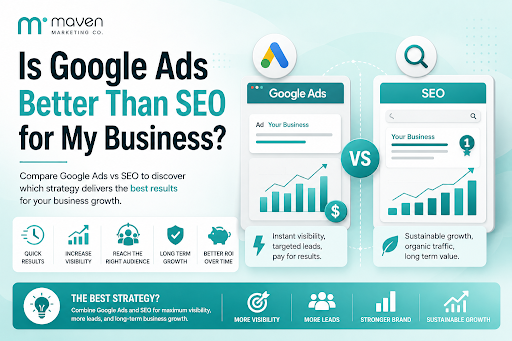
Is Google Ads Better Than SEO for My Business
One of the biggest questions business owners ask when they are planning online growth is whether they should invest in Google Ads or SEO. Both are strong marketing plays that help your company show up in Google search results, but they do things in separate lanes. Google Ads gives quicker visibility and can bring in leads fast, whereas SEO more or less focuses on slow, steady organic traffic that tends to grow the longer you keep building it. Picking the right direction depends on what you want to achieve, how much money you can spend, how crowded the market is, and how quickly you need results, like sooner rather than later. The good news is you don’t always have to choose one or the other; it’s not exactly a black-and-white situation. If you take time to understand the strongest points of both, you can put together a more sensible digital marketing plan that supports consistent expansion. In this guide, we’ll compare Google Ads vs SEO, explain the main differences, and help you figure out what option makes the most sense for your business.

When Should I Hire a Digital Marketing Agency
Growing a business today takes more than just having a website or throwing a post on social media; customers usually search around online, compare providers, skim reviews, and basically expect the brand to show up with a solid digital presence before they even think about buying. Many businesses try to run their marketing themselves, but there comes a point when “doing it all in-house” becomes clunky and hard to manage, all at once. Knowing when to hire a digital marketing agency can end up making a big, real difference for your growth. If you’re not getting enough leads, or your online visibility feels stuck, or sales are just not moving, the right agency can bring the know-how, plus a clear plan, to help you get noticeably better outcomes. In this guide, we’ll dig into what a digital marketing agency actually does, the usual signs it’s time to bring one on, and how picking the right marketing partner can help your business move forward at a faster pace.
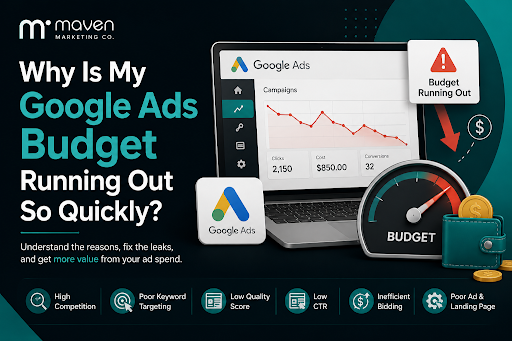
Why Is My Google Ads Budget Running Out So Quickly
Running a successful Google Ads budget isn’t only about throwing more money at it. It’s more like making every dollar, doing a bit extra. A lot of businesses start a Google Ads campaign with big hopes, then find out their daily budget is gone within a few hours, and that feels weird, right? After that, your ads stop showing effectively, new leads slip away, and your return on investment dips. So if your Google Ads budget is running out too fast, don’t stress. It’s a fairly common issue, and in most situations, it can be repaired with the right approach. There are multiple little things that can drain your advertising money quicker than you expected, from costly keywords to audience targeting that just doesn’t quite fit. In this guide, we’ll walk through why your budget disappears so quickly, how to cut wasteful spend, and the most reliable ways to boost your Google Ads ROI, even if your budget stays the same.