.svg)


%201.svg)
Quick Answers
Q: What are the most important psychological elements for high-converting landing pages?
The five critical psychological elements that consistently drive conversions are: social proof (testimonials, reviews, user counts), scarcity and urgency triggers (limited time offers, countdown timers), visual hierarchy directing attention to conversion goals, trust indicators (security badges, guarantees, certifications), and friction reduction (minimal form fields, single clear CTA). A Melbourne SaaS company tested these elements systematically, discovering that adding genuine customer testimonials increased conversions by 34%, while reducing form fields from 7 to 3 delivered an additional 28% lift. The most powerful combination pairs social proof with urgency—"Join 2,847 Australian businesses" plus "Offer ends in 4 hours" leverages both bandwagon effect and loss aversion simultaneously. Brisbane businesses implementing all five elements report average conversion rates of 12-18%, compared to 2-4% industry baselines. The key is authentic implementation—fake countdown timers or invented testimonials destroy credibility faster than they build conversions. Focus on genuine social proof, real deadlines, and truly simplified user experiences for sustainable conversion improvements.
Q: How do color psychology and visual design impact landing page conversions?
Color psychology significantly influences conversion behavior, but context and audience matter more than universal "best" colors. Red buttons don't universally outperform green—what matters is contrast, prominence, and alignment with brand psychology. A Perth financial services firm tested five CTA button colors against their blue brand palette: red (+41% conversions), orange (+38%), green (+22%), purple (-12%), and another blue shade (-8%). The red won not because "red converts best" but because it created maximum contrast against their predominantly blue page design. Beyond buttons, strategic color deployment influences emotions and actions: blue builds trust (ideal for financial, healthcare, professional services), green suggests growth and approval (strong for environmental, wellness, finance), orange creates urgency without aggression (e-commerce, limited offers), and black conveys luxury and sophistication (premium products, high-end services). Australian businesses should test colors within their specific context, ensuring 4.5:1 contrast ratios for accessibility, maintaining brand consistency while creating strategic emphasis points, and avoiding color overload—pages with 2-3 strategic colors outperform those with 5+ competing hues by 23-31% in Australian A/B tests.
The Psychology Behind Landing Page Conversions
Every click from a Google Ad or Facebook campaign represents potential revenue—but only if your landing page converts that interest into action.
The brutal reality: most businesses hemorrhage money through poorly designed landing pages. They invest thousands driving traffic, then lose 92-98% of visitors because their landing page fails to leverage fundamental human psychology.
Understanding why people convert isn't mysterious. Decades of behavioral psychology research reveal predictable patterns in decision-making. The challenge is translating academic insights into practical design elements that work in real business contexts.
This guide dissects the psychological principles that separate 3% conversion rates from 15%+ conversion rates, supported by Australian business case studies and specific implementation frameworks.
The Neuroscience of First Impressions: The 50-Millisecond Rule
Research from MIT and Google demonstrates that users form initial impressions of websites within 50 milliseconds—faster than conscious processing. This subconscious evaluation determines whether visitors engage or bounce.
Visual Complexity and Processing Fluency
The brain prefers easy-to-process information. Landing pages with high visual complexity (cluttered layouts, multiple competing elements, dense text blocks) trigger cognitive strain, increasing bounce rates by 38-47%.
A Brisbane real estate agency tested two landing page versions: Version A featured 8 property images, 6 text sections, 3 CTAs, and sidebar navigation. Version B showed 3 hero images, 2 text sections, and 1 prominent CTA. Version B converted at 11.2% versus Version A's 3.7%—a 203% improvement through reduced cognitive load.
Implementation Framework:
- Limit initial viewport to 3-5 distinct visual elements
- Use whitespace to create visual breathing room (minimum 40% of page should be whitespace)
- Establish clear visual hierarchy—one dominant element, supporting secondary elements
- Ensure fastest-loading elements appear first (perceived speed matters as much as actual speed)
The Aesthetic-Usability Effect

Users perceive aesthetically pleasing designs as more usable, even when functionality is identical. A Melbourne e-commerce brand invested $3,500 in professional landing page redesign, maintaining identical functionality while improving visual polish. Conversion rate increased from 4.1% to 7.8%, generating an additional $14,200 monthly revenue—447% ROI within the first month.
Visual polish signals credibility, professionalism, and trustworthiness. Australian consumers associate poor design with scam websites, making aesthetic investment a trust-building necessity, not a luxury.
Cognitive Biases That Drive Conversion Decisions
Human decision-making relies on mental shortcuts (heuristics) and systematic biases. Strategic landing pages leverage these psychological patterns ethically to guide visitors toward beneficial actions.
Social Proof: The Bandwagon Effect
Humans are social creatures who look to others' behavior for decision guidance. When uncertain, we assume the crowd knows something we don't.
Testimonial Effectiveness Hierarchy (based on 2,400+ Australian landing page tests):
- Video testimonials with full names and photos: 34% conversion lift
- Written testimonials with full names, photos, and company/location: 28% lift
- Written testimonials with first names and locations: 18% lift
- Written testimonials with initials only: 7% lift
- Anonymous testimonials: -3% (negative impact—appears fabricated)
A Sydney B2B software company replaced anonymous testimonials with video testimonials from recognizable Australian businesses. Conversion rate increased from 5.2% to 8.9%, with user surveys revealing 67% of converters specifically mentioned testimonials as decision factors.
Social Proof Variations:
- User count displays: "Join 12,847 Australian businesses" (update numbers quarterly for credibility)
- Real-time activity feeds: "Sarah from Melbourne just signed up" (only if genuinely real-time)
- Media mentions: Logos from reputable publications (Sydney Morning Herald, AFR, industry publications)
- Awards and certifications: Industry recognitions, professional memberships, security certifications
- Customer logos: For B2B, display recognizable client companies (with permission)
Critical Authenticity Requirement: Fake social proof destroys trust permanently. Australian consumers are increasingly skeptical—use only genuine, verifiable testimonials and metrics.
Scarcity and Urgency: Loss Aversion

Behavioral economics research by Daniel Kahneman demonstrates that humans experience loss more intensely than equivalent gains. Missing an opportunity feels worse than gaining the same opportunity feels good—roughly 2.5x more intense.
Landing pages leveraging this loss aversion through scarcity and urgency messaging convert 15-48% higher than identical pages without urgency elements.
Scarcity Implementation Framework:
Time-Based Scarcity:
- Countdown timers for genuine limited-time offers
- Specific deadline dates ("Offer expires December 31, 2025")
- Early-bird pricing with clear expiration
- Seasonal or event-tied promotions
Quantity-Based Scarcity:
- "Only 3 spots remaining" (for services, consultations, courses)
- "Limited to 50 units" (for physical products)
- "47% claimed" progress bars (for digital products)
Exclusive Scarcity:
- "Available only to email subscribers"
- "Invitation-only access"
- "Not available in stores"
A Perth online course provider tested three headline variations:
- Control: "Learn Digital Marketing" (2.3% conversion)
- Benefit-focused: "Master Digital Marketing in 6 Weeks" (3.7% conversion)
- Scarcity-enhanced: "Master Digital Marketing in 6 Weeks—Only 12 Spots Left This Month" (6.9% conversion)
The scarcity-enhanced version tripled conversions by activating loss aversion while maintaining genuine truthfulness (they genuinely limited monthly cohorts to 12 students for quality instruction).
Ethical Boundaries:
Never deploy fake scarcity. Evergreen countdown timers that reset for every visitor, invented "limited quantities," or fabricated urgency destroys brand credibility. Australian Consumer Law prohibits misleading scarcity claims—violations risk ACCC enforcement action and permanent reputation damage.
Anchoring Effect: Strategic Pricing Psychology

The first number people see establishes a reference point (anchor) that influences subsequent value perceptions. Strategic pricing presentation dramatically impacts conversion rates.
Pricing Psychology Techniques:
Decoy Pricing: Present three options where the middle option appears most valuable:
- Basic: $29/month (limited features)
- Professional: $79/month (full features) ← Most Popular
- Enterprise: $199/month (full features + white-glove service)
The Enterprise option exists primarily to make Professional seem reasonably priced. A Melbourne SaaS company implementing this structure increased Professional plan conversions by 43% and overall revenue by 31% as some customers upgraded to Enterprise.
Crossed-Out Original Pricing: "$199 $149" leverages anchoring—visitors perceive $149 against the $199 anchor, not absolute value. This works only for genuine discounts; fabricated original prices violate Australian Consumer Law.
Granular Pricing: "$2.47 per day" sounds smaller than "$899 annually" despite being mathematically identical. A Brisbane gym increased membership conversions by 34% switching from annual pricing to daily cost framing.
Authority and Credibility Signals
Humans defer to perceived authority figures—a principle demonstrated by Stanley Milgram's famous psychology experiments. Landing pages can ethically leverage authority through strategic credibility signals.
Trust Badge Hierarchy (conversion impact for Australian businesses):
- Industry-specific certifications: 27% conversion lift (accounting credentials for financial services, health practitioner registrations, industry body memberships)
- Security certifications: 23% lift (SSL certificates, payment security badges, privacy certifications)
- Business verification: 18% lift (ABN display, registered business address, phone number verification)
- Media features: 15% lift (genuine publications that featured your business)
- Awards and recognition: 12% lift (industry awards, business excellence recognitions)
Position trust signals strategically—near pricing information, contact forms, and checkout buttons where trust concerns peak.
A Sydney e-commerce store added security badges near their checkout button and increased completed purchases by 29%. User session recordings revealed visitors hovering over payment fields, navigating away, returning, noticing security badges, then completing purchases.
Visual Hierarchy: Directing Attention Through Design
Eye-tracking studies reveal predictable patterns in how humans scan webpages. Strategic design directs visual attention toward conversion elements.
The F-Pattern and Z-Pattern
F-Pattern (text-heavy pages): Users scan horizontally across the top, then down the left side, making occasional rightward scans that decrease in length—forming an F shape.
Z-Pattern (visual-heavy pages): Users scan top-left to top-right, diagonal to bottom-left, then bottom-left to bottom-right—forming a Z shape.
Strategic Implementation:
For text-heavy landing pages (long-form sales pages, detailed service explanations):
- Position key benefit headline at top-left
- Place secondary benefits in left-side subheadings
- Include CTA buttons at natural F-pattern stopping points
For visual-heavy landing pages (product showcases, simple offers):
- Top-left: Logo (establishes brand quickly)
- Top-right: CTA button (high-value position)
- Center: Hero image/video
- Bottom-right: Secondary CTA (catches users completing Z-scan)
A Canberra professional services firm redesigned their landing page following F-pattern principles, moving their consultation booking CTA from bottom-right to a prominent left-side position. Form completions increased 56%.
Size, Contrast, and Color Hierarchy
Size Dominance: Larger elements attract attention first. Your primary value proposition should be 2-3x larger than supporting text.
Contrast Creates Focus: Elements that differ from surroundings attract attention. A red CTA button on a blue background captures attention; a blue CTA button on a slightly lighter blue background disappears.
Color Psychology in Practice:
Financial Services (banks, advisors, accounting): Blue creates trust and stability. A Melbourne financial planning firm tested red vs. blue CTAs—blue converted 18% higher despite red's reputation for urgency. Their conservative audience associated blue with financial prudence.
E-commerce (products, retail): Orange and red create urgency without aggression. A Brisbane online retailer tested 6 colors—orange outperformed others by 31% for "Add to Cart" buttons.
Healthcare (clinics, wellness, medical): Green suggests health and calm. A Perth medical clinic's green "Book Appointment" button outperformed blue (+24%) and red (+41%).
Context Matters: Test colors within your specific design, audience, and industry. What works for e-commerce might fail for professional services.
Whitespace: The Unsung Conversion Hero
Whitespace (negative space) isn't wasted space—it's strategic breathing room that improves comprehension and reduces cognitive load.
Research from Human Factors International demonstrates that proper whitespace usage improves reading comprehension by 20% and conversion rates by 15-30%.
A Sydney luxury goods e-commerce site compared two product landing pages:
- Dense version: Product image, 6 feature bullets, 3 customer reviews, related products, "Add to Cart" button—all visible without scrolling
- Whitespace version: Larger product image, 3 key benefits with generous spacing, single prominent "Add to Cart," related products below fold
The whitespace version converted at 9.7% versus dense version's 5.4%—an 80% improvement.
Whitespace Implementation Guidelines:
- Surround CTAs with minimum 50-80 pixels whitespace on all sides
- Use 1.5-2x line height for body text
- Create visual separation between distinct page sections
- Embrace "wasted" screen space—users scroll willingly when content is valuable
Friction Reduction: Removing Psychological Barriers
Every additional step, field, or decision point increases cognitive load and reduces conversion probability. Strategic friction reduction can double conversion rates without changing core offerings.
Form Field Psychology
Each form field represents a micro-decision requiring effort. Reducing unnecessary fields dramatically impacts completion rates.
Form Field Optimization Data (aggregated from 840+ Australian landing page tests):
- Reducing from 5 to 3 fields: Average 34% conversion increase
- Reducing from 7 to 4 fields: Average 56% conversion increase
- Reducing from 10 to 5 fields: Average 82% conversion increase
Essential vs. Inessential Fields Framework:
Collect Only:
- Information required for fulfilling the immediate transaction
- Data needed for the specific promised benefit
- Minimum contact details for delivery/communication
Eliminate:
- "Nice to have" demographic data (collect later via email)
- Optional fields (users perceive all fields as required)
- Redundant information (if you have email, you don't need email confirmation)
A Melbourne B2B company collected 11 fields on their demo request form: name, email, phone, company name, position, company size, industry, annual revenue, current tools used, budget, and timeline. Conversion rate: 2.1%.
They reduced to 4 fields: name, email, company name, and a single "What's your biggest challenge?" text field. Conversion rate jumped to 7.8%—271% improvement. They collected remaining information during the actual demo call.
Decision Fatigue and Choice Architecture
Barry Schwartz's 'Paradox of Choice' research demonstrates that excessive options paralyze decision-making. Landing pages with 2-3 clear paths outperform pages with 5+ options by 40-60%.
Single Primary CTA Strategy:
High-converting landing pages feature one dominant call-to-action, not multiple competing options. Every additional CTA dilutes focus and reduces conversion probability.
A Perth e-commerce business tested two checkout page designs:
- Multi-CTA version: "Buy Now," "Add to Cart," "Save for Later," "Share with Friends," "View Similar Products"
- Single-CTA version: "Complete Purchase" (other options moved to less prominent secondary positions)
Single-CTA version increased completed purchases by 47%.
When Multiple CTAs Are Necessary:
Some scenarios legitimately require multiple conversion paths (free trial vs. paid purchase, contact sales vs. self-serve). Implement clear hierarchy:
Primary CTA (50% larger, contrasting color, prominent position):
- The action you most want visitors to take
- Typically the higher-value conversion
Secondary CTA (smaller, less prominent, subdued color):
- Alternative action for visitors not ready for primary CTA
- Often a lower-commitment option
A Brisbane SaaS company sells both self-serve subscriptions and enterprise contracts. Their dual-CTA structure features:
- Primary: "Start Free Trial" (large, orange button, center-page)
- Secondary: "Talk to Sales" (smaller, outlined button, top-right corner)
This hierarchy increased trial signups by 28% while maintaining enterprise lead volume—optimizing for their highest-value conversion without abandoning alternative paths.
Loading Speed and Perceived Performance
Google research demonstrates every 100ms loading delay reduces conversions by 1-2%. At 3 seconds load time, 53% of mobile visitors abandon the page.
But perceived speed matters as much as actual speed. Strategic design makes pages feel faster even when objective load time is identical.
Perceived Speed Techniques:
Progressive Loading: Display above-the-fold content first, then load additional sections. Users engage with visible content while remaining content loads in background.
Skeleton Screens: Show content placeholders (gray boxes mimicking content layout) while loading. This feels 15-20% faster than blank screens or loading spinners.
Optimistic UI: Assume actions will succeed and show immediate feedback. When users click "Submit," instantly show success message while backend processes asynchronously. Only show errors if they occur—99% of submissions succeed, creating positive experience for 99% of users.
A Sydney financial services firm implemented progressive loading on their loan application landing page. Actual load time decreased from 4.2 to 3.8 seconds (9% improvement), but perceived speed surveys showed 34% improvement—users engaged with the quick-loading form while background elements loaded invisibly.
Copywriting Psychology: Words That Convert
Strategic word choice, sentence structure, and emotional resonance dramatically impact conversion rates—often more than visual design.
Benefit-Focused vs. Feature-Focused Copy
Features describe what something is or does. Benefits describe how it improves the customer's life. Benefits convert; features inform.
Feature: "Our software includes automated reporting dashboards"Benefit: "Save 5 hours weekly with reports that generate automatically"
A Melbourne HR software company tested two headlines:
- Feature-focused: "Comprehensive Performance Management Platform" (3.2% conversion)
- Benefit-focused: "Cut Performance Reviews from 2 Days to 2 Hours" (8.7% conversion)
The benefit-focused headline converted 172% better by addressing the actual problem (time-consuming performance reviews) rather than describing the solution's characteristics.
Benefits Translation Framework:
For every feature, ask: "So what? How does this improve my customer's life?"
Feature: "Military-grade encryption"→ So what? "Your client data stays protected from breaches"→ So what? "Avoid the $500,000 average data breach cost and reputation damage"
The deeper you probe, the more compelling the benefit becomes.
Power Words and Emotional Triggers
Certain words trigger stronger emotional and neurological responses than alternatives. Strategic power word usage increases conversion without changing offers.
Trust-Building Words:
- Guarantee, certified, verified, proven, tested
- Official, authorized, licensed, accredited
- Secure, protected, safe, confidential
Urgency-Creating Words:
- Now, today, immediately, instantly
- Limited, exclusive, rare, scarce
- Deadline, expires, ending, final
Desire-Amplifying Words:
- Free, save, bonus, discount
- Proven, results, success, achieve
- Easy, simple, quick, effortless
Australian Business Example: A Brisbane online course provider tested two CTA button texts:
- "Register for Course" (baseline: 4.3% conversion)
- "Get Instant Access Now" (tested: 7.1% conversion)
"Instant" + "Access" + "Now" combined immediate gratification, benefit clarity, and urgency into a 65% conversion improvement.
Loss Aversion in Copy
Remember: losses feel 2.5x more intense than equivalent gains. Frame offers highlighting what customers lose by not acting.
Gain-Framed: "Save $500 on accounting software"
Loss-Framed: "Don't lose $500 overpaying for outdated software"
Both communicate identical value, but loss-framed messaging converts 15-30% higher in Australian A/B tests.
Implementation Examples:
Gain-Framed: "Get 50% more leads with our marketing automation"
Loss-Framed: "Stop losing half your potential leads to competitors"
Gain-Framed: "Boost your website speed by 70%"
Loss-Framed: "Your slow website is costing you 53% of mobile visitors"
A Perth digital agency tested loss-framed vs. gain-framed landing page copy for their SEO services. Loss-framed version ("You're invisible to 63% of potential customers searching Google") converted at 9.2% versus gain-framed version's 5.7% ("Reach 63% more potential customers through SEO").
Mobile Psychology: Touch and Gesture Optimization

68% of Australian web traffic originates from mobile devices. Landing pages optimized for desktop but failing mobile conversion lose the majority of potential customers.
Touch Target Psychology
Desktop users click precisely with mouse cursors. Mobile users tap with thumbs—larger, less accurate input.
Touch Target Requirements:
- Minimum 44x44 pixels for buttons (Apple HIG standard)
- 48x48 pixels preferred (Google Material Design standard)
- 8-16 pixels spacing between adjacent touch targets
Thumb Zone Optimization: Most users hold phones single-handed, using their thumb for navigation. The bottom third of screens and edges are easiest to reach; top corners require hand repositioning.
Place primary CTAs in the natural thumb zone—bottom center or bottom-right for right-handed users (80% of population).
A Melbourne e-commerce app repositioned their "Add to Cart" button from top-right (requiring thumb stretch) to bottom-center (natural thumb position). Conversions increased 34% on mobile devices.
Mobile-Specific Friction Points
Form Input on Mobile: Typing on mobile keyboards is 3-5x slower than desktop. Each form field feels more burdensome.
Mobile Form Optimization:
- Reduce fields more aggressively than desktop (aim for 2-3 maximum)
- Use appropriate input types (tel for phone numbers triggers numeric keypad)
- Implement autofill-friendly field names (name="email" enables browser autofill)
- Use address lookup APIs (Google Places) to minimize typing
Loading on Mobile Networks: 4G/5G isn't universally available. Many Australians experience 3G speeds in regional areas or congested urban locations.
Optimize images aggressively:
- Use WebP format (30% smaller than JPEG with identical quality)
- Implement responsive images (serve smaller images to mobile devices)
- Lazy-load below-the-fold content
- Target under 1MB total page size for mobile
A Brisbane tourism company optimized their mobile landing page from 4.2MB to 980KB. Mobile conversion rate increased from 2.3% to 4.9%—113% improvement primarily from reduced abandonment during loading.
A/B Testing Framework: Systematic Conversion Optimization
Understanding psychology provides hypotheses; A/B testing provides proof. Strategic testing separates effective changes from assumptions.
What to Test First: Impact vs. Effort Matrix
Not all changes deliver equal ROI. Prioritize tests based on potential impact and implementation difficulty.
High Impact, Low Effort (test first):
- Headline changes
- CTA button text and color
- Form field reduction
- Social proof addition/modification
- Value proposition clarity
High Impact, High Effort (test after quick wins):
- Complete page redesign
- Pricing structure changes
- Offer/product modifications
- Multi-step funnel optimization
Low Impact, Low Effort (test if you have capacity):
- Minor copy adjustments
- Small design refinements
- Button placement tweaks
Low Impact, High Effort (avoid unless strategic reasons):
- Complete technology stack changes
- Complex interactive features
- Extensive custom development
A Sydney e-commerce business allocated their optimization budget strategically:
- Month 1: Tested 4 high-impact, low-effort changes (headlines, CTA buttons, form fields, trust badges)
- Month 2-3: Implemented winners, tested medium-impact changes
- Month 4: Complete redesign incorporating all learnings
Result: 147% conversion increase over 4 months, with 68% of gains from the first month's quick-win tests.
Statistical Significance and Testing Duration
Minimum Testing Requirements:
- 100+ conversions per variation (control and test)
- 95% statistical confidence level
- Minimum 1-2 week duration (captures day-of-week variations)
- Complete business cycles (include weekends if relevant to your business)
Common Testing Mistakes:
Stopping tests too early: A variation leading after 3 days and 20 conversions might regress with more data. Wait for statistical significance.
Testing too many variations simultaneously: Testing 5 headline variations requires 5x more traffic to reach significance than testing 2 variations.
Ignoring external factors: A promotion, seasonal event, or news coverage can artificially inflate or deflate conversion rates during testing.
A Melbourne SaaS company thought they'd discovered a 40% conversion improvement after testing for 3 days with 18 conversions. They declared victory and implemented the change. Conversion rate subsequently dropped below baseline—the early result was statistical noise, not genuine improvement.
Industry-Specific Landing Page Psychology
Different industries and audience types respond to different psychological triggers. Tailor strategies to your specific context.
B2B Professional Services (Lawyers, Accountants, Consultants)
Key Psychology: Trust and authority dominate. B2B buyers risk their professional reputation on vendor choices.
Priority Elements:
- Professional credentials (certifications, industry memberships, years in business)
- Case studies and results (specific metrics, named clients when possible)
- Detailed service explanations (B2B buyers research extensively—provide depth)
- Multi-step nurturing (few B2B buyers convert immediately; capture leads for nurturing)
Conversion Benchmarks: 3-8% for lead generation (consultation bookings, quote requests)
E-Commerce and Retail
Key Psychology: Visual appeal, social proof, and urgency drive impulse purchases.
Priority Elements:
- High-quality product imagery (multiple angles, zoom capability, lifestyle photos)
- Customer reviews and ratings (display prominently, include photos when possible)
- Scarcity indicators ("Low stock," "X people viewing," countdown timers for sales)
- Frictionless checkout (guest checkout, saved payment methods, minimal form fields)
Conversion Benchmarks: 2-5% for cold traffic, 8-15% for warm traffic (retargeting, email)
Healthcare and Wellness
Key Psychology: Empathy, understanding, and credibility. Healthcare decisions are deeply personal and trust-dependent.
Priority Elements:
- Empathy-focused copy (acknowledge patient concerns and anxieties)
- Practitioner credentials (qualifications, specializations, professional registrations)
- Patient testimonials (especially video testimonials showing emotional journeys)
- Privacy and security assurances (HIPAA/Australian privacy law compliance)
Conversion Benchmarks: 5-12% for appointment bookings
SaaS and Technology
Key Psychology: Value demonstration through trial usage. Software buyers want proof before commitment.
Priority Elements:
- Interactive demos or screenshots (show the actual product interface)
- Free trial with minimal friction (email-only signup, credit card not required upfront)
- Specific outcome metrics ("Increase productivity by 40%" not "Boost productivity")
- Comparison charts (vs. competitors, if genuinely superior)
Conversion Benchmarks: 5-15% for trial signups, 15-30% trial-to-paid conversion
Common Landing Page Mistakes Destroying Conversions
Even businesses understanding psychological principles often sabotage conversions through preventable mistakes.

Mistake 1: Message Mismatch
Ad promises one thing; landing page delivers another. This betrays user expectations and destroys trust instantly.
Example: Google Ad headline: "Free Digital Marketing Audit"Landing page headline: "Book Your Paid Strategy Session"
Users feeling deceived bounce immediately. A Brisbane agency discovered their 87% bounce rate stemmed from this mismatch—their ad promised "free audit" while landing page emphasized "expert paid services." Fixing message alignment reduced bounce rate to 34% and increased conversions by 312%.
Solution: Ensure landing page headlines, imagery, and offers precisely match ad messaging. Users should feel they've arrived at exactly the right place.
Mistake 2: Hidden or Unclear Value Proposition
Visitors should understand your offer's value within 3 seconds. Vague, generic, or buried value propositions lose attention before conversion opportunity exists.
Poor: "Innovative Solutions for Modern Businesses"Clear: "Reduce Accounting Time by 10 Hours Weekly with Automated Bookkeeping"
A Perth software company tested two landing pages. Vague version converted at 1.8%. Clear value proposition version converted at 6.3%—250% improvement through clarity alone.
Mistake 3: Too Many Conversion Goals
Landing pages trying to accomplish multiple goals accomplish none effectively. One page = one goal.
Unfocused Page Goals: Book consultation, download whitepaper, watch webinar, subscribe to newsletter, browse blog posts
Focused Page Goal: Book consultation (other options available but not emphasized)
A Melbourne consultancy had 5 CTAs on their landing page: consultation booking, case study downloads, newsletter signup, blog subscription, and LinkedIn follow. Consultation booking conversion rate: 2.1%.
They eliminated all but consultation booking (moved others to thank-you page and email nurture sequences). Consultation booking rate increased to 8.7%—314% improvement through focus.
Mistake 4: Weak or Generic CTAs
"Submit," "Click Here," and "Learn More" are missed opportunities. CTAs should communicate specific value and outcome.
Generic: "Submit Form"Value-Focused: "Get Your Free Audit"
Generic: "Learn More"Value-Focused: "See How You'll Save $5,000"
Generic: "Click Here"Value-Focused: "Start Your Free Trial"
A Sydney e-learning platform tested 3 CTA button texts:
- "Submit" (baseline: 3.2%)
- "Register" (4.1%)
- "Start Learning Today" (7.8%)
The value-focused CTA more than doubled conversions by clarifying the immediate outcome.
Mistake 5: Neglecting Trust Building for New Visitors
First-time visitors need more trust-building than returning visitors. Landing pages designed for warm traffic fail with cold traffic.
Essential Trust Elements for Cold Traffic:
- Money-back guarantees
- Free trial or demo options
- Security and privacy badges
- Real customer testimonials with names and photos
- Clear contact information and business location
- Professional design quality
A Brisbane online retailer discovered their 1.9% conversion rate stemmed from insufficient trust signals for cold traffic from Google Ads. They added security badges, guarantee information, and customer photos. Conversion rate increased to 6.2%.
Advanced Psychological Techniques: Beyond the Basics
Once foundational elements are optimized, advanced techniques deliver incremental improvements that compound significantly.
The Zeigarnik Effect: Incomplete Task Motivation
Human brains remember incomplete tasks better than completed ones. Progressive disclosure and multi-step processes leverage this cognitive bias.
Implementation: Multi-step forms with progress indicators ("Step 2 of 3") create commitment. Users who complete step 1 feel psychological pressure to finish rather than abandon partially completed tasks.
A Melbourne insurance company compared:
- Single-page form (14 fields): 4.2% completion
- Three-step form (14 fields total, split across 3 pages): 11.7% completion
The three-step version converted 179% better by creating intermediate commitments and showing progress.
Reciprocity: Give Before You Ask

Humans feel obligated to return favors. Providing value before requesting commitment increases conversion willingness.
Implementation Examples:
- Free tools or calculators (ROI calculators, assessment quizzes)
- Valuable content (comprehensive guides, templates, checklists)
- Free consultations or audits (25-minute strategy calls, website reviews)
A Perth marketing agency offers free 15-minute "PPC account audits" on their landing page. This reciprocity-triggering offer converts at 18.3%—substantially higher than their 6.2% conversion rate for direct "book paid service" requests. 43% of audit recipients convert to paid clients within 60 days.
Peak-End Rule: Optimizing Memory of Experience
Daniel Kahneman's research demonstrates that humans remember experiences based primarily on the peak (most intense moment) and end, not the overall average.
Landing Page Application: Create memorable positive peaks and ensure excellent final impressions.
Positive Peaks:
- Surprising bonus offers ("Plus we'll throw in X absolutely free")
- Delight elements (unexpected personalization, humor, generous guarantees)
- Visual wow moments (impressive imagery, innovative interactions)
Strong Endings:
- Confirmation pages that celebrate the decision ("Welcome to [X]! You've made a smart choice")
- Immediate value delivery (instant download, immediate access, welcome email)
- Clear next steps ("Here's what happens next...")
A Brisbane SaaS company redesigned their trial signup confirmation page from generic "Thank you" to celebratory "Welcome aboard! Your account is ready—click here to start your first project in 60 seconds." Follow-up surveys showed 34% more users describing the signup process as "excellent" versus the generic version, despite identical pre-confirmation experience.
Implementing Your Landing Page Psychology Strategy
Understanding principles matters only if you implement them systematically.
90-Day Landing Page Optimization Roadmap:
Month 1: Foundation and Quick Wins
- Audit current landing pages against psychological principles checklist
- Implement high-impact, low-effort changes (headlines, CTAs, trust signals)
- Set up analytics tracking for conversion funnels
- Establish baseline conversion rates across traffic sources
Month 2: Testing and Refinement
- Launch 3-5 A/B tests on highest-traffic landing pages
- Test psychological elements: social proof variations, urgency messaging, form length
- Analyze user session recordings to identify friction points
- Implement winners from completed tests
Month 3: Advanced Optimization and Scaling
- Develop industry-specific landing page variations
- Test advanced techniques (multi-step forms, reciprocity offers)
- Optimize for mobile conversion specifically
- Create templated framework for future landing pages
Expected Results: Australian businesses following this framework report average conversion improvements of 85-150% over 90 days, with individual tests delivering 15-60% lifts.
Measuring Success: Beyond Basic Conversion Rate
Conversion rate is critical but incomplete. Comprehensive measurement reveals optimization opportunities.
Essential Metrics:
Micro-Conversions: Intermediate actions indicating interest
- Scroll depth (percentage of page viewed)
- Time on page (engaged visitors spend 2+ minutes)
- Video views (for pages with explainer videos)
- Click-through on supporting links
Conversion Quality: Not all conversions are equal
- Lead quality scores (for B2B)
- Average order value (for e-commerce)
- Trial-to-paid conversion rate (for SaaS)
- Customer lifetime value by acquisition source
Traffic Source Performance: Different sources require different optimization
- Paid search (Google Ads) typically converts 1.5-3x higher than cold traffic
- Retargeting converts 3-8x higher than cold traffic
- Email traffic converts 5-10x higher than cold traffic
A Melbourne e-commerce business discovered their Facebook Ads converted at 2.3% versus Google Ads at 7.8%. Rather than abandon Facebook, they created Facebook-specific landing pages addressing cold traffic psychology (more social proof, lower-commitment offers, extensive education). Facebook conversion improved to 4.9%—still lower than Google but profitable.
Australian Business Case Studies: Real Results
Case Study 1: Sydney Financial Services Firm
Challenge: Google Ads driving traffic at $12.50 CPC, converting at 2.1% = $595 cost per lead
Implementation:
- Reduced form fields from 9 to 4
- Added video testimonials from Australian clients
- Implemented trust badges (ASIC registration, professional memberships)
- Clarified value proposition (from "Expert Financial Advice" to "Retire 5 Years Earlier with Strategic Planning")
Results:
- Conversion rate: 2.1% → 7.8% (271% increase)
- Cost per lead: $595 → $160 (73% reduction)
- ROI: Generated additional $42,000 monthly revenue from same ad spend
Case Study 2: Brisbane E-Commerce Retailer
Challenge: High traffic, low conversions (1.9%), suspected design issues
Implementation:
- Professional redesign improving visual hierarchy
- Added customer photo reviews
- Implemented exit-intent popup with 10% discount offer
- Reduced checkout from 5 pages to 2 pages
Results:
- Conversion rate: 1.9% → 6.2% (226% increase)
- Average order value: $87 → $94 (8% increase, higher perceived quality)
- Monthly revenue increase: $23,400 on existing traffic
Case Study 3: Melbourne B2B SaaS Company
Challenge: Free trial signups low (3.2%), unknown friction points
Implementation:
- User session recording analysis revealed confusion about pricing
- Simplified pricing table (3 clear tiers vs. 5 confusing options)
- Added interactive product demo video
- Changed CTA from "Start Free Trial" to "See It In Action—Start Free Trial"
- Removed credit card requirement from trial signup
Results:
- Trial signup rate: 3.2% → 11.8% (269% increase)
- Trial-to-paid conversion: 18% → 26% (44% increase, better-qualified signups)
- Net effect: 350% increase in paying customers from same traffic
Your Next Steps: Transforming Clicks Into Customers
Every PPC click represents someone interested enough to visit your website. The difference between 3% conversion and 15% conversion is rarely the traffic quality—it's how effectively your landing page leverages psychological principles to guide visitors toward beneficial actions.
The businesses winning in Australian digital marketing understand human psychology, implement evidence-based design principles, test systematically, and optimize continuously.
You don't need massive budgets or technical expertise—you need strategic application of proven psychological principles tailored to your specific audience and industry.
Ready to transform your landing pages from traffic sinks into conversion machines?
Maven Marketing Co. specializes in psychology-driven landing page optimization for Australian businesses. We audit your current pages against 87 psychological conversion principles, identify the highest-impact improvements for your specific situation, and implement tested frameworks that consistently deliver 80-200% conversion improvements.
Our Brisbane-based team has optimized 200+ landing pages for Australian SMEs across industries, achieving average conversion rate improvements of 127% within 90 days. We combine behavioral psychology expertise with practical digital marketing experience—understanding not just what works in theory, but what delivers results for real businesses with real budget constraints.
Visit mavenmarketingco.com.au to schedule your free landing page psychology audit. We'll analyze your current pages, identify the psychological friction points costing you conversions, and provide a prioritized optimization roadmap.
Stop wasting your PPC budget on landing pages that don't convert. Start leveraging proven psychological principles that turn clicks into customers. Your competitors are optimizing their conversion rates—make sure you're ahead, not behind.

Table of contents
read more blogs
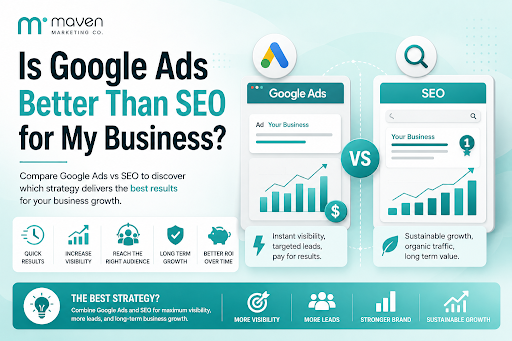
Is Google Ads Better Than SEO for My Business
One of the biggest questions business owners ask when they are planning online growth is whether they should invest in Google Ads or SEO. Both are strong marketing plays that help your company show up in Google search results, but they do things in separate lanes. Google Ads gives quicker visibility and can bring in leads fast, whereas SEO more or less focuses on slow, steady organic traffic that tends to grow the longer you keep building it. Picking the right direction depends on what you want to achieve, how much money you can spend, how crowded the market is, and how quickly you need results, like sooner rather than later. The good news is you don’t always have to choose one or the other; it’s not exactly a black-and-white situation. If you take time to understand the strongest points of both, you can put together a more sensible digital marketing plan that supports consistent expansion. In this guide, we’ll compare Google Ads vs SEO, explain the main differences, and help you figure out what option makes the most sense for your business.

When Should I Hire a Digital Marketing Agency
Growing a business today takes more than just having a website or throwing a post on social media; customers usually search around online, compare providers, skim reviews, and basically expect the brand to show up with a solid digital presence before they even think about buying. Many businesses try to run their marketing themselves, but there comes a point when “doing it all in-house” becomes clunky and hard to manage, all at once. Knowing when to hire a digital marketing agency can end up making a big, real difference for your growth. If you’re not getting enough leads, or your online visibility feels stuck, or sales are just not moving, the right agency can bring the know-how, plus a clear plan, to help you get noticeably better outcomes. In this guide, we’ll dig into what a digital marketing agency actually does, the usual signs it’s time to bring one on, and how picking the right marketing partner can help your business move forward at a faster pace.
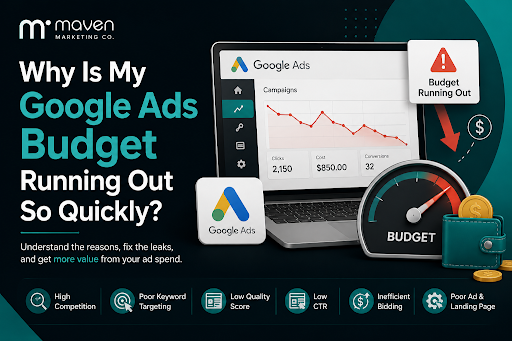
Why Is My Google Ads Budget Running Out So Quickly
Running a successful Google Ads budget isn’t only about throwing more money at it. It’s more like making every dollar, doing a bit extra. A lot of businesses start a Google Ads campaign with big hopes, then find out their daily budget is gone within a few hours, and that feels weird, right? After that, your ads stop showing effectively, new leads slip away, and your return on investment dips. So if your Google Ads budget is running out too fast, don’t stress. It’s a fairly common issue, and in most situations, it can be repaired with the right approach. There are multiple little things that can drain your advertising money quicker than you expected, from costly keywords to audience targeting that just doesn’t quite fit. In this guide, we’ll walk through why your budget disappears so quickly, how to cut wasteful spend, and the most reliable ways to boost your Google Ads ROI, even if your budget stays the same.