.svg)


%201.svg)

Key Takeaways
- Search volume is a measure of query frequency, not commercial value. Keywords with high volume in a category frequently attract audiences at an early research stage whose conversion probability is significantly lower than those searching with specific, queries with purchase orientation.
- Intent classification divides keywords into four categories: informational, navigational, commercial investigation, and transactional. The commercial value of a keyword is substantially determined by which category it belongs to and whether that category aligns with the content and conversion infrastructure available on the site.
- Australian market specificity is a dimension of keyword research that generic keyword tools underserve. A keyword's relevance to the Australian market includes its geographic modifiers, its seasonal calendar alignment with Australian conditions, and its sensitivity to Australian regulatory, pricing, and cultural context.
- Keyword difficulty metrics from tools such as Ahrefs, Semrush, and Moz reflect the authority of the pages currently ranking, not the achievability of ranking for a new page. Assessing feasibility requires reviewing the actual ranking content, not just the domain authority scores.
- The long tail of keyword research, the large number of queries that are more specific and lower in volume that each individually address a narrow intent, collectively represents a larger share of total search volume in most industries than the small number of head terms with high volume, and converts at a substantially higher rate.
- People Also Ask data, related searches, and Google Suggest completions reveal the specific questions and vocabulary the target audience actually uses, which often differs meaningfully from the vocabulary the business uses internally to describe its products and services.
- Keyword research should be treated as an ongoing programme rather than a single exercise. New query patterns emerge, competitor rankings shift, and seasonal opportunities recur, requiring periodic review and refreshing of the keyword set.
Why Search Volume Alone Misleads
The appeal of search volume as a primary keyword selection criterion is understandable. It is a specific, measurable number that appears in every keyword research tool and that seems to represent commercial opportunity in a direct way. A keyword with 10,000 monthly searches looks like it represents more opportunity than one with 500 monthly searches, and for a business accustomed to thinking about audience reach this framing feels intuitive.
The problem is that search volume measures how often a query is entered into a search engine. It does not measure why. Two keywords in the same product category with similar monthly search volumes can have dramatically different commercial profiles. "How to fix a leaking tap" and "plumber Brisbane" both generate traffic for a plumbing business targeting Brisbane, but the first attracts people who want to solve the problem themselves and the second attracts people who want to hire someone to solve it. A plumbing business that prioritises "how to fix a leaking tap" because it has higher volume than "plumber Brisbane" is optimising for traffic that has no commercial intent with the business.
This distinction becomes more consequential as the keyword research process scales. Australian marketing teams that select keywords primarily on the basis of volume end up with content calendars full of informational articles that attract significant traffic and generate minimal revenue, while the specific, queries with strong commercial intent that their actual customers use to find businesses like theirs receive little attention because their search volumes look unimpressive in a spreadsheet.
The correction is to build keyword evaluation frameworks that assign commercial weight to the intent and specificity of each keyword rather than treating search volume as a proxy for value.
Intent Classification: The Foundation of Keyword Strategy
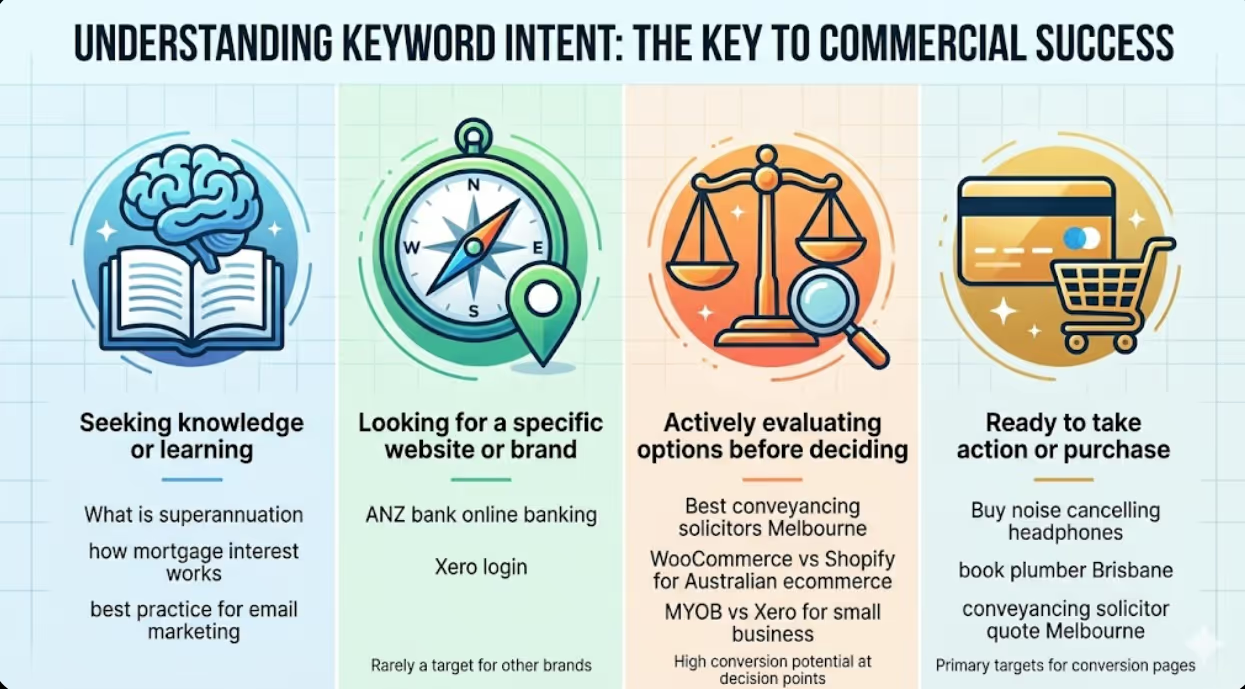
Intent classification is the most important analytical step in keyword research and the one that search volume does not capture. Classifying each keyword by the intent it represents allows the keyword set to be aligned with the content and conversion infrastructure available on the site, and prevents the misallocation of effort toward keywords that cannot convert the audience they attract.
Informational intent keywords represent queries from people seeking to learn something. "What is superannuation," "how does mortgage interest work," and "best practices for email marketing" are informational queries. The searcher behind them is in a learning mode. They may be the business's eventual customer, but they are not in an active evaluation or purchase mode at the time of the query. Content targeting informational keywords builds topical authority and establishes the brand as a credible resource, but it should not be evaluated against the same commercial return expectations as content targeting transactional queries.
Navigational intent keywords represent queries from people looking for a specific website or brand. "ANZ bank online banking" and "Xero login" are navigational queries. They are rarely the appropriate target for SEO content from businesses other than the brand being navigated to, because the searcher already knows where they want to go.
Commercial investigation intent keywords represent queries from people who are actively evaluating options before making a decision. "Best conveyancing solicitors Melbourne," "WooCommerce vs Shopify for Australian ecommerce," and "MYOB vs Xero for small business" are commercial investigation queries. The searcher is in a comparison and evaluation mindset, and content that provides a genuine assessment of the options they are evaluating can be among the content with the highest conversion rate a business publishes, because it reaches the audience at the critical moment of decision formation.
Transactional intent keywords represent queries from people who are ready to take an action. "Buy noise cancelling headphones," "book plumber Brisbane," and "conveyancing solicitor quote Melbourne" are transactional queries. The conversion rate from this audience is the highest of any intent category, and these keywords should be the primary targets for service pages, product pages, and other pages whose explicit purpose is to convert visitors into customers or enquiries.
The correct allocation of keyword effort across these intent categories depends on the business's current state. A new business with no organic presence needs to prioritise keywords it can rank for rather than only the queries with the strongest conversion potential, which means mixing informational and commercial investigation queries alongside transactional targets. An established business with strong domain authority should prioritise the commercial investigation and transactional keywords where its authority can deliver visibility in the queries with the highest commercial value.
Australian Market Specificity
Generic keyword tools report search volumes that in many cases aggregate data from across English speaking markets or present data specific to Australia that reflects broader patterns rather than the local nuances that determine whether a keyword is genuinely relevant to an Australian audience.
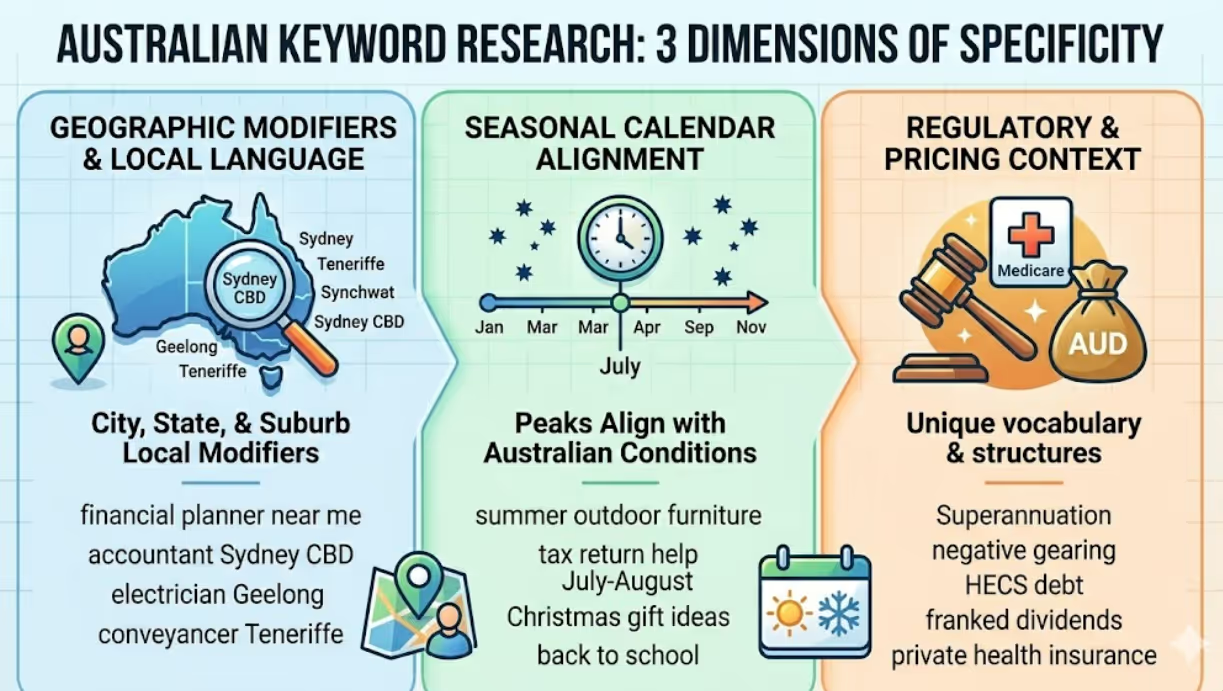
Australian market specificity in keyword research covers three dimensions.
Geographic modifiers and local language patterns. Australian search behaviour includes geographic modifiers at the city, state, and suburb level that are not captured in national search volume data. "Financial planner near me," "accountant Sydney CBD," "electrician Geelong," and "conveyancer Teneriffe" all represent genuine Australian search patterns at levels of geographic specificity that national keyword data does not surface. For Australian businesses serving specific geographic markets, the keyword research process must include a systematic expansion of each target query to include the relevant geographic modifiers, not because the geographic version has higher volume but because it has higher relevance to the specific audience the business serves.
Seasonal calendar alignment. Australia's seasonal calendar differs from the northern hemisphere calendar that underpins most search trend data and content marketing guides. Keyword research for Australian businesses must account for the fact that "summer outdoor furniture" peaks in November rather than May, that "tax return help" peaks around July to August as the Australian financial year closes, that "Christmas gift ideas" and "back to school" follow Australian school term patterns, and that weather and outdoor activity content performs at different times of year from northern hemisphere equivalents. Keyword research tools that show seasonal trends should be reviewed against the Australian date context rather than the default northern hemisphere interpretation.
Regulatory and pricing context. Some keyword categories in Australia reflect the specific regulatory, pricing, and product availability context of the Australian market. Financial products have different names, different regulatory structures, and different search vocabulary in Australia than in the UK or USA. Healthcare products and services reflect the Medicare and private health insurance context. Superannuation, negative gearing, HECS debt, and franked dividends are financial vocabulary specific to Australia that represent significant keyword opportunity for financial services businesses. Keyword research for Australian businesses operating in regulated categories must incorporate the vocabulary specific to the Australian regulatory context rather than importing keyword lists from overseas markets.
Competitive Feasibility Assessment
Keyword difficulty scores from Ahrefs, Semrush, and Moz provide a useful initial filter for assessing whether a keyword is achievable for a site at its current authority level, but they are a starting point rather than a definitive assessment. The score reflects the authority of the pages currently ranking, but not the quality of those pages or the specific content gaps that might make the target keyword achievable despite a high difficulty rating.
A thorough competitive feasibility assessment for a target keyword involves reviewing the actual pages ranking in Australian Google results rather than relying on the difficulty number. The review should assess:
Content quality and depth. Are the ranking pages genuinely comprehensive on the topic, or do they cover it superficially? A keyword with a high difficulty score where the ranking pages are thin, outdated, or fail to address important aspects of the topic is more achievable than the difficulty score suggests, because a thoroughly researched article has a genuine quality advantage over the existing ranking content.
Domain authority distribution. If all five ranking pages come from domains with very high authority that publish enormous volumes of content across the topic area, the keyword is unlikely to be achievable for a smaller domain regardless of content quality. If the ranking pages represent a mix of authority levels, including some at levels similar to or below the target domain, the keyword is a viable candidate.
Content type match. Does the search intent for the query produce results that match the content format the target site can produce? A query returning only video results, only product pages, or only large reference databases may not be achievable through a standard article or service page regardless of content quality.
SERP features. Keywords where the search results are dominated by featured snippets, People Also Ask sections, image packs, or local results leave different amounts of clickable space for traditional organic results. A keyword where a featured snippet answers the query completely may generate fewer clicks to the ranking articles than a keyword with a clean, standard organic results page.
Building Keyword Clusters and Topical Architecture
Modern keyword research is not primarily a process of identifying individual target keywords. It is a process of identifying topical territories, and within each territory, building a cluster of related keywords that together define the full range of intents, specificity levels, and audience stages relevant to that topic.
A topical cluster begins with a pillar keyword representing the broadest relevant query in the territory: "small business accounting Australia," for example. Around this pillar, the cluster includes:
Supporting informational keywords that attract the audience at the research stage: "how to set up accounting for a small business," "what accounting records do I need to keep for my Australian small business," "GST registration requirements Australia."
Commercial investigation keywords that reach the audience during evaluation: "best accounting software for Australian small business," "should I hire an accountant or use accounting software," "online accountant vs local accountant."
Transactional keywords that reach the audience at purchase: "small business accountant near me," "book an accountant for small business Australia," "accountant for sole trader Melbourne."
Long-tail variants that address specific situations: "accountant for tradesperson ABN registration," "bookkeeper vs accountant for small business," "do I need an accountant if I use Xero."
This cluster approach produces several advantages. Internal links between the cluster articles strengthen the topical authority signal of the whole cluster in Google's assessment. The range of intent stages means the business captures the audience at multiple points in their journey. The variants in the long tail collectively represent significant search volume and high conversion rates, even when individually small.
FAQs
How many keywords should an Australian business target in a given month's content programme?
The number of keywords to target depends entirely on the content publishing capacity, not on some optimal number derived from keyword research principles. A business publishing four articles per month should target four primary keywords per month, each as the primary focus of one article, with supporting secondary keywords included within each article where they are naturally relevant. The quality of keyword selection matters more than the quantity: four carefully selected keywords that match the business's authority level, intent alignment, and content infrastructure will produce better results than twenty keywords spread across articles that cannot rank for any of them. The goal of the keyword research process is to identify the highest-priority keywords across the relevant topic clusters and match the publishing programme to the opportunities in priority order, starting with the most achievable and most commercially valuable.
What keyword research tools are most useful for the Australian market specifically?
No single tool is optimised specifically for Australian keyword research, but several produce more useful Australian data than others when used with Australian locale settings. Ahrefs allows location filtering to Australia in its keyword explorer, which produces more accurate volume estimates for Australian search than global figures. Semrush's Keyword Magic Tool similarly allows country filtering to Australia. Google Keyword Planner, which requires a Google Ads account, provides the most granular Australian data of any tool because it draws directly from Google's advertising data infrastructure. For Australian local keyword research at the suburb and city level, Google Search Console performance data from an existing website is the most accurate source because it reflects actual query performance for the specific domain and geography. Google Suggest, People Also Ask results, and the related searches at the bottom of Google results pages when performed from within Australia provide qualitative vocabulary data that supplements the quantitative volume data from keyword tools.
How should Australian businesses prioritise between keywords with high volume and broad intent and lower-volume keywords with specific commercial intent?
For businesses with a new or developing domain with limited existing authority, the keywords with lower volume and specific commercial intent should be prioritised, for two reasons. First, they are more achievable: the existing pages ranking for specific, queries with strong intent tend to have lower authority than those ranking for broad, terms with high volume, making it more realistic to compete for them. Second, they convert at a higher rate: the specificity of the query is a signal of the searcher's intent, and a transactional query with lower volume typically delivers more commercial value per visit than a informational query that has high volume. For businesses with established domain authority, the prioritisation shifts toward the commercial investigation queries with higher volume and informational queries where their authority advantage can deliver visibility at scale. In both cases, the long tail of specific queries should not be overlooked: collectively, the large number of queries with lower volume that address specific intents represents a significant and highly converting portion of the available search opportunity.
Keywords Are a Map of What Your Audience Is Looking For. Build the Right Map.
A keyword research process that begins and ends with sorting a list of terms by monthly search volume produces a map of the most frequently asked questions in a topic area. What Australian businesses actually need is a map of the questions their specific audience asks when they are closest to taking the action that the business needs them to take. These are not always the same map. Building the right one requires assessing intent, specificity, Australian market context, competitive feasibility, and topical architecture alongside the volume data that most teams start with and too often stop at.
Maven Marketing Co conducts keyword research and strategy development for Australian businesses, building keyword frameworks that align search opportunity with commercial objectives across every stage of the audience's decision journey.
Talk to the team at Maven Marketing Co →

Table of contents
read more blogs
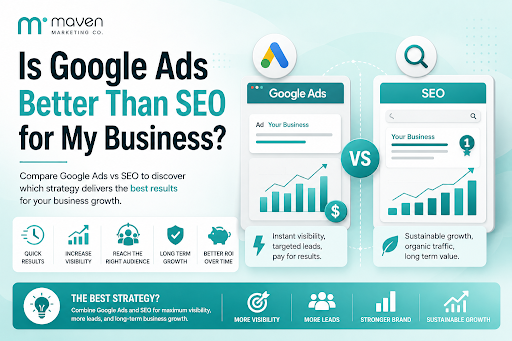
Is Google Ads Better Than SEO for My Business
One of the biggest questions business owners ask when they are planning online growth is whether they should invest in Google Ads or SEO. Both are strong marketing plays that help your company show up in Google search results, but they do things in separate lanes. Google Ads gives quicker visibility and can bring in leads fast, whereas SEO more or less focuses on slow, steady organic traffic that tends to grow the longer you keep building it. Picking the right direction depends on what you want to achieve, how much money you can spend, how crowded the market is, and how quickly you need results, like sooner rather than later. The good news is you don’t always have to choose one or the other; it’s not exactly a black-and-white situation. If you take time to understand the strongest points of both, you can put together a more sensible digital marketing plan that supports consistent expansion. In this guide, we’ll compare Google Ads vs SEO, explain the main differences, and help you figure out what option makes the most sense for your business.

When Should I Hire a Digital Marketing Agency
Growing a business today takes more than just having a website or throwing a post on social media; customers usually search around online, compare providers, skim reviews, and basically expect the brand to show up with a solid digital presence before they even think about buying. Many businesses try to run their marketing themselves, but there comes a point when “doing it all in-house” becomes clunky and hard to manage, all at once. Knowing when to hire a digital marketing agency can end up making a big, real difference for your growth. If you’re not getting enough leads, or your online visibility feels stuck, or sales are just not moving, the right agency can bring the know-how, plus a clear plan, to help you get noticeably better outcomes. In this guide, we’ll dig into what a digital marketing agency actually does, the usual signs it’s time to bring one on, and how picking the right marketing partner can help your business move forward at a faster pace.
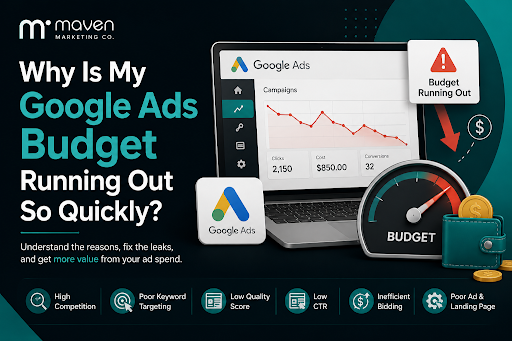
Why Is My Google Ads Budget Running Out So Quickly
Running a successful Google Ads budget isn’t only about throwing more money at it. It’s more like making every dollar, doing a bit extra. A lot of businesses start a Google Ads campaign with big hopes, then find out their daily budget is gone within a few hours, and that feels weird, right? After that, your ads stop showing effectively, new leads slip away, and your return on investment dips. So if your Google Ads budget is running out too fast, don’t stress. It’s a fairly common issue, and in most situations, it can be repaired with the right approach. There are multiple little things that can drain your advertising money quicker than you expected, from costly keywords to audience targeting that just doesn’t quite fit. In this guide, we’ll walk through why your budget disappears so quickly, how to cut wasteful spend, and the most reliable ways to boost your Google Ads ROI, even if your budget stays the same.