.svg)


%201.svg)

Key Takeaways
- Instagram Guides are a native content format allowing brands to curate posts, products, or places into scrollable collections with added commentary, creating a more durable content experience than standard feed posts.
- There are three Guide types: Posts Guides curating existing Instagram posts, Products Guides showcasing items from your Instagram Shopping catalogue, and Places Guides collecting location recommendations with descriptions.
- Guides appear in a dedicated tab on your profile and can be shared in Stories and direct messages, extending their reach beyond the initial publication moment.
- Australian brands should treat Guides as evergreen assets that answer recurring audience questions, showcase expertise, or curate a perspective on a topic their audience genuinely cares about.
- The introductory text on each entry within a Guide is the primary opportunity to add unique value. Guides where every entry has thoughtful commentary outperform those where the posts are simply listed without context.
- Guides are particularly effective as a sales and education tool for brands focused on product, allowing customers to explore themed product collections with guidance from the brand before committing to a purchase.
- Promoting Guides through Stories with a direct link increases their reach significantly. Without active promotion, Guides are passive assets that rely entirely on profile visitors discovering them.
What Instagram Guides Actually Are
Before any strategy discussion is useful, it is worth being precise about what Guides are, because they are frequently described in ways that make them sound more complex or more limited than they actually are.
An Instagram Guide is a curated collection of content presented in a scrollable format, accessible through a dedicated tab on your Instagram profile. Each Guide has a cover image, a title, a description, and a series of entries. Depending on the Guide type, each entry can be an existing Instagram post (from your own account or anyone else's public post), a product from your Instagram Shopping catalogue, or a physical location from Instagram's places database.
Within each entry, you can add a custom title and a block of descriptive text, which is where the editorial voice and unique value of a Guide is created. This is the element that most brands either skip entirely or treat as a formality, and it is precisely the element that separates a Guide worth reading from a Guide that is simply a list with thumbnails.
Guides are accessible via a compass icon tab on your profile, which means they are discoverable by anyone who visits your profile. They can also be shared directly in Instagram Stories and in direct messages, sent to specific followers, or linked in your bio. The content within a Guide does not expire in the way feed posts progressively disappear from feeds. A Guide published six months ago is as accessible today as it was on the day of publication, which makes the format fundamentally different from most Instagram content in terms of its longevity and sustained value.
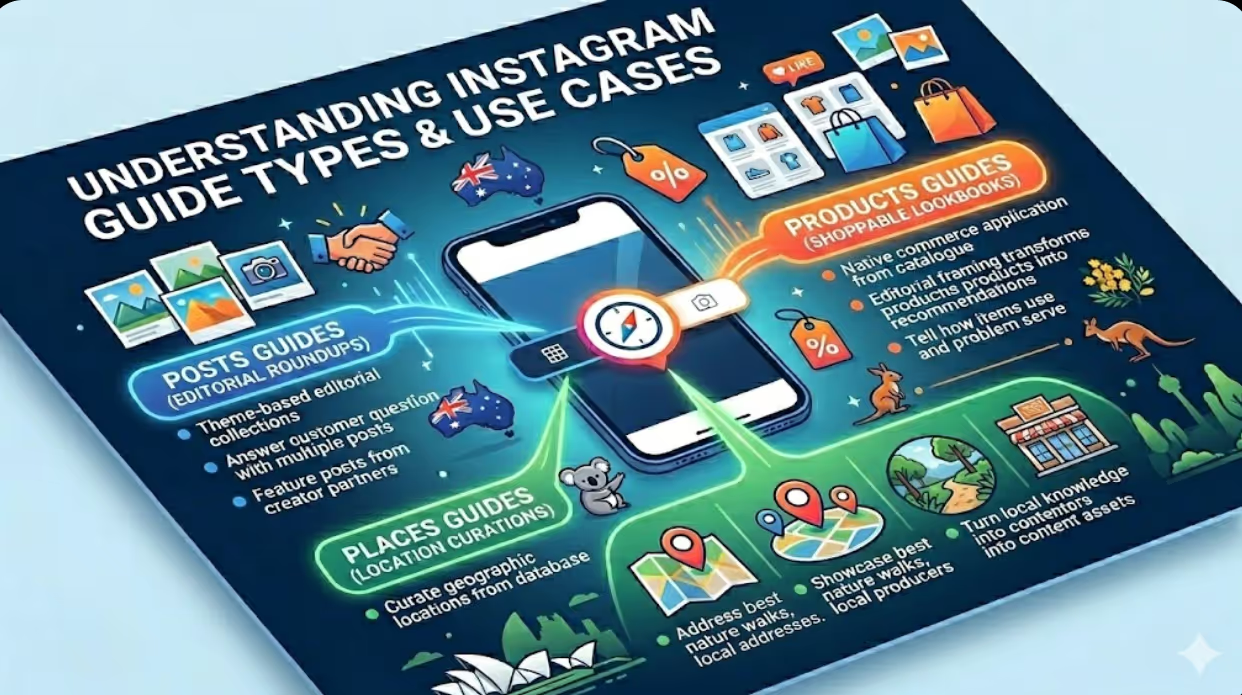
The Three Guide Types and When to Use Each
Understanding which Guide type serves which purpose prevents the common error of choosing the wrong format for a particular content goal.
Posts Guides are the most flexible type. They allow you to curate any collection of existing Instagram posts, your own or others', around a theme. For Australian brands, Posts Guides work well as editorial collections that take a position on a topic, as roundups of your highest performing content on a specific subject, as resources that answer a recurring customer question by pointing to multiple relevant posts, or as collaborative content that features posts from creators, community members, or industry voices alongside your own. The ability to include posts from accounts other than your own is particularly useful for building a sense of community and for positioning your brand as a thoughtful curator of your category rather than purely a brand promoting only itself.
Products Guides are the native commerce application of the format. They curate items from your Instagram Shopping catalogue into themed collections with editorial framing, functioning as shoppable lookbooks, gift guides, buying guides, or category-based product edits. For Australian retailers with an Instagram Shop set up, Products Guides allow you to do something that a standard product grid cannot: tell the customer why these specific items belong together, how they might use them, and what problem or occasion they serve. That editorial layer transforms a list of products into a considered recommendation, which is a qualitatively different shopping experience.
Places Guides curate physical locations using Instagram's places database. They are the format most aligned with travel, hospitality, food and beverage, and tourism content, though they have applications for any brand with a geographic dimension to its offering. An Australian tourism operator might create a Places Guide showcasing the best morning walks in their region. A Melbourne food brand might create a Guide to local producers who supply their ingredients. A Sydney fitness brand might curate the best parks for outdoor training across different suburbs. The format turns local knowledge into a reusable content asset that provides genuine value to an audience planning to act on the recommendations.
Designing Guides That People Actually Read
The format advantage of Instagram Guides means nothing if the content inside them is not worth the time they ask of the audience. The gap between a Guide that earns attention and one that simply occupies a tab on a profile is almost entirely a function of the editorial quality of the commentary within each entry.
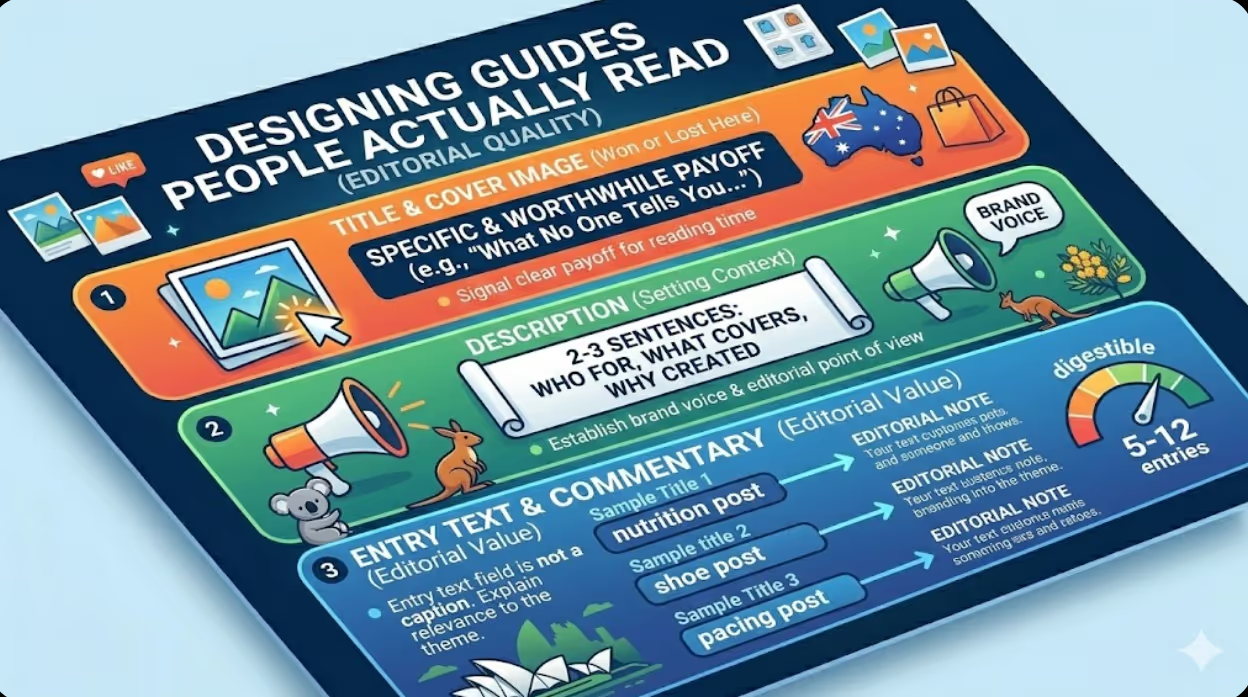
The entry text field in a Guide is not a caption. It is a brief editorial note that explains why this post, product, or place is included in this collection, what makes it relevant to the theme, and what the reader should take from it or do with the information. A Guide about preparing for a first marathon that includes a post about nutrition, a post about shoe selection, and a post about pacing strategy becomes genuinely useful when each entry is accompanied by a short paragraph explaining what runners at the early stage of their training most need to understand about that specific topic. Without that commentary, the same collection of posts is just a list that provides no more value than the posts would individually.
A few structural principles apply across all three Guide types.
The title and cover image determine whether anyone opens the Guide at all. As with all Instagram content, the first impression carries disproportionate weight. A Guide titled "Running Tips" with a generic stock photo will not attract the same interest as a Guide titled "What No One Tells You Before Your First Half Marathon" with a striking and relevant cover image. The title should be specific enough to signal a clear and worthwhile payoff for the time required to read the Guide.
The description beneath the title sets expectations and context. Two to three sentences explaining who the Guide is for, what it covers, and why it was created gives the reader enough information to decide whether to commit. This is also the place to establish the brand's voice and point of view on the topic, which makes the Guide feel like a genuine editorial perspective rather than a content marketing exercise.
Entry count matters. Guides with too few entries feel thin. Guides with too many entries become exhausting. For most topics, between five and twelve entries hits the balance between depth and digestibility. If a topic genuinely requires more than twelve entries, consider whether it is better served as two separate Guides rather than one very long one.
Content Strategy Applications for Australian Brands
The practical application of Instagram Guides varies significantly by industry and audience, but a few strategic applications are particularly well suited to the Australian market.
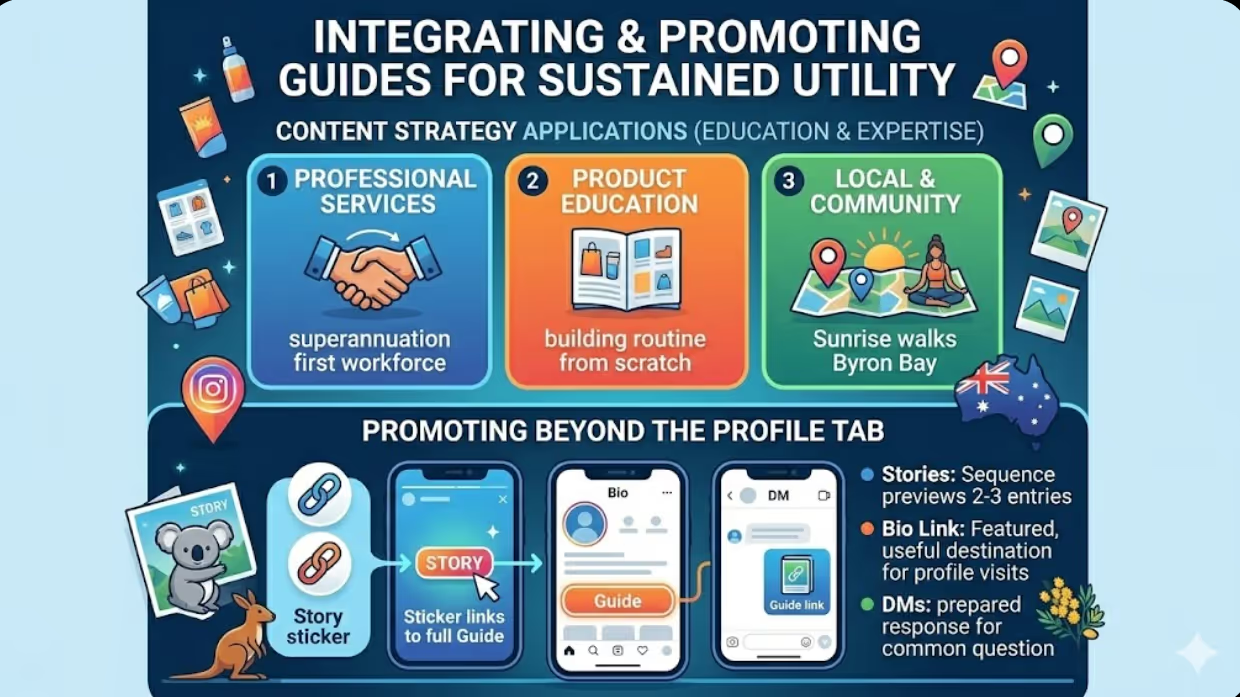
Education and expertise positioning. For Australian professional services brands, consultants, health professionals, and specialist retailers, Guides offer a way to demonstrate depth of knowledge in a format that is native to Instagram's environment. A financial education brand might create a Guide to understanding superannuation for workers entering the workforce for the first time. A skincare clinic might create a Guide to building a morning routine for different skin types. A legal services provider might create a Guide to the most common mistakes people make when buying their first property. Each of these represents a genuine service to the audience and simultaneously positions the brand as a credible and knowledgeable voice in its category.
Product education and gifting. For Australian product brands running an Instagram Shop, Products Guides serve as a shoppable editorial layer on top of the standard product catalogue. A Guide titled "Gifts for the Homebody" creates a curated shopping experience that is fundamentally more useful to a gift buyer than a page of individual product listings. A Guide titled "Building a Skincare Routine From Scratch" takes a product category decision and turns it into a guided journey. These applications reduce friction in the purchasing process by answering the question the customer is actually asking, which is not "what do you sell" but "which of these things is right for me."
Local and community content. For Australian brands with a strong geographic identity, Places Guides create a content category that serves audiences actively planning their engagement with a place. A Surry Hills restaurant might curate the best independent coffee spots within walking distance, positioning itself as a local guide and community participant rather than just a business. A Byron Bay wellness brand might curate the best spots for sunrise walks, yoga, and outdoor swimming in the region. This type of Guide earns genuine saves and shares from an audience that finds it practically useful, extending its reach well beyond the brand's existing followers.
Campaign and seasonal content. Guides created around seasonal moments, campaigns, or product launches create a structured editorial home for content that might otherwise be scattered across the feed. A Guide accompanying a sustainability campaign might curate posts from partner brands, behind the scenes production content, and customer stories in a single collection that tells the full story of the campaign in a way the individual posts cannot. This approach extends the shelf life of campaign content beyond the active promotion period and gives it a form that remains discoverable and coherent well after the campaign has concluded.
Promoting Guides Beyond the Profile Tab
A Guide that exists only on the profile tab and is never actively promoted is a missed opportunity. The content in most Guides is substantive enough to warrant multiple promotion moments, and the format supports several distribution approaches that most Australian brands are not using.
Sharing a Guide to Stories with a link sticker is the most direct promotion approach. A Stories sequence that introduces the Guide, previews two or three of its best entries, and ends with a clear prompt to open the full Guide is a straightforward format that consistently drives profile visits and Guide reads. This works particularly well immediately after publication and again several weeks later when the Guide has had time to accumulate entries or has become newly relevant due to a seasonal moment or campaign.
Including a link to a featured Guide in the bio link page gives profile visitors a direct path to content that represents your brand's expertise more thoroughly than a standard feed post would. For brands using a custom bio link page on their own domain, adding a Guide link alongside links to the website, booking page, or lead form creates a more useful destination for interested visitors.
Referencing Guides in direct messages when the Guide answers a question a customer or follower has asked is one of the most natural and effective distribution mechanisms available. An Australian brand that has created a Guide answering a common question before purchase has a prepared response they can send to anyone asking that question in their direct messages, which is both genuinely helpful and a low pressure commercial touchpoint.
According to Instagram's own creator resources on content planning, content that provides sustained utility and is designed to be referenced repeatedly rather than consumed once tends to generate stronger long-term profile engagement than content optimised purely for immediate feed performance. Guides are the format on Instagram most directly aligned with this principle.
FAQs
Do Instagram Guides affect the algorithm or help with reach?
Guides do not directly boost the reach of the underlying posts they contain, nor do they function as a reach amplification tool in the way that Reels or Stories do. Their algorithmic value is indirect. Guides contribute to the overall engagement profile of your account by generating profile visits, saves, and shares when promoted actively. A profile that visitors find substantive and worth spending time in, because of content like thoroughly constructed Guides, sends positive signals to the algorithm about account quality. The primary value of Guides is in depth of engagement and evergreen discoverability rather than immediate reach.
Can you include posts from other accounts in a Guide?
Yes. Any public Instagram post can be included in a Posts Guide, not just your own content. This capability is significantly underused by Australian brands and represents a genuine opportunity. Including posts from credible industry voices, content generated by customers, collaborating brands, or community members adds perspective and social proof that a Guide composed entirely of the brand's own posts cannot achieve. It also creates a natural reason to notify the account whose post you have included, which can generate reciprocal engagement and new audience exposure.
How long does it take to create an Instagram Guide?
A thoroughly constructed Guide with eight to ten entries and thoughtful commentary on each takes most brands between one and three hours to produce, depending on how much of the source content already exists and how much original writing the entry commentary requires. The majority of that time is in the writing and editing of the commentary text rather than the technical steps of building the Guide in the Instagram interface. Brands that treat Guide production as a content investment comparable to writing a substantive blog post will produce Guides that earn sustained engagement. Brands that treat it as a quick content task will produce Guides that nobody reads.
Build Content That Stays Useful
Most Instagram content is designed to be seen once and forgotten. Guides are designed to be found, saved, shared, and returned to. For Australian brands investing in Instagram as a marketing channel, that distinction in durability and utility is worth taking seriously.
Maven Marketing Co helps Australian brands build Instagram content strategies that go beyond the standard feed cadence to create formats that build genuine authority and serve audiences in ways that compound in value over time.
Talk to the team at Maven Marketing Co →

Table of contents
read more blogs

6 Ways Digital Marketing Can Boost B2B Lead Generation
B2B lead generation is not about filling a CRM with as many names as possible. The real objective is to attract businesses that fit your offer, give the right people a reason to engage and create enough confidence for a genuine sales conversation to start.That distinction matters because B2B buying is usually more targeted than consumer marketing and often involves several people influencing the decision. Current LinkedIn lead-generation guidance makes the same point: more leads do not automatically mean better results if only a small proportion are genuinely relevant or likely to progress.Digital marketing helps by creating multiple paths into the business. Search can capture active demand. Paid media can put an offer in front of a tightly defined audience. Content can build authority before a buyer is ready to talk. Social media can keep the brand visible across a long decision cycle. Your website turns interest into action, while email helps nurture that interest over time.The strongest B2B digital marketing strategies do not treat these as six separate activities. They use them as one connected system designed to generate quality B2B leads, support sales and build a more dependable pipeline
How to Build a Brand Positioning Strategy That Sets Your Business Apart
Most businesses can explain what they sell. Far fewer can explain, in a sentence or two, why the right customer should choose them instead of another credible option. That gap is where brand positioning matters.A strong brand positioning strategy gives your business a clear place in the market and a clear place in the customer's mind. It helps your team decide who you are speaking to, what you want to be known for, which benefits deserve the most attention and how your marketing should sound and look across every channel.It is not a slogan exercise and it is not something reserved for large consumer brands. For an Australian service business, e-commerce brand, professional firm, or growing B2B company, positioning can make everyday decisions easier, from website copy and campaign messaging to pricing, sales conversations, and brand identity. The goal is not to look different for the sake of it. The goal is to be meaningfully different in a way the right customers understand and value.

The Role of Digital PR in Long Term SEO Growth
Building a solid online presence is basically more than just posting content now and then or sprinkling keywords across your website. Search engines such as Google tend to point users toward businesses that feel trustworthy, useful, and backed up by others online, even if it’s not always obvious at first. When a company puts together a well-thought-out digital PR strategy, it can bring in solid media mentions, earning high-quality backlinks and stronger brand awareness, all of which feed long-term SEO progress. Rather than obsessing solely over rankings, digital PR helps you build credibility plus authority, so your site looks more appealing to search engines and also to real people who might become customers. In this guide, we’ll walk through how digital PR supports SEO, what makes it such a key part of modern marketing, and the most effective approaches for sustainable growth in search results.