.svg)


%201.svg)

Key Takeaways
- Influencer vetting is the most consequential phase of influencer partnership management. A partnership with the wrong creator cannot be rescued by excellent negotiation or sophisticated tracking. Selecting the right creator is the foundational decision.
- Follower count is the least reliable metric for assessing creator value. Engagement rate, audience demographic alignment, content quality, brand safety history, and the authenticity of the creator's relationship with their audience are all more predictive of commercial performance.
- The brief provided to a creator before the campaign begins is the document that determines whether the content produced is commercially effective. A vague brief produces creative content that does not serve the brand's objectives. A clear, specific brief with defined messaging requirements, format expectations, and approval processes produces content that is both authentic and commercially directed.
- Influencer agreements should be written documents covering usage rights, exclusivity periods, revision entitlements, disclosure requirements under Australian law, payment terms, and the specific deliverables expected from the partnership. Verbal agreements and email threads are not adequate governance for commercial partnerships of this nature.
- Campaign tracking requires unique tracking links, platform analytics, and where possible, a discount code or landing page specific to the creator, to create a clear attribution path between creator content and commercial outcomes.
- Nano and micro influencers, those with audiences between 1,000 and 50,000 followers, consistently deliver higher engagement rates and more commercially responsive audiences for most Australian brands than macro or celebrity influencers, despite commanding significantly lower fees.
- Influencer partnerships that are managed as ongoing relationships rather than transactions conducted once produce compounding value: the creator's audience develops genuine familiarity with the brand over time, and the creator's content becomes more effective as they develop a deeper understanding of the product and brand positioning.
Stage One: Vetting
The vetting process for influencer partnerships is the phase that determines whether the investment that follows is sound. It cannot be compressed without accepting the risk of paying for influence that does not exist, reach that does not convert, or brand association that creates reputational problems rather than commercial benefit.
Defining the Right Creator Profile
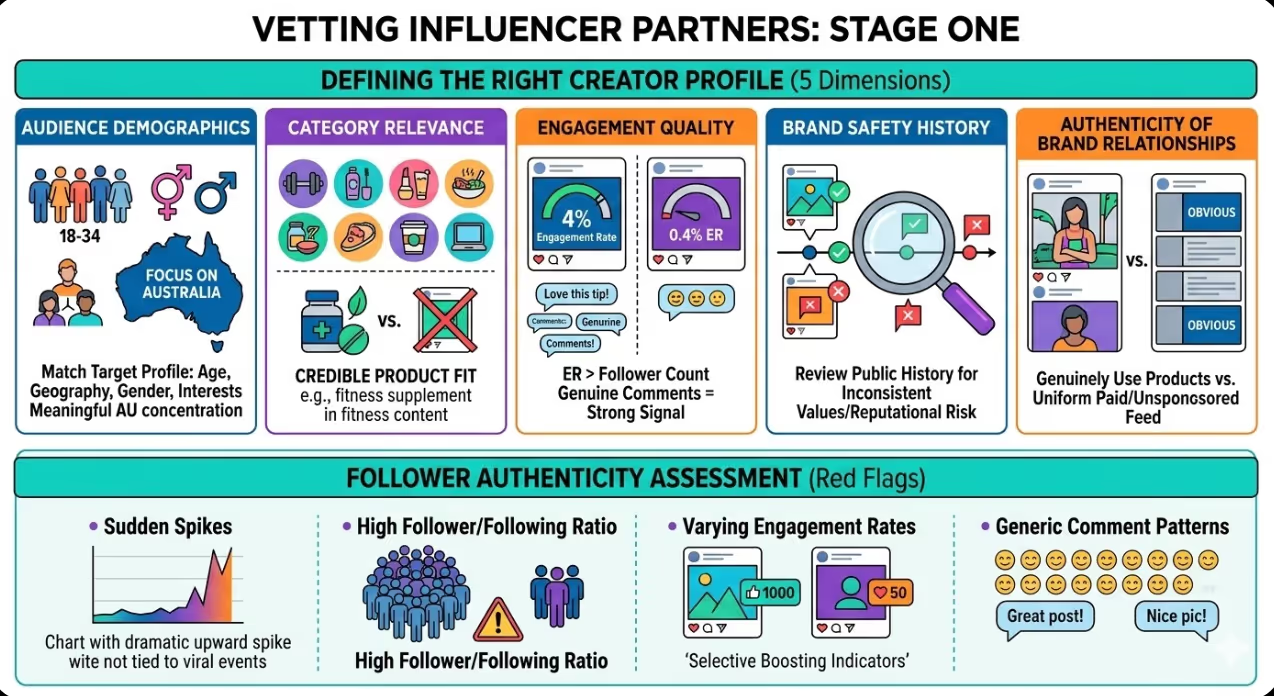
Before searching for creators, the brand must define what the right creator looks like. This definition covers five dimensions.
Audience demographics. The creator's audience should match the brand's target customer profile in age range, geographic location, gender composition, and relevant interest categories. For Australian brands, the geographic component is particularly important: a creator with 200,000 followers globally but only 15,000 in Australia is not a 200,000-follower Australian influencer. The audience location breakdown, available through media kits or directly from the creator's analytics, should demonstrate meaningful Australian audience concentration before the partnership is pursued.
Category relevance. The creator's content should be genuinely aligned with the product or service category. The alignment does not need to be exact, but the brand's product should fit naturally into the creator's content world in a way that their audience would find credible. A fitness creator promoting a performance supplement is credible. The same creator promoting an unrelated financial product is not, and their audience will read the disconnect immediately.
Engagement quality. Engagement rate, calculated as total interactions divided by followers or reach, is a more reliable performance signal than follower count alone. An account with 50,000 followers and a four percent engagement rate has a more commercially valuable audience than an account with 200,000 followers and a 0.4 percent engagement rate. Beyond the rate, the quality of the engagement matters: genuine comments that engage with the content are a stronger signal than generic emoji responses, which can indicate an audience of low quality or engagement manipulation.
Brand safety history. The creator's past content should be reviewed for any posts, statements, or associations that are inconsistent with the brand's values or that could create reputational risk. This review should cover the creator's full public content history, not just their recent posts, and should include a check of their public statements on sensitive topics relevant to the brand's category and audience.
Authenticity of existing brand relationships. Creators who authentically use products similar to the one being promoted, or who have integrated relevant brand partnerships naturally into their content in the past, are more likely to produce genuinely credible promotional content. Creators whose feeds alternate uniformly between unsponsored personal content and obvious paid posts with no relationship to their organic content are a weaker partnership prospect.
Follower Authenticity Assessment
Purchased followers and artificially inflated engagement metrics remain a problem in the Australian influencer market. Before committing budget to a partnership, the authenticity of the creator's following should be assessed using one of the available independent audit tools that analyse follower quality, engagement pattern consistency, and the relationship between follower growth events and content activity.
Red flags in a follower audit include a follower growth history that includes sudden spikes not tied to viral content events, an unusually high ratio of followers to following that is inconsistent with organic growth patterns, engagement rates that vary dramatically between posts in ways that suggest selective boosting, and a comment pattern dominated by generic phrases that appear across multiple creator accounts.
Platform Selection
The vetting process should also confirm that the creator's primary platform is where the target audience is most active and receptive. A creator with a strong Instagram following but a nascent TikTok presence is not a TikTok influencer for campaign purposes, regardless of how the partnership is framed.
Stage Two: Negotiating
Once a creator has passed the vetting process, the negotiation phase establishes the commercial terms of the partnership. Approaching influencer negotiation without a clear framework results in either overpaying relative to the value delivered or agreeing to terms that leave the brand exposed to creative decisions, usage limitations, or exclusivity gaps that undermine the campaign.
Understanding Creator Pricing
Influencer pricing in Australia in 2026 varies enormously and is driven by a combination of follower count, engagement rate, platform, content type, usage rights, and the creator's demand relative to the brands pursuing them. There are no universal benchmarks that apply across all categories and formats, but there are structural considerations that should inform every fee negotiation.
Fees for a single Instagram feed post from a creator with between 10,000 and 50,000 engaged Australian followers typically range from $300 to $1,500 depending on engagement quality and category relevance. TikTok video content from the same creator range typically runs from $400 to $2,000 given the additional production effort. Creators with between 50,000 and 200,000 followers command significantly higher fees, typically $1,500 to $8,000 per deliverable depending on the factors above. These figures are indicative rather than definitive and shift considerably based on category, campaign timing, and how actively the creator is being pursued by other brands at the time of negotiation.
Usage rights are a separate and often underestimated cost component. A creator's base fee typically covers the content being published on their own channel. If the brand wants to use that content in paid advertising, on its own website, in email campaigns, or across other channels, usage rights need to be negotiated explicitly and will add to the fee. The duration and scope of usage rights should be defined clearly in the agreement: a right to use content in paid social advertising for twelve months is a different and more valuable right than a right to use it in a single email campaign.
Key Agreement Terms
The written agreement for an influencer partnership should cover the following at minimum.
Deliverables. The specific pieces of content expected: the number of posts, Stories frames, videos, or other formats; the platform or platforms on which they will be published; and the timing of publication relative to the campaign schedule.
Content brief and approval process. The messaging requirements, visual guidelines, mandatory inclusions (such as product features or calls to action to be included), and the approval process the creator must follow before publishing. The number of revision rounds the fee includes should be specified.
Disclosure requirements. Under Australian Consumer Law and the Australian Association of National Advertisers' influencer marketing guidelines, sponsored content must be clearly disclosed. The agreement should specify the disclosure format required, such as a paid partnership label or a hashtag such as #ad or #sponsored, and confirm the creator's responsibility for compliance.
Exclusivity. Whether the creator is prohibited from working with competing brands during the campaign period, and if so, the definition of which brands constitute competitors and the duration of the exclusivity window.
Usage rights. The specific channels, formats, and duration for which the brand may use the content beyond the creator's own publication.
Payment terms. The fee amount, payment schedule, and conditions under which payment is made or withheld.
Stage Three: Campaign Tracking
The tracking infrastructure for an influencer campaign must be built before the campaign goes live. Attempting to measure performance after the fact from platform analytics alone produces incomplete attribution data and makes it impossible to distinguish the commercial contribution of different creators in a multi-creator campaign.
Attribution Infrastructure
Every influencer campaign should include unique tracking links for each creator, generated through the brand's URL shortening or UTM parameter system and pointing to the relevant landing page or product page. These links, published in the creator's bio, Story link sticker (where available), or included in the caption as a destination reference, create a clear data trail from creator content to website traffic and conversion events.
For campaigns promoting a product, a unique discount code assigned to each creator serves a dual attribution purpose: it provides an incentive for the creator's audience to convert, and it creates a trackable conversion event that links directly back to the individual creator. Discount codes are not appropriate for all brand categories and should not be used where they would undermine the brand's pricing positioning, but for consumer product categories they are the most reliable attribution mechanism available.
Landing pages created specifically for influencer traffic, distinct from the standard website pages used for other channels, allow the brand to present a targeted message that reinforces the creator's referral and measure the conversion performance of influencer traffic independently of other traffic sources.
Performance Metrics
The performance metrics for an influencer campaign should be defined before the campaign begins, with benchmarks established based on the creator's historic performance data and the campaign objectives.
Reach and impressions measure how many people saw the content, providing a baseline for the campaign's total potential exposure.
Engagement rate measures how the campaign content performed relative to the creator's typical content performance and relative to the rates observed during vetting. A creator whose campaign posts underperform their typical engagement rate is a signal that the content or the product integration did not resonate with their audience.
Click-through rate from the creator's content to the brand's tracked destination, where the tracking infrastructure makes this measurable, indicates how effectively the content converted awareness into intent.
Conversion rate from tracked influencer traffic to the desired commercial outcome, whether a purchase, a newsletter subscription, an enquiry, or another defined action, is the most commercially meaningful metric in the tracking set and the one against which the campaign's cost efficiency should ultimately be assessed.
Cost per outcome divides the total creator fee and production costs by the number of commercial outcomes generated through the tracked attribution paths, providing a comparable efficiency metric that can be benchmarked against other paid channels.
FAQs
How should Australian brands structure their influencer budget across nano, micro, and macro creators?
The budget allocation between creator tiers should be guided by the campaign objective rather than by a fixed formula. Campaigns with a primary objective of broad awareness and reach, such as a new product launch targeting the widest possible relevant audience, typically justify a higher allocation to macro creators who can deliver that reach. Campaigns with a primary objective of driving conversion or building genuine advocacy among a specific audience segment typically produce better returns from a larger number of nano and micro creators whose audiences are more tightly aligned with the target profile and more responsive to recommendations. For Australian brands in most consumer categories, a portfolio approach that allocates thirty to forty percent of the influencer budget to one or two macro creators for reach and sixty to seventy percent to a larger group of micro and nano creators for conversion and advocacy tends to outperform a approach using a single creator tier in both total reach and cost efficiency. This allocation should be reviewed after each campaign based on the actual performance data from each creator tier.
What are the legal disclosure requirements for influencer marketing in Australia?
Under Australian Consumer Law, influencer content that has been produced in exchange for payment, product, or other valuable consideration must be clearly identified as commercial content. The Australian Competition and Consumer Commission has published guidance indicating that disclosures must be prominent, unambiguous, and placed so that they cannot be missed by a viewer consuming the content in a normal way. Labels such as #ad, #sponsored, or the paid partnership label available on Instagram and TikTok are all acceptable disclosure formats, provided they appear at the beginning of the caption or in a position where they are visible without requiring the viewer to expand the post. Disclosures buried at the end of a long caption after multiple lines of content written to sound unsponsored do not meet the standard of prominence the guidelines require. Brands are responsible for ensuring their influencer partners comply with disclosure requirements, and this responsibility should be made explicit in the partnership agreement.
How long should an Australian brand give an influencer partnership before evaluating whether to continue?
A single post or a campaign conducted once provides too little data to evaluate the genuine commercial value of an influencer relationship. The strongest evaluation basis is a minimum of three to four pieces of content published across at least four to six weeks, which provides enough data points to distinguish a strong partnership from a weak one with reasonable confidence. If the tracked performance data after that initial period shows engagement rates below the benchmarks established during vetting, rates of clicks through that do not justify the fee, and conversion data that indicates the audience is not commercially aligned with the product, the partnership should not be extended. If the data shows strong engagement, meaningful traffic, and commercially responsive conversions, extending the relationship into an ongoing ambassador arrangement amplifies that performance as the creator's audience develops deeper familiarity with the brand over successive campaign cycles.
Structure Turns Influencer Marketing From a Gamble Into a Channel
Influencer marketing's reputation as an unpredictable, hard to measure, tactic dependent on relationships is not inherent to the channel. It is the reputation earned by the version of influencer marketing that operates without a vetting framework, without written agreements, and without attribution infrastructure. The version that applies rigour at every stage, treating creators as commercial partners whose performance can be measured, managed, and improved over time, produces results that sit comfortably alongside other paid media channels in a properly structured marketing mix.
Maven Marketing Co manages influencer partnership programmes for Australian brands, including creator vetting, agreement negotiation, brief development, and full campaign tracking from content publication through to commercial outcome attribution.
Talk to the team at Maven Marketing Co →

Table of contents
read more blogs

The Ultimate Guide to E-commerce Product Page Optimisation
A strong e-commerce product page has to do several jobs at once. It needs to be discoverable in search, easy to understand, persuasive enough to build confidence and simple enough for a customer to buy without unnecessary friction. That combination is what makes product page optimisation such an important part of both ecommerce SEO and conversion strategy.The difficulty is that product pages are often built from one reusable template across hundreds or thousands of products. If the template is weak, the problem scales. Thin descriptions, poor imagery, unclear variants, buried shipping information or an awkward mobile experience can affect a large part of the store at the same time.Current product-page UX research from Baymard continues to show how often shoppers abandon otherwise suitable products because of avoidable usability issues. At the same time, Google provides dedicated guidance for e-commerce sites, product structured data, product variants and image optimisation because product information needs to be clear and machine-readable as well as useful to people.The goal is not to stuff every product page with more text or technical markup. A complete digital marketing strategy combines SEO, user experience, content and conversion improvements to help ecommerce businesses attract and convert the right customers. It is to give shoppers the information they need, in the right order, while helping search engines understand what the product is, whether it is available and how the page relates to the wider store. This guide covers the practical elements that make that happen.

How to Choose the Right Digital Marketing Channels for Your Business
Choosing digital marketing channels is one of the easiest places for businesses to lose clarity. There are more options than ever, every platform promises reach and results, and it is easy to assume that the best strategy is simply to be everywhere. In reality, most businesses do better when they choose channels with intention rather than spreading budget and effort too thinly.The right channel mix depends on where your audience spends time, how they search or discover solutions, what your business is trying to achieve and how much resource you actually have to support execution properly. A channel is only useful if it helps move the right people towards a commercial outcome that matters to the business.This is why strong digital marketing strategy is not really about finding one perfect platform. It is about understanding the role each channel can play across awareness, demand capture, conversion and retention. SEO might build long-term visibility, Google Ads might capture active intent, social media might support familiarity and reach, while email may help nurture prospects and strengthen customer value over time.This guide explains what digital marketing channels are, how to assess them properly and how to build a balanced channel mix for your business. The focus is practical. Rather than chasing every new platform, the goal is to help you choose the channels that fit your audience, goals, budget and internal capability.

How to Build a Customer Journey Map for Your Digital Marketing Strategy
A strong digital marketing strategy is not just about channels, creative or traffic. It is about understanding how real people move from first awareness through to enquiry, purchase and ongoing loyalty. That is exactly why customer journey mapping matters.Without a clear view of the journey, businesses often optimise in fragments. They improve the website without thinking about the ad that drove the visit, produce content without considering where the audience is in the decision process, or judge conversion performance without understanding the friction points that sit earlier in the experience.A customer journey map helps you step back and see the bigger picture. It shows the stages people move through, the touchpoints they interact with, the questions they ask, the barriers they face and the moments where your marketing can either help or lose them.This guide explains how to build a practical customer journey map for your digital marketing strategy, what information to include, how to use the map to improve performance and which common mistakes to avoid. The goal is not to create a pretty workshop artefact that gets forgotten. It is to build a working tool that improves messaging, user experience, channel decisions and conversion outcomes.