



Good marketing becomes much easier when everyone in the business knows what to say, how to say it and which ideas should stay consistent wherever the brand appears. That is the job of a brand messaging framework.
Without one, messaging often becomes fragmented. The website says one thing, sales decks say another, social media develops its own personality and paid campaigns focus on whichever benefit seems easiest to promote at the time. None of those pieces may be individually wrong, but together they can make the brand feel unclear or inconsistent.
A useful brand messaging framework gives the business a shared language. It defines the value proposition, the core messages you want people to remember, the proof that makes those messages credible and the voice and tone used to express them. It should also show how the same core story can be adapted for different audiences, channels and stages of the buying journey without changing what the brand fundamentally stands for.
This guide explains how to build that framework in a practical way. A strong digital marketing strategy connects brand messaging with SEO, content, advertising and customer experience to create consistent growth across digital channels. The goal is not to produce a long brand document that nobody uses. It is to create a clear system that helps marketing, sales, content, advertising and customer-facing teams communicate the brand more consistently and more effectively.
Key takeaways
· A brand messaging framework translates brand positioning into the language your business uses across marketing and sales.
· The core framework should include a value proposition, a small set of message pillars, supporting proof, brand voice and clear guidance for different audiences and channels.
· Consistency does not mean using identical copy everywhere. The core message stays stable while tone, emphasis and format adapt to context.
· Strong messaging is specific, credible and easy to understand. Claims should be supported by genuine evidence rather than broad marketing language.
· The framework should be reviewed over time using customer feedback, engagement, lead quality, conversion performance and the consistency of real-world execution.
What Is a Brand Messaging Framework?
A brand messaging framework is a structured guide to the ideas, claims and language a business uses to communicate its value. It gives teams a common reference point for what the brand should say and how those messages should be expressed across websites, advertising, social media, email, sales collateral and customer communication.
It sits between high-level brand strategy and day-to-day copywriting. Professional branding services help businesses define their positioning, messaging, visual identity and customer experience so every marketing channel communicates a consistent brand story. The messaging framework turns that strategic position into usable language: who you help, the problem you solve, why your approach matters, what makes you different and what evidence supports those claims.
That distinction is important. A messaging framework is not simply a list of taglines, slogans or approved phrases. Those can sit within it, but the real value is the hierarchy underneath them. When the hierarchy is clear, different teams can write fresh copy without drifting away from the same brand story.
Why Consistent Brand Messaging Matters
Consistency reduces the amount of work the audience has to do to understand your brand. If your website, paid ads, social content and sales conversations all reinforce the same core ideas, people build familiarity more quickly. They know what you stand for, what you offer and why it may be relevant to them.
It also improves internal efficiency. Teams spend less time reinventing language for every campaign and there is less disagreement about which benefits or claims should be prioritised. A clear framework gives writers, designers, salespeople and external partners a shared starting point.
Consistency should not be confused with repetition. The same wording does not need to appear everywhere. GOV.UK's design guidance makes a useful distinction by encouraging consistency without requiring uniformity. The principle translates well to brand communication: keep the underlying ideas and standards stable, while adapting the expression to the audience, task and channel.
Consistent messaging also supports trust. When your claims, tone and proof align from first impression through to conversion, the business feels more deliberate and credible. If the advertising promises one thing and the website or sales process communicates something different, confidence can fall quickly.
Key Elements of a Brand Messaging Framework
The strongest frameworks are usually simpler than people expect. You do not need dozens of messages. You need a clear hierarchy that makes it obvious which ideas are primary, which ones support them and which evidence proves them.
Value Proposition
Your value proposition is the foundation. It should explain who you help, what meaningful problem you solve or outcome you create, why that matters and what makes your approach relevant or distinctive. It does not need to be a polished headline on day one. It needs to be strategically clear.
A weak value proposition is usually too broad: 'high-quality service', 'tailored solutions' or 'we put customers first'. Those statements may be true, but they do not give the audience enough reason to understand why your business is the right fit. A stronger proposition connects the audience, problem, outcome and difference more specifically.
This is also where your messaging framework should stay aligned with the brand positioning work. The value proposition should not create a new competitive story; it should translate the strategic position into language people can understand and remember.
Key Brand Messages
Below the value proposition, define a small number of message pillars. Three to five is usually enough for most businesses. Each pillar should represent an idea you want the market to associate with your brand and should be broad enough to support multiple campaigns without becoming vague.
A service business might build pillars around specialist expertise, commercial outcomes, ease of working together and long-term support. A product business might prioritise product performance, usability, design, reliability and customer value. The exact themes depend on what genuinely matters to your audience and what the business can credibly own.
Every message pillar should be backed by proof. That might include case studies, client outcomes, expertise, certifications, reviews, product data, years of experience or other evidence. In Australia, this is more than a credibility issue. ACCC guidance states that advertising claims should be accurate, truthful and based on reasonable grounds, and businesses should be able to substantiate the claims they make.
How to Define Your Brand Voice and Tone
Brand voice is the consistent personality behind your communication. Tone is how that voice changes depending on the situation. Keeping those two ideas separate makes the framework much easier to use.
For example, a brand might have a voice that is clear, confident, human and informed. That voice can stay consistent across channels. The tone, however, may become more concise and action-oriented in paid advertising, more conversational on social media, more explanatory in a service guide and more empathetic when dealing with a sensitive customer issue.
Nielsen Norman Group's research on tone of voice identifies four useful dimensions: formal versus casual, serious versus funny, respectful versus irreverent, and matter-of-fact versus enthusiastic. You do not need to adopt those dimensions exactly, but they are a useful way to make voice decisions more concrete instead of relying on vague descriptions such as 'professional but friendly'.
The practical test is whether a writer who did not create the brand strategy could read the framework and produce copy that still sounds recognisably like the same business. Include short examples of what the voice sounds like, what it does not sound like and how the tone changes in common situations.

Creating Messaging for Different Audiences and Channels
A good messaging framework keeps the core proposition stable while allowing emphasis to shift. Different audiences often care about different parts of the same offer. A business owner may care most about commercial return, a marketing manager may focus on delivery and reporting, and a technical stakeholder may want to understand process or integration.
The answer is not to create a completely different brand story for every segment. Start with the same value proposition and message pillars, then decide which benefit, proof point or objection should be emphasised for each audience. This creates relevance without creating inconsistency.
Channel adaptation works the same way. Website copy has room to explain and prove. Search ads need to match intent quickly. Effective Google Ads management services ensure advertising messages align with customer needs, landing pages and business goals while maintaining consistent brand communication. Social content can be more conversational and episodic. Email needs clarity and relevance in a smaller space. Sales presentations can build a more detailed narrative around the audience's specific commercial problem.
This is particularly useful for SEO and AI visibility because clear, consistent language around services, audiences and areas of expertise helps both people and machines understand what the business is about. Professional SEO services help businesses structure this information effectively so search engines can better understand and surface relevant content. Google Search Central continues to recommend people-first content that uses the words people actually use to look for information, while demonstrating real expertise and usefulness.
How to Keep Marketing Messages Consistent
Consistency usually breaks down because the framework exists but the process does not. A PDF stored in a shared drive will not improve messaging on its own. Teams need practical controls that make the framework easy to apply in everyday work.
Start with a concise approved language set: the value proposition, core message pillars, preferred service terms, proof points and any claims that require careful wording. Add examples showing how those messages appear in website copy, ads, social posts, emails and presentations.
Then make ownership clear. Someone should be responsible for reviewing material changes to messaging and updating the framework when the business, market or offer changes. This does not mean every piece of content needs a slow approval process. The aim is to give teams enough clarity to work independently while protecting the core story.
Regular audits are useful as well. Review high-visibility touchpoints such as the homepage, service pages, campaign landing pages, paid ads, social profiles and sales decks. Look for terminology drift, unsupported claims, outdated proof and places where the message no longer reflects the current business.
Infographic: The Brand Messaging Framework
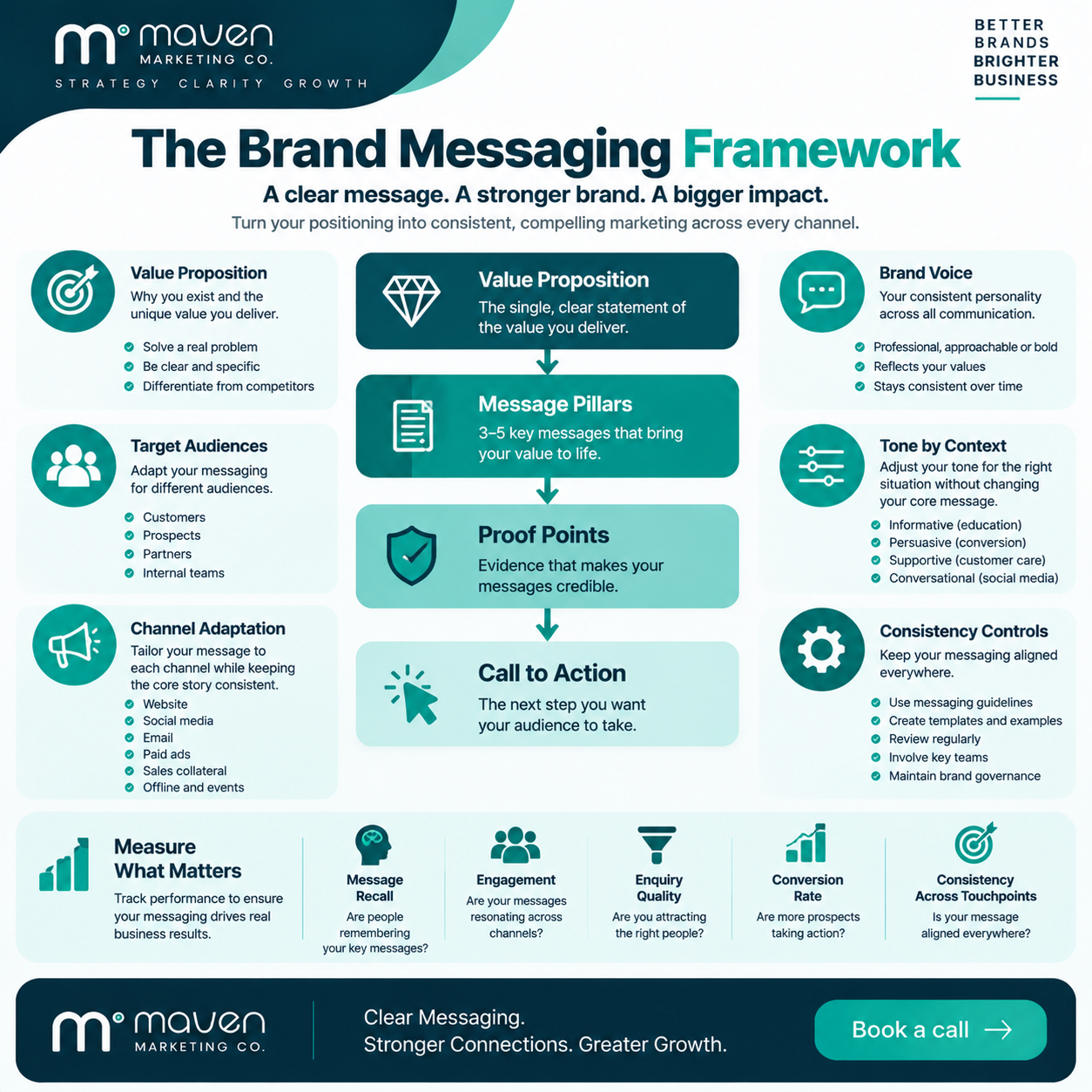
Examples of Brand Messaging Applications
The framework becomes most useful when it is applied to real marketing tasks.On a website, the value proposition can shape the homepage hero, while message pillars become the structure for supporting sections, service pages and proof. Professional web development services help businesses translate these messaging frameworks into user-friendly websites that support engagement and conversions. In paid campaigns, one message pillar might become the campaign theme while the ad and landing page use the same promise and evidence.
For social media, the framework can guide recurring content themes so the brand builds recognisable associations over time rather than publishing disconnected posts. Through professional social media marketing services, businesses can maintain consistent messaging, engage audiences and strengthen brand recognition across platforms. For email, the same pillars can help maintain continuity from lead nurture through to customer communication. For sales, they can shape discovery questions, proposal language and presentation structure.
The framework can also help when multiple people or external partners create content. Instead of briefing every job from zero, the business can provide the approved hierarchy, proof and tone rules. That gives creators room to write naturally while reducing the risk that each person invents a different version of the brand.
Over time, measure whether the messaging is helping. Useful indicators can include message recall in customer conversations, engagement with key content, enquiry quality, conversion rate, sales feedback and the consistency of terminology across major touchpoints. Not every metric will prove messaging effectiveness on its own, but together they can show where the story is resonating and where refinement is needed.
FAQs
What is a brand messaging framework?
A brand messaging framework is a structured guide to the core ideas and language a business uses to communicate its value. It normally includes the value proposition, key message pillars, supporting proof, brand voice and guidance for different audiences and channels.
Why is brand messaging important?
Brand messaging helps people understand what your business offers, why it matters and what makes it relevant. It also gives internal teams a consistent foundation for websites, advertising, social media, email and sales communication.
What should a brand messaging framework include?
At minimum, include a clear value proposition, three to five key message pillars, proof points, brand voice and tone guidance, audience adaptations, channel examples and a simple process for maintaining consistency.
How do I define my brand voice?
Choose a small set of characteristics that reflect how the brand should consistently communicate, then make those characteristics practical with examples. Define both what the voice sounds like and what it should avoid, and explain how tone changes by context.
How does consistent messaging help a business?
Consistent messaging builds familiarity, improves clarity and helps marketing and sales reinforce the same core story. It can also make content production more efficient because teams are working from an agreed message hierarchy rather than starting from scratch each time.
Build a message system your whole business can actually use
A strong brand messaging framework is not about controlling every word. It gives the business enough structure to stay recognisable while still adapting communication to different people, channels and situations.
Maven Marketing Co. helps businesses turn strategy and positioning into practical messaging that can work across websites, campaigns, content and sales. If your brand feels inconsistent or your team is struggling to explain the value of the business clearly, book a call with the team to review the messaging foundation.

Table of contents
read more blogs

How to Measure Marketing ROI Across SEO, PPC and Social Media
Marketing reporting can become very busy without becoming very useful. A dashboard might show thousands of impressions, rising traffic, cheaper clicks and strong engagement, yet still leave the most important question unanswered: is marketing creating enough commercial value for the business?That is the purpose of marketing ROI. It moves the conversation away from activity alone and towards the return generated from the money, time and resources invested in marketing. For some businesses that return is direct revenue. For others it is qualified pipeline, customer acquisition, repeat business or a combination of outcomes that eventually translate into profit.Measuring digital marketing ROI is not as simple as forcing SEO, PPC and social media into one identical formula. A connected digital marketing strategy helps businesses evaluate each channel based on its role, contribution and impact on overall growth. Paid search often produces clearer campaign-level cost and conversion data. SEO may compound over a longer period. Social media can create awareness, assist later conversions and support customer relationships as well as generate direct leads. The measurement framework needs to respect those differences while still connecting every channel to commercial outcomes.This guide explains how to measure marketing ROI across SEO, PPC and social media, which metrics matter, how attribution changes the picture and how to build a reporting process that helps you make better budget and strategy decisions.

How to Build a Strong Online Presence for Your Business
A strong online presence is no longer just about having a website and a few social media accounts. It is the combined experience people have when they search for your business, visit your website, see your content, read reviews, encounter your advertising and interact with your brand across digital channels.For most businesses, that experience shapes trust before a conversation ever happens. Potential customers can compare providers, read reviews, visit service pages, check social activity and form an opinion about your credibility long before they enquire. If those signals are weak, inconsistent or hard to find, the business can lose opportunities without ever knowing they were there.Building a strong online presence is therefore less about being everywhere and more about being easy to find, easy to understand and easy to trust. A complete digital marketing strategy helps businesses connect their website, search visibility, content, advertising and customer engagement into one consistent growth system. Your website, search visibility, content, social presence, paid activity, brand and customer engagement all need to reinforce the same commercial story.This guide explains how to build a stronger business online presence step by step. The focus is practical: improving visibility, creating useful content, strengthening brand consistency, reducing friction and measuring whether your digital presence is actually helping the business attract and convert better opportunities.

The Ultimate Guide to E-commerce Product Page Optimisation
A strong e-commerce product page has to do several jobs at once. It needs to be discoverable in search, easy to understand, persuasive enough to build confidence and simple enough for a customer to buy without unnecessary friction. That combination is what makes product page optimisation such an important part of both ecommerce SEO and conversion strategy.The difficulty is that product pages are often built from one reusable template across hundreds or thousands of products. If the template is weak, the problem scales. Thin descriptions, poor imagery, unclear variants, buried shipping information or an awkward mobile experience can affect a large part of the store at the same time.Current product-page UX research from Baymard continues to show how often shoppers abandon otherwise suitable products because of avoidable usability issues. At the same time, Google provides dedicated guidance for e-commerce sites, product structured data, product variants and image optimisation because product information needs to be clear and machine-readable as well as useful to people.The goal is not to stuff every product page with more text or technical markup. A complete digital marketing strategy combines SEO, user experience, content and conversion improvements to help ecommerce businesses attract and convert the right customers. It is to give shoppers the information they need, in the right order, while helping search engines understand what the product is, whether it is available and how the page relates to the wider store. This guide covers the practical elements that make that happen.


