
.svg)


%201.svg)

Your brand's story is no longer entirely yours to control. Right now, AI systems are reshaping how Australian consumers discover and understand your business, and many companies have no idea it's happening.
With 40% of Australian SMEs now adopting AI and Google's AI Overviews launching across the country, your brand messaging is being filtered, interpreted, and sometimes distorted by artificial intelligence before it ever reaches your customers. The question isn't whether this affects your business. It's whether you'll recognise the damage before it's too late.
The Silent Threat: When AI Rewrites Your Brand Story

Semantic drift, the phenomenon where AI generated content gradually strays from your intended message, is creating what researchers call a "brand drift crisis." According to a 2024 study on semantic drift in text generation, most factual and intent drift occurs early in AI outputs, and these errors compound in multi turn conversations without correction.
Here's what makes this particularly dangerous for Australian businesses: your official brand voice, customer complaints, leaked memos, and outdated materials are all feeding large language models that generate responses seen by millions. Every disgruntled review, every internal document that wasn't meant for public eyes, every piece of shadow content lurking on your servers can shape AI generated narratives about your company.
Think about that for a moment. An AI chatbot might be telling potential customers about your business right now, drawing from information you never approved for public consumption.
The consequences extend far beyond minor inaccuracies. When AI systems confidently present false information about your brand, customers rarely distinguish between "the AI made a mistake" and "your company gave me false information." Your credibility is on the line either way.
Three Ways AI Distorts Your Brand Message
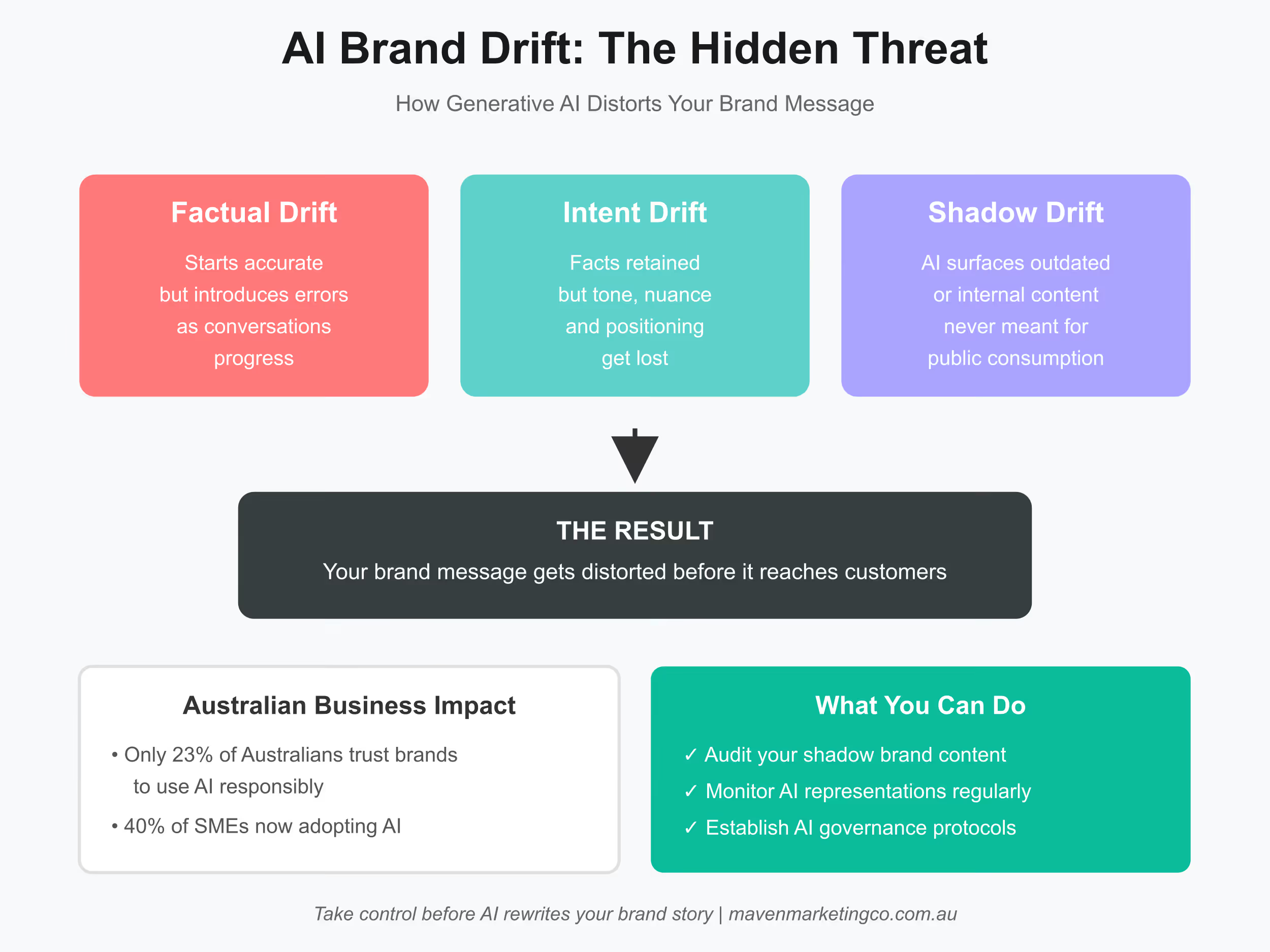
Factual Drift: The AI starts with accurate information but introduces errors as conversations progress. Outdated product specs, incorrect pricing, or superseded policies can suddenly become the "truth" an AI confidently shares with your prospects. These aren't obvious mistakes that customers might question. They're plausible errors that sound authoritative, making them more dangerous to your reputation.
Intent Drift: Facts remain intact, but your carefully crafted tone, positioning, and nuance evaporate. Your premium brand gets described in generic terms. Your commitment to sustainability becomes a checkbox mention. Your unique value proposition blends into competitor messaging until you're indistinguishable. The statistical nature of large language models means they naturally gravitate toward the "average" way of expressing ideas, smoothing away the distinctive edges that make your brand recognisable.
Shadow Brand Drift: AI systems surface content from your digital footprint that was never meant for public consumption, old presentations, internal wikis, recruitment PDFs, partner documents. If it's online, even buried deep, it's training material for AI models. This creates a parallel brand narrative built from fragments you never intended to be your public face.
The Real World Cost of AI Hallucinations
The damage from AI brand distortion isn't theoretical. Companies worldwide are already paying the price when AI confidently generates false information about their brand.
In late 2024, a Canadian tribunal forced Air Canada to honour a discount after its AI customer service chatbot confidently cited a nonexistent "bereavement fare" policy. The airline faced financial damages and days of embarrassing headlines. Their defence that "the AI made the mistake" didn't work in court or public opinion.
When Google's Bard chatbot incorrectly claimed during a promotional video that the James Webb Space Telescope took the first picture of an exoplanet, the company's market value dropped $100 billion in a single day. One false statement, delivered with AI confidence, triggered massive financial consequences.
An Australian mayor was falsely accused by ChatGPT of being guilty in a bribery case despite actually being a whistleblower. These aren't edge cases. They're warning signs of what happens when AI systems generate content without adequate oversight.
According to industry experts, AI chatbots providing inaccurate information harm customer trust and brand reputation with far reaching consequences. Misleading AI generated content can misinform customers, while flawed recommendations alienate them, reducing engagement and damaging your brand's image substantially.
The Australian Context: Why This Matters More Here
Only 23% of Australians trust organisations to use AI responsibly, well below the global average of 29%. Meanwhile, 58% fear automation will prevent them from connecting with real people when needed. This scepticism makes brand drift even more damaging in the Australian market.
When AI misrepresents your brand, you're not just losing accuracy. You're confirming the worst fears of an already wary customer base. Recent analysis of major Australian companies like CBA and Telstra shows that inconsistent AI related messaging creates immediate credibility gaps, fuelling union criticism and negative headlines that spread rapidly on social media.
The stakes are higher because Australian consumers have longer memories and tighter communities. One distorted brand message can ricochet through industry groups, social channels, and word of mouth networks faster than you can issue a correction. In markets where personal reputation and trusted relationships drive business decisions, AI generated misinformation doesn't just cost you a customer. It costs you their entire network.
Four Critical Vulnerabilities Every Business Faces

Research from Meta and Anthropic identifies what happens when AI takes control of your narrative:
1. Loss of Coherence: Your messaging loses clarity. The logical flow breaks down. Self consistency crumbles. Customers encounter contradictions that erode trust. When your website says one thing, your chatbot says another, and your email marketing tells a third story, customers stop believing any of it.
2. Loss of Relevance: AI generated content becomes saturated with irrelevant information. Your key messages get diluted. What should take three sentences to explain takes thirty, and the point gets lost. The signal to noise ratio collapses until customers give up trying to understand what you actually offer.
3. Loss of Truthfulness: Fabricated details emerge. Statements diverge from facts. What starts as a minor error snowballs into misinformation that's harder to correct than if you'd never published anything. Once false information enters the AI training ecosystem, it spreads and reinforces itself across multiple platforms.
4. Narrative Collapse: When AI outputs become training data for other AI systems, your original intent morphs beyond recognition. This recursive loop creates what researchers call "model collapse", where each generation loses fidelity until the output becomes generic noise. Your carefully crafted brand story becomes an unrecognisable amalgamation of competing narratives.
The Hidden Danger: When Your Team Stops Thinking Critically
Perhaps the most insidious consequence of AI brand drift isn't what the technology does to your external messaging. It's what reliance on unverified AI outputs does to your team's critical thinking skills.
When teams depend on AI without scrutiny, they gradually lose the habit of questioning, verifying, and thinking deeply about brand consistency. AI hallucinations become symptomatic of a broader problem: organisational disengagement from the very messages that define your competitive position.
The best approach treats AI as collaboration, not dependence. Your team's judgment remains irreplaceable. AI should amplify human creativity and efficiency, never replace the strategic thinking that protects your brand's unique voice in the market.
What Australian Businesses Can Do Right Now
Audit Your Shadow Brand: Map every piece of content online that could train an AI model. Internal documents, old websites, archived materials, partner portals, recruitment presentations. If it's accessible anywhere online, it's trainable data. Remove or update anything off message. This isn't paranoia. It's protecting your narrative before AI systems weaponise your own forgotten content against you.
Establish Comprehensive AI Governance: Create clear, documented protocols for how your team uses AI tools. Who approves AI generated content? What's the mandatory review process? Where's the human oversight checkpoint? What happens when AI generates content that contradicts your brand guidelines? Without governance frameworks, you're playing Russian roulette with your reputation every time someone hits "generate."
Monitor AI Representations Religiously: Build systematic processes for tracking how AI represents your brand. Regularly search for your company in ChatGPT, Google's AI Overviews, Claude, Perplexity, and other AI platforms. What story are they telling? Is it accurate? Is it current? Is it aligned with your positioning? Document what you find and track changes over time. This isn't optional monitoring. It's competitive intelligence about your own brand.
Provide Clear, Structured Brand Information: Make it easy for AI to get your story right. Maintain updated, authoritative sources that clearly state your positioning, values, and key messages. Use schema markup and structured data on your website. Create comprehensive brand voice guidelines. The clearer and more accessible your official narrative, the more likely AI systems will default to accurate representations.
Implement Rigorous Content Audits: Review all customer facing content quarterly at minimum. Is your messaging consistent across channels? Have you updated changed policies everywhere they appear? Are outdated materials still indexed by search engines? Have product descriptions, pricing, or service offerings changed without corresponding updates across all platforms? Inconsistencies in your own content multiply when AI systems attempt to synthesise information from conflicting sources.
Train Your Entire Team on Semantic Drift: Everyone creating or approving content needs to understand how AI distorts messaging. Brief them on the risks with real examples. Show them what factual drift, intent drift, and shadow brand drift look like in practice. Make brand consistency a measurable priority with clear accountability, not a vague aspiration mentioned in quarterly meetings.
Define and Enforce Brand Voice Standards: Create detailed brand voice charts that serve as reference guides for anyone involved in content creation. According to research on maintaining brand voice consistency, establishing clear guidelines about tone, style, values, and personality is crucial before deploying any AI tools. These standards become your defence against tone flattening and inconsistent persona problems.
Build Verification Workflows: Never trust AI outputs without validation. Create mandatory checkpoints where human experts review AI generated content against brand standards before publication. Use AI as a starting point for drafts, but always add the human touch that ensures authenticity and accuracy.
Establish Transparency Protocols: When you use AI significantly in content creation, consider brief disclosures that build trust rather than hiding AI involvement. Modern consumers increasingly support transparency requirements. Disclosure doesn't weaken your brand when paired with evidence of human oversight and quality control.

The Trust Factor: Why Getting This Right Matters
A 2024 survey found that people believe only 41% of what they read online is both accurate and human generated. More than three quarters say they trust the internet less than they used to. Most support legal requirements for AI disclosure.
In this environment, brand voice stops being a copywriting detail and becomes a strategic risk. Your brand's consistency, authenticity, and reliability directly impact whether sceptical consumers choose to trust you over competitors.
AI isn't inherently your enemy. It's a powerful tool that can scale your messaging and improve efficiency. But without proper guardrails, monitoring, and human oversight, it becomes a risk multiplier that erodes the very trust you've spent years building.
The Bottom Line
AI driven brand drift isn't a future threat. It's happening now. While you've been focused on creating great products and serving customers, AI systems have been quietly reshaping your narrative. The companies that recognise this reality and take action will maintain control of their brand story. Those that ignore it will wake up one day wondering why their reputation doesn't match their reality.
Consider the compounding effect: every piece of distorted brand messaging that enters the AI ecosystem becomes training data for future outputs. Every hallucination that goes uncorrected reinforces itself across multiple platforms. Every inconsistency in your own content multiplies when AI systems attempt to synthesise information.
Your competitors are either figuring this out or suffering from it. The ones who understand AI brand drift are implementing governance frameworks, monitoring their AI representations, and maintaining rigorous content standards. The ones who don't are bleeding credibility without understanding why customer trust is eroding.
Which group will you join?
The choice isn't whether to use AI. That ship has sailed. AI is already interpreting, reshaping, and presenting your brand to customers whether you participate in the process or not. The choice is whether you'll take control of how AI represents you, or whether you'll surrender your narrative to algorithms trained on incomplete, outdated, and contradictory information.
Take Control of Your Brand Narrative Today
Don't let AI systems rewrite your story without your knowledge. At Maven Marketing Co., we help Australian businesses audit their digital presence, identify brand drift vulnerabilities, and implement comprehensive strategies to maintain message integrity across AI platforms.
Your brand has taken years to build. Don't let it erode in months because of unchecked AI distortion.
We understand the unique challenges facing Australian businesses in an AI driven marketplace. Our team combines deep expertise in brand management, digital marketing, and AI technology to deliver solutions that protect your reputation while leveraging AI's benefits.
Contact Maven Marketing Co. today for a comprehensive brand messaging audit and discover what AI is really saying about your business. Let's ensure your brand story remains yours to control.

Table of contents
read more blogs
Is Google Ads Better Than SEO for My Business
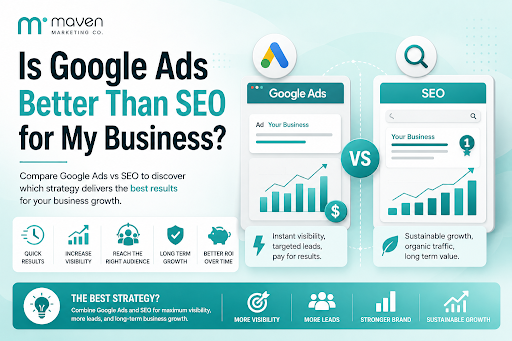
One of the biggest questions business owners ask when they are planning online growth is whether they should invest in Google Ads or SEO. Both are strong marketing plays that help your company show up in Google search results, but they do things in separate lanes. Google Ads gives quicker visibility and can bring in leads fast, whereas SEO more or less focuses on slow, steady organic traffic that tends to grow the longer you keep building it. Picking the right direction depends on what you want to achieve, how much money you can spend, how crowded the market is, and how quickly you need results, like sooner rather than later. The good news is you don’t always have to choose one or the other; it’s not exactly a black-and-white situation. If you take time to understand the strongest points of both, you can put together a more sensible digital marketing plan that supports consistent expansion. In this guide, we’ll compare Google Ads vs SEO, explain the main differences, and help you figure out what option makes the most sense for your business.

When Should I Hire a Digital Marketing Agency
Growing a business today takes more than just having a website or throwing a post on social media; customers usually search around online, compare providers, skim reviews, and basically expect the brand to show up with a solid digital presence before they even think about buying. Many businesses try to run their marketing themselves, but there comes a point when “doing it all in-house” becomes clunky and hard to manage, all at once. Knowing when to hire a digital marketing agency can end up making a big, real difference for your growth. If you’re not getting enough leads, or your online visibility feels stuck, or sales are just not moving, the right agency can bring the know-how, plus a clear plan, to help you get noticeably better outcomes. In this guide, we’ll dig into what a digital marketing agency actually does, the usual signs it’s time to bring one on, and how picking the right marketing partner can help your business move forward at a faster pace.
Why Is My Google Ads Budget Running Out So Quickly
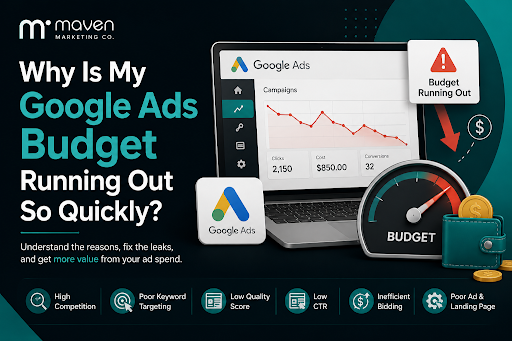
Running a successful Google Ads budget isn’t only about throwing more money at it. It’s more like making every dollar, doing a bit extra. A lot of businesses start a Google Ads campaign with big hopes, then find out their daily budget is gone within a few hours, and that feels weird, right? After that, your ads stop showing effectively, new leads slip away, and your return on investment dips. So if your Google Ads budget is running out too fast, don’t stress. It’s a fairly common issue, and in most situations, it can be repaired with the right approach. There are multiple little things that can drain your advertising money quicker than you expected, from costly keywords to audience targeting that just doesn’t quite fit. In this guide, we’ll walk through why your budget disappears so quickly, how to cut wasteful spend, and the most reliable ways to boost your Google Ads ROI, even if your budget stays the same.


