.svg)


%201.svg)

Key Takeaways
- Guest post outreach earns backlinks through editorial placements on relevant, authoritative publications, combining link building value with referral traffic, brand authority, and relationship building in a single activity.
- Target site selection is the most consequential decision in guest post outreach. A link from a publication with genuine authority and strong topical relevance provides significantly more ranking value than ten links from marginal or unrelated sites.
- Pitches that demonstrate specific familiarity with the target publication, reference recent content, and propose topics that fit the audience's interests and knowledge gaps achieve dramatically higher acceptance rates than generic outreach templates.
- The content delivered for a guest post must meet or exceed the editorial standard of the target publication, as editors remember poor contributions and will not accept future pitches from the same source.
- Google's guidelines distinguish between editorially earned links, which are acceptable and valuable, and links obtained through link schemes or paid placements presented as editorial, which can result in manual actions against the linking or linked site.
- Australian businesses should prioritise placements on Australian publications for local search authority and on relevant international publications for broader topical authority, with the selection guided by audience relevance rather than domain metrics alone.
- A sustainable guest post programme requires a pipeline approach: continuously researching new targets, developing pitch angles, maintaining relationships with editors, and tracking placement outcomes over time rather than conducting outreach campaigns conducted once and not sustained.
The Value of an Editorial Link
Not all backlinks are equal in their contribution to search authority, and the editorial quality of a link is one of the most significant factors determining its value. An editorial link is one that appears in published content because an editor judged the linking source to be genuinely relevant and valuable to their audience. It was not paid for, not exchanged on a reciprocal basis, and not placed through a link network or directory submission. It exists because a human being at a credible publication made a deliberate decision that the content it points to is worth recommending.
Google's approach to link evaluation is designed to identify and reward exactly this kind of link. The signals it uses to assess link quality include the topical relevance of the linking site to the linked site, the authority of the linking domain as established through its own link profile, the placement of the link within the content (links within editorial body copy are valued more highly than sidebar or footer links), and the naturalness of the anchor text. Editorial links from relevant, authoritative publications typically score well across all of these dimensions.
For Australian businesses, the competitive reality of organic search in most industries is that building a backlink profile with genuine editorial depth is necessary to compete with established players who have accumulated authority over years or decades. Guest post outreach is the most direct path to acquiring these links at meaningful scale without waiting passively for other sites to link to the content unprompted.
The referral traffic value of guest post placements is an additional commercial benefit that is easily underestimated. A strategically placed article on a publication whose readership overlaps with the target customer profile can generate qualified leads directly, independent of its SEO contribution. The best guest post targets are those where the editorial link value and the audience relevance are both high.
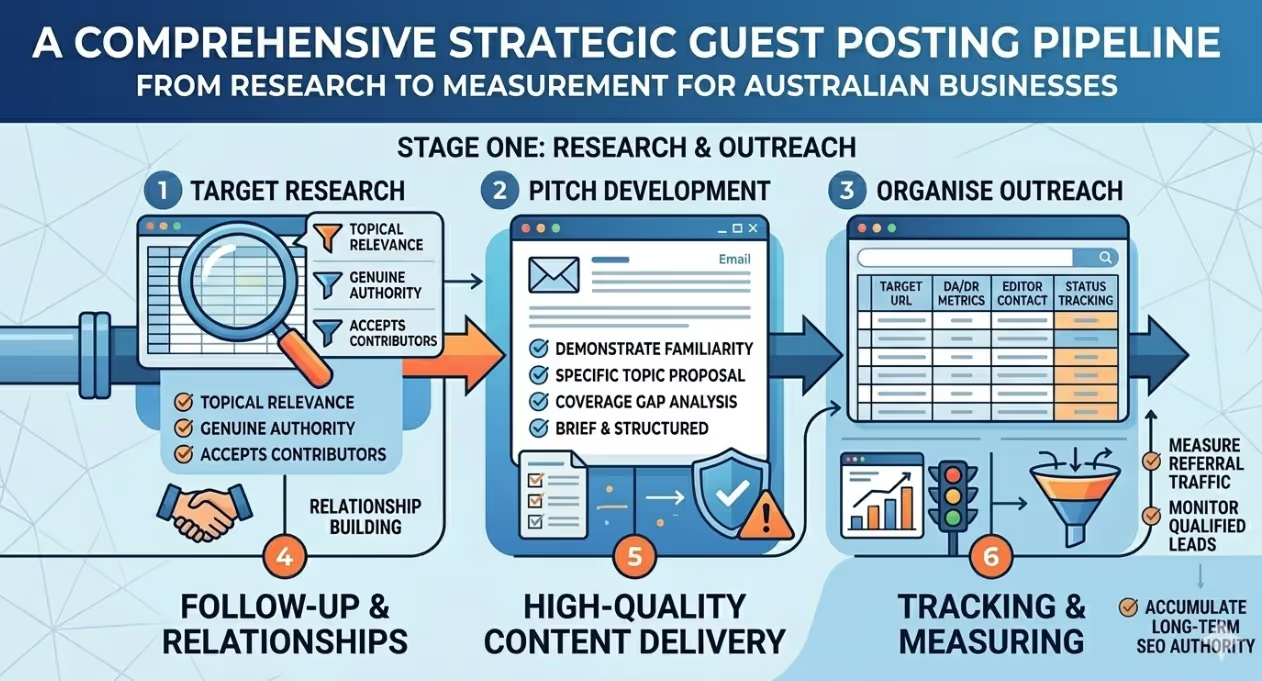
Step One: Target Research and Selection
Target research is the most important phase of guest post outreach and the one most frequently compressed or skipped in favour of moving directly to pitching. The quality of the target list determines the ceiling on what the outreach programme can achieve.
The ideal guest post target is a publication that meets four criteria simultaneously. It covers topics relevant to the pitching brand's industry or audience. It publishes content from contributors outside its own editorial team, meaning it genuinely accepts guest contributions. It has a meaningful audience and domain authority that will make the resulting link valuable. And its editorial standard is consistent enough that a link from it will be regarded as a genuine endorsement rather than a signal of link acquisition of poor quality.
Identifying relevant targets requires research across several discovery methods. Searching for publications in the industry using terms such as "[industry] write for us" or "[industry] contributor guidelines" surfaces sites that actively solicit guest contributions. Reviewing the existing guest post profiles of competitors, using tools such as Ahrefs or Semrush to see where they have earned links, reveals established targets that have already demonstrated a willingness to publish contributed content in the relevant topic area. Monitoring industry newsletters, roundups, and syndication networks identifies publications that regularly feature contributed voices.
Domain authority metrics from tools such as Moz Domain Authority, Ahrefs Domain Rating, and Semrush Authority Score provide a useful initial filter but should not be the primary selection criterion. A publication with a moderate domain rating and a highly relevant, engaged audience in the target industry will deliver more commercial value than a publication with a high domain rating in an unrelated field. For Australian businesses, prioritising publications whose audiences are based in Australia or cover Australian industry topics specifically is generally more valuable for local search authority than comparable placements on overseas publications without Australian audience overlap.
A research spreadsheet tracking each target's name, URL, domain metrics, topical relevance, contact details, contributor guidelines URL, and outreach status provides the organisational foundation for running a sustained programme without losing track of where each target is in the pipeline.
Step Two: Pitch Development
A pitch email to a publication editor is a piece of business writing with one purpose: to convince a busy person that accepting a guest contribution from the sender is worth their time. Editors of quality publications receive many generic pitches per week. The pitches that succeed are the ones that demonstrate, specifically and concisely, that the sender has read the publication, understands its audience, and has something genuinely valuable to offer.
Research the publication before writing a single word. Read five to ten recent articles published on the target site. Identify the topics they cover, the style and depth at which they cover them, the audience level they address, and any obvious gaps in coverage that a contributed article could fill. The pitch should demonstrate this familiarity explicitly, not claim it in general terms.
Propose a specific, developed topic rather than a vague subject area. A pitch that proposes to "write about digital marketing" is not a pitch. A pitch that proposes "a guide to setting up Google Analytics 4 event tracking for Australian ecommerce sites, covering the five custom events that most GA4 setups miss and how to validate them before relying on the data for reporting decisions" is a pitch with enough specificity that the editor can evaluate whether it fits their audience and editorial calendar.
Connect the proposed topic to a gap or extension of existing coverage. Referencing a specific article the publication has already run and positioning the proposed piece as a natural natural extension, a counterpoint, or a deeper exploration of a dimension the existing article did not cover demonstrates that the pitch has been developed for this publication rather than sent to fifty sites simultaneously.
Keep the pitch brief and structured. A pitch should be readable in sixty seconds. The standard structure covers who the sender is and why they are credible on this topic, the specific article title and angle proposed, a brief explanation of why this topic is valuable for the publication's audience, and two or three proposed subheadings or key points to give the editor a sense of the article's scope. Links to one or two published writing samples relevant to the proposed topic close the pitch.
Step Three: Following Up and Managing Relationships
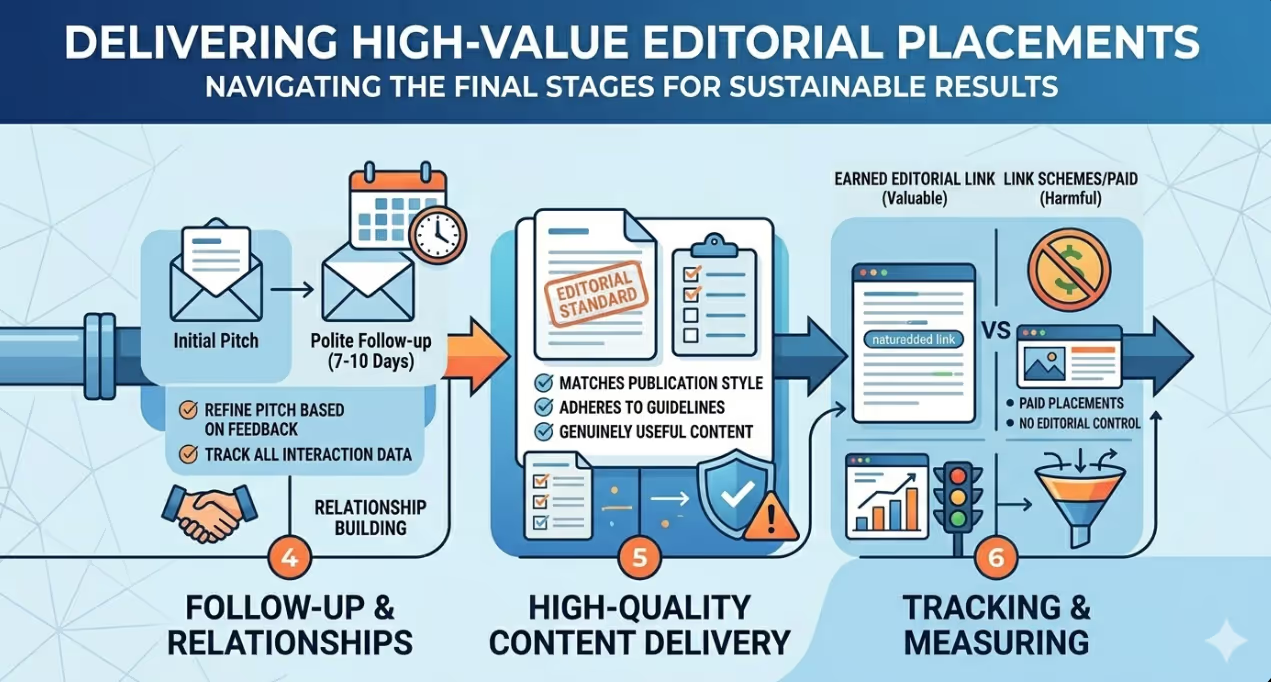
Most editors who will ultimately accept a pitch do not respond to the first email. A single polite follow up email, sent seven to ten days after the initial pitch, is standard practice and increases response rates substantially without creating the negative impression that aggressive or repeated follow up creates. The follow up email should be a brief addition to the original email thread, not a fresh pitch, and should restate the key value of the proposed article in one sentence before asking whether the editor had a chance to consider the proposal.
Editors who decline a pitch have provided valuable information. A decline that comes with feedback about why the topic does not fit is an invitation to pitch again with a more appropriate angle. A decline with no reason is a signal to either refine the approach for this publication or move it to a lower priority in the pipeline. An editor who responds positively but asks for revisions or a different angle is a relationship worth investing in, even if the first pitch does not result in an immediate placement.
Tracking all outreach interactions in the research spreadsheet, including dates of initial contact, dates of follow up contact, responses received, and outcomes, prevents the unprofessional situation of contacting again an editor who has already declined, or losing track of a positive response that required a revised pitch.
Step Four: Content Delivery and Link Placement
When a pitch is accepted, the standard of the content delivered determines both the outcome of this placement and the likelihood of future opportunities with the same publication. Delivering content that is below the quality promised in the pitch, that requires extensive editorial revision, or that reads as promotional rather than genuinely informative will result in the article being declined after acceptance, accepted with heavy revisions that may remove or weaken the target link, or published once without further opportunities.
The content delivered for a guest placement should be among the best work the brand produces, not a piece produced under time pressure to meet an opportunity. It should match the publication's editorial style, adhere to any word count or formatting requirements specified in the contributor guidelines, include appropriate references and supporting data, and read as genuine editorial content rather than a marketing piece with a link embedded.
Link placement within guest posts requires care. Google is attentive to guest post link patterns, and links that appear in contexts that look designed rather than editorial can be discounted or flagged. The most natural and valuable link placement is within the body of the article at a point where the reference is genuinely relevant to the argument being made. Anchor text should be descriptive of the content it links to and should vary naturally across different placements rather than repeating exact keyword phrases that would look unnatural in editorial writing.
Google's guidelines on link schemes explicitly address guest posting as a link building tactic and distinguish between guest posts where the primary purpose is link acquisition with little editorial value and genuinely useful contributed content that earns links as a secondary benefit. The distinction matters practically: building a guest post programme around genuine editorial value is both safer from a Google penalty perspective and more effective at building the long-term publication relationships that compound in value over time.
Identifying and Avoiding Low-Quality Targets
The guest posting landscape includes a significant volume of sites that exist primarily or entirely as link selling platforms, presenting themselves as genuine publications while operating as paid link networks. Placing content on these sites provides no meaningful SEO value and may cause harm, as Google's spam detection systems identify link networks and may penalise the sites receiving links from them.
Signs that a publication is a link scheme rather than a genuine editorial outlet include an explicit statement that links are included in return for payment, contributor guidelines that impose no quality requirements on submitted content, a back catalogue of articles that show no thematic consistency or editorial voice, an implausibly broad range of topic coverage with no apparent specialisation, and contact forms or emails that immediately offer link packages rather than discussing editorial fit.
For Australian businesses, legitimate targets include industry association publications, trade journals, regional business media, professional services publications, specialist blogs with demonstrable audiences and genuine editorial standards, and reputable national media outlets with contributor programmes. These targets are harder to pitch successfully than link farms, but the placements they provide are worth vastly more in both SEO and commercial terms.
FAQs
How many guest post pitches should an Australian business send per month to build meaningful results?
The volume of pitches that produces meaningful results depends on the quality of the target list, the specificity of the pitches, and the conversion rate achieved. As a practical starting benchmark, an Australian business conducting guest post outreach as a sustained programme rather than a activity conducted once and not sustained should aim to research and pitch ten to fifteen new targets per month, with a goal of securing two to four placements per month over time. Conversion rates from pitch to placement in quality editorial outreach typically range from ten to 25 percent for well targeted, carefully crafted pitches on genuinely relevant targets, and lower for generic outreach. The emphasis should be on quality of targeting and pitch quality rather than raw volume: fifty generic pitches sent to poorly matched targets will produce fewer and placements of lower quality than fifteen specific, researched pitches to genuinely qualified targets.
Should Australian businesses disclose that guest posts are written for SEO purposes?
The disclosure question has both an ethical and a practical dimension. Google's guidelines require that links in guest posts intended primarily for link building carry a rel="nofollow" or rel="sponsored" attribute. Publications that require this attribute on contributed content links are effectively reducing the SEO value of the placement, which is why many guest post programmes focus on targets that do not impose this requirement. The more commercially important principle is that the editorial value of the guest post should be genuine regardless of the link building motivation: content that is worth reading and sharing provides the publication's audience with value, which is the basis on which editorial relationships are built and maintained. Treating guest posting as a legitimate editorial activity that happens to include a link, rather than as a link delivery mechanism dressed up as content, is both more sustainable and more effective over time.
How long does it take for guest post links to affect search rankings?
The time between a link being published and its effect on search rankings becoming measurable is variable and depends on several factors including how quickly Googlebot discovers and crawls the linking page, how quickly the linking domain's authority is reassessed, the competitiveness of the queries being targeted, and the number of links in the campaign. In practice, individual guest post links from quality publications typically take four to twelve weeks to show measurable impact in ranking data, with the effect accumulating over a longer period as more placements are added to the profile. A sustained guest post programme of two to four placements per month on genuinely relevant, publications with genuine authority typically produces measurable organic ranking improvements within six to twelve months, with results that compound as the link profile deepens. Australian businesses expecting immediate results from individual placements will consistently underestimate the value of a link building programme evaluated over its full twelve to eighteen month horizon.
Earned Links Are the Foundation of Durable Authority
A backlink profile built through genuine editorial placements is one of the most defensible assets in SEO. Unlike technical optimisations that can be replicated quickly or changes to the page that competitors can match immediately, a set of editorial relationships with quality publications in an industry takes time and genuine effort to build, and it is not easily replicated by a competitor who has not made the same investment. For Australian businesses with a view that extends over the long term of their organic search performance, guest post outreach conducted with editorial seriousness is among the activities with the highest return the marketing team can undertake.
Maven Marketing Co manages guest post outreach programmes for Australian businesses, from target research and pitch development through to content production and placement tracking.
Talk to the team at Maven Marketing Co →

Table of contents
read more blogs

How to Choose the Right Digital Marketing Channels for Your Business
Choosing digital marketing channels is one of the easiest places for businesses to lose clarity. There are more options than ever, every platform promises reach and results, and it is easy to assume that the best strategy is simply to be everywhere. In reality, most businesses do better when they choose channels with intention rather than spreading budget and effort too thinly.The right channel mix depends on where your audience spends time, how they search or discover solutions, what your business is trying to achieve and how much resource you actually have to support execution properly. A channel is only useful if it helps move the right people towards a commercial outcome that matters to the business.This is why strong digital marketing strategy is not really about finding one perfect platform. It is about understanding the role each channel can play across awareness, demand capture, conversion and retention. SEO might build long-term visibility, Google Ads might capture active intent, social media might support familiarity and reach, while email may help nurture prospects and strengthen customer value over time.This guide explains what digital marketing channels are, how to assess them properly and how to build a balanced channel mix for your business. The focus is practical. Rather than chasing every new platform, the goal is to help you choose the channels that fit your audience, goals, budget and internal capability.

How to Build a Customer Journey Map for Your Digital Marketing Strategy
A strong digital marketing strategy is not just about channels, creative or traffic. It is about understanding how real people move from first awareness through to enquiry, purchase and ongoing loyalty. That is exactly why customer journey mapping matters.Without a clear view of the journey, businesses often optimise in fragments. They improve the website without thinking about the ad that drove the visit, produce content without considering where the audience is in the decision process, or judge conversion performance without understanding the friction points that sit earlier in the experience.A customer journey map helps you step back and see the bigger picture. It shows the stages people move through, the touchpoints they interact with, the questions they ask, the barriers they face and the moments where your marketing can either help or lose them.This guide explains how to build a practical customer journey map for your digital marketing strategy, what information to include, how to use the map to improve performance and which common mistakes to avoid. The goal is not to create a pretty workshop artefact that gets forgotten. It is to build a working tool that improves messaging, user experience, channel decisions and conversion outcomes.

Why Your Google Ads Campaign Is Not Getting Results: Common Mistakes and Solutions
If your Google Ads campaign is getting impressions or clicks but not producing enough enquiries, sales, or qualified leads, the problem is usually not Google Ads itself. It is more often a strategy, tracking, or conversion issue somewhere in the system.That matters because paid search can look busy without being commercially effective. You can have traffic coming in, a reasonable click-through rate and money leaving the account every day, yet still have very little to show for it if your keywords are weak, your ad copy is misaligned, your landing pages do not convert or your tracking is incomplete.A strong campaign works as one connected chain. Search intent, keyword targeting, ad relevance, bidding, landing-page experience, and conversion tracking all need to support the same commercial outcome. If one link breaks, results usually suffer quickly.This guide explains the most common reasons a Google Ads campaign is not getting results, what those issues normally look like in practice and how to fix them without relying on guesswork. The focus is not on vanity metrics. It is on improving lead quality, conversion rate, and return on spend.