.svg)


%201.svg)

Quick Answers
What is the difference between SEO and GEO for Australian businesses in 2026?
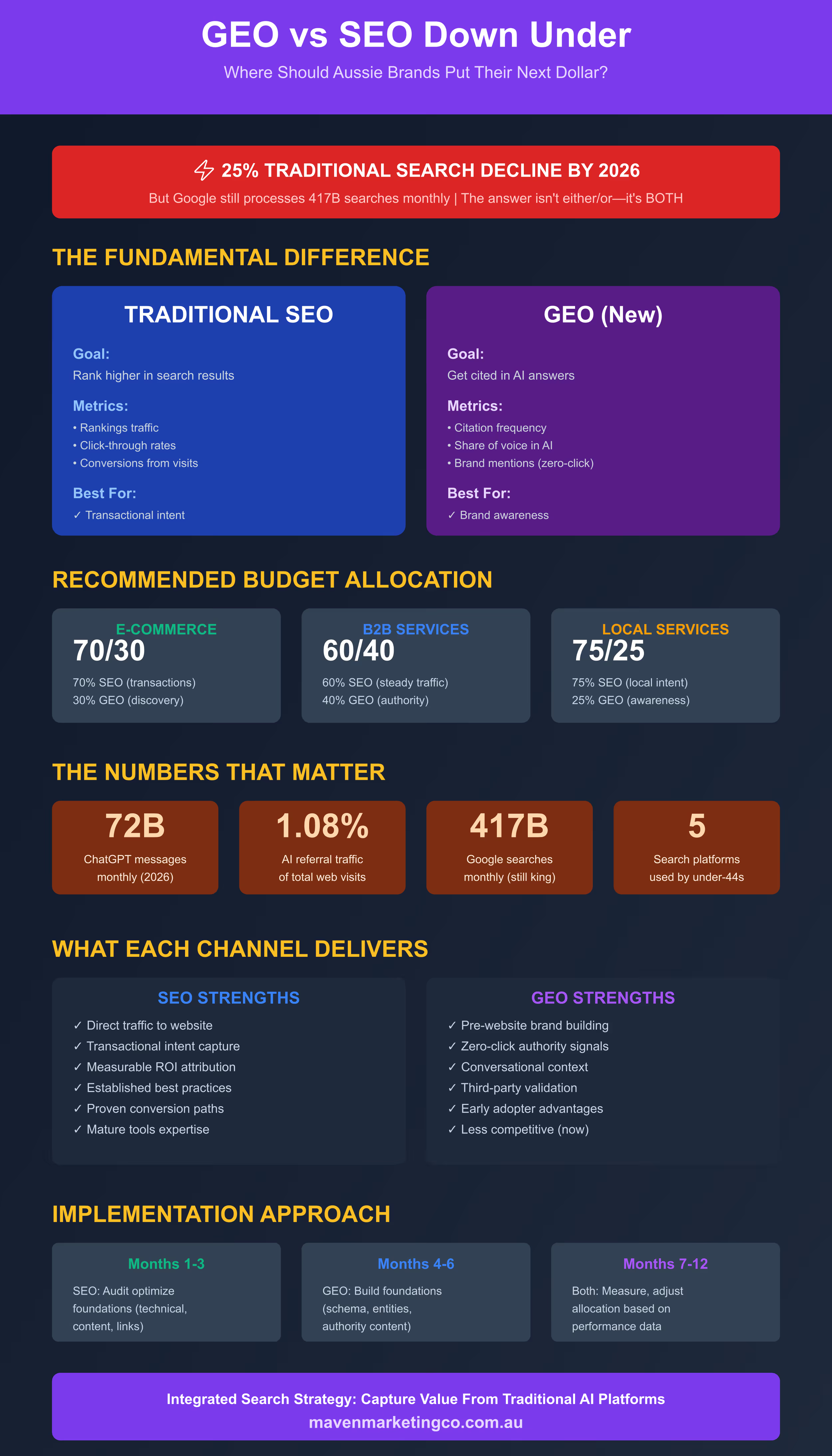
SEO focuses on ranking higher in traditional search engine results pages, whilst GEO focuses on getting your brand cited or referenced inside AI-generated answers. Traditional SEO optimizes for keywords, backlinks, technical site health, and user engagement signals that determine where you appear in Google search results. Generative Engine Optimization optimizes for how AI platforms like ChatGPT, Perplexity, Google AI Overviews, and Claude select, synthesize, and cite your content when generating responses to user queries. The fundamental difference lies in success metrics: SEO measures rankings, traffic, and click-through rates, whilst GEO measures reference rates, citation frequency, and share of voice within AI-generated answers. For Australian businesses, this distinction matters because users increasingly receive complete answers from AI platforms without clicking through to websites, creating zero-click scenarios where brand visibility occurs without traffic generation. Strong SEO provides advantages for GEO since AI platforms prioritize authoritative, well-structured content with clear expertise signals, but ranking alone does not guarantee AI citations. GEO expands beyond your website, as AI engines pull from third-party mentions, forums, reviews, and diverse sources when deciding what to cite, demanding broader digital ecosystem management than traditional SEO ever required.
Should Australian businesses invest in GEO or SEO in 2026, and what budget allocation makes sense?
The strategic answer is not either/or but systematic integration of both, with allocation depending on industry, audience demographics, and business model. For most Australian businesses, maintain 60 to 70 percent of search marketing budget on proven SEO foundations whilst allocating 30 to 40 percent toward GEO experimentation and implementation. SEO remains critical because traditional search still drives measurable traffic, conversions occur through website visits, and Google continues dominating Australian search market share despite AI platform growth. However, early GEO investment creates compound advantages as AI platforms increasingly influence purchase decisions before prospects visit websites. Industries targeting younger demographics or technical audiences should weight GEO higher, as these groups adopt AI search faster. B2B businesses benefit particularly from GEO since decision makers research through AI platforms synthesizing complex information. E-commerce requires maintaining strong SEO for transactional queries whilst using GEO for product discovery and brand awareness. The optimal approach treats SEO as foundation whilst systematically building GEO capabilities, measuring which channel drives specific business outcomes, and adjusting allocation quarterly based on performance data rather than industry hype or fear of missing out on emerging trends.

Your marketing director asks a simple question: "Should we invest in traditional SEO or this new GEO thing everyone's talking about?"
You do not have a simple answer.
The False Choice: Understanding the Real Question
Australian brands face a perceived either-or decision that frames the question incorrectly. The strategic reality is not SEO versus GEO but rather understanding how these complementary approaches work together whilst allocating finite budgets across both.
The urgency stems from measurable shifts. ChatGPT alone processes 72 billion messages monthly, whilst users under 44 now use an average of five platforms for search including TikTok, Reddit, review sites, and AI assistants. Discovery has fragmented beyond Google's historical monopoly.
Yet Google still processes 417 billion searches monthly. Traditional search remains dominant whilst AI platforms grow rapidly from relatively small bases. For Australian businesses, this creates strategic tension requiring nuanced resource allocation rather than binary choices.

What Traditional SEO Still Delivers in 2026
Despite AI disruption predictions, traditional SEO continues delivering measurable value through mechanisms that GEO cannot yet replicate.
Direct Traffic Generation
SEO drives users to your website where conversion events occur. E-commerce transactions, lead form submissions, demo bookings, and countless other business-critical actions require website visits. GEO creates awareness through AI mentions but typically does not drive immediate traffic at scale.
AI referral traffic currently represents just 1.08% of total website visits, growing approximately 1% monthly. This remains tiny compared to organic search traffic from traditional SEO efforts. For Australian businesses measuring ROI through conversion events, SEO's traffic-driving capability justifies continued investment.
Transactional Intent Capture
When users search with clear purchase intent, they want links to vendors, not AI summaries. Searches like "buy noise-cancelling headphones Sydney" or "Melbourne plumber emergency service" demand immediate action that only traditional search results enable.
GEO excels at informational queries where users seek answers, recommendations, or understanding. SEO dominates transactional queries where users want to complete actions. Australian businesses selling products or services cannot abandon the channel capturing bottom-funnel intent.
Measurable Attribution
Traditional SEO provides clear attribution from keyword rankings through traffic to conversions. You see which queries drive traffic, which pages convert, and can calculate precise ROI for optimization investments.
GEO attribution remains murky. When AI platforms mention your brand without linking, how do you measure business impact? Awareness builds, but connecting AI citations to revenue requires sophisticated tracking that most Australian businesses lack currently.
Established Best Practices
Twenty-five years of SEO evolution created proven methodologies, comprehensive tools, and deep expertise pools. Australian businesses can hire experienced SEO specialists, access mature tooling, and implement strategies with predictable outcomes.
GEO remains experimental with methodologies evolving rapidly, limited specialized talent, and tools still maturing. The risk-reward calculation favors proven SEO tactics for businesses unable to absorb experimentation costs.
What GEO Uniquely Enables
Despite SEO's continued relevance, GEO creates visibility opportunities that traditional search optimization cannot deliver.
Pre-Website Brand Building
AI citations build brand awareness before users visit websites. When ChatGPT recommends your accounting software or Perplexity cites your company in industry analysis, you gain mind-share with prospects who may never click through immediately.
This top-funnel visibility compounds over time. Repeated exposure through AI platforms establishes familiarity and trust that traditional search rankings struggle to match. For Australian brands competing against established international players, AI citation frequency can level playing fields that SEO dominance cannot crack.
Zero-Click Authority
AI-generated answers provide complete information without requiring clicks. Users receive product comparisons, feature explanations, and recommendations directly within AI interfaces. Brands cited in these responses gain authority associations even without traffic.
For Australian service businesses particularly, this authority building proves valuable. When AI platforms consistently cite your legal firm for property law questions or recommend your marketing agency for small business clients, you build market positioning that influences offline conversations and referrals beyond digital attribution.

Conversational Context Capture
AI interactions are conversational, contextual, and iterative. Users refine queries, ask follow-ups, and explore topics deeply within single sessions. GEO-optimized content appears throughout these extended conversations, maintaining visibility across multi-turn interactions.
Traditional SEO captures single query moments. GEO enables sustained presence throughout discovery journeys as users explore topics comprehensively. For complex B2B purchases common among Australian businesses, this extended visibility influences decision-making more effectively than isolated search result appearances.
Third-Party Validation
AI platforms synthesize information from diverse sources including reviews, forums, social media, and third-party mentions. GEO extends beyond your website to your entire digital ecosystem, requiring reputation management and presence across platforms where AI discovers information about your brand.
This ecosystem approach forces Australian businesses to manage their complete digital footprint rather than just optimizing owned properties. The shift from domain authority to entity authority demands broader strategies than traditional SEO ever required.
The Budget Allocation Framework
Australian businesses need systematic approaches allocating resources between SEO and GEO based on their specific contexts rather than industry averages or competitor behaviors.
Start With Business Model Analysis
E-commerce businesses selling physical products should maintain 70% SEO, 30% GEO allocation. Product discovery and transactions require website visits that SEO drives, whilst GEO builds brand awareness in competitive categories.
B2B service businesses benefit from 60% SEO, 40% GEO splits. Complex sales cycles involve extensive research where AI platform visibility throughout extended decision journeys influences outcomes significantly.
Local service businesses should prioritize 75% SEO, 25% GEO. Local search intent demands immediate action through website visits, phone calls, or directions that traditional search results enable better than AI citations.
Content publishers and media businesses might experiment with 50/50 splits. AI platforms increasingly surface content directly, potentially displacing traffic whilst building authority and reach.
Audience Demographics Matter
Younger audiences adopt AI search faster than older demographics. Australian businesses targeting Gen Z and millennials should weight GEO higher, as these cohorts increasingly default to ChatGPT or Perplexity for discovery.
Professional and technical audiences research through AI platforms more frequently than general consumers. B2B brands targeting developers, marketers, or technical decision-makers benefit from elevated GEO investment.
Budget-conscious consumers seeking comprehensive comparisons use AI platforms to research purchases thoroughly before vendor website visits. Brands competing primarily on price or features should maintain strong SEO whilst building GEO presence for discovery phase influence.
Geographic Considerations
Australian market specificity creates both challenges and opportunities. Content addressing Australian-specific contexts, regulations, and market conditions gets cited more frequently in AI responses to Australian users than generic international content.
Geographic distance from major AI training data sources means Australian perspectives are underrepresented in base models. Creating Australia-focused content fills gaps AI platforms recognize and cite when serving Australian users.
Smaller Australian market size relative to US and European markets means lower competitive intensity for AI citations. Australian businesses implementing GEO systematically face fewer competitors than their international counterparts, creating first-mover advantages.
Implementation: SEO Foundations First, GEO Layer Second
Practical implementation for most Australian businesses should prioritize SEO foundations whilst systematically adding GEO capabilities rather than attempting parallel full-scale deployments.
Month 1-3: SEO Audit and Optimization
Ensure technical SEO fundamentals are solid including fast site speed, mobile responsiveness, clean site architecture, and proper indexing. These technical foundations benefit both traditional search and AI platform crawling.
Conduct comprehensive keyword research identifying terms your Australian audience actually searches. Focus on commercial intent keywords driving conversions rather than purely informational queries.
Optimize high-value pages for target keywords through on-page SEO including title tags, meta descriptions, header structures, and content optimization. Prioritize pages driving revenue or leads over comprehensive site-wide optimization.
Build authoritative backlink profiles through digital PR, content marketing, and relationship building with relevant Australian websites. Domain authority built through traditional SEO provides advantages for GEO citation selection.
Month 4-6: GEO Foundation Building
Implement comprehensive schema markup across your site using Product, Organization, LocalBusiness, FAQ, and other relevant schema types. Structured data helps AI platforms understand your content relationships and authority signals.
Create cornerstone content pieces answering common questions in your industry comprehensively. These depth-oriented resources get cited more frequently by AI platforms synthesizing information.
Develop clear entity relationships connecting your brand to relevant topics, industries, and concepts. Ensure consistency in how your organization is described across all digital properties.
Begin tracking AI citations manually by periodically querying ChatGPT, Perplexity, and Google AI Overviews for brand mentions and competitor comparisons in your category.
Month 7-12: GEO Expansion and Measurement
Expand presence across third-party platforms including industry directories, review sites, forums, and social media where AI discovers information about brands. This ecosystem presence influences AI citation decisions beyond your owned properties.
Create data-driven content including original research, surveys, and statistics that other sources reference. AI platforms prioritize citing primary data sources, creating citation advantages for content producers.
Implement proper AI visibility tracking using tools like LLMrefs, Amplitude AI Visibility, or similar platforms providing systematic citation measurement. Replace manual checking with automated monitoring.
Adjust allocation based on measured performance. If AI citations drive meaningful brand awareness or influence tracked through surveys or brand search volume increases, shift more resources toward GEO. If traditional SEO continues driving disproportionate revenue, maintain current allocation.
The Measurement Challenge: Tracking What Matters
Measuring GEO effectiveness requires different frameworks than traditional SEO metrics given the zero-click nature of AI visibility.
Citation Frequency and Share of Voice
Track how often your brand appears in AI responses to relevant queries compared to competitors. Share of voice within AI-generated answers indicates brand prominence regardless of traffic generation.
For Australian businesses, measure citation frequency for Australian-specific queries separately from generic international queries. Your local market citation performance matters more than global averages.

Brand Search Volume
Monitor branded search volume in traditional search engines as a proxy for awareness built through AI citations. Users discovering your brand through AI platforms often search your name directly afterward for verification or additional information.
Increases in branded search volume following GEO implementation suggest AI visibility is driving awareness even without direct traffic attribution from AI platforms.
Assisted Conversion Tracking
Implement survey questions asking how prospects discovered your brand. Include options for AI platforms like ChatGPT, Perplexity, or Google AI alongside traditional channels.
This qualitative data reveals AI platform influence on customer journeys even when analytics cannot attribute visits directly to AI sources.
Sentiment and Accuracy
Monitor not just citation frequency but how AI platforms describe your brand. Inaccurate information, negative sentiment, or missing key value propositions indicate optimization opportunities.
For Australian businesses, ensure AI platforms correctly represent your local market focus, Australian ownership, or other differentiating factors relevant to domestic customers.
Common Mistakes Australian Businesses Make

The SEO versus GEO tension creates predictable errors that waste resources and miss opportunities.
Abandoning SEO Prematurely
Some Australian businesses, reading sensational predictions about search's death, reallocate entire SEO budgets toward GEO. This creates immediate traffic and revenue declines that experimental GEO gains cannot offset yet.
Traditional search remains dominant for transactional intent. Abandoning proven traffic sources for experimental channels creates unnecessary risk.
Ignoring GEO Completely
Conversely, many Australian businesses dismiss GEO as hype, maintaining 100% SEO focus whilst competitors build AI visibility. This creates compounding disadvantages as early movers establish citation history that becomes harder to displace.
The window for establishing AI presence whilst competition remains moderate is narrowing. Waiting until GEO is mature and proven means entering when advantages have already accrued to early adopters.
Treating GEO as SEO 2.0
GEO requires different content approaches, broader ecosystem management, and distinct success metrics than traditional SEO. Applying SEO tactics directly to GEO creates suboptimal results.
Content optimized for AI citations emphasizes authority signals, structured data, clear entity relationships, and comprehensive topic coverage differently than keyword-optimized SEO content.
Expecting Immediate ROI
GEO operates on longer time horizons than traditional SEO. Citation frequency builds gradually as AI platforms index and begin trusting your content. Expecting immediate traffic or revenue from GEO implementation creates disappointment.
Australian businesses should frame GEO as brand building and market positioning rather than direct response channels, adjusting ROI expectations accordingly.
The Australian Advantage in GEO

Despite geographic distance and smaller market size, Australian businesses possess unique advantages implementing GEO strategies effectively.
Lower Competitive Intensity
Fewer Australian businesses are optimizing systematically for AI citations compared to US and European markets. This creates opportunities for Australian brands to dominate local AI visibility whilst international competitors focus on their home markets.
Australian-specific queries face less competition for AI citations, making it easier to become the cited authority for topics relevant to Australian audiences.
Content Gap Opportunities
AI platforms' training data underrepresents Australian perspectives, regulations, and market conditions. Creating comprehensive Australia-focused content fills gaps AI recognizes when serving Australian users.
Content addressing Australian tax law, consumer protections, market dynamics, and cultural contexts gets cited preferentially for Australian queries given limited alternative sources.
Cultural and Linguistic Nuance
Australian English, terminology, and cultural references differentiate content from generic international alternatives. AI platforms recognize these signals when determining which sources are most relevant for Australian users.
For local businesses particularly, this cultural alignment creates defensible advantages that international competitors cannot easily replicate without Australian market knowledge and presence.
Looking Forward: The 2027 Reality
The SEO versus GEO tension will resolve not through one channel defeating the other but through strategic integration as complementary approaches serve different purposes.
Hybrid Search Interfaces
Expect traditional search results and AI-generated answers to coexist within unified interfaces. Google already implements this through AI Overviews appearing alongside traditional results. This hybrid model will extend across platforms.
Australian businesses need optimization strategies addressing both result types simultaneously rather than choosing between them. Content must rank in traditional results whilst earning AI citations.
Platform Proliferation
AI search will not consolidate into single platforms but fragment across dozens of specialized assistants. Health inquiries might flow to medical AI, legal questions to legal AI, financial research to finance-specific platforms.
Australian businesses must identify which AI platforms their specific audiences use rather than attempting presence across every emerging platform. Strategic focus on relevant platforms beats thin presence everywhere.
Regulatory Evolution
Australian and international regulations around AI transparency, attribution, and commercial relationships with cited sources will evolve throughout 2026-2027. These regulatory frameworks will clarify citation practices and potentially create paid citation opportunities.
Early adopters establishing organic citation presence will have advantages regardless of how paid citation markets develop, similar to early SEO movers benefiting before paid search advertising matured.
Your Strategic Decision
The question is not should Australian brands invest in SEO or GEO. The question is what allocation achieves your specific business objectives given your audience, business model, competitive landscape, and risk tolerance.
For most Australian businesses in 2026, the pragmatic answer is 60-70% SEO maintenance combined with 30-40% GEO experimentation, adjusting quarterly based on measured performance rather than industry hype.
The businesses dominating their markets in 2027 will be those that started building systematic GEO capabilities in 2026 whilst maintaining proven SEO foundations, not those who chose one channel exclusively.
Ready to develop an integrated search strategy that captures value from both traditional search and AI platforms? The specialists at Maven Marketing Co. build comprehensive search strategies for Australian businesses navigating fragmentation. We do not recommend abandoning proven SEO tactics or rushing blindly into unproven GEO experiments. We conduct thorough audience analysis determining where your specific customers actually search, implement systematic SEO optimization maintaining traffic and revenue from traditional search, build strategic GEO foundations through schema markup, entity optimization, and ecosystem presence, establish measurement frameworks tracking both traditional and AI visibility, and adjust allocation quarterly based on data rather than guesswork. Stop agonizing over SEO versus GEO as if they were competitors. Contact us today for an integrated search strategy audit revealing exactly where your next dollar should go based on your unique business context, not generic industry recommendations.

Table of contents
read more blogs
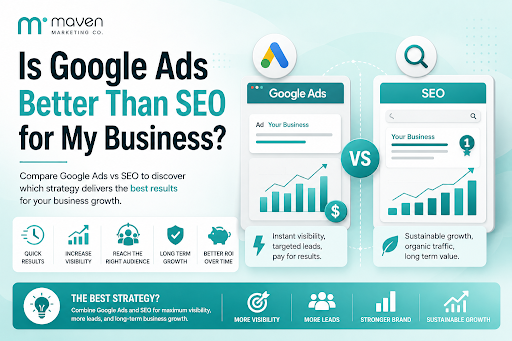
Is Google Ads Better Than SEO for My Business
One of the biggest questions business owners ask when they are planning online growth is whether they should invest in Google Ads or SEO. Both are strong marketing plays that help your company show up in Google search results, but they do things in separate lanes. Google Ads gives quicker visibility and can bring in leads fast, whereas SEO more or less focuses on slow, steady organic traffic that tends to grow the longer you keep building it. Picking the right direction depends on what you want to achieve, how much money you can spend, how crowded the market is, and how quickly you need results, like sooner rather than later. The good news is you don’t always have to choose one or the other; it’s not exactly a black-and-white situation. If you take time to understand the strongest points of both, you can put together a more sensible digital marketing plan that supports consistent expansion. In this guide, we’ll compare Google Ads vs SEO, explain the main differences, and help you figure out what option makes the most sense for your business.

When Should I Hire a Digital Marketing Agency
Growing a business today takes more than just having a website or throwing a post on social media; customers usually search around online, compare providers, skim reviews, and basically expect the brand to show up with a solid digital presence before they even think about buying. Many businesses try to run their marketing themselves, but there comes a point when “doing it all in-house” becomes clunky and hard to manage, all at once. Knowing when to hire a digital marketing agency can end up making a big, real difference for your growth. If you’re not getting enough leads, or your online visibility feels stuck, or sales are just not moving, the right agency can bring the know-how, plus a clear plan, to help you get noticeably better outcomes. In this guide, we’ll dig into what a digital marketing agency actually does, the usual signs it’s time to bring one on, and how picking the right marketing partner can help your business move forward at a faster pace.
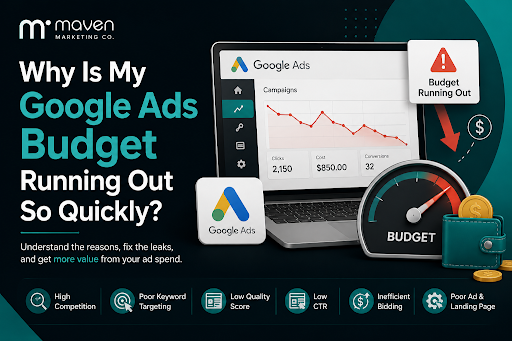
Why Is My Google Ads Budget Running Out So Quickly
Running a successful Google Ads budget isn’t only about throwing more money at it. It’s more like making every dollar, doing a bit extra. A lot of businesses start a Google Ads campaign with big hopes, then find out their daily budget is gone within a few hours, and that feels weird, right? After that, your ads stop showing effectively, new leads slip away, and your return on investment dips. So if your Google Ads budget is running out too fast, don’t stress. It’s a fairly common issue, and in most situations, it can be repaired with the right approach. There are multiple little things that can drain your advertising money quicker than you expected, from costly keywords to audience targeting that just doesn’t quite fit. In this guide, we’ll walk through why your budget disappears so quickly, how to cut wasteful spend, and the most reliable ways to boost your Google Ads ROI, even if your budget stays the same.