.svg)


%201.svg)
Key Takeaways
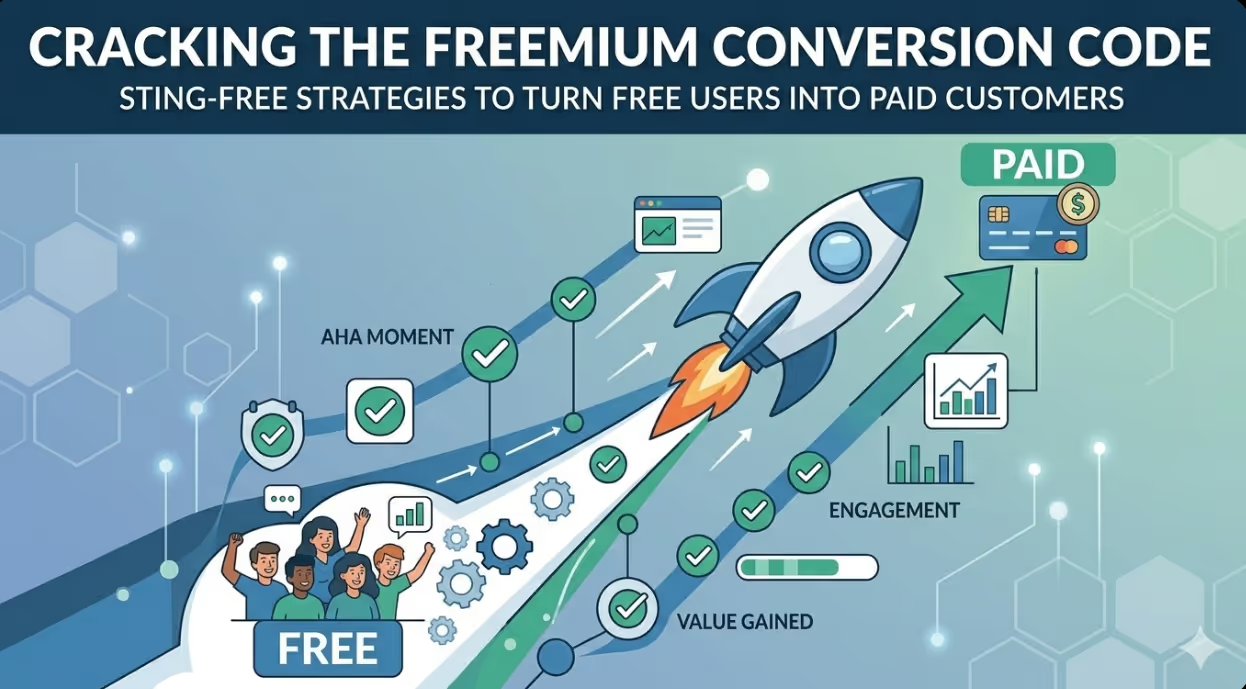
- Freemium conversion is determined primarily by the product experience, not by the upgrade prompt. The decision to convert is made across days or weeks of product use, and the prompt is simply the mechanism that captures a decision that has already been formed.
- The free tier must deliver genuine, meaningful value to the user. A free tier that is so limited as to be barely functional does not demonstrate the product's worth. It demonstrates its frustration potential, and users who are frustrated leave rather than upgrade.
- The value fence, the specific limit or capability that separates the free tier from the paid tier, must be placed at the point where the user has already experienced enough value to justify paying, not at the point where they have experienced so little that the paid tier seems speculative.
- In-product upgrade prompts that appear at moments of genuine friction, when the user is trying to do something the free tier does not support, convert significantly better than prompts that appear at arbitrary intervals or on pages the user visits regardless of intent.
- Lifecycle email sequences for free users should be designed to accelerate value realisation in the free tier, not to pressure upgrade before the user has experienced enough to justify the decision. A user who has not yet reached their aha moment is not ready to convert.
- Identifying the specific usage patterns and product events that correlate with conversion is the analytical foundation of freemium optimisation. The features used, the sessions completed, and the milestones reached in the first two to four weeks of free use predict conversion probability with meaningful accuracy in most products.
- Free-to-paid conversion is not the only commercial outcome to optimise. Reducing free user churn and extending the active free user lifespan increases the number of users who eventually reach the conversion decision, even among users who take longer than average to get there.
The Structure of the Freemium Conversion Decision
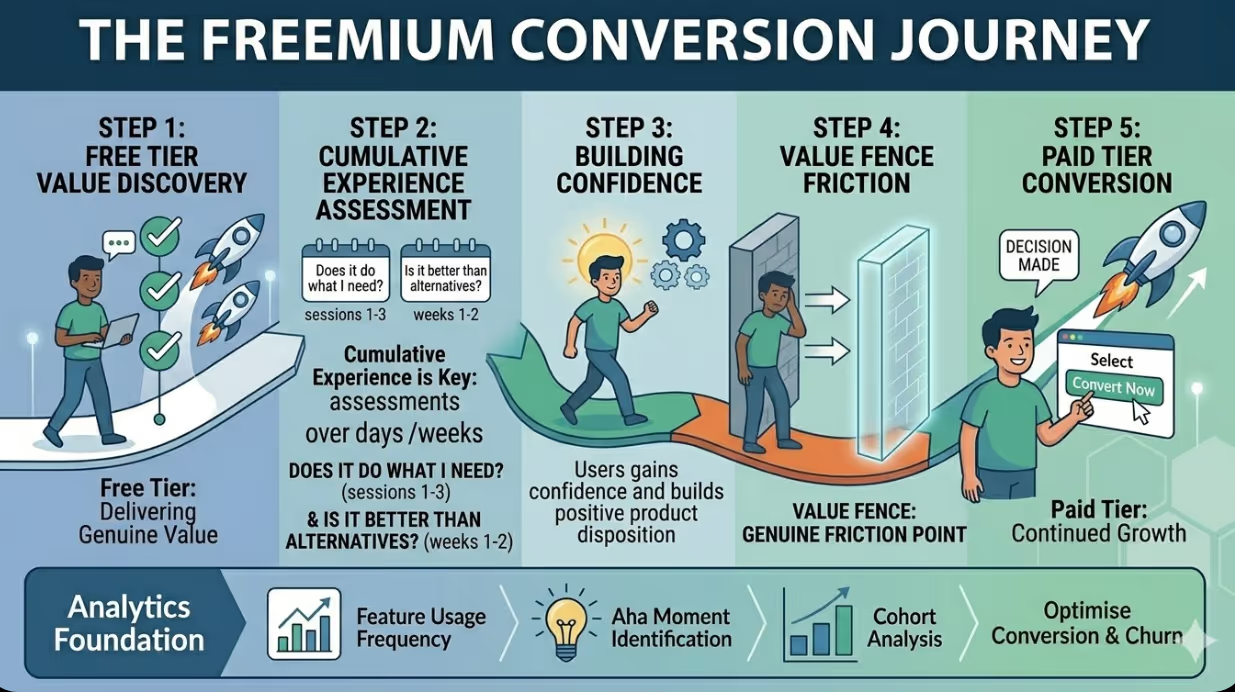
The conversion from free to paid is not a single decision made at the moment the user sees the upgrade prompt. It is the accumulation of a series of smaller assessments the user makes throughout their free tier experience:
Does this product do what I need? This is assessed in the first one to three sessions. If the free tier demonstrates the core capability of the product clearly and the user can accomplish their primary goal, the answer is yes. If the free tier is so constrained that the user cannot get a clear picture of what the product is actually capable of, the answer is uncertain, which often converts to departure.
Is this product better than the alternatives I already have? This is assessed over the first one to two weeks of use. The user is comparing the product to their existing workflow, their existing tools, and the competitors they considered before signing up. If the product has a clear superiority in at least one commercially important dimension, the conversion probability increases.
Is the paid tier worth the cost for the value I have already received? This is the direct commercial question, and it is answered by the cumulative experience of the free tier, not by the content of the pricing page. A user who has experienced significant value in the free tier approaches the pricing page with a positive disposition. A user who has experienced friction, uncertainty, or indifference approaches it sceptically.
Is now the right time to commit? This is the timing question that separates users who convert promptly from those who convert eventually and from those who never convert despite having formed a positive product disposition. Triggers that make the timing feel right include reaching the free tier limit on a task the user genuinely needs to complete, a workflow change that makes the paid features newly relevant, or an external prompt like an email that arrives at a moment of renewed product engagement.
Understanding which users are at which stage of this assessment sequence at any given time is the foundation of a freemium programme optimised for conversion.
Designing the Value Fence
The value fence, the combination of features, limits, and capabilities that distinguishes the free tier from the paid tier, is the most consequential product decision in a freemium model. Get it wrong and the freemium product either gives away too much (making the paid tier feel unnecessary) or too little (making the free tier too frustrating to demonstrate value).
The free tier must demonstrate the product's core value proposition. If the product's fundamental value is in a feature that is locked behind the paid tier, the user has no basis for judging whether the paid version is worth their money. The free tier should allow the user to experience the thing that makes the product genuinely useful, with limits on the scale, frequency, or depth of that experience rather than a complete removal of it.
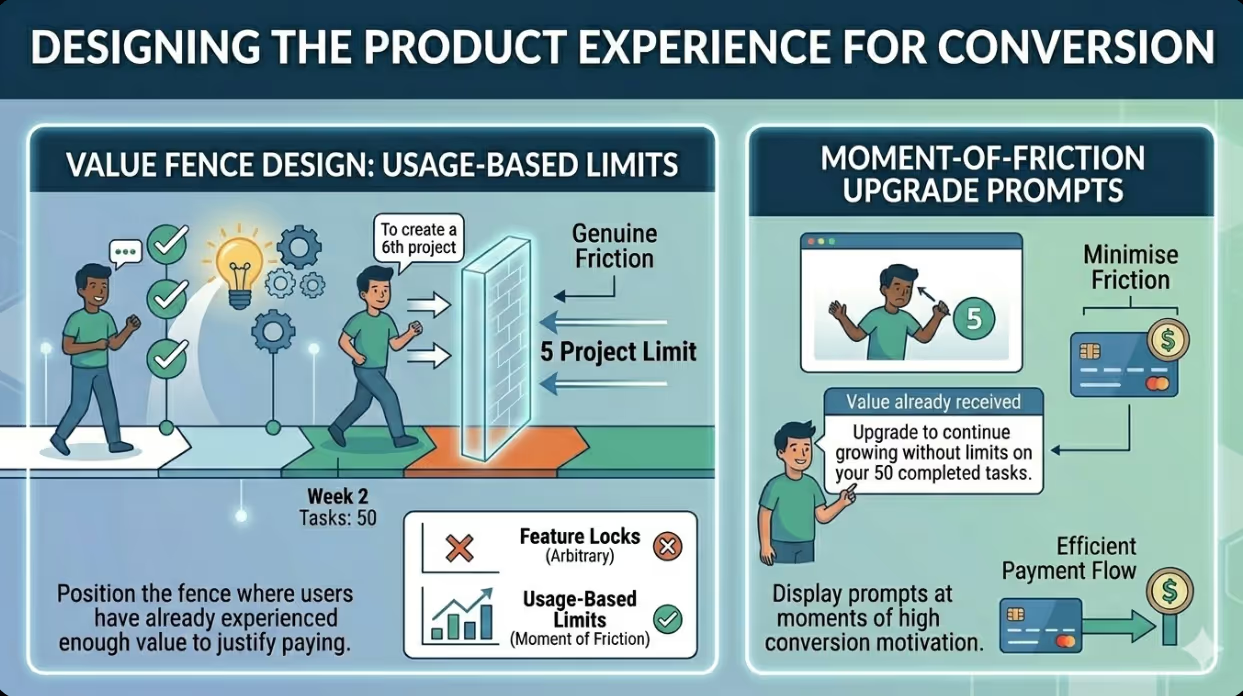
The paid tier must solve a problem the user has already encountered. The most effective value fences are placed at points where the user hits a limit they find genuinely frustrating because they are trying to accomplish something specific. "You have reached the 5 project limit. Upgrade to create unlimited projects" is effective when the user is actively trying to create a sixth project and genuinely needs it. It is ineffective when the user has used two projects and the limit feels abstract.
Feature exclusivity in the paid tier should be features the power user needs, not features the average user needs. If a feature that every user needs is locked behind the paid tier, the free tier cannot demonstrate the product's value and the user leaves rather than upgrades. If the paid tier adds capabilities that early users rarely need but active, committed users cannot work without, the value fence creates the right dynamic: a free experience that demonstrates value, a conversion trigger that arrives when the user's usage has grown to the point where the paid features become necessary.
Usage-based limits are more effective conversion triggers than feature locks. Limits on the quantity of a core action (number of projects, number of reports, number of contacts, gigabytes of storage) allow the user to experience the full product functionality and develop genuine usage habits, then hit a limit at the point where they are sufficiently engaged to make upgrading feel like a natural continuation rather than a speculative commitment.
In-Product Upgrade Prompts
The upgrade prompt is the surface through which the conversion decision is captured. Its timing, placement, and message determine how effectively it converts the disposition formed through product experience into an actual upgrade action.
Moment-of-friction prompts convert better than ambient prompts. A prompt that appears when the user is actively trying to do something the free tier does not support is arriving at the exact moment of highest conversion motivation. The user has just experienced the value fence directly and has a concrete task they want to complete. The prompt should acknowledge the specific action they were trying to take and explain precisely how the upgrade enables it.
The prompt message should reference the value already received. A user who has been using the product for six weeks and has completed forty tasks in the free tier is a different conversion prospect from a user who signed up yesterday. The prompt can and should acknowledge the user's established relationship with the product ("You have been managing 4 projects with us. Upgrade to continue growing without limits.") rather than treating every user as if they are encountering the product for the first time.
Friction in the upgrade path abandons conversions. A user who has decided to upgrade and then encounters a complex payment flow, an unexpected price, a confusing plan comparison table, or a requirement to contact sales will abandon the upgrade at a rate that reflects the friction encountered. The upgrade path should be as short as possible: upgrade decision to active paid account in the fewest possible steps, with pre-population of any information already known about the user.
Trial offers and reversibility reduce upgrade anxiety. Offering a 14 to 30 day paid trial before the first charge, or a straightforward downgrade path back to the free tier if the paid experience does not meet expectations, reduces the perceived risk of converting. For Australian SaaS businesses, the ability to cancel easily and the absence of requirements for a long-term commitment are significant factors in the conversion decision for small to medium businesses that are cautious about recurring software costs.
Lifecycle Email for Free User Conversion
The email sequence for free users is one of the channels with the highest leverage for improving conversion rates, because it operates across the entire free user lifecycle rather than only at the moment of the prompt that appears within the product.
Onboarding emails should accelerate value realisation, not promote upgrading. The first four to eight emails a free user receives should be focused on helping them get maximum value from the free tier: guidance through the core workflow step by step, workflow, prompts to complete setup actions that increase engagement, and explanations of features the user may not have discovered. A free user who has not experienced the product's core value yet is not a conversion candidate, and an upgrade prompt sent before value realisation is perceived as pressure rather than helpfulness.
Emails triggered by usage events convert better than those sent on a fixed schedule. Emails triggered by specific product events, such as completing a first key action, approaching a usage limit, returning after a period of inactivity, or reaching a usage milestone, are more relevant and more commercially effective than emails sent on a fixed schedule regardless of user behaviour. The infrastructure to send emails triggered by usage events requires product analytics integration with the email platform (typically through tools such as Customer.io, Intercom, or Klaviyo for appropriate product types) but the conversion impact justifies the integration investment.
The upgrade email should arrive at the right moment in the product experience. For users who are approaching or have reached the free tier limit on a core metric, an email that specifically references the limit they are about to hit and explains what the upgrade enables is arriving with maximum relevance. For users who have reached a usage milestone that indicates deep engagement, an email that recognises their progress and explains the additional capabilities available in the paid tier is arriving at a moment of high purchase motivation.
Winback sequences for churned free users reactivate a proportion of the departing user base. Free users who go inactive and stop using the product represent a population with known product awareness, known onboarding investment, and a genuine previous reason for signing up. A reactivation sequence that acknowledges the lapse, offers a specific reason to return (a new feature, a use case prompt, or a limited offer), and reduces the barrier to reengagement recovers a proportion of churned free users who would otherwise never return.
Analytics: Finding the Conversion Signals
The analytical foundation of freemium conversion optimisation is identifying which product events, usage patterns, and user characteristics in the first two to four weeks of free use predict subsequent conversion to paid.
Feature usage patterns. Which combination of features does a user who converts typically engage with during their free trial period? The absence of a specific feature engagement in the first two weeks is often a reliable predictor of eventual churn without conversion.
Usage frequency and depth. How many sessions does a converting user typically have in the first 30 days? How many actions do they complete per session? Users who engage frequently and deeply in the early period are significantly more likely to convert than those who log in occasionally and complete few actions.
Aha moment identification. The aha moment is the specific product experience that makes the user's perceived value of the product shift from uncertain to confirmed. Identifying this moment, whether it is completing a specific workflow, seeing a specific output, or reaching a specific milestone, and optimising the free user experience to get more users to that moment faster, is one of the conversion improvements with the highest impact available in any freemium product.
Cohort analysis. Segmenting free users by the cohort that signed up together and tracking the conversion rate of each cohort over time reveals whether conversion rates are improving or declining with product and messaging changes, and at what point in the free user lifecycle conversions are most likely to occur.
FAQs
What free-to-paid conversion rate should an Australian SaaS business expect from a freemium model?
Industry benchmarks for freemium conversion rates vary widely by product category, pricing, and free tier design, but the commonly cited range for B2C and B2B SaaS freemium products is 2 to 5 percent of all registered free users converting to paid within 12 months. Products with strong characteristics of growth led by the product, clear value fences, and conversion programmes that are well optimised can reach 8 to 15 percent. Products with weak value fences, poor onboarding, or misaligned free tier design typically convert below 2 percent. Australian SaaS businesses should benchmark against their specific category rather than the overall average: B2B products with a clear value proposition around productivity or cost savings tend to convert at higher rates than B2C lifestyle or entertainment products where the willingness to pay is lower. The unit economics of the freemium model, the cost of acquiring and supporting a free user versus the lifetime value of a converting paid user, should be calculated for the specific business rather than assumed to be favourable based on category benchmarks alone.
How should Australian digital product businesses balance the generosity of the free tier against conversion pressure?
The most common mistake in freemium tier design is making the free tier too restrictive in an attempt to force conversion. This produces a poor first experience that drives users away before they have had the opportunity to form a positive product disposition, resulting in both a high churn rate from the free tier and a low conversion rate. The principle supported by research is that a more generous free tier, one that allows users to genuinely experience the product's value, produces higher conversion rates than a restrictive one, because conversion is driven by demonstrated value rather than by necessity. The practical limit is a free tier so generous that the vast majority of users never need the paid features: this is the model that produces the sustainable business problem of a large, costly free user base with a very low conversion rate. The optimal free tier design is one where the core use case is fully accessible but the scaling, collaboration, advanced features, or commercial use cases that active power users need are reserved for the paid tier.
Should Australian freemium businesses prioritise optimising the conversion rate of existing free users or increasing the total number of free users acquired?
The answer depends on the current conversion rate relative to what is achievable and the cost of acquisition relative to the value of converting users. If the existing conversion rate from free to paid is significantly below the product category benchmark, optimising the conversion funnel for existing users will produce a higher return than spending the same resource on acquiring more free users who will also convert at the current low rate. Conversion rate optimisation is a multiplier: improving a 1.5 percent conversion rate to 3 percent doubles the commercial output of the same free user base without increasing acquisition costs. Once the conversion rate is at or near the achievable benchmark for the category, the priority shifts toward scaling the free user base to grow the absolute number of converting paid users. For most Australian digital product businesses in the early growth stage, conversion rate optimisation of the existing free user base is the investment with the higher priority.
Free Users Are Not Costs to Minimise. They Are Candidates to Convert.
The strategic error in many Australian freemium businesses is treating the free user base as a cost centre to be minimised rather than as a pipeline to be cultivated. A free user who has been using the product for four months and has not yet converted is not a failed acquisition. They are a user who has been demonstrating sustained product engagement for four months and who is significantly more likely to convert than a free user in their first week. Optimising the freemium conversion funnel means extending the active lifespan of free users, deepening their product engagement, and ensuring that the value fence, the prompts within the product, and the lifecycle email programme are all working together to convert the disposition that the product experience has been building. That is the difference between a freemium model that works and one that looks good on the acquisition dashboard while quietly losing money on every free user it retains.
Maven Marketing Co develops freemium conversion strategy and lifecycle email programmes for Australian SaaS and digital product businesses, from free user onboarding through to upgrade prompt optimisation and paid tier positioning.
Talk to the team at Maven Marketing Co →

Table of contents
read more blogs
Is Google Ads Better Than SEO for My Business
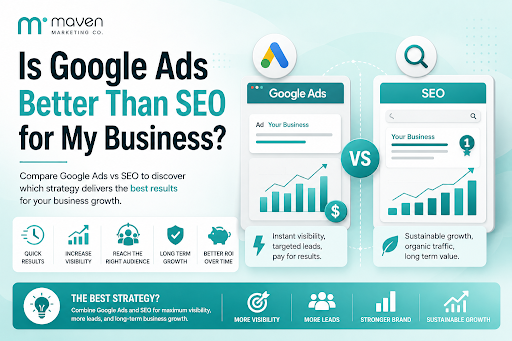
One of the biggest questions business owners ask when they are planning online growth is whether they should invest in Google Ads or SEO. Both are strong marketing plays that help your company show up in Google search results, but they do things in separate lanes. Google Ads gives quicker visibility and can bring in leads fast, whereas SEO more or less focuses on slow, steady organic traffic that tends to grow the longer you keep building it. Picking the right direction depends on what you want to achieve, how much money you can spend, how crowded the market is, and how quickly you need results, like sooner rather than later. The good news is you don’t always have to choose one or the other; it’s not exactly a black-and-white situation. If you take time to understand the strongest points of both, you can put together a more sensible digital marketing plan that supports consistent expansion. In this guide, we’ll compare Google Ads vs SEO, explain the main differences, and help you figure out what option makes the most sense for your business.

When Should I Hire a Digital Marketing Agency
Growing a business today takes more than just having a website or throwing a post on social media; customers usually search around online, compare providers, skim reviews, and basically expect the brand to show up with a solid digital presence before they even think about buying. Many businesses try to run their marketing themselves, but there comes a point when “doing it all in-house” becomes clunky and hard to manage, all at once. Knowing when to hire a digital marketing agency can end up making a big, real difference for your growth. If you’re not getting enough leads, or your online visibility feels stuck, or sales are just not moving, the right agency can bring the know-how, plus a clear plan, to help you get noticeably better outcomes. In this guide, we’ll dig into what a digital marketing agency actually does, the usual signs it’s time to bring one on, and how picking the right marketing partner can help your business move forward at a faster pace.
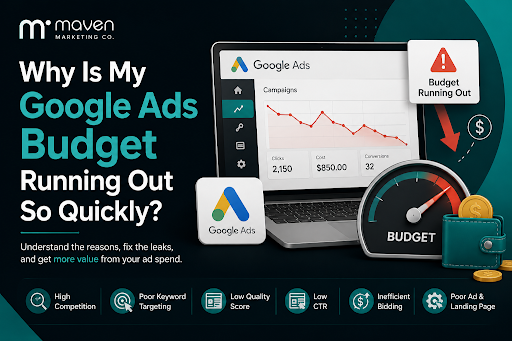
Why Is My Google Ads Budget Running Out So Quickly
Running a successful Google Ads budget isn’t only about throwing more money at it. It’s more like making every dollar, doing a bit extra. A lot of businesses start a Google Ads campaign with big hopes, then find out their daily budget is gone within a few hours, and that feels weird, right? After that, your ads stop showing effectively, new leads slip away, and your return on investment dips. So if your Google Ads budget is running out too fast, don’t stress. It’s a fairly common issue, and in most situations, it can be repaired with the right approach. There are multiple little things that can drain your advertising money quicker than you expected, from costly keywords to audience targeting that just doesn’t quite fit. In this guide, we’ll walk through why your budget disappears so quickly, how to cut wasteful spend, and the most reliable ways to boost your Google Ads ROI, even if your budget stays the same.