
.svg)


%201.svg)

Flat vs. Deep Site Structures in 2026: Which One Actually Wins?
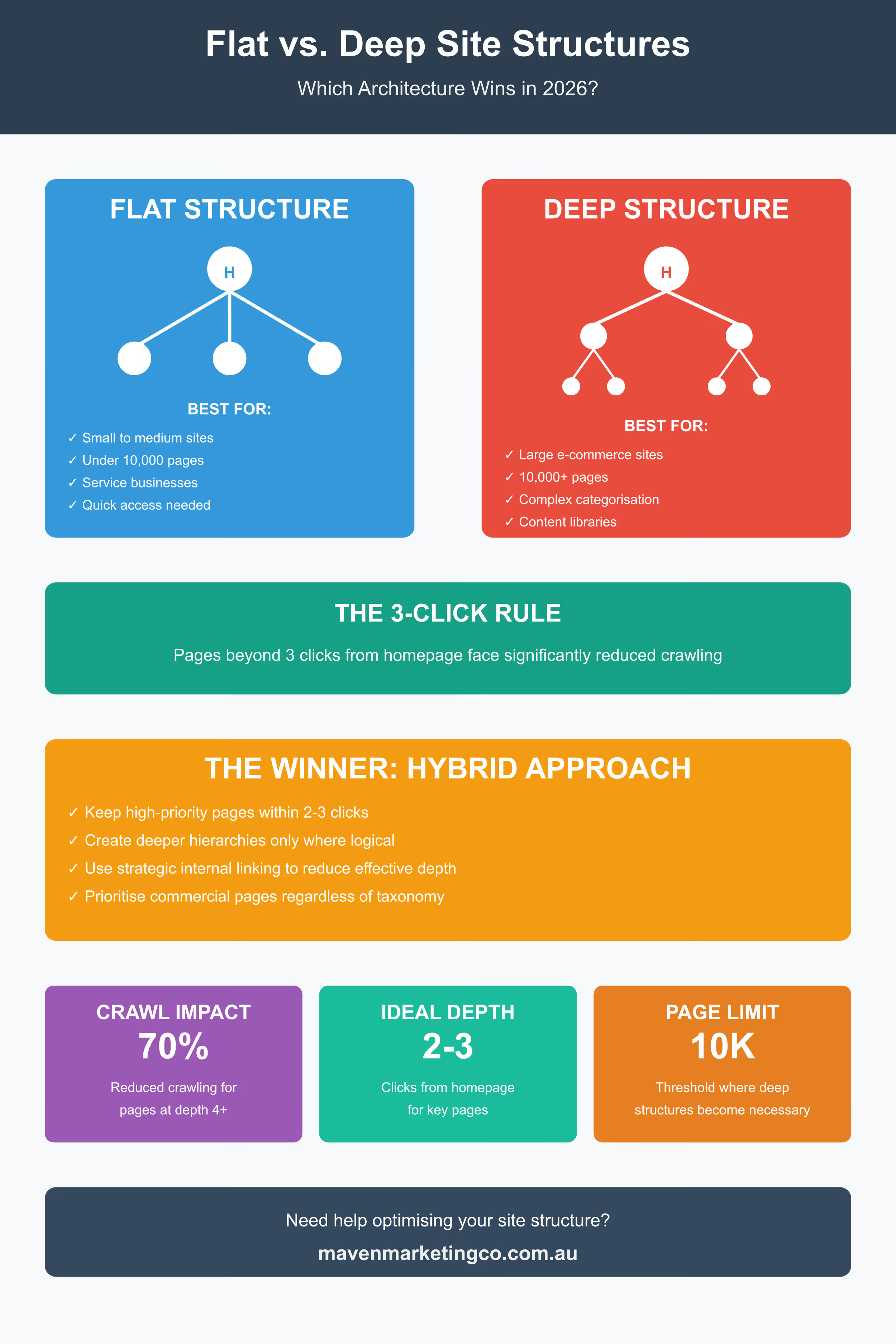
Quick Answer: Neither flat nor deep site structures universally "win" in 2026. Flat architectures excel for smaller sites with straightforward offerings, keeping all content within 3 clicks and maximising crawlability. Deep structures suit large-scale websites with extensive product catalogues or content libraries. The real winner? A strategic hybrid approach that keeps high-priority pages shallow whilst creating logical hierarchies where needed.
Your website's architecture isn't just a technical detail buried in your developer's to-do list. It's the invisible foundation that determines whether Google's crawlers can find your best content, whether visitors can navigate without frustration, and ultimately, whether your site ranks or disappears into the digital void.
Here's what nobody tells you: The debate between flat and deep site structures isn't actually a binary choice. In 2026, with Google's increasingly sophisticated algorithms and the rise of AI-powered search, the question isn't which structure to choose—it's how to strategically blend both approaches to match your specific business needs.
Understanding the Fundamentals: What These Structures Actually Mean
A flat website architecture positions most content pages within just a few clicks from your homepage. Typically, important pages remain accessible within three clicks, creating a shallow hierarchy that prioritises accessibility over categorisation. Think of it as a bungalow—everything spread out on one level, easily reachable.
Deep site architecture, conversely, creates multiple layers of navigation. Users and search engine crawlers must click through several levels to reach specific content—homepage to category to subcategory to product page, for instance. It resembles a high-rise building where you need to take the lift through multiple floors to reach your destination.
The critical distinction here isn't merely aesthetic. These structural decisions fundamentally alter how link equity flows through your site, how search engines allocate their crawl budget, and how users experience your brand.
The Hidden Truth About Crawl Depth and Rankings
Google's crawlers don't explore websites randomly. They follow a specific path, and the number of clicks required to reach a page from your homepage—its crawl depth—directly impacts whether that page gets indexed at all.
Research consistently shows that pages buried beyond depth 3 face significantly reduced crawling frequency. When Google allocates a limited crawl budget to your site, it prioritises pages closer to your homepage. Pages at depth 4, 5, or deeper might be crawled less frequently or potentially ignored entirely, regardless of how brilliant your content might be.
This matters because uncrawled pages cannot rank. It's that simple. You could have the most comprehensive product description or the most insightful blog post, but if Google's bots don't discover it within their allocated time on your site, it might as well not exist.
John Mueller from Google clarified this years ago, and it remains true in 2026: The number of clicks from the homepage signals page importance to search engines. Fewer clicks indicate higher priority. This isn't speculation—it's how Google's algorithms interpret your site's structure.
When Flat Architecture Dominates

Flat structures shine in specific scenarios that many Australian businesses fit perfectly. If you're running a service-based business with distinct offerings—say, an accounting firm with tax services, bookkeeping, and business advisory—a flat structure ensures potential clients can access any service page directly from your homepage.
The advantages stack up quickly. Link equity flows more directly from your strongest page (the homepage) to your content pages, boosting average page authority across your entire site. Search engines can crawl and index your complete site efficiently, often within a single session.
For users, the experience is refreshingly straightforward. No hunting through nested menus or clicking through multiple category pages. They land on your site, see what they need, and get there in one or two clicks. This reduced cognitive load translates directly into lower bounce rates and higher conversion rates.
Small to medium-sized websites—those under 10,000 pages—typically benefit enormously from flat structures. There's simply no need to create elaborate hierarchies when your entire offering can be presented clearly at the top level.
The Case for Deep Structures (And Why They're Not Evil)
Before you rush to flatten everything, understand that deep architectures serve critical purposes for specific types of websites. Large e-commerce platforms, content-heavy publishers, and enterprise sites with thousands of pages cannot function effectively with purely flat structures.
Consider an online retailer selling thousands of products across hundreds of categories. A flat structure would create an overwhelming, unusable navigation nightmare. Deep hierarchies organise vast content libraries into logical, browsable taxonomies that help users narrow their search progressively.
These structures excel at establishing clear relationships between topics. When you create category layers like "Electronics > Smartphones > iPhone > iPhone 15 Pro," you're explicitly telling search engines how these concepts relate. This semantic understanding helps algorithms comprehend your content organisation, potentially capturing broader ranges of search queries through your category and subcategory pages.
The challenge isn't the deep structure itself—it's managing it properly. Deep architectures demand meticulous attention to internal linking, strategic use of breadcrumbs, and deliberate efforts to pass link equity down to deeper pages through well-placed links from higher-authority pages.

The Hybrid Approach: Building What Actually Works in 2026
Here's the reality that successful Australian businesses have discovered: You don't need to choose between flat and deep. You need to strategically blend both approaches based on your content's nature and your users' needs.
Start with a relatively flat top-level structure for your main categories and high-priority pages. These should all sit within 2-3 clicks from your homepage. Then, create deeper hierarchies within specific sections where they make logical sense for organisation and user experience.
For instance, a home renovation business might maintain a flat structure for their main service pages (kitchen renovations, bathroom remodels, extensions) whilst creating deeper structures within their blog section (DIY Tips > Kitchens > Cabinet Refinishing).
The key is ensuring your most commercially important pages—those that drive conversions and revenue—never get buried. If a product page generates significant sales, it deserves a prominent position in your architecture, regardless of where it might theoretically fit in your category taxonomy.
Strategic internal linking becomes your secret weapon here. Even if a page sits at depth 4 in your site's tree structure, you can effectively reduce its crawl depth by linking to it from high-authority pages closer to your homepage. This distributes link equity more effectively and improves crawlability across your entire site.
Practical Implementation for 2026 and Beyond

Building or restructuring your site architecture requires systematic thinking, not guesswork. Start by auditing your current structure using tools like Screaming Frog or Google Search Console to identify pages at excessive depth.
Prioritise your content based on business value. Which pages drive conversions? Which topics establish your authority? These pages deserve the shortest paths from your homepage, regardless of your overall structure approach.
Create robust internal linking throughout your content. Don't just rely on your navigation menu—embed contextual links within blog posts, product descriptions, and service pages that guide users (and crawlers) to related content.
Implement breadcrumbs consistently across your site. These navigational aids help users understand their location within your hierarchy whilst providing additional internal links that reduce effective page depth.
Submit and regularly update your XML sitemap. This acts as a roadmap for search engines, ensuring they discover all your important pages even if your internal linking isn't perfect.
Monitor your site's performance metrics continuously. Watch for pages with high bounce rates or low organic traffic—these often indicate structural problems where users or crawlers struggle to find valuable content.
Making the Decision That Fits Your Business
Your ideal site structure depends entirely on your specific circumstances. A boutique law firm with five practice areas needs a completely different approach from a national e-commerce retailer with 50,000 products.
Consider these factors honestly:
Site size matters. Under 1,000 pages? Flat structures typically perform brilliantly. Over 10,000 pages? You'll need deeper hierarchies simply to maintain usability.
Content relationships are crucial. If your content naturally groups into clear categories and subcategories, embrace that structure. If your offerings are distinct and independent, keep them flat.
User search behaviour dictates success. How do your visitors actually look for content? If they browse categories, deep structures support that behaviour. If they search directly for specific pages, flat structures minimise friction.
Business priorities trump theoretical perfection. Your most profitable pages deserve preferential treatment in your architecture, even if it creates some structural inconsistencies.
Your Next Step Towards Structural Excellence
Website architecture isn't a "set and forget" decision. It's a strategic asset that evolves with your business, requiring regular assessment and optimisation as you grow.
The businesses dominating search results in 2026 aren't those rigidly adhering to pure flat or deep structures. They're the ones strategically designing architectures that serve both their users' needs and search engines' requirements—hybrid approaches that prioritise accessibility whilst maintaining logical organisation.
Ready to transform your website's structure into a competitive advantage? The team at Maven Marketing Co. specialises in architecting high-performing websites that balance user experience with technical SEO excellence. We'll analyse your current structure, identify opportunities for improvement, and implement changes that drive measurable results. Don't let poor site architecture bury your best content—contact us today for a comprehensive site architecture audit.

Table of contents
read more blogs
Is Google Ads Better Than SEO for My Business
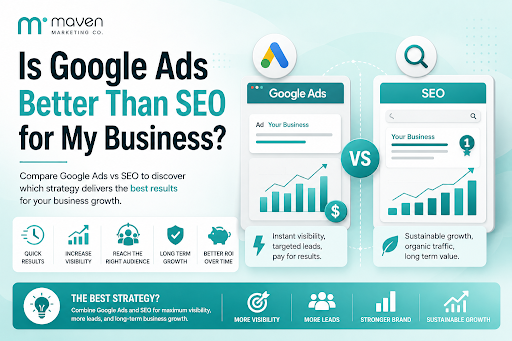
One of the biggest questions business owners ask when they are planning online growth is whether they should invest in Google Ads or SEO. Both are strong marketing plays that help your company show up in Google search results, but they do things in separate lanes. Google Ads gives quicker visibility and can bring in leads fast, whereas SEO more or less focuses on slow, steady organic traffic that tends to grow the longer you keep building it. Picking the right direction depends on what you want to achieve, how much money you can spend, how crowded the market is, and how quickly you need results, like sooner rather than later. The good news is you don’t always have to choose one or the other; it’s not exactly a black-and-white situation. If you take time to understand the strongest points of both, you can put together a more sensible digital marketing plan that supports consistent expansion. In this guide, we’ll compare Google Ads vs SEO, explain the main differences, and help you figure out what option makes the most sense for your business.

When Should I Hire a Digital Marketing Agency
Growing a business today takes more than just having a website or throwing a post on social media; customers usually search around online, compare providers, skim reviews, and basically expect the brand to show up with a solid digital presence before they even think about buying. Many businesses try to run their marketing themselves, but there comes a point when “doing it all in-house” becomes clunky and hard to manage, all at once. Knowing when to hire a digital marketing agency can end up making a big, real difference for your growth. If you’re not getting enough leads, or your online visibility feels stuck, or sales are just not moving, the right agency can bring the know-how, plus a clear plan, to help you get noticeably better outcomes. In this guide, we’ll dig into what a digital marketing agency actually does, the usual signs it’s time to bring one on, and how picking the right marketing partner can help your business move forward at a faster pace.
Why Is My Google Ads Budget Running Out So Quickly
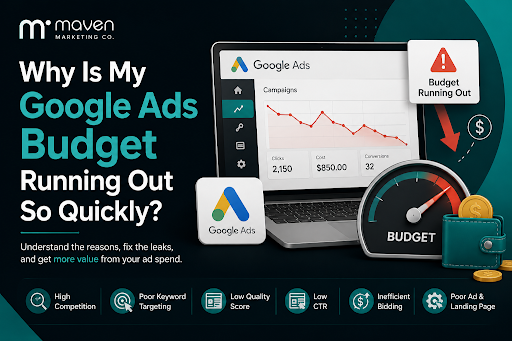
Running a successful Google Ads budget isn’t only about throwing more money at it. It’s more like making every dollar, doing a bit extra. A lot of businesses start a Google Ads campaign with big hopes, then find out their daily budget is gone within a few hours, and that feels weird, right? After that, your ads stop showing effectively, new leads slip away, and your return on investment dips. So if your Google Ads budget is running out too fast, don’t stress. It’s a fairly common issue, and in most situations, it can be repaired with the right approach. There are multiple little things that can drain your advertising money quicker than you expected, from costly keywords to audience targeting that just doesn’t quite fit. In this guide, we’ll walk through why your budget disappears so quickly, how to cut wasteful spend, and the most reliable ways to boost your Google Ads ROI, even if your budget stays the same.


