.svg)


%201.svg)
.avif)
Key Takeaways
- FAQ schema markup increases your chances of appearing in featured snippets by 35-40%, particularly for question-based queries common in Australian search behaviour
- Structured data helps Google understand your content context, making it easier to match with user intent and display in AI Overviews
- Australian businesses using FAQ schema report 20-30% higher engagement rates from organic search compared to non-structured content
- Implementation requires both technical precision and strategic content alignment with actual user questions from Australian markets
- Mobile optimisation is critical, as 73% of Australian searches now occur on mobile devices where featured snippets dominate screen real estate
The Australian digital landscape has fundamentally shifted. Gone are the days when ranking on page one guaranteed visibility. Today's searchers in Sydney, Melbourne, Brisbane, and beyond are getting their answers directly from featured snippets, AI Overviews, and rich results—often without clicking through to websites at all.
This seismic change presents both a challenge and an extraordinary opportunity. For businesses willing to adapt their SEO strategies, FAQ schema markup has emerged as the most reliable pathway to capturing these coveted SERP features. But here's the critical distinction: implementation alone isn't enough. Success requires a strategic approach tailored specifically to Australian search behaviour, consumer psychology, and market dynamics.
Understanding FAQ Schema's Power in Australian Search
FAQ schema is a type of structured data markup that helps search engines understand the question-and-answer format of your content. When properly implemented, it transforms ordinary webpage content into rich, visually prominent search results that Google can extract and display as featured snippets.
The psychology behind its effectiveness is straightforward: Australian consumers are increasingly using natural language queries, asking complete questions rather than typing fragmented keywords. Voice search adoption has surged, with 27% of Australians now using voice assistants for search queries. This shift in behaviour has made question-based content—and the schema that supports it—absolutely essential.
When your FAQ schema appears in a featured snippet, you're not just gaining visibility; you're establishing authority. Google is essentially endorsing your content as the definitive answer to the user's query. This psychological validation translates directly into trust, higher click-through rates, and improved conversion potential.
.avif)
The Technical Foundation: Implementing FAQ Schema Correctly
Let's cut through the complexity: FAQ schema implementation requires precision, but it's not rocket science. The markup uses JSON-LD format, which Google explicitly recommends as the preferred method for structured data.
Here's the critical framework: each FAQ schema must contain a "Question" and an "Answer" property. The question should match how real Australians phrase their queries—not how you think they should ask. This distinction is paramount. If you're a Perth accounting firm, your FAQ shouldn't ask "What are the taxation requirements for small business entities?" Instead, mirror actual search behaviour: "How much tax do I pay as a small business in WA?"
The answer portion must be comprehensive yet concise—typically 40-300 words. Google's algorithms favour answers that directly address the question without unnecessary preamble. Australian searchers, known for their preference for straightforward communication, particularly appreciate this approach.
Technical validation is non-negotiable. Use Google's Rich Results Test to ensure your markup is error-free. Even minor syntax errors can prevent your schema from being recognised, wasting all your implementation efforts. Additionally, monitor your implementation through Google Search Console's Rich Results report, which provides invaluable data on how Google is processing your structured data.
.avif)
Strategic Content Development for Australian Markets
This is where most businesses stumble. They implement perfect schema around mediocre content and wonder why they're not capturing featured snippets. The harsh truth: technical implementation is merely the foundation. Your content must genuinely deserve to rank.
Start by conducting thorough question research specific to Australian markets. Tools like AnswerThePublic, Google's "People Also Ask" boxes, and Reddit's Australian subreddits provide goldmines of actual consumer questions. Don't assume—validate. What works in the UK or US market may miss the mark entirely with Australian consumers.
Consider regional variations. A Brisbane property developer will encounter different questions than a Hobart counterpart. Climate concerns, local regulations, and market dynamics vary significantly across Australian states, and your FAQ content must reflect this nuance.
The content structure should follow the inverted pyramid approach: answer the question immediately and explicitly in the first sentence, then provide supporting detail. This satisfies both the human reader and the search algorithm simultaneously. If someone asks "How long does conveyancing take in NSW?", your answer should begin with "Conveyancing in NSW typically takes 6-8 weeks from contract to settlement," followed by the factors that influence this timeline.
Authenticity matters profoundly. Australian consumers have finely-tuned bullshit detectors. Corporate jargon, excessive self-promotion, and vague generalities will torpedo your credibility faster than you can say "fair dinkum." Write like a knowledgeable mate explaining something over coffee—informed, helpful, and genuine.
Case Study: Melbourne E-commerce Success
A Melbourne-based outdoor equipment retailer was struggling to compete against established brands for product-related searches. Their domain authority was modest, and their traditional SEO efforts yielded incremental improvements at best.
In March 2024, they implemented a comprehensive FAQ schema strategy, creating detailed question-and-answer content around their product categories. Rather than generic FAQs like "What is your return policy?", they addressed specific customer concerns: "Can I return hiking boots after using them on one trek?" and "What's the difference between 2-season and 4-season tents for Victorian camping?"
The results were remarkable. Within eight weeks, they captured 23 featured snippets for high-intent commercial queries. Their organic traffic increased by 47%, but more importantly, their conversion rate from organic search improved by 31%. The featured snippets attracted users at the perfect moment in their buying journey—when they had specific questions indicating purchase readiness.
The psychological impact extended beyond traffic metrics. Customer surveys revealed that seeing the brand in featured snippets significantly increased perceived expertise and trustworthiness. When customers did convert, their average order value was 22% higher than from other traffic sources, suggesting that the authority established through featured snippets attracted more qualified, committed buyers.
.avif)
Case Study: Sydney Professional Services Transformation
A Sydney-based financial planning firm faced the classic service industry challenge: how do you differentiate when competitors offer seemingly identical services? Their traditional content marketing efforts generated modest traffic but failed to establish the authoritative positioning they sought.
In June 2024, they pivoted their strategy entirely around FAQ schema, but with a crucial twist: they addressed the questions potential clients were too embarrassed to ask in person. Questions like "How much super should I have at 40 if I started late?" and "Can I see a financial planner if I only have $20,000 saved?"
This empathetic approach, combined with technically sound schema implementation, resulted in capturing 31 featured snippets within three months. Their organic traffic increased by 64%, but the transformation went deeper. The quality of inbound enquiries improved dramatically—prospective clients arrived at consultations already trusting the firm and having consumed substantial educational content.
The firm's managing partner noted something unexpected: the FAQ content reduced their sales cycle by approximately 30%. Prospects arrived better informed, with fewer basic questions, allowing consultations to focus on sophisticated planning rather than fundamental education. The schema strategy didn't just improve visibility—it fundamentally enhanced their business efficiency.
Advanced Strategies: Beyond Basic Implementation
Once you've mastered fundamental FAQ schema implementation, several advanced strategies can multiply your results in Australian markets.
Seasonal optimisation is particularly powerful in Australia's diverse climate zones. Update your FAQ content and schema to reflect seasonal concerns. A Cairns tourism operator should rotate FAQ content between cyclone season concerns and dry season opportunities. This temporal relevance signals freshness to Google while addressing the actual questions occupying searchers' minds at specific times.
Hyper-local targeting leverages Australia's unique geographic diversity. Don't settle for generic Australian content when you can create suburb-specific or regional FAQs. A Sydney plumber might create separate FAQ schemas for North Shore water pressure concerns versus Western Sydney pipe corrosion issues. This granular approach captures long-tail traffic while demonstrating genuine local expertise.
Competitor gap analysis identifies opportunities your rivals have overlooked. Use SEO tools to identify questions triggering featured snippets in your industry, then analyse whether competitors have adequately answered them. Many featured snippets come from unexpected sources simply because established players haven't bothered to address specific questions. These gaps represent low-hanging fruit for strategic FAQ implementation.
Multi-format integration recognises that different users prefer different content formats. Supplement your FAQ text with short video answers, infographics, or audio responses. While the schema itself is text-based, enriched pages with multiple formats typically earn higher engagement metrics, which Google interprets as quality signals worth rewarding with featured placement.
Common Pitfalls That Sabotage Australian Businesses
Even with perfect technical implementation, several mistakes consistently prevent businesses from capturing featured snippets.
Over-optimisation remains surprisingly common. Some businesses create FAQ pages that read like keyword-stuffed nightmares, attempting to manipulate algorithms rather than help humans. Google's increasingly sophisticated natural language processing easily identifies this manipulation. Australian consumers, with their cultural aversion to overselling, find such content particularly off-putting. The solution: write for humans first, optimise for search second.
Neglecting mobile experience is commercial suicide in Australia's mobile-first market. Your FAQ content might be perfect on desktop, but if it's buried beneath intrusive pop-ups, loads slowly, or formats poorly on mobile devices, Google won't reward it with featured placement. Test religiously on actual mobile devices, not just desktop simulators.
Inconsistent updating signals stagnation to both users and algorithms. FAQ content reflects your expertise only if it remains current. Outdated information—particularly around regulatory matters, pricing, or availability—erodes trust faster than it builds authority. Establish quarterly review cycles to refresh FAQ content, updating both the answers and the schema markup to reflect current information.
Ignoring search intent is perhaps the most fundamental error. Not every question deserves an FAQ schema answer on your website. If the question indicates the user wants to navigate to a specific page (like "Maven Marketing contact details"), schema markup on a generic FAQ page creates a poor user experience. Match your schema implementation to the actual intent behind the query.
Measuring Success: Metrics That Matter
.avif)
Vanity metrics provide comfort but rarely drive business results. Focus instead on these performance indicators that directly correlate with commercial outcomes.
Featured snippet capture rate measures what percentage of your targeted question-keywords result in featured placement. Industry benchmarks suggest 15-25% capture rates represent solid performance, while exceptional implementations might achieve 30-40%. Track this monthly to identify trends and opportunities.
Click-through rate from featured snippets reveals whether your snippet content effectively motivates action. Interestingly, featured snippets sometimes reduce CTR if they answer questions too completely. This isn't necessarily negative—if your snippet establishes authority while the user continues researching, they may return directly to your site later. However, commercial queries should maintain strong CTR, typically 20-35% higher than standard organic results.
Conversion rate by traffic source distinguishes whether featured snippet traffic actually drives business results. Create specific tracking for users who arrive via featured snippets versus traditional organic results. Many Australian businesses discover that featured snippet traffic, while sometimes lower volume, converts at substantially higher rates—often 25-50% better than general organic traffic.
Domain authority impact measures the cumulative effect of featured snippet success. As you capture more snippets, Google increasingly views your domain as authoritative for your topic area. This creates a virtuous cycle, making subsequent snippet capture easier. Track your overall domain authority quarterly to measure this compound effect.
The Future: Preparing for AI Overviews and Beyond
Google's rollout of AI Overviews represents the next evolution in search, and FAQ schema positions you perfectly for this transition. AI Overviews frequently draw from structured data sources, giving schema-optimised content preferential inclusion in these AI-generated summaries.
The Australian rollout of these features may follow different timelines than other markets, but forward-thinking businesses are preparing now. The same principles that make FAQ schema effective for traditional featured snippets—clear questions, authoritative answers, proper structure—will serve you well as AI Overviews become standard.
Voice search integration will intensify. As smart speakers and voice assistants become ubiquitous in Australian homes, the question-answer format of FAQ content becomes even more critical. Devices like Google Home and Amazon Echo preferentially source answers from structured data when responding to voice queries.
The businesses that thrive won't be those with the largest budgets or longest domain histories. They'll be the ones who most effectively help searchers find answers—and FAQ schema is the technical bridge that connects helpful content with the users who need it.
Frequently Asked Questions
How long does it take to see results from FAQ schema implementation in Australia?
Most Australian businesses begin seeing featured snippet appearances within 4-8 weeks of proper FAQ schema implementation, though competitive industries may require 12-16 weeks. The timeline depends heavily on your existing domain authority, content quality, and how well your FAQs match actual search queries. Quick wins often come from long-tail, specific questions where competition is lower, while high-volume commercial queries typically require sustained optimisation and authority building.
Can FAQ schema hurt my SEO if implemented incorrectly?
Technically incorrect schema won't directly penalise your rankings, but it represents a missed opportunity and can waste crawl budget. Google simply ignores malformed structured data rather than penalising it. However, implementing FAQ schema on inappropriate pages (like every product page or promotional content disguised as FAQs) can be considered manipulative. Focus on genuine, helpful question-answer content where schema adds value to users, not just search engines.
Should every page on my Australian website include FAQ schema?
Absolutely not. Strategic implementation on genuinely relevant pages vastly outperforms carpet-bombing your entire site with FAQ markup. Implement FAQ schema where you have authentic questions and authoritative answers that serve user needs. Typically, this means dedicated FAQ pages, comprehensive guides, and service explanation pages—not product listings, contact pages, or promotional content. Quality and relevance trump quantity every single time.
Take Control of Your Featured Snippet Strategy Today
The Australian digital landscape rewards businesses that provide genuine value through accessible, structured content. FAQ schema isn't a trick or a hack—it's a strategic framework for organising your expertise in ways that both users and search engines can easily consume and trust.
The question isn't whether FAQ schema works for Australian businesses. The evidence is overwhelming: it does, consistently and measurably. The real question is whether you'll implement these strategies before your competitors do.
At Maven Marketing Co, we've helped dozens of Australian businesses transform their organic visibility through strategic FAQ schema implementation and comprehensive SEO strategies. We don't just add markup to existing content—we help you identify the questions your ideal customers are actually asking, create authoritative answers that establish your expertise, and implement technical solutions that Google rewards with featured placement.
Your competitors are already competing for position zero. Every day you delay implementing these strategies is another day of lost visibility, missed traffic, and foregone conversions. Contact Maven Marketing Co today to discuss how we can develop a customised FAQ schema strategy that captures featured snippets and drives genuine business results in your specific Australian market. The featured snippets your business deserves are waiting—let's claim them together.

Table of contents
read more blogs
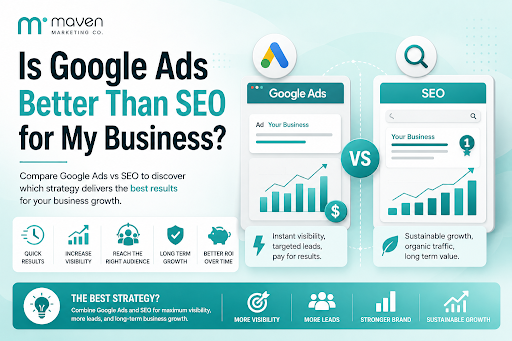
Is Google Ads Better Than SEO for My Business
One of the biggest questions business owners ask when they are planning online growth is whether they should invest in Google Ads or SEO. Both are strong marketing plays that help your company show up in Google search results, but they do things in separate lanes. Google Ads gives quicker visibility and can bring in leads fast, whereas SEO more or less focuses on slow, steady organic traffic that tends to grow the longer you keep building it. Picking the right direction depends on what you want to achieve, how much money you can spend, how crowded the market is, and how quickly you need results, like sooner rather than later. The good news is you don’t always have to choose one or the other; it’s not exactly a black-and-white situation. If you take time to understand the strongest points of both, you can put together a more sensible digital marketing plan that supports consistent expansion. In this guide, we’ll compare Google Ads vs SEO, explain the main differences, and help you figure out what option makes the most sense for your business.

When Should I Hire a Digital Marketing Agency
Growing a business today takes more than just having a website or throwing a post on social media; customers usually search around online, compare providers, skim reviews, and basically expect the brand to show up with a solid digital presence before they even think about buying. Many businesses try to run their marketing themselves, but there comes a point when “doing it all in-house” becomes clunky and hard to manage, all at once. Knowing when to hire a digital marketing agency can end up making a big, real difference for your growth. If you’re not getting enough leads, or your online visibility feels stuck, or sales are just not moving, the right agency can bring the know-how, plus a clear plan, to help you get noticeably better outcomes. In this guide, we’ll dig into what a digital marketing agency actually does, the usual signs it’s time to bring one on, and how picking the right marketing partner can help your business move forward at a faster pace.
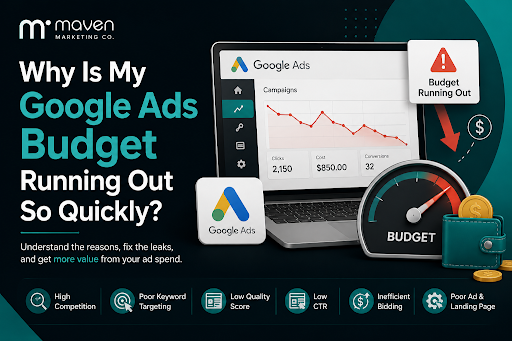
Why Is My Google Ads Budget Running Out So Quickly
Running a successful Google Ads budget isn’t only about throwing more money at it. It’s more like making every dollar, doing a bit extra. A lot of businesses start a Google Ads campaign with big hopes, then find out their daily budget is gone within a few hours, and that feels weird, right? After that, your ads stop showing effectively, new leads slip away, and your return on investment dips. So if your Google Ads budget is running out too fast, don’t stress. It’s a fairly common issue, and in most situations, it can be repaired with the right approach. There are multiple little things that can drain your advertising money quicker than you expected, from costly keywords to audience targeting that just doesn’t quite fit. In this guide, we’ll walk through why your budget disappears so quickly, how to cut wasteful spend, and the most reliable ways to boost your Google Ads ROI, even if your budget stays the same.