.svg)


%201.svg)
.avif)
Key Takeaways
- Google's Knowledge Graph contains over 500 billion facts about 5 billion entities, creating a semantic understanding of how brands, people, places, and concepts interconnect
- Brands recognized as entities receive preferential treatment in search results, including Knowledge Panels, rich snippets, and prominent placement in AI-generated summaries
- Entity SEO requires consistent NAP (Name, Address, Phone) data across the web, with studies showing 73% improvement in local search visibility when entity signals align
- Structured data markup acts as your direct communication channel to Google, helping the search engine understand what your entity represents and how it relates to other entities
- Building entity authority takes 6-12 months of sustained effort but creates compounding advantages that traditional keyword SEO cannot replicate
The game has changed. While your competitors obsess over keyword rankings, Google has quietly revolutionized how it understands and presents information. The search engine no longer merely matches keywords—it comprehends entities, their relationships, and their real-world significance.
This evolution isn't theoretical. When someone searches for your brand name, does a Knowledge Panel appear on the right side of results? Do your executives show up with verified information? Does Google accurately understand what your business does, where you operate, and how you're connected to your industry?
For most Australian businesses, the answer is no—not because they lack authority, but because they haven't deliberately built their entity presence. This gap represents the single largest untapped opportunity in modern SEO.
Understanding Entity-Based Search: The Fundamental Shift
.avif)
Traditional SEO operated on a simple premise: match keywords in queries to keywords on pages. If someone searched "best coffee Sydney," Google showed pages containing those words. This keyword-centric approach worked reasonably well for decades.
Entity SEO operates differently. Google now understands that "best coffee Sydney" isn't just a string of words—it's a query about a category of businesses (cafes) in a specific location (Sydney), potentially related to other entities like coffee roasters, cafe culture, and specific neighborhoods.
Google's Knowledge Graph transforms search from matching text to understanding meaning. When you establish your business as an entity, you're not competing solely on content quality—you're building recognition in a structured database that powers countless search features.
The psychological impact is profound. Knowledge Panels don't just provide information; they confer legitimacy. When Google displays a Knowledge Panel for your brand, it's essentially validating your existence and importance. Users instinctively trust entities Google recognizes over those it doesn't.
The Anatomy of Entity Recognition: What Google Needs to Know
.avif)
Google determines entity status through multiple interconnected signals. Understanding these signals allows you to systematically build recognition.
Consistent identity markers form the foundation. Your business name, physical address, phone number, and website URL must appear identically across hundreds of web properties. Inconsistencies confuse Google's entity resolution algorithms—if your business appears as "Smith & Co," "Smith and Company," and "Smith Co." across different sites, Google struggles to confidently merge these into a single entity.
Australian businesses face unique challenges here. Many operate with trading names different from registered business names, have multiple locations with slight address variations, or use local versus national phone numbers inconsistently. These variations, while understandable from a business perspective, create entity ambiguity that undermines recognition.
Authoritative mentions signal entity importance. When established entities (news publications, industry associations, verified Wikipedia articles, government databases) reference your brand, Google interprets this as evidence you're a legitimate, notable entity worth tracking.
The quality of mentions matters exponentially more than quantity. A single reference in the Australian Financial Review carries more entity-building weight than dozens of directory listings. This creates a paradox: you need entity recognition to earn authoritative mentions, but you need authoritative mentions to build entity recognition.
Structured data markup provides explicit entity information directly to Google. Organization schema, LocalBusiness schema, and more specialized types like MedicalOrganization or LegalService tell Google exactly what your entity represents, its attributes, and its relationships to other entities.
Most Australian businesses either don't implement structured data or implement it incorrectly. The difference between partial implementation and comprehensive entity markup is the difference between Google guessing what you are and Google knowing with certainty.
Strategic Schema Implementation for Entity Building
.avif)
Schema markup isn't optional for entity SEO—it's the primary mechanism through which you communicate entity information to Google. Yet implementation requires strategic thinking beyond basic technical compliance.
Organization schema should appear on your homepage and describe your entity comprehensively. This includes obvious attributes like name, logo, and contact information, but also critical entity-building elements like founding date, number of employees, industry classification, and social media profiles.
Many businesses implement minimal Organization schema with just a name and URL. This misses the opportunity to establish entity richness. Google's Knowledge Graph thrives on connections—the more attributes you provide, the more opportunities Google has to understand your entity's place within the broader semantic web.
SameAs properties explicitly connect your entity across platforms. When you list your Wikipedia page, Wikidata entry, Crunchbase profile, LinkedIn page, and official social accounts, you're telling Google "all these profiles represent the same entity." This consolidation strengthens entity signals dramatically.
The strategic sequence matters. Start with properties you control (your website, social profiles), then expand to third-party platforms (directories, review sites), and ultimately aim for presence on knowledge bases (Wikipedia, Wikidata). Each layer reinforces the previous one.
Knowledge Panel optimization requires understanding what information Google prioritizes. The search engine pulls data from multiple sources when constructing Knowledge Panels, with a general preference hierarchy: Wikidata, Wikipedia, official websites with structured data, authoritative third-party mentions, and user-generated content.
For Australian businesses without Wikipedia presence, focusing on Wikidata entry creation and enrichment provides the most direct path to Knowledge Panel generation. Wikidata is an open, structured database that feeds directly into Google's Knowledge Graph. Unlike Wikipedia, it has lower notability requirements and accepts business entities more readily.
Case Study: Brisbane Tech Startup's Entity Transformation
.avif)
A Brisbane-based SaaS company launched in 2022 with solid product-market fit but zero brand recognition in search. Searching their company name returned only their website and a few generic directory listings. No Knowledge Panel, no rich results, no entity presence.
Their entity-building strategy focused on systematic signal development:
Phase 1: Foundation (Months 1-2) involved comprehensive schema implementation across all web properties, NAP consistency verification across 150+ business directories, and creation of their Wikidata entry with detailed company information.
Phase 2: Authority Building (Months 3-6) centered on securing mentions in Australian tech publications, contributing expert commentary to industry discussions, and building relationships with complementary SaaS entities through strategic partnerships publicly announced via press releases.
Phase 3: Entity Enrichment (Months 7-9) expanded their entity footprint through executive LinkedIn optimization (turning founders into recognized entities themselves), comprehensive blog content linking to industry entity topics, and consistent brand mentions in relation to industry trends and events.
The results exceeded traditional SEO metrics. By month 8, searching their company name generated a full Knowledge Panel with logo, founding information, key people, and related entities. More significantly, they began appearing in AI-generated summaries for industry queries despite having lower domain authority than established competitors.
The commercial impact was measurable: brand search volume increased 340% as entity recognition improved discoverability. Conversion rates from branded traffic increased 67% because Knowledge Panel presence established immediate credibility. Their sales team reported that prospects arrived at conversations already familiar with and trusting the brand—a direct result of entity presence creating psychological legitimacy.
Case Study: Melbourne Law Firm's Local Entity Dominance
A mid-sized Melbourne law firm faced the challenge common to professional services: dozens of competitors with similar offerings and comparable expertise. Traditional SEO efforts yielded incremental improvements but failed to establish distinctive authority.
Their entity SEO approach focused specifically on local entity dominance, recognizing that legal services operate primarily within geographic bounds.
Local entity signals became the foundation. They implemented comprehensive LocalBusiness schema with detailed jurisdiction information, practice area specifications, and attorney profiles marked up as Person entities with connections to the parent organization.
Multi-location entity management required treating each office as a distinct but connected entity. Their three Melbourne locations (CBD, Southbank, Docklands) each received unique LocalBusiness markup with precise geographical coordinates, specific contact information, and office-specific schema—all connected through parent Organization markup.
Attorney entity building transformed individual lawyers into recognized entities. Each senior attorney received optimized schema markup, consistent mentions across legal directories, contributions to legal publications, and speaking engagements documented through Event schema on the firm's website.
Within 11 months, all three locations generated Knowledge Panels showing practice areas, reviews, and contact information. Individual attorneys began appearing with their own knowledge cards when searched by name. Most powerfully, searching "Melbourne employment lawyer" or "commercial litigation Victoria" showed the firm's Knowledge Panel in local pack results—a feature only appearing for strongly recognized local entities.
Client acquisition transformed. Inbound enquiry quality improved as prospects self-selected after reviewing comprehensive Knowledge Panel information. The firm's managing partner noted that new clients consistently mentioned seeing the Knowledge Panel as a trust signal that distinguished the firm from competitors.
Building Personal Brand Entities: The Executive Advantage
One of entity SEO's most underutilized opportunities involves establishing executives and thought leaders as individual entities connected to your brand entity. Google increasingly shows personal Knowledge Panels for business leaders, and these create halo effects that strengthen your organizational entity.
Personal schema markup on executive bio pages tells Google these individuals are notable entities. Person schema should include comprehensive details: job title, affiliation with your organization, educational background, awards, publications, and social profiles.
The strategic insight: when executives become recognized entities, their connection to your organization strengthens your organizational entity. If your CEO appears with a Knowledge Panel listing your company as their employer, Google establishes a verified entity relationship that reinforces both entities.
Content attribution amplifies this effect. When your executives author content (blog posts, articles, reports), use Author schema to explicitly connect the content to their entity. Over time, Google begins associating your executives with specific topics, creating topical authority that extends to your organizational entity.
Speaking engagements and media appearances provide powerful entity-building signals. Each time an executive speaks at a conference, appears on a podcast, or is quoted in media, it represents an authoritative mention of their personal entity. Document these through Event schema and mentions on your website.
Australian business culture sometimes resists personal brand promotion, viewing it as ego-driven or inappropriate. This cultural tendency creates entity-building disadvantages. Markets where executives actively build personal entities (particularly in tech, finance, and professional services) systematically outperform in entity recognition because they're playing a longer game—building interconnected entity networks rather than isolated organizational presences.
Entity Relationships: The Network Effect
Entity SEO's true power emerges not from isolated entity recognition but from strategic entity relationships. Google's Knowledge Graph operates on connections—entities gain authority partly through their relationships with other authoritative entities.
Strategic partnerships should be documented through structured data. When you partner with recognized brands, create content announcing the partnership with Organization schema connecting both entities. Google interprets verified relationships between entities as authority signals for both.
Industry association participation provides entity-building advantages beyond traditional networking. Membership in established industry bodies creates entity relationships Google recognizes. List these affiliations in your Organization schema memberOf properties, and ensure the associations list you as a member on their websites with proper entity markup.
Supply chain relationships in B2B contexts offer overlooked entity opportunities. If you manufacture products for recognized brands or supply services to notable clients, these relationships (when documented with permission) create entity connections. A Brisbane manufacturer supplying Toyota, for example, benefits from entity association with a globally recognized entity.
Geographic entity anchoring ties your business to place entities Google already understands. Rather than vaguely claiming to serve "Australia," specify suburbs, regions, or cities with precise schema markup. A Bondi Junction retailer benefits from association with the Bondi Junction entity, which carries its own recognition and attributes.
The strategic approach involves identifying which entity relationships provide the strongest authority signals for your vertical, then systematically building and documenting those relationships through both real-world activities and structured data implementation.
Common Entity SEO Mistakes That Undermine Recognition
.avif)
Even businesses investing in entity building often sabotage their efforts through preventable mistakes.
Inconsistent entity attributes represent the most common failure. Your business name appears differently across platforms, your address uses varying formats, or your phone number switches between formats (04 vs 0004 vs +614). Each inconsistency reduces Google's confidence in merging signals into a single entity.
The solution requires systematic auditing. Use tools to identify where your business appears online, document all variations, and methodically correct inconsistencies. This isn't glamorous work, but it's foundational.
Neglecting negative entity signals allows competitors or dissatisfied customers to define your entity. Google's Knowledge Graph incorporates information from multiple sources, including negative reviews, complaints, and critical coverage. Ignoring these doesn't make them disappear—it simply cedes entity definition to others.
Monitor your entity presence actively. Set up alerts for your business name, track Knowledge Panel changes, and proactively address negative signals through reputation management. Entity SEO requires defensive as well as offensive strategies.
Over-optimization through manipulation tempts businesses seeking shortcuts. Creating fake Wikipedia articles, generating artificial mentions, or implementing misleading schema markup might temporarily influence entity signals but carries severe long-term risks.
Google's entity algorithms specifically target manipulation. Penalties for entity spam can result in complete Knowledge Panel removal and suppression of entity recognition across all Google properties. The risk-reward calculation makes manipulation categorically unwise.
Abandoning traditional SEO fundamentals in favor of exclusive entity focus creates imbalanced strategies. Entity SEO complements rather than replaces content quality, technical optimization, and link building. The most successful approaches integrate entity building into comprehensive SEO strategies rather than treating it as a standalone tactic.
Measuring Entity SEO Success: Metrics That Matter
Entity building requires different measurement approaches than traditional SEO. Standard metrics like keyword rankings and organic traffic provide incomplete pictures of entity recognition progress.
Knowledge Panel presence serves as the primary binary indicator. Does your brand generate a Knowledge Panel? What information appears? How comprehensive is it? Track changes over time as you add entity signals.
Entity mentions in AI Overviews indicate how Google's AI systems incorporate your entity into generated responses. Search queries related to your industry and note whether your brand appears in AI-generated summaries, even for queries that don't specifically name your brand.
Brand search volume growth suggests improving entity recognition. As Google better understands your entity and displays it more prominently in relevant contexts, more users discover and subsequently search for your brand name directly.
SERP feature dominance for branded queries measures how comprehensively you control your brand entity's search results. Ideally, branded searches should show: Knowledge Panel, official website, social profiles, news mentions, videos, and related entities—all presenting accurate, controlled information.
Entity relationship expansion tracks how many verified entity connections you've established. Monitor your Wikidata entry's relationships, mentions alongside other entities in Knowledge Panels, and co-occurrence in authoritative contexts.
Topical authority signals measure whether Google associates your entity with specific topics. Create test searches around your target topics and track whether your entity appears in results, related entities, or AI-generated content even when not directly mentioned in queries.
These metrics require longer measurement timeframes than traditional SEO. Meaningful entity recognition often requires 6-12 months of sustained effort. Weekly tracking provides noise; monthly or quarterly assessment reveals genuine progress.
The Future: Entity SEO in an AI-Driven Search Landscape
Google's evolution toward AI-generated search results makes entity recognition more critical, not less. AI Overviews, conversational search, and multimodal search all rely heavily on the Knowledge Graph's entity understanding.
When ChatGPT or Google's AI generates a response about your industry, it draws from entity data. Brands recognized as authoritative entities appear in AI-generated content; those lacking entity recognition disappear from AI-mediated discovery.
The Australian market faces particular dynamics here. As global entities (international brands, multinational corporations) already possess strong entity recognition, local Australian businesses must proactively build entity presence or risk algorithmic invisibility.
Voice search amplification intensifies entity importance. Voice assistants rely almost exclusively on entity databases when responding to queries. "Hey Google, what's the best [product category] in [Australian city]?" returns results based substantially on entity recognition rather than traditional ranking signals.
The businesses thriving in this evolving landscape won't be those with the largest budgets or oldest domain names. They'll be those who understood earliest that search had transformed from information retrieval to entity comprehension—and acted accordingly.
Frequently Asked Questions
How long does it take to build entity recognition for an Australian business?
Building genuine entity recognition typically requires 6-12 months of sustained, strategic effort. Smaller wins—like improving NAP consistency and implementing comprehensive schema—can show results within 4-6 weeks. However, earning a Knowledge Panel, establishing topical authority, and achieving preferential treatment in AI Overviews demands longer timeframes. The timeline depends heavily on your current entity signals, industry competitiveness, and whether you're building from zero or enhancing existing recognition. Businesses with some existing authority (established brands, media mentions, industry recognition) may see accelerated results, while new entities or those in highly competitive verticals should expect the full 12-month timeframe before achieving comprehensive entity recognition.
Can small Australian businesses compete with international entities in Google's Knowledge Graph?
Absolutely—with the right strategy. While international entities possess inherent advantages (more mentions, older presence, broader recognition), small Australian businesses can establish strong local entity recognition through geographic specificity, niche authority, and relationship building with regional entities. Focus on becoming the dominant entity for location-specific queries (e.g., "best [service] in [Australian suburb]") rather than competing directly for broad category recognition. Build relationships with local entities (business associations, local publications, regional partners) that strengthen your geographic entity signals. Many small Australian businesses successfully generate Knowledge Panels and achieve local entity dominance by focusing strategically rather than attempting to compete on scale with global entities.
Is entity SEO worth the investment compared to traditional SEO efforts?
Entity SEO and traditional SEO aren't competing strategies—they're complementary. The most effective approach integrates entity building into comprehensive SEO programs. However, if forced to prioritize, entity SEO offers several advantages: results compound over time (unlike content that degrades), it creates defensible competitive advantages (harder to replicate than content or links), and it aligns with Google's long-term trajectory toward semantic understanding. For Australian businesses in competitive verticals, entity recognition increasingly determines visibility in AI-generated results, voice search, and featured content—channels traditional SEO alone cannot adequately address. The investment makes most sense for established businesses seeking sustainable competitive advantages and brands operating in local markets where entity recognition creates disproportionate trust signals.
Take Control of Your Entity Presence Before Your Competitors Do
Entity SEO isn't coming—it's here. Every day you operate without deliberate entity strategy is another day of algorithmic invisibility, another opportunity for competitors to claim entity recognition you should own, another lost chance to appear in AI-generated results guiding purchase decisions.
The businesses winning in Australian markets aren't necessarily those with superior products or larger marketing budgets. They're the ones Google understands, trusts, and confidently presents as authoritative entities when users need solutions.
Your brand deserves recognition—not just from customers, but from the algorithms increasingly mediating how those customers discover solutions. Entity SEO provides the framework to build that recognition systematically, measurably, and sustainably.
At Maven Marketing Co, we've helped Australian businesses across industries establish entity recognition, earn Knowledge Panels, and dominate their competitive landscapes through strategic entity optimization. We don't just implement schema markup—we build comprehensive entity strategies tailored to your brand, your market, and your specific competitive dynamics.
Stop letting Google guess what your brand represents. Stop ceding entity definition to competitors, directories, and outdated information. Stop missing opportunities to appear in AI-generated results that increasingly determine market share.
Partner with Maven Marketing Co today to develop your entity SEO strategy. We'll audit your current entity signals, identify critical gaps, and create a systematic roadmap to build the entity recognition your brand deserves. The Knowledge Graph isn't waiting for you to catch up—let's claim your entity presence together, starting now.

Table of contents
read more blogs
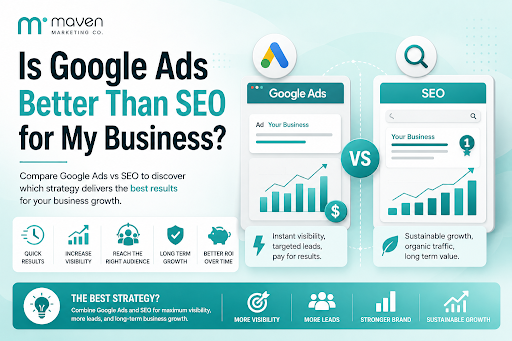
Is Google Ads Better Than SEO for My Business
One of the biggest questions business owners ask when they are planning online growth is whether they should invest in Google Ads or SEO. Both are strong marketing plays that help your company show up in Google search results, but they do things in separate lanes. Google Ads gives quicker visibility and can bring in leads fast, whereas SEO more or less focuses on slow, steady organic traffic that tends to grow the longer you keep building it. Picking the right direction depends on what you want to achieve, how much money you can spend, how crowded the market is, and how quickly you need results, like sooner rather than later. The good news is you don’t always have to choose one or the other; it’s not exactly a black-and-white situation. If you take time to understand the strongest points of both, you can put together a more sensible digital marketing plan that supports consistent expansion. In this guide, we’ll compare Google Ads vs SEO, explain the main differences, and help you figure out what option makes the most sense for your business.

When Should I Hire a Digital Marketing Agency
Growing a business today takes more than just having a website or throwing a post on social media; customers usually search around online, compare providers, skim reviews, and basically expect the brand to show up with a solid digital presence before they even think about buying. Many businesses try to run their marketing themselves, but there comes a point when “doing it all in-house” becomes clunky and hard to manage, all at once. Knowing when to hire a digital marketing agency can end up making a big, real difference for your growth. If you’re not getting enough leads, or your online visibility feels stuck, or sales are just not moving, the right agency can bring the know-how, plus a clear plan, to help you get noticeably better outcomes. In this guide, we’ll dig into what a digital marketing agency actually does, the usual signs it’s time to bring one on, and how picking the right marketing partner can help your business move forward at a faster pace.
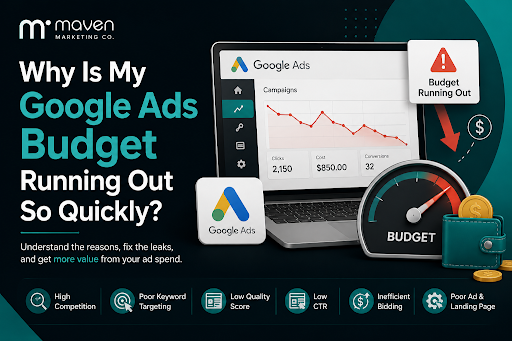
Why Is My Google Ads Budget Running Out So Quickly
Running a successful Google Ads budget isn’t only about throwing more money at it. It’s more like making every dollar, doing a bit extra. A lot of businesses start a Google Ads campaign with big hopes, then find out their daily budget is gone within a few hours, and that feels weird, right? After that, your ads stop showing effectively, new leads slip away, and your return on investment dips. So if your Google Ads budget is running out too fast, don’t stress. It’s a fairly common issue, and in most situations, it can be repaired with the right approach. There are multiple little things that can drain your advertising money quicker than you expected, from costly keywords to audience targeting that just doesn’t quite fit. In this guide, we’ll walk through why your budget disappears so quickly, how to cut wasteful spend, and the most reliable ways to boost your Google Ads ROI, even if your budget stays the same.