.svg)


%201.svg)
Quick Answers
How can Australian businesses automate email marketing while maintaining genuine personalization?
Australian businesses can maintain personalization in automated email sequences through strategic segmentation, behavioral triggers, and dynamic content that adapts to individual subscriber characteristics. The foundation is robust data collection—capturing not just email addresses but preferences, behaviors, purchase history, and engagement patterns. Use this data to create meaningful segments beyond basic demographics: behavioral segments based on website activity, engagement level segments separating active from dormant subscribers, purchase stage segments distinguishing prospects from customers, and interest-based segments reflecting content preferences. Implement behavioral triggers that send emails based on specific actions rather than arbitrary time delays—abandoned cart sequences triggered by leaving items unpurchased, browse abandonment emails following product page visits, re-engagement campaigns for inactive subscribers, and post-purchase sequences customized to specific products purchased. Leverage dynamic content blocks that change based on subscriber data, showing different product recommendations, testimonials, or offers to different segments within the same email template. The key is treating automation as a delivery mechanism for personalized experiences rather than a broadcast tool. Australian businesses successfully balancing automation and personalization report 3-5x higher engagement rates compared to generic automated sequences, with subscribers consistently noting that automated emails feel relevant and timely rather than obviously automated.
What's the optimal email automation workflow structure for nurturing leads through the sales funnel?
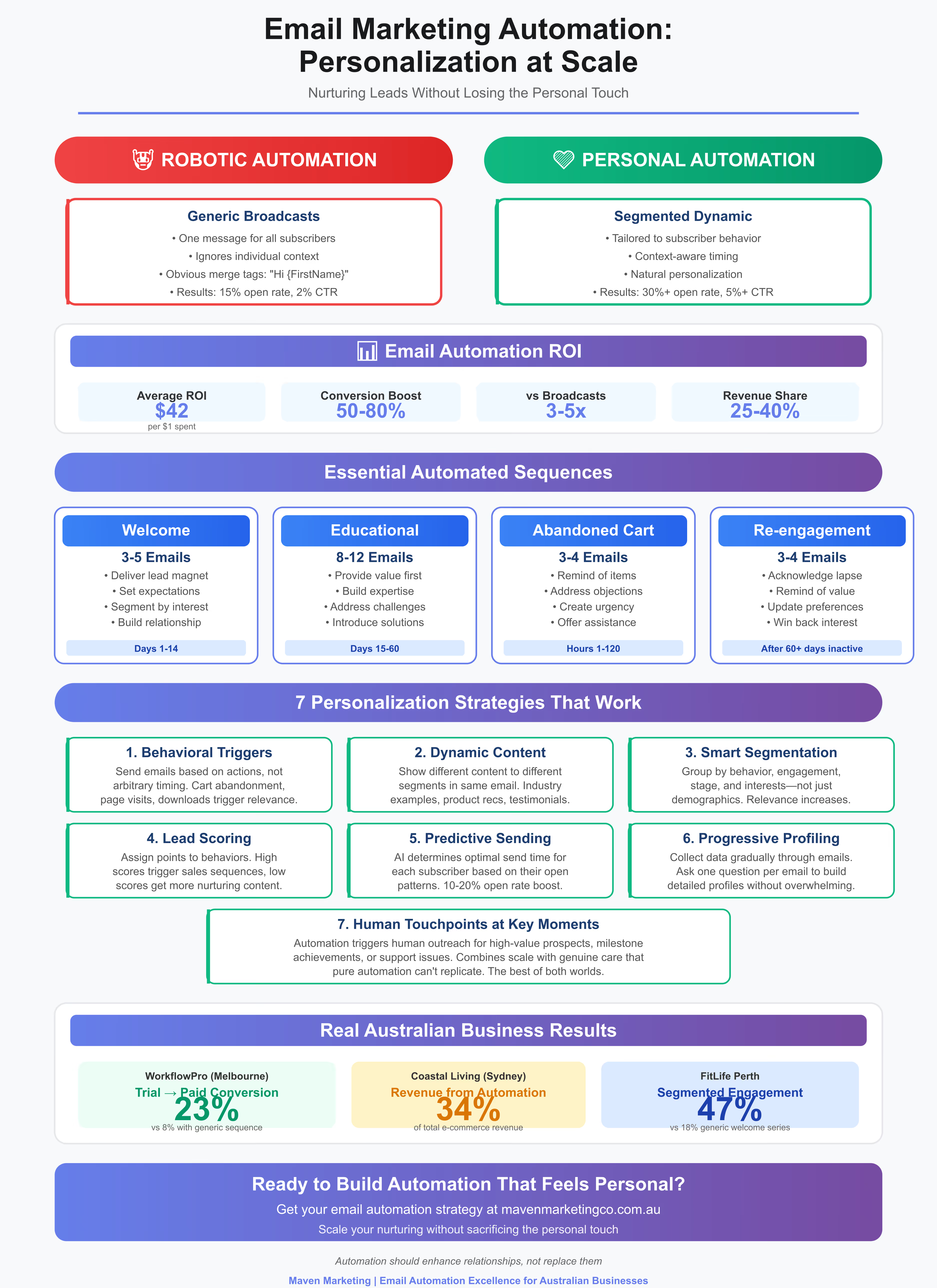
The most effective lead nurturing automation follows a strategic multi-sequence approach aligned with the customer journey, with each sequence designed for specific stages and subscriber behaviors. Start with a welcome sequence (3-5 emails over 7-14 days) that introduces new subscribers to your brand, delivers promised lead magnets, establishes expectations for future communications, and segments subscribers based on their initial engagement and preferences. Follow with educational nurture sequences (8-12 emails over 30-60 days) that provide genuine value without aggressive selling, positioning your business as a helpful expert while gradually introducing your solutions. Implement behavior-triggered sequences for specific actions: product interest sequences for subscribers who view specific product categories, abandoned cart sequences (3-4 emails over 5-7 days) for e-commerce, content upgrade sequences offering additional resources to engaged readers, and event registration sequences for webinars or workshops. Create segment-specific sequences tailored to different buyer personas or industries, ensuring content relevance. Build re-engagement sequences (3-4 emails over 14-21 days) to revive inactive subscribers before list cleaning. The critical insight is that these sequences should interconnect—subscribers can move between sequences based on their behavior, creating a dynamic rather than linear experience. Australian B2B businesses using this multi-sequence approach report lead-to-customer conversion rates 40-60% higher than single-path nurture campaigns, with average sales cycles reduced by 25-35% because prospects receive relevant information matched to their specific stage and needs rather than generic content that may be premature or repetitive.
The Automation Paradox Australian Businesses Must Solve
Email marketing automation represents both the greatest opportunity and the biggest risk in digital marketing for Australian businesses. The opportunity is clear: automated sequences nurture leads 24/7, maintain consistent communication without manual effort, scale personalized engagement to thousands of subscribers, and deliver measurable ROI that typically exceeds any other marketing channel. Yet the risk is equally apparent—automated emails that feel robotic, impersonal, or irrelevant destroy brand perception and drive unsubscribes faster than manual campaigns ever could.
The statistics reveal the stakes. Properly implemented email automation generates an average ROI of $42 for every dollar spent, making it the highest-returning marketing channel. Australian businesses using sophisticated automation report conversion rates 50-80% higher than those relying solely on broadcast emails. However, poorly executed automation—generic sequences treating all subscribers identically—achieves open rates below 15%, click-through rates under 2%, and unsubscribe rates above 1% per send.
The businesses thriving with email automation haven't chosen between efficiency and personalization—they've systematically solved the paradox by treating automation as an enabler of personalization rather than its enemy. Melbourne-based SaaS company WorkflowPro exemplifies this approach. Their automated welcome sequence adapts based on each subscriber's industry, company size, and initial feature interest, delivering different case studies, tutorials, and offers to different segments. Despite being 100% automated, subscribers consistently report feeling that emails are "written specifically for their needs." This personalized automation converts 23% of free trial users to paid customers, compared to 8% from their previous generic welcome sequence.
Understanding Modern Email Automation Capabilities
Email automation has evolved dramatically beyond simple autoresponders. Modern email marketing platforms offer sophisticated capabilities that enable truly personalized experiences at scale. Understanding these capabilities is essential for Australian businesses building effective automation strategies.
Behavioral triggers represent the foundation of personalized automation. Instead of sending emails based solely on time delays ("3 days after signup"), behavioral triggers respond to specific subscriber actions. When someone abandons a cart, views a specific product category, downloads a particular resource, or reaches a usage threshold, automated sequences trigger in response. This ensures emails are contextually relevant to the subscriber's current interests and behaviors rather than arbitrarily timed.
Dynamic content blocks allow single email templates to display different content to different subscribers based on their characteristics. An email promoting your services might show construction industry case studies to builders, retail examples to shop owners, and hospitality testimonials to restaurant managers—all from the same campaign. Product recommendations can adapt to previous purchases, content offers can match demonstrated interests, and calls-to-action can vary based on subscriber stage in the funnel.
Advanced segmentation goes far beyond basic demographic data. Modern platforms enable segments based on email engagement patterns (highly engaged vs. dormant), website behavior tracked through integrations, purchase history and customer lifetime value, content preferences indicated through link clicks, and custom fields capturing business-specific data. These segments become targeting parameters for different automation paths and content variations.
Lead scoring assigns point values to subscriber behaviors and characteristics, creating a quantified measure of sales-readiness. Opening emails, clicking links, visiting pricing pages, and downloading resources each contribute to a score that determines which automated sequences activate and when sales outreach should occur. This prevents premature sales contact with early-stage leads while ensuring hot prospects receive immediate attention.
Integration capabilities connect email automation with other business systems, enabling truly sophisticated personalization. CRM integrations sync contact data and sales activities, e-commerce integrations trigger sequences based on purchase behavior and enable product recommendations, website tracking reveals browse behavior and content interests, webinar platforms trigger registration and follow-up sequences, and survey tools capture preference data that informs segmentation.
Sydney-based e-commerce retailer Coastal Living leverages these capabilities to create highly personalized automated experiences. Their abandoned cart sequences display the exact products left in cart with dynamic pricing that reflects any active promotions. Browse abandonment sequences recommend related products based on viewed categories. Post-purchase sequences provide product-specific care instructions and complementary product suggestions. Welcome sequences segment new subscribers by stated interests (coastal decor, beach fashion, outdoor living) and deliver customized content accordingly. This sophisticated automation generates 34% of their total revenue while requiring minimal ongoing manual management.
Building Your Foundation: Data Collection and Segmentation
Effective personalized automation requires robust data about your subscribers. The businesses achieving exceptional results systematically collect and organize data that enables meaningful segmentation and relevant messaging. This foundation must be built before automation sequences are constructed.
Progressive profiling collects data gradually rather than overwhelming new subscribers with lengthy forms. Your initial signup form might request only email address and first name. Subsequent emails can request additional information through embedded questions or preference centers: "What's your biggest challenge with [topic]?" or "Which products interest you most?" This progressive approach increases completion rates while building detailed profiles over time.
Behavioral data capture automatically records subscriber actions without requiring explicit input. Email marketing platforms track which emails are opened, which links are clicked, and how frequently subscribers engage. Website tracking via pixels or integrations captures page visits, time on site, and content consumed. E-commerce integrations record purchase history, average order value, and product categories purchased. This behavioral data often proves more valuable than explicitly stated preferences because it reflects actual interests rather than stated intentions.
Preference centers allow subscribers to explicitly control what they receive, simultaneously reducing unsubscribes and improving data quality. Well-designed preference centers ask about email frequency preferences (daily, weekly, monthly), content topics of interest (industry news, educational resources, product updates), preferred content format (articles, videos, case studies), and business characteristics relevant to your offering (company size, industry, role). Brisbane accounting firm TaxWise Australia's preference center asks subscribers to indicate their business structure (sole trader, partnership, company), annual revenue range, and key tax concerns. This data enables highly targeted automation that addresses each subscriber's specific situation.
Strategic lead magnets attract subscribers while simultaneously collecting qualifying data. Instead of offering a generic "newsletter signup," create specific lead magnets that appeal to distinct segments: industry-specific guides for different sectors, role-based templates for various positions, problem-specific checklists addressing different challenges, and stage-appropriate resources for different funnel positions. The lead magnet someone downloads immediately signals their interests and needs, informing which automated sequence they enter.
Segmentation strategy organizes subscribers into meaningful groups that receive different automation experiences. Demographic segments based on location, industry, company size, or role provide basic targeting. Behavioral segments distinguish engaged subscribers (opened recent emails) from dormant ones (no engagement in 60+ days), frequent purchasers from one-time buyers, and website visitors from non-visitors. Stage-based segments separate prospects from customers, trial users from paid subscribers, and leads from unqualified subscribers. Interest segments group subscribers by demonstrated preferences, content engagement patterns, and stated priorities.
The critical insight is that subscribers should exist in multiple segments simultaneously—a Brisbane-based restaurant owner who frequently engages with marketing content and is a paying customer belongs to geographic, industry, engagement, customer, and interest segments. Sophisticated automation leverages these overlapping segments to deliver highly relevant experiences.
Crafting Automated Sequences That Feel Personal
The art of maintaining personalization within automation lies in sequence design. Generic automated emails are immediately recognizable—they ignore subscriber context, use placeholder merge tags awkwardly, and follow rigid timing that disregards individual readiness. Personalized automated sequences feel timely, relevant, and genuinely helpful.
Welcome sequences represent your first automated impression and should establish the tone for your entire subscriber relationship. The most effective welcome sequences deliver immediate value through the promised lead magnet or first educational content, set clear expectations about email frequency and content value, segment subscribers based on their initial responses and preferences, and begin establishing your brand voice and personality. Perth-based fitness coaching business FitLife Perth's welcome sequence asks new subscribers to complete a brief fitness assessment in the first email, segments them into beginner/intermediate/advanced categories based on responses, and delivers subsequent welcome emails with workout content matched to their fitness level. This segmented approach achieves 47% engagement rates compared to 18% from their previous one-size-fits-all welcome sequence.
Educational nurture sequences provide the value that builds trust and positions your business as a helpful expert before any direct selling occurs. Effective nurture sequences follow strategic content progressions that gradually increase subscriber understanding and qualification: early emails address surface-level challenges and provide quick wins, middle emails explore deeper problems and introduce frameworks or methodologies, and later emails demonstrate how your specific solution addresses these challenges. Each email should provide standalone value while building toward the next topic. Adelaide wine retailer Vine & Barrel's nurture sequence educates subscribers about wine selection, storage, and pairing before introducing their subscription service. By email 6, subscribers understand wine basics and recognize the value of expert curation, making the sales pitch feel like natural progression rather than interruption.
Behavioral trigger sequences respond to specific actions, making them inherently contextual and personal. Abandoned cart sequences should remind subscribers of specific items left behind, address common purchase objections (shipping costs, return policies, product questions), create urgency without feeling manipulative, and offer assistance rather than just promotion. Browse abandonment sequences should acknowledge the subscriber's demonstrated interest, provide additional information about viewed products, suggest complementary items, and invite questions or consultations. Re-engagement sequences should acknowledge the relationship lapse honestly, remind subscribers of the value they originally sought, offer a preference update or frequency reduction option, and provide a compelling reason to re-engage.
Post-purchase sequences transform one-time buyers into repeat customers and brand advocates. Effective post-purchase automation includes immediate order confirmation with delivery expectations, proactive shipping updates and delivery confirmation, product-specific onboarding or usage tips, strategic cross-sell and upsell recommendations based on the purchase, review and feedback requests at optimal timing, and replenishment reminders for consumable products. Melbourne pet supply retailer Pets & Co sends product-specific care emails after purchase—new puppy buyers receive training tips and product usage guides, while cat owners receive different content. This customization drives 28% repeat purchase rates within 60 days.
Personalization elements that maintain human feel within automation include natural-language subject lines that avoid obviously automated patterns ("Your cart is waiting" is clearly automated; "Forgot something?" feels more personal), conversational copy that sounds like one person writing to another rather than corporate broadcasts, specific references to subscriber actions or characteristics that demonstrate attention, strategic questions that invite responses and engagement, and authentic sender names and reply-to addresses that encourage direct communication. Automation should feel like a well-organized assistant sending relevant emails on your behalf, not a robot broadcasting to masses.
Technical Implementation: Tools and Platforms
Selecting the right email automation platform significantly impacts your ability to deliver personalized experiences at scale. Australian businesses have access to platforms ranging from simple automation tools to sophisticated marketing automation systems. Understanding platform capabilities and limitations guides selection aligned with your needs and growth trajectory.
Entry-level platforms like Mailchimp, Constant Contact, or MailerLite offer accessible automation for small businesses starting their journey. These platforms provide basic automation workflows triggered by signups, clicks, or dates, simple segmentation based on subscriber data and engagement, pre-built templates for common sequences, and straightforward interfaces requiring minimal technical knowledge. They're suitable for businesses with simple customer journeys, limited integration needs, subscriber lists under 10,000, and straightforward segmentation requirements. Pricing typically ranges from $10-300 monthly depending on list size.
Mid-tier platforms like ActiveCampaign, ConvertKit, or Drip offer more sophisticated automation for growing businesses. These provide advanced workflow builders with complex logic and branching, detailed behavioral tracking and lead scoring, robust integration capabilities with common business tools, extensive personalization through dynamic content and conditional logic, and superior deliverability through dedicated infrastructure. They're appropriate for businesses with complex customer journeys requiring multiple sequence paths, significant integration requirements with CRM or e-commerce platforms, lists from 5,000-100,000 subscribers, and advanced segmentation and personalization needs. Pricing typically ranges from $50-800 monthly.
Enterprise platforms like HubSpot, Marketo, or Pardot provide comprehensive marketing automation for larger organizations. These offer complete marketing automation ecosystems including CRM integration, advanced lead scoring with customizable criteria, sophisticated reporting and attribution modeling, extensive API access for custom integrations, and dedicated support and strategic guidance. They're suitable for large businesses with complex sales processes, significant marketing teams requiring collaboration features, enterprise-level integration requirements, and budgets supporting $800-3,000+ monthly investments.
Specialized platforms serve specific industry needs. E-commerce businesses benefit from Klaviyo's deep Shopify and WooCommerce integrations and sophisticated product recommendation engines. B2B companies may prefer Pardot's Salesforce integration or HubSpot's complete CRM. Content creators often choose ConvertKit's creator-focused features.
The key decision factors include integration requirements with existing systems (CRM, e-commerce, website), complexity of customer journey and required automation sophistication, team size and technical capability, current and projected subscriber list size, and budget for both platform costs and implementation time. Sydney consulting firm Growth Advisory initially chose Mailchimp for cost-effectiveness but migrated to ActiveCampaign after 18 months when their growing list and complex service offerings required more sophisticated automation. The migration required significant effort but enabled conversion rate improvements that justified the investment within four months.
Advanced Personalization Strategies
Beyond foundational automation, sophisticated strategies elevate personalized experiences to exceptional levels. These advanced techniques distinguish industry leaders from average performers.
Predictive sending uses machine learning to identify the optimal send time for each individual subscriber based on their historical engagement patterns. Rather than sending all automated emails at 9am, predictive sending delivers to each subscriber when they're most likely to open and engage. Most mid-tier and enterprise platforms now offer this capability, with users reporting 10-20% open rate improvements.
AI-powered content selection analyzes subscriber behavior and characteristics to determine which content, offers, or product recommendations to include in each email. Rather than manually creating segments and rules, AI algorithms identify patterns and optimize content selection automatically. Early adopters report significant conversion improvements, though this technology requires substantial data to function effectively.
Multi-channel orchestration coordinates automated email with other channels—SMS, push notifications, retargeting ads, direct mail—to create cohesive experiences across touchpoints. A subscriber might receive an abandoned cart email, followed by a retargeting ad if the email isn't opened, then an SMS reminder if still no action. This orchestration requires integration between platforms but dramatically improves conversion rates by meeting subscribers where they're most likely to engage.
Conversational email invites and incorporates replies into automation logic. Instead of one-way broadcasts, conversational sequences ask questions and branch based on responses. "Which challenge is most pressing for you right now?" might offer three response options, with each triggering a different sub-sequence addressing that specific challenge. This interactivity dramatically increases engagement and data collection.
Lookalike expansion identifies your best customers' characteristics and targets similar prospects differently. If analysis reveals that customers from professional services firms with 10-50 employees convert at high rates, automation can provide extra nurturing and targeted content to new subscribers matching that profile while deprioritizing less promising segments.
Brisbane-based online education platform SkillUp Australia implemented AI-powered course recommendations in their automated nurture sequences. Rather than promoting all courses equally, their system analyzes each subscriber's browse behavior, course category interests, and similar users' enrollment patterns to recommend the most relevant courses. This personalization increased course enrollment from automated sequences by 67% while reducing unsubscribes by 22% because subscribers receive relevant recommendations rather than irrelevant promotions.
Measuring Success: Metrics That Actually Matter
Effective email automation requires continuous monitoring and optimization based on meaningful metrics. Many businesses track vanity metrics that don't correlate with business objectives while ignoring indicators that predict revenue and growth.
Engagement metrics reveal whether your content resonates. Open rates above 20-25% for promotional emails and 25-35% for targeted automated sequences indicate strong subject lines and sender reputation. Click-through rates above 3-5% suggest compelling content and clear calls-to-action. Click-to-open rates above 15-20% demonstrate that content delivers on subject line promises. However, these engagement metrics mean little without conversion tracking.
Conversion metrics connect automation to business results. Sequence conversion rate measures the percentage of subscribers who complete the desired action (purchase, trial signup, consultation booking) by the end of an automated sequence. Revenue per subscriber calculates total revenue generated divided by subscribers in the sequence, enabling ROI calculation. Time to conversion measures how long automated sequences nurture subscribers before conversion, informing sequence length optimization. Conversion rate by segment reveals which subscriber types respond best, guiding audience development focus.
List health metrics indicate sustainability. Unsubscribe rates below 0.5% per send suggest relevant, welcome content. Complaint rates below 0.1% indicate permission-based practices and appropriate frequency. Bounce rates under 2% demonstrate good list hygiene. Growth rate measures new subscribers minus unsubscribes and should trend positively over time.
Automation-specific metrics evaluate sequence effectiveness. Sequence completion rate shows what percentage of subscribers progress through the entire sequence versus dropping out, highlighting problematic emails that cause disengagement. Engagement drop-off identifies specific emails where open and click rates decline significantly. Cross-sequence movement tracks how subscribers flow between different automation sequences, revealing customer journey patterns. Win-back success rate measures re-engagement sequence effectiveness at reactivating dormant subscribers.
Comparative analysis provides context for improvement. Compare automated sequence performance to broadcast campaigns to quantify automation's value. Compare different sequence variations to optimize approach. Compare performance across segments to understand which audiences respond best. Track metrics over time to identify trends and assess optimization efforts.
Perth financial advisory firm Wealth Pathways tracks detailed automation metrics weekly. They discovered their welcome sequence's engagement dropped dramatically at email 4, prompting sequence revision that improved completion rates from 34% to 58%. They also found that subscribers who engaged with their tax planning content series converted to consultations at 3x the rate of those receiving generic content, leading them to expand topic-specific nurture sequences. These data-driven optimizations increased qualified consultation bookings by 43% over six months.
Common Pitfalls and How to Avoid Them
Even with sophisticated platforms and good intentions, Australian businesses frequently make predictable mistakes that undermine email automation effectiveness. Understanding these pitfalls enables prevention.
Over-automation occurs when businesses automate every possible interaction, creating exhausting email frequency that drives unsubscribes. Automation should enhance communication, not replace human judgment about appropriate contact frequency. Implement frequency caps that limit total automated emails per week regardless of sequence triggers. Review subscriber email volume regularly and consolidate multiple sequences when appropriate. Provide frequency preference options so subscribers can self-regulate.
Under-personalization happens when businesses implement automation infrastructure but fail to leverage segmentation and personalization capabilities, essentially creating automated broadcasts rather than targeted sequences. This defeats automation's primary advantage. Start with basic segmentation and enhance over time rather than waiting for perfect data. Use available data even if incomplete—personalizing to stated industry with a fallback for those who haven't provided it is better than no personalization.
Ignoring mobile experience cripples results since 60%+ of emails are opened on mobile devices. Automated emails must use responsive templates that adapt to screen sizes, employ clear, large calls-to-action easily tapped on touchscreens, keep content concise for small-screen consumption, and test rendering across common email clients and devices.
Neglecting sender reputation can cause deliverability issues where automated emails land in spam folders rather than inboxes, rendering even perfect sequences ineffective. Maintain sender reputation through permission-based list growth avoiding purchased lists, regular list cleaning removing inactive subscribers and bounces, authentication setup with SPF, DKIM, and DMARC records, and gradual volume increases when launching new sequences or growing lists rapidly.
Set-and-forget mentality assumes automated sequences require no ongoing attention once built. Effective automation requires regular review and optimization based on performance data, content updates ensuring examples and information remain current, segment refinement as you learn more about subscriber characteristics, and strategic evolution aligning sequences with business changes.
Generic segmentation creates supposedly personalized sequences that treat broad categories as homogeneous. "Small business owners" encompasses vastly different needs across industries, stages, and challenges. Develop narrower segments even if it means smaller audience sizes—relevance to 1,000 subscribers outperforms generic content to 10,000. Adelaide e-commerce platform ShopSmart initially segmented only by business size but achieved minimal conversion improvements. Refining segmentation to include industry and e-commerce platform used enabled highly relevant content that tripled conversion rates despite smaller segment sizes.
Building Authentic Relationships at Scale
The ultimate goal of personalized automation isn't just higher metrics—it's building genuine relationships that drive long-term customer value. The businesses achieving sustained success recognize that automation serves relationship-building rather than replacing it.
Strategic manual intervention identifies moments where automated sequences should notify human team members for personal outreach. High-value prospects exhibiting strong engagement signals should trigger sales notifications. Customers experiencing product issues should receive human support outreach, not just automated troubleshooting. Long-time subscribers reaching milestones deserve personal acknowledgment. These manual touchpoints at critical moments demonstrate genuine attention that pure automation cannot replicate.
Community integration connects automated email subscribers with broader community experiences—exclusive Facebook groups, member forums, live events, or webinars—where relationships extend beyond inbox interactions. Automated sequences can invite community participation, but the community itself provides the human connection that deepens relationships.
Authentic voice and storytelling makes automated emails feel personally written rather than corporately produced. Share real stories about your team, customers, or business journey. Include specific details and personality that generic content lacks. Write as you would to a friend you're helping, not as a corporation broadcasting to masses. Melbourne startup accelerator LaunchPad's automated founder journeys feature real quotes from program graduates, specific challenge examples from their experience, and behind-the-scenes accelerator photos. This storytelling approach achieves 41% engagement rates and positions the accelerator as personally invested in founder success.
Response encouragement and handling invites subscribers to reply to automated emails with questions, feedback, or conversation. When subscribers do respond, human team members should reply thoughtfully and personally. These conversations transform one-way automation into two-way relationships. Many businesses use automated sequences with no-reply sender addresses, missing relationship-building opportunities and frustrating subscribers seeking engagement.
Transparency about automation can actually build trust when handled appropriately. Rather than pretending every email is manually written, acknowledge automation while emphasizing personalization: "I've automated this sequence so everyone starting their marketing journey receives these foundational strategies, but I've customized the content for [their industry/situation] and genuinely want to hear your specific challenges." This honesty coupled with evident personalization builds credibility.
Take Action: Transform Your Email Automation Strategy
The opportunity in sophisticated email automation is substantial, but it requires strategic thinking and ongoing commitment. The businesses achieving exceptional results—conversion rates 3-5x industry averages, email revenue driving 25-40% of total marketing-attributed revenue—have invested in building foundations, implementing thoughtfully, and optimizing continuously.
The path forward isn't necessarily complex technology or massive lists. It's strategic data collection that enables meaningful segmentation, sequence design that delivers genuine value before asking for anything, personalization that makes subscribers feel individually understood, continuous testing and optimization based on data, and human touchpoints at critical moments that automation alone cannot serve.
Ready to build email automation that nurtures leads effectively while maintaining authentic personalization? Contact Maven Marketing for a comprehensive email automation audit and implementation strategy. We'll analyze your current email marketing approach (or help you start from scratch), design segmentation strategies and automated sequences aligned with your customer journey, implement personalization that makes subscribers feel individually understood, and establish measurement frameworks that connect email metrics to business results. Don't let competitors build relationships and revenue through sophisticated automation while you're still manually sending broadcasts. Get in touch today and transform your email marketing from time-consuming task to automated growth engine that actually feels personal.

Table of contents
read more blogs
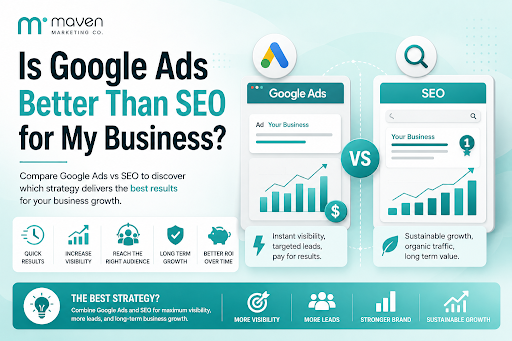
Is Google Ads Better Than SEO for My Business
One of the biggest questions business owners ask when they are planning online growth is whether they should invest in Google Ads or SEO. Both are strong marketing plays that help your company show up in Google search results, but they do things in separate lanes. Google Ads gives quicker visibility and can bring in leads fast, whereas SEO more or less focuses on slow, steady organic traffic that tends to grow the longer you keep building it. Picking the right direction depends on what you want to achieve, how much money you can spend, how crowded the market is, and how quickly you need results, like sooner rather than later. The good news is you don’t always have to choose one or the other; it’s not exactly a black-and-white situation. If you take time to understand the strongest points of both, you can put together a more sensible digital marketing plan that supports consistent expansion. In this guide, we’ll compare Google Ads vs SEO, explain the main differences, and help you figure out what option makes the most sense for your business.

When Should I Hire a Digital Marketing Agency
Growing a business today takes more than just having a website or throwing a post on social media; customers usually search around online, compare providers, skim reviews, and basically expect the brand to show up with a solid digital presence before they even think about buying. Many businesses try to run their marketing themselves, but there comes a point when “doing it all in-house” becomes clunky and hard to manage, all at once. Knowing when to hire a digital marketing agency can end up making a big, real difference for your growth. If you’re not getting enough leads, or your online visibility feels stuck, or sales are just not moving, the right agency can bring the know-how, plus a clear plan, to help you get noticeably better outcomes. In this guide, we’ll dig into what a digital marketing agency actually does, the usual signs it’s time to bring one on, and how picking the right marketing partner can help your business move forward at a faster pace.
Why Is My Google Ads Budget Running Out So Quickly
Running a successful Google Ads budget isn’t only about throwing more money at it. It’s more like making every dollar, doing a bit extra. A lot of businesses start a Google Ads campaign with big hopes, then find out their daily budget is gone within a few hours, and that feels weird, right? After that, your ads stop showing effectively, new leads slip away, and your return on investment dips. So if your Google Ads budget is running out too fast, don’t stress. It’s a fairly common issue, and in most situations, it can be repaired with the right approach. There are multiple little things that can drain your advertising money quicker than you expected, from costly keywords to audience targeting that just doesn’t quite fit. In this guide, we’ll walk through why your budget disappears so quickly, how to cut wasteful spend, and the most reliable ways to boost your Google Ads ROI, even if your budget stays the same.