.svg)


%201.svg)
.avif)
.avif)
Most Australian SMEs are sitting on a goldmine of content that isn't performing. Their blogs are full of individual articles targeting specific keywords, published independently without any strategic relationship to one another.
Google’s algorithm surveys this fragmented landscape and concludes: this site publishes disconnected articles but demonstrates no comprehensive expertise on any single subject.
The solution is shifting from keyword-focused content to Topic Clusters. This methodology is separating market leaders from followers in competitive industries. By organizing content into semantic powerhouses, businesses are seeing organic traffic increases of 40-80%.
Here is how to move from scattered posts to topical dominance.
Key Takeaways
- Authority Over Keywords: Topic clusters increase organic traffic by establishing comprehensive topical authority that modern algorithms reward over isolated page optimization.
- The Architecture: A cluster consists of a single "Pillar Page" (a 3,000–5,000 word authoritative overview) linked bidirectionally to 8–15 "Cluster Pages" (exploring subtopics in depth).
- Semantic Signaling: Internal linking architecture is crucial. It signals topic relationships to search engines, demonstrating a coherent content ecosystem.
- Reduced Cannibalization: Clusters establish clear hierarchical relationships, preventing multiple pages on your site from competing for the exact same search intent.
Consider the difference in approach. One site has 127 disconnected blog posts overlapping on "digital marketing tips," "social media strategies," and "content best practices." A competitor has interconnected these into a cohesive cluster around "Digital Marketing," with a central pillar linking to every facet systematically.
Guess who Google ranks higher?
.avif)
Case Study: Brisbane digital marketing agency Dilate restructured their blog from 215 keyword-targeted articles into 12 strategic topic clusters. Within six months, organic traffic increased 73% without creating a single new article—purely through reorganization that demonstrated topical authority.
Understanding Traditional SEO Limitations
Traditional keyword-focused SEO optimizes individual pages for specific keywords without considering content relationships. This approach emerged when search algorithms relied heavily on exact-match keywords and backlinks to determine relevance.
Today, this approach has severe limitations:
- Keyword cannibalization occurs when multiple shallow pages compete against themselves.
- Weak topical authority signals fail to communicate the breadth of your expertise to search algorithms.
- Vulnerability to algorithm updates like Google’s BERT and MUM models, which prioritize semantic understanding and topical depth over simple keyword matching.
Google wants to reward sites demonstrating genuine expertise, not just tactical keyword optimization.
Topic Cluster Architecture: The Strategic Alternative
The topic cluster model organizes content hierarchically. It creates an interconnected ecosystem that demonstrates to search engines that you are the definitive resource on a broad subject.
According to HubSpot, who popularized this model, topic clusters are the evolution of SEO needed to survive in modern search.
The components are defined as:
- The Pillar Page: A comprehensive 3,000–5,000 word overview of a broad topic. It covers all major aspects superficially and targets high-volume competitive keywords.
- Cluster Content: 8–15 shorter articles (1,200–2,000 words) that explore specific subtopics mentioned on the pillar page in great detail. These target long-tail keywords and specific user intents.
- Internal Linking: The glue that holds it together. The pillar links to all cluster articles, and all cluster articles link back to the pillar using descriptive anchor text.
.avif)
Melbourne SaaS company MYOB implemented a topic cluster for "accounting software." Their pillar page covered a comprehensive overview of selection and features. Cluster content included 12 specific articles covering nuances like "cloud vs. desktop," "multi-currency features," and "GST compliance." Within four months, organic traffic for that topic increased 340% through topical authority recognition.
Internal Linking Architecture: Signaling Topic Relationships
Strategic internal linking is not just for user navigation; it is the primary way you communicate content relationships to search algorithms.
To maximize the effectiveness of your clusters, follow these linking best practices:
- Bidirectional Linking: Ensure reciprocal links between the pillar and every cluster piece. This signals a hierarchical relationship with the pillar as the authoritative hub.
- Descriptive Anchor Text: Avoid generic phrases like "click here." Use specific phrases that describe the linked content. Descriptive anchor text provides crucial context to search engines about the topic of the target page.
- Link Equity Distribution: A sound cluster structure allows authority to flow from high-performing pages (like your pillar or homepage) down to specific cluster content.
Measuring Topic Cluster Performance
Don't just build clusters and hope for the best. Strategic measurement validates their effectiveness and identifies opportunities for optimization.
.avif)
Key metrics to track include:
- Organic Traffic by Cluster: Measure total engagement for the pillar and all associated cluster articles combined.
- Keyword Ranking Improvements: Monitor the pillar page for primary keywords alongside long-tail improvements for cluster pages.
- Featured Snippet Capture: Well-structured cluster articles answering specific questions are prime candidates for winning featured snippets.
- Engagement Flow: Use Google Analytics to see if users are progressing from pillar to cluster content, indicating deeper exploration of your site.
Transitioning Existing Content to Topic Clusters
Most Australian businesses already possess substantial content. The task is reorganization, not just creation.
Start with a content audit to catalog existing articles, keywords, and traffic. Identify related content that can be grouped into logical clusters. Perform a gap analysis to see what subtopics are missing that prevent comprehensive coverage.
Once identified, develop pillar pages to link existing content together and fill the gaps with new cluster articles. A Sydney agency observed a 23% traffic increase within just 30 days of simply restructuring existing content using this methodology.
Frequently Asked Questions
How many topic clusters should an Australian SME maintain? Start small. Aim for 3-5 core topic clusters aligned with your primary business offerings. Quality matters more than quantity. Focus on building authoritative coverage of a few topics rather than superficial treatment of many.
Can topic clusters work for local service businesses? Absolutely. A Brisbane plumber might develop an "Emergency Plumbing" pillar page, with cluster articles addressing specific issues like "burst pipes in Brisbane," "blocked drains," and "hot water failures." This demonstrates comprehensive local expertise better than scattered blog posts.
How long until topic clusters show SEO results? Initial improvements typically appear within 30-45 days as Google recrawls the restructured architecture. Significant traffic increases usually manifest over 3-6 months as rankings improve across primary and long-tail keywords.
Build Lasting Search Authority Through Topic Dominance
The algorithmic reality of search today rewards comprehensive topical coverage over scattered keyword targeting.
Yet, most Australian SMEs lack the content strategy expertise for confident cluster implementation, risking poorly structured attempts that waste resources.
Maven Marketing Co specializes in topic cluster strategy for Australian businesses. We provide content audits, pillar page development, internal linking architecture planning, and performance measurement.
From initial cluster identification through to implementation, we transform fragmented content libraries into strategic topic ecosystems that dominate search results.
Schedule your topic cluster consultation with Maven Marketing Co today. Stop publishing isolated articles and start building topical dominance.

Table of contents
read more blogs
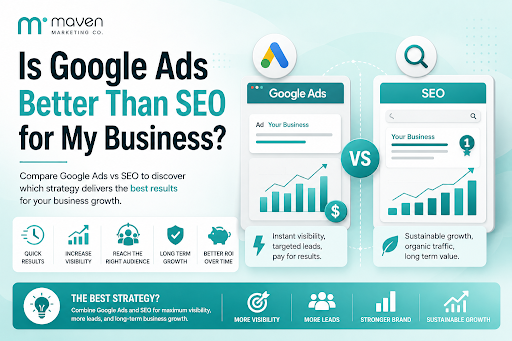
Is Google Ads Better Than SEO for My Business
One of the biggest questions business owners ask when they are planning online growth is whether they should invest in Google Ads or SEO. Both are strong marketing plays that help your company show up in Google search results, but they do things in separate lanes. Google Ads gives quicker visibility and can bring in leads fast, whereas SEO more or less focuses on slow, steady organic traffic that tends to grow the longer you keep building it. Picking the right direction depends on what you want to achieve, how much money you can spend, how crowded the market is, and how quickly you need results, like sooner rather than later. The good news is you don’t always have to choose one or the other; it’s not exactly a black-and-white situation. If you take time to understand the strongest points of both, you can put together a more sensible digital marketing plan that supports consistent expansion. In this guide, we’ll compare Google Ads vs SEO, explain the main differences, and help you figure out what option makes the most sense for your business.

When Should I Hire a Digital Marketing Agency
Growing a business today takes more than just having a website or throwing a post on social media; customers usually search around online, compare providers, skim reviews, and basically expect the brand to show up with a solid digital presence before they even think about buying. Many businesses try to run their marketing themselves, but there comes a point when “doing it all in-house” becomes clunky and hard to manage, all at once. Knowing when to hire a digital marketing agency can end up making a big, real difference for your growth. If you’re not getting enough leads, or your online visibility feels stuck, or sales are just not moving, the right agency can bring the know-how, plus a clear plan, to help you get noticeably better outcomes. In this guide, we’ll dig into what a digital marketing agency actually does, the usual signs it’s time to bring one on, and how picking the right marketing partner can help your business move forward at a faster pace.
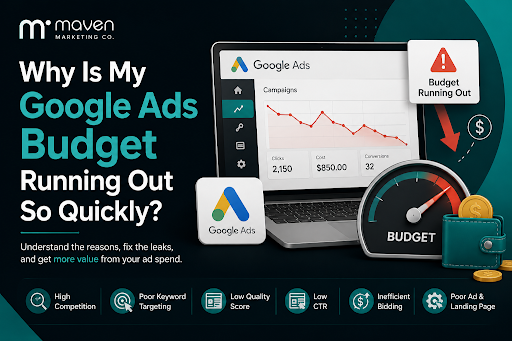
Why Is My Google Ads Budget Running Out So Quickly
Running a successful Google Ads budget isn’t only about throwing more money at it. It’s more like making every dollar, doing a bit extra. A lot of businesses start a Google Ads campaign with big hopes, then find out their daily budget is gone within a few hours, and that feels weird, right? After that, your ads stop showing effectively, new leads slip away, and your return on investment dips. So if your Google Ads budget is running out too fast, don’t stress. It’s a fairly common issue, and in most situations, it can be repaired with the right approach. There are multiple little things that can drain your advertising money quicker than you expected, from costly keywords to audience targeting that just doesn’t quite fit. In this guide, we’ll walk through why your budget disappears so quickly, how to cut wasteful spend, and the most reliable ways to boost your Google Ads ROI, even if your budget stays the same.