.svg)


%201.svg)

Quick Answers
What is degrowth economics and why does it matter now?
Degrowth economics refers to a deliberate downscaling of production and consumption to achieve ecological sustainability, social equity, and wellbeing without relying on GDP growth as the primary measure of progress. Unlike recession, which is chaotic and harmful, degrowth is intentional and managed. The concept matters now because 73% of climate policy researchers believe worldwide economic growth is incompatible with environmental sustainability, while the richest 10% generate 48% of all emissions. Degrowth focuses on improving quality of life through health, education, leisure, and community rather than material consumption, advocating for fairer resource distribution and localised economies.
When will artificial general intelligence arrive and what are the economic implications?
Current surveys of AI researchers predict AGI around 2040, with some experts like Dario Amodei of Anthropic predicting it as soon as 2026. AGI refers to AI systems that can perform virtually any cognitive task as well as or better than humans. Economic implications are profound with productivity potentially increasing by 0.125% to 0.875% annually at current AI usage levels, potentially doubling in 10 years. However, economists warn of massive labour market disruption, wage compression, and wealth concentration unless new distribution mechanisms like universal basic income are implemented. AGI could turbocharge economic growth while simultaneously threatening traditional employment models and exacerbating inequality.
The Full Guide

We stand at the intersection of two transformative forces that will fundamentally reshape how we think about business, prosperity, and planetary survival.
On one side, artificial general intelligence looms on the horizon. OpenAI's Sam Altman recently declared, "We are now confident we know how to build AGI as we have traditionally understood it." Tech leaders predict machines matching human cognitive performance across all domains within years, not decades. This technology promises to turbocharge economic growth, accelerate scientific discovery, and increase material abundance beyond anything humanity has experienced.
On the other side, a growing movement of economists, climate scientists, and social theorists argues that endless economic growth itself is the problem. Degrowth advocates propose something radical: that genuine wellbeing and planetary survival require us to deliberately downscale production and consumption, to reject GDP growth as our north star, and to reimagine prosperity entirely.
These two forces appear contradictory. Yet understanding their intersection may be the most important strategic question facing Australian business leaders today.
The Degrowth Proposition
The degrowth movement emerged from a simple but uncomfortable observation about infinite growth on a finite planet. The mathematics don't work. The ecology doesn't work. And increasingly, the human costs don't work either.
Research from resilience.org defines degrowth as a downscaling of production and consumption to reduce ecological footprints, planned democratically in a way that is equitable while securing wellbeing. Unlike recession, which happens chaotically and harms vulnerable populations disproportionately, degrowth represents an intentional, managed transition.
The case for degrowth rests on increasingly undeniable evidence. Global materials extraction reached 7 gigatonnes in 2022, with higher income nations accounting for 31% of world material consumption. The richest 1 billion individuals consume 72% of global resources, while the 1.2 billion poorest account for just 1%. When it comes to climate change, the richest 10% generate 48% of all emissions while the poorest half of humanity accounts for only 12% of the global carbon footprint.
These aren't just statistics about fairness. They represent physical limits on planetary systems. The 17 Sustainable Development Goals recognise that ending poverty must go hand in hand with strategies that protect the environment. Yet a 2025 survey of nearly 800 climate policy researchers found that 73% believe worldwide economic growth is incompatible with environmental sustainability.
Degrowth proponents argue we need to redefine progress itself. Instead of measuring success by GDP, focus on life expectancy, health, education, housing, and ecologically sustainable work. Instead of pursuing ever increasing consumption, prioritise sufficiency, wellbeing, and community connection. Instead of accepting massive inequality as the price of growth, redistribute resources more equitably.
Critics dismiss degrowth as unrealistic, arguing that slowing economic growth would increase unemployment, poverty, and suffering. They contend that green growth through technological innovation and efficiency offers a more viable path to sustainability. Yet mounting evidence suggests that decoupling economic growth from environmental harm at the scale and speed required remains elusive.
The Superintelligence Timeline
While degrowth advocates question growth itself, the AI industry races toward a technology that could supercharge it beyond anything we've imagined.
Artificial general intelligence refers to AI systems that can perform virtually any cognitive task as well as or better than humans. Unlike today's narrow AI, which excels at specific tasks, AGI would demonstrate general reasoning ability across all domains. Superintelligence takes this further, describing an intellect that vastly exceeds human cognitive performance in virtually all areas.
The timeline for AGI has accelerated dramatically. In September 2025, analysis of expert predictions reported that most surveys indicate a 50% probability of achieving AGI between 2040 and 2061. However, leading AI company executives offer far more aggressive predictions. Dario Amodei, CEO of Anthropic, expects the singularity by 2026. Elon Musk anticipates AI smarter than the smartest humans by 2026. Sam Altman has written about superintelligence arriving in "a few thousand days."
Whether AGI arrives in two years or twenty, its potential economic impact is staggering. Research from the American Enterprise Institute analysing economic scenarios found that aggressive AGI deployment could see the economy skyrocket while wages plummet after just three years, with only investors benefiting. More gradual scenarios still project massive labour market disruption as AI systems become capable of most economically valuable work.
OpenAI's position is that AGI "could help us elevate humanity by increasing abundance, turbocharging the global economy, and aiding in the discovery of new scientific knowledge that changes the limits of possibility." The promise is material prosperity beyond current imagination. New medicines discovered in days instead of decades. Scientific breakthroughs accelerating exponentially. Solutions to problems we currently consider intractable.
Yet this optimistic vision exists alongside serious concerns. Current work based social insurance would fail in an AGI disrupted labour market. Developing countries relying on cheap labour could suffer as this advantage disappears. The concentration of AI capabilities in a few companies and nations could worsen global inequality dramatically. And the environmental costs of the computational infrastructure required for AGI remain largely unexamined.

The Uncomfortable Intersection
Here's where things get interesting, and uncomfortable, for business leaders trying to navigate the future.
AI development is fundamentally a growth accelerating technology. Analysis from AI + Planetary Justice Alliance argues that AI systems are products of "growthism and dualism," built on extractive infrastructures and driven by an ideology of more. The harms aren't anomalies but structural, baked into development models that prioritise scale, speed, and accumulation over care, sustainability, and justice.
Consider the environmental footprint. Training large AI models requires massive computational resources and energy. Data centres consume enormous amounts of water for cooling. The supply chains for AI hardware involve mining rare earth materials under conditions that often devastate local ecosystems and communities. As AI capabilities expand, so do these environmental costs.
Research published in the Journal of Cleaner Production explored what happens when superintelligence emerges in an economy shaped by neoliberal growth policies. The conclusion was sobering. Such policies would exacerbate the risk of extremely adverse impacts, magnifying the socioecological consequences of economic growth. The challenge of superintelligence cannot be separated from other major environmental and social challenges, demanding fundamental transformation along degrowth lines.
This creates a genuine dilemma. If we pursue AGI within current growth paradigms, we may accelerate environmental destruction even as we increase material output. The AI industry projects that 50% of carbon reductions needed to reach net zero will come from technologies not yet invented. But what if the computing infrastructure required to invent those technologies itself contributes substantially to the problem?
Yet simply rejecting AI entirely seems neither realistic nor necessarily wise. Digital technologies play crucial roles in monitoring environmental systems, optimising resource use, and coordinating complex transitions. The question isn't whether to use AI but how to develop and deploy it in ways that genuinely serve sustainability rather than undermining it.
Toward A Degrowth Perspective on AI
A small but growing body of research asks how AI might exist within a degrowth framework. The answer starts with fundamentally different questions.
Instead of asking "How can AI accelerate economic growth?" a degrowth perspective asks "What is the problem we're trying to solve, and is AI the appropriate tool?" This shifts focus from technological capability to collective purpose. Not all problems require technological solutions, and not all innovations represent progress.
Research from the 2025 ISEE/Degrowth Conference proposes a framework built around ecological embeddedness, relationality, plurality, care, and refusal. Ecological embeddedness means recognising that AI systems aren't abstract or immaterial but extensions of physical, social, and planetary systems. Designing AI under this value means respecting ecological limits, prioritising frugality, and accounting for harm across entire supply chains.
Relationality emphasises that knowledge, agency, and wellbeing are coproduced through relationships among humans, nonhumans, and the environment. This calls for AI design processes grounded in collective inquiry rather than isolated optimisation for narrow metrics.
Care means attending to the slow, often invisible forms of labour that sustain both social and ecological life. It means recognising that some of the most urgent technological work isn't innovation but maintenance, support, and the cultivation of mutual trust.
Refusal acknowledges that saying no to certain technological paths is legitimate and generative. It enables communities to protect their autonomy, knowledge systems, and ecological balance against the encroachment of extractive, imposed technologies.
This isn't anti-technology. It's about technology developed and deployed in service of genuine flourishing rather than growth for growth's sake.
What This Means For Australian Businesses
Australian business leaders face strategic choices that will define competitive positioning for decades.
The temptation is to view AI adoption as purely an efficiency and growth opportunity. And certainly, businesses that don't adapt to AI capabilities risk being left behind. Current AI usage increases productivity by 0.125% to 0.875% annually, with potential to double as adoption expands. That's significant competitive advantage.
But businesses that race to adopt AI without considering sustainability implications may find themselves on the wrong side of history. Australian consumers increasingly demand environmental responsibility. Regulatory frameworks are tightening globally around both AI governance and environmental impact. The social licence to operate depends on demonstrating genuine commitment to planetary wellbeing.
Smart businesses will ask deeper questions. How can we use AI to genuinely improve wellbeing rather than just driving consumption? Can we deploy AI to optimise for sufficiency rather than endless growth? What would it mean to develop AI capabilities that enhance community resilience, enable circular economy models, and support ecological regeneration?
This might involve prioritising AI applications that reduce waste, optimise resource use, enable product longevity, and support sustainable practices. It could mean choosing AI infrastructure with lower environmental footprints even when more resource intensive options offer marginal performance advantages. It requires transparent accounting of AI's environmental costs alongside its economic benefits.
Most importantly, it demands thinking about business purpose beyond shareholder returns. The degrowth critique isn't fundamentally about GDP numbers. It's about what we value, how we measure success, and what kind of world we're building.
The Path Forward
The convergence of AGI and degrowth thinking isn't contradiction. It's opportunity.
AI capabilities could genuinely accelerate the transition to sustainable economies if developed and deployed with that explicit purpose. Machine learning could optimise renewable energy systems, predict maintenance needs to extend product lifespans, coordinate sharing economy platforms, and model complex ecological systems to inform better stewardship.
But this requires intentionality. It requires resisting the default assumption that AI should maximise growth and instead asking how it might support flourishing within planetary boundaries.
For Australian businesses, this presents both challenge and competitive advantage. Companies that pioneer sustainable AI deployment establish market leadership as regulatory and consumer pressure intensifies. Those that integrate degrowth values into their AI strategy position themselves for a future where material excess gives way to genuine prosperity.
The age of superintelligence may indeed be approaching. The question is whether we'll deploy that extraordinary capability to accelerate our current trajectory or to fundamentally reimagine what progress means.
The businesses that thrive in the coming decades will be those that recognise this isn't just about adopting new technology. It's about participating in the most important economic transformation in human history. One that determines not just business success but civilisational survival.
The future isn't about choosing between AI and sustainability. It's about demanding both, together, on purpose.
Ready to Navigate the Sustainable AI Future?
At Maven Marketing Co, we help Australian businesses develop strategies that balance technological innovation with genuine sustainability. Our team understands that the future of marketing and business itself requires rethinking growth, purpose, and impact.
Whether you're exploring how AI can serve your sustainability goals, reimagining your business model for a post growth economy, or simply trying to understand what these massive transformations mean for your competitive positioning, we're here to guide you through complexity toward clarity.
Let's build your sustainable future together

Table of contents
read more blogs
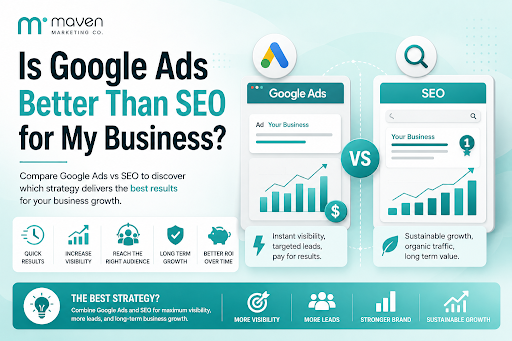
Is Google Ads Better Than SEO for My Business
One of the biggest questions business owners ask when they are planning online growth is whether they should invest in Google Ads or SEO. Both are strong marketing plays that help your company show up in Google search results, but they do things in separate lanes. Google Ads gives quicker visibility and can bring in leads fast, whereas SEO more or less focuses on slow, steady organic traffic that tends to grow the longer you keep building it. Picking the right direction depends on what you want to achieve, how much money you can spend, how crowded the market is, and how quickly you need results, like sooner rather than later. The good news is you don’t always have to choose one or the other; it’s not exactly a black-and-white situation. If you take time to understand the strongest points of both, you can put together a more sensible digital marketing plan that supports consistent expansion. In this guide, we’ll compare Google Ads vs SEO, explain the main differences, and help you figure out what option makes the most sense for your business.

When Should I Hire a Digital Marketing Agency
Growing a business today takes more than just having a website or throwing a post on social media; customers usually search around online, compare providers, skim reviews, and basically expect the brand to show up with a solid digital presence before they even think about buying. Many businesses try to run their marketing themselves, but there comes a point when “doing it all in-house” becomes clunky and hard to manage, all at once. Knowing when to hire a digital marketing agency can end up making a big, real difference for your growth. If you’re not getting enough leads, or your online visibility feels stuck, or sales are just not moving, the right agency can bring the know-how, plus a clear plan, to help you get noticeably better outcomes. In this guide, we’ll dig into what a digital marketing agency actually does, the usual signs it’s time to bring one on, and how picking the right marketing partner can help your business move forward at a faster pace.
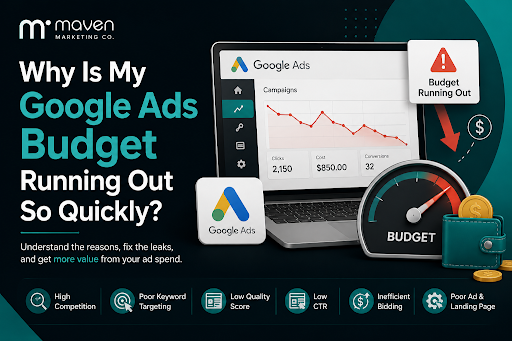
Why Is My Google Ads Budget Running Out So Quickly
Running a successful Google Ads budget isn’t only about throwing more money at it. It’s more like making every dollar, doing a bit extra. A lot of businesses start a Google Ads campaign with big hopes, then find out their daily budget is gone within a few hours, and that feels weird, right? After that, your ads stop showing effectively, new leads slip away, and your return on investment dips. So if your Google Ads budget is running out too fast, don’t stress. It’s a fairly common issue, and in most situations, it can be repaired with the right approach. There are multiple little things that can drain your advertising money quicker than you expected, from costly keywords to audience targeting that just doesn’t quite fit. In this guide, we’ll walk through why your budget disappears so quickly, how to cut wasteful spend, and the most reliable ways to boost your Google Ads ROI, even if your budget stays the same.