.svg)


%201.svg)

What is creative automation and why does it matter for marketers in 2025?
Creative automation uses AI tools to streamline content production, from generating social media posts to drafting email campaigns and creating visual assets. It matters because 92% of marketers say automation is key to remaining competitive, while 96% have used automation platforms somewhere in their business. The technology tackles repetitive tasks like scheduling posts, analysing data, and creating content variations, freeing marketers to focus on strategy and creativity. However, automation struggles with brand voice consistency over time and can output emotionally hollow content, making human oversight essential. Marketers who currently use automation daily report seeing 80% increase in leads and 47% cost reduction on paid ads, demonstrating both efficiency gains and business impact.
How do you maintain authenticity when using AI for content creation?
Maintaining authenticity with AI requires treating it as a collaborative tool rather than a replacement. Successful brands use AI for ideation, draft generation, and data analysis while keeping creativity, storytelling, and emotional resonance firmly in human hands. Key practices include establishing clear brand voice guidelines before automation, reviewing all AI output for emotional depth and cultural sensitivity, using AI for efficiency tasks like formatting and scheduling while humans handle strategic narrative, and being transparent with audiences about where AI fits into your process. Research shows consumers equate authenticity with reliability and empathy, responding more favourably to content they believe involves human creativity. The brands that succeed combine AI's speed and scale with human judgment and emotional intelligence.
The Full Guide
Your content calendar is relentless. Three social posts daily. Weekly blog articles. Email campaigns. Ad creative. Video scripts. Product descriptions. The demand never stops, yet your team hasn't doubled in size and your budget certainly hasn't either.
Enter AI automation, promising to solve your capacity crisis. Tools that can generate months of content in hours. Platforms that optimise campaigns while you sleep. Systems that scale your output exponentially without adding headcount.
The promise is intoxicating. The execution is where most brands stumble.
Because here's what the automation advocates often gloss over: in a world where AI can generate infinite content, the content that actually connects is becoming more valuable, not less. And that content requires something machines fundamentally cannot provide: genuine human understanding of what makes people feel, care, and act.
The challenge facing Australian marketers in 2025 isn't whether to automate. It's how to automate intelligently, leveraging AI's power while preserving the human elements that actually drive business results.

The Automation Imperative
The statistics paint a compelling picture of an industry in transformation. According to recent research, 78% of organisations now deploy AI in one or more business functions, up dramatically from previous years. Among marketers specifically, 92% say automation is key to remaining competitive, while 96% have used automation platforms somewhere in their business.
The impact is measurable. Of marketers using automation platforms, 80% report increased leads. Nearly half say automation has cut costs on paid advertising. Half of all marketers now use automation daily, with another 33% using it regularly.
Analysis from Harvard's Division of Continuing Education found that marketing professionals increasingly rely on AI tools embedded in their daily workflows, with many saying they "couldn't live without AI." The technology is reducing time spent on repetitive, data driven tasks across content marketing, email, social media, and customer relationship management.
For good reason. Manual content creation simply cannot match the volume demands of modern omnichannel marketing. A single campaign might require dozens of ad variations, personalised landing pages, email sequences, social content, and supporting collateral. Producing this manually would require massive teams or sacrifice quality for quantity.
AI automation offers a third path: maintaining quality while dramatically increasing output. Tools powered by large language models can generate content drafts, suggest headlines, optimise copy for different platforms, create variations for testing, and even produce visual assets, all in a fraction of the time traditional methods require.
By 2025, industry projections suggest 90% of marketers will use generative AI for content creation, up from just 55% today. The train has left the station. The question isn't whether to board but how to ride it effectively.
.avif)
The Authenticity Problem
Yet even as automation accelerates, a counter trend is emerging with equal force. Consumers are experiencing what researchers call "authenticity fatigue," a growing weariness with experiences that feel too polished, too calculated, too devoid of genuine human touch.
Research from Sprout Social found that 86% of consumers say authenticity is a key factor in deciding which brands they support. The message is unambiguous: people trust people, not bots. Brands prioritising honesty, vulnerability, and human storytelling see higher engagement and stronger loyalty than those relying purely on automated perfection.
The reason is psychological. When we perceive something as authentic, we assume it reflects intent, care, and human involvement. Studies show people respond more favourably to art, music, and social media content when they believe humans created it rather than algorithms. We value the imperfections that signal effort, emotion, and individuality.
AI content, no matter how sophisticated, struggles with this dimension. Artificial intelligence doesn't truly understand what it creates. It identifies patterns, predicts probable next steps, and arranges outputs statistically rather than intuitively. There's no emotion, purpose, or narrative, only data relationships.
This creates what researchers describe as content that feels "technically impressive but emotionally neutral." A perfectly structured social post that checks all optimisation boxes but fails to spark genuine connection. An email campaign with flawless personalisation that still feels like a broadcast rather than a conversation. Marketing materials that are data driven but emotionally empty.
Over automated experiences can make customers feel like numbers rather than individuals. When every interaction feels optimised rather than genuine, it diminishes brand loyalty and erodes trust. In crowded markets where multiple brands offer similar products, authenticity becomes the differentiator. A handcrafted message conveys commitment, taste, and credibility in ways automation cannot replicate.
The Integration Solution
The answer isn't rejecting automation. That ship has sailed, and businesses that resist will simply fall behind competitors who embrace these tools effectively. But neither is the answer uncritical adoption that sacrifices the human elements that actually drive conversion.
The solution lies in strategic integration: using AI for what it does best while preserving human judgment for what machines fundamentally cannot do well.
Leading marketing agencies describe the framework as treating AI as a tool, not a substitute. Everything automated gets reviewed, refined, and enhanced by humans before reaching audiences. The workflow becomes collaborative: machines handle efficiency, humans provide emotional intelligence and strategic direction.
Think of it as a partnership where each party contributes their strengths. AI excels at processing information, identifying patterns, generating variations, and handling repetitive tasks at scale. Humans excel at understanding context, applying judgment, recognising emotional nuance, and crafting narratives that resonate at deeper levels.
Applied to content creation, this means:
AI handles: Draft generation, headline options, formatting, basic optimisation, data analysis, A/B test variations, scheduling, and distribution logistics.
Humans handle: Strategic direction, brand voice refinement, emotional resonance, cultural sensitivity, ethical oversight, final approval, and relationship building.
The most successful implementations don't replace human creators. They amplify them, removing tedious tasks so creative professionals can focus on the strategic and emotional work that machines cannot replicate.

Building Your Automation Framework
Implementing creative automation effectively requires more than just adopting tools. It demands thoughtful frameworks that balance efficiency with authenticity.
Start with clarity on brand voice. Before automating content creation, codify what makes your brand sound like itself. Document tone, vocabulary, values, and the emotional territory you occupy. AI tools can maintain consistency only when you've defined what consistency means. Create style guides that specify not just grammar and formatting but voice characteristics, perspectives, and boundaries.
Define the automation boundaries. Be explicit about what gets automated and what requires human creation. Simple announcements, product descriptions, and data driven reports might be primarily AI generated with human review. Brand manifestos, customer service responses to complex issues, and crisis communications should be primarily human crafted with AI support. Establish clear rules that evolve as you learn what works.
Implement rigorous review processes. All AI generated content should pass through human review before publication. Train reviewers to evaluate for brand voice consistency, emotional resonance, factual accuracy, cultural appropriateness, and strategic alignment. The review isn't just about catching errors but enhancing quality, adding the human touches that transform functional content into compelling communication.
Layer personalisation intelligently. AI excels at dynamic personalisation at scale, adjusting content based on user behaviour, preferences, and context. But avoid personalisation that feels invasive or manipulative. The goal is relevance, not surveillance. Use data to serve users better, not to exploit psychological vulnerabilities. Transparent personalisation that adds genuine value builds trust. Opaque personalisation that feels creepy destroys it.
Preserve space for human stories. Within your automated content engine, intentionally create opportunities for unautomated human storytelling. Customer testimonials, employee spotlights, founder letters, behind the scenes content, and community features inject authenticity that no AI can replicate. These don't need to be daily, but regular human voices prevent your brand from feeling entirely machine generated.
Be transparent about AI use. Consumers increasingly can detect AI generated content. Rather than pretending everything is human crafted, be honest about how you use automation. Frame it as a tool that lets you serve customers better by freeing your team to focus on meaningful work. Transparency builds trust. Deception, even passive deception through omission, erodes it when eventually discovered.
Measure what matters. Track not just efficiency metrics like content volume and time savings but also engagement quality. Are comments more substantive? Are conversion rates improving? Is customer sentiment positive? Does your audience feel connected to your brand? Efficiency without effectiveness is ultimately counterproductive. The goal is business results, not just output volume.
The Australian Context
For Australian businesses, the automation opportunity comes with specific considerations. The Australian market's relatively smaller size compared to the US or UK means content volume requirements may be less extreme, but competition for attention remains fierce.
Australian consumers demonstrate strong preferences for authenticity and tend to be sceptical of overly polished or obviously manufactured content. This cultural tendency makes the balance between automation and human touch particularly important locally. Content that works in larger markets might feel inauthentic to Australian audiences if it lacks local cultural fluency.
The cost efficiency of automation matters enormously for small to medium Australian businesses operating with constrained budgets. A marketing team of three cannot produce the content volume of a team of thirty, yet market expectations for omnichannel presence remain constant. Intelligent automation levels the playing field, allowing smaller Australian businesses to compete with larger players on content volume while potentially winning on authenticity and connection.
Australian regulatory requirements around advertising disclosure and data use also demand careful implementation. Automated systems must respect privacy regulations and maintain appropriate disclosure when using consumer data for personalisation. The Australian Competition and Consumer Commission takes a dim view of misleading conduct, which includes AI generated content that misrepresents facts or creates false impressions.
Local agencies and marketing teams should also consider the opportunity to differentiate through thoughtful automation implementation. While global competitors might default to fully automated content, Australian brands that demonstrate superior balance between efficiency and authenticity can build competitive advantage through that reputation.

The Tools Landscape
The creative automation technology stack has matured rapidly. Understanding the categories helps in building an effective toolkit.
Generative AI platforms like ChatGPT, Claude, and Gemini handle text generation, ideation, and editing. These form the foundation of most content automation strategies. They excel at drafting, suggesting variations, summarising information, and reformatting content for different platforms.
Specialised content tools including Jasper, Copy.ai, and similar platforms add marketing specific features like brand voice training, content templates, and workflow integration. These often provide more controlled environments than general purpose AI while maintaining strong generation capabilities.
Visual automation tools like Midjourney, DALL-E, and Canva's AI features handle image creation and manipulation. While visual AI lags text AI in sophistication, it's improving rapidly and can significantly accelerate asset creation, particularly for social media, display advertising, and preliminary design concepts.
Marketing automation platforms including HubSpot, Marketo, and ActiveCampaign integrate AI across broader marketing functions. These combine content generation with campaign management, personalisation engines, analytics, and customer relationship management, creating comprehensive automated workflows.
Social media management tools such as Hootsuite and Buffer now incorporate AI for scheduling optimisation, content suggestions, and performance prediction. These help maintain consistent social presence without constant manual intervention.
Video creation platforms like Synthesia and Descript use AI for video generation, editing, and personalisation. While video automation remains more limited than text, it's advancing quickly and offers efficiency gains for training content, personalised communications, and social video.
The key is integration rather than proliferation. A small Australian business doesn't need every category. Start with one or two tools that address your biggest bottlenecks, learn to use them effectively within your framework, then expand gradually as needs and capabilities grow.
Common Pitfalls To Avoid
Even with strong frameworks, certain mistakes consistently undermine automation efforts.
Over automation tops the list. Brands that automate everything create sterile, soulless presences that repel rather than attract audiences. If your social media feels like it's run entirely by robots, audiences disengage. Leave space for spontaneity, humanity, and genuine interaction.
Insufficient review allows low quality content to reach audiences, damaging brand reputation. AI makes mistakes, hallucinates facts, misses context, and produces generic output. Without human oversight, these problems become public. Every piece of automated content needs eyes on it before publication.
Ignoring brand voice lets AI's default voice override your distinctive personality. Large language models have characteristic patterns and tendencies that bleed through without active management. Generic AI voice sounds like everyone else using AI voice. Your brand loses distinctiveness.
Forgetting context causes automated content to miss nuance, cultural moments, or sensitivity requirements. AI doesn't understand when a topic has become controversial, when a phrase has taken on new meaning, or when global events make certain content inappropriate. Human judgment catches these issues before they become crises.
Neglecting relationships happens when automation extends into areas requiring genuine human connection. Customer service can be partially automated, but complex issues need human empathy. Community management benefits from automation but dies without authentic human participation. Sales outreach scales with automation but closes with relationship building.
Chasing volume over value produces endless mediocre content that clutters channels without driving results. More content isn't always better. Sometimes it's just more. Focus automation on producing higher quality at sustainable volume rather than maximum quantity at minimum quality.
The Future Of Creative Work
Looking ahead, the relationship between automation and human creativity will continue evolving. AI capabilities will expand, making more sophisticated content generation possible. Simultaneously, human creativity and authenticity will become more valuable precisely because they become more rare.
The marketing roles that thrive will be those that evolve into hybrid positions emphasising creativity, data literacy, strategic oversight, and emotional intelligence. Future marketers won't compete with AI. They'll direct it, refine its output, and provide the human judgment that transforms functional content into compelling communication.
For Australian businesses, this represents opportunity. Companies that master the balance early establish competitive advantage. Those that resist change or adopt uncritically both face challenges. The winning path threads between extremes, embracing automation's power while protecting the human elements that drive genuine connection.
The brands that succeed in 2025 and beyond will be those that understand a fundamental truth: in a world of increasing automation, authentic human connection becomes the ultimate differentiator. Technology enables scale. Humanity creates meaning. The art lies in having both.
Ready To Scale Without Losing Your Soul?
At Maven Marketing Co, we help Australian businesses implement creative automation strategies that increase efficiency without sacrificing authenticity. Our team understands that successful marketing automation isn't about replacing humans but empowering them to focus on what they do best: strategy, creativity, and genuine connection.
Whether you're just beginning to explore AI tools, looking to optimise existing automation, or need to rebuild content processes that have lost their human touch, we're here to guide you toward solutions that drive real business results.
Let's build your intelligent content engine together

Table of contents
read more blogs
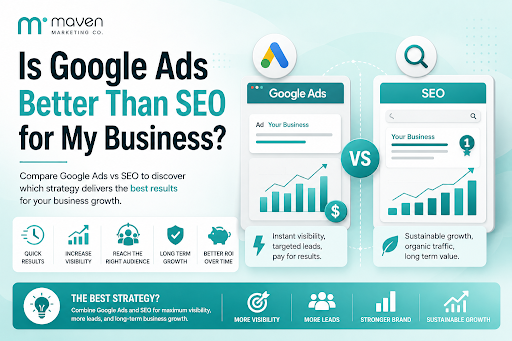
Is Google Ads Better Than SEO for My Business
One of the biggest questions business owners ask when they are planning online growth is whether they should invest in Google Ads or SEO. Both are strong marketing plays that help your company show up in Google search results, but they do things in separate lanes. Google Ads gives quicker visibility and can bring in leads fast, whereas SEO more or less focuses on slow, steady organic traffic that tends to grow the longer you keep building it. Picking the right direction depends on what you want to achieve, how much money you can spend, how crowded the market is, and how quickly you need results, like sooner rather than later. The good news is you don’t always have to choose one or the other; it’s not exactly a black-and-white situation. If you take time to understand the strongest points of both, you can put together a more sensible digital marketing plan that supports consistent expansion. In this guide, we’ll compare Google Ads vs SEO, explain the main differences, and help you figure out what option makes the most sense for your business.

When Should I Hire a Digital Marketing Agency
Growing a business today takes more than just having a website or throwing a post on social media; customers usually search around online, compare providers, skim reviews, and basically expect the brand to show up with a solid digital presence before they even think about buying. Many businesses try to run their marketing themselves, but there comes a point when “doing it all in-house” becomes clunky and hard to manage, all at once. Knowing when to hire a digital marketing agency can end up making a big, real difference for your growth. If you’re not getting enough leads, or your online visibility feels stuck, or sales are just not moving, the right agency can bring the know-how, plus a clear plan, to help you get noticeably better outcomes. In this guide, we’ll dig into what a digital marketing agency actually does, the usual signs it’s time to bring one on, and how picking the right marketing partner can help your business move forward at a faster pace.
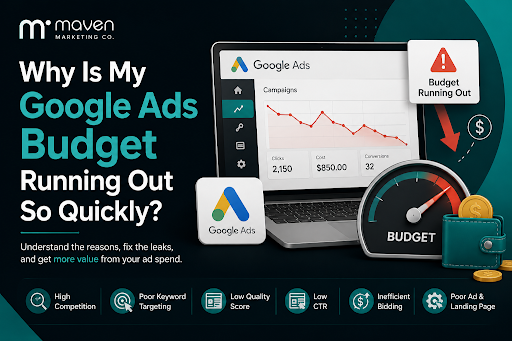
Why Is My Google Ads Budget Running Out So Quickly
Running a successful Google Ads budget isn’t only about throwing more money at it. It’s more like making every dollar, doing a bit extra. A lot of businesses start a Google Ads campaign with big hopes, then find out their daily budget is gone within a few hours, and that feels weird, right? After that, your ads stop showing effectively, new leads slip away, and your return on investment dips. So if your Google Ads budget is running out too fast, don’t stress. It’s a fairly common issue, and in most situations, it can be repaired with the right approach. There are multiple little things that can drain your advertising money quicker than you expected, from costly keywords to audience targeting that just doesn’t quite fit. In this guide, we’ll walk through why your budget disappears so quickly, how to cut wasteful spend, and the most reliable ways to boost your Google Ads ROI, even if your budget stays the same.