.svg)


%201.svg)

Key Takeaways
- Content refresh identifies articles that are already indexed and receiving some search visibility but are underperforming relative to their potential, and updates them to be more competitive in current search results.
- Articles ranking in positions four to fifteen for their target queries are the highest priority for content refresh, because they already have ranking traction and a quality improvement is most likely to push them into the top three positions where traffic volumes are substantially higher.
- A content refresh is not cosmetic editing. It involves researching what the current content currently ranking at the top covers that the existing article does not, expanding the article to match competitive depth, updating outdated statistics and references, and improving the structural and technical elements of the page.
- The publication date update and a prominent last updated notice signal to both readers and search engines that the content reflects current information, which matters particularly for queries where content freshness is a ranking signal.
- Content decay is the gradual decline in rankings and traffic that most articles experience over time as newer content from competitors is published and as Google's assessment of topical completeness evolves. A refresh programme addresses decay proactively rather than reactively.
- Internal linking should be reviewed as part of every content refresh, ensuring the refreshed article links to relevant newer content and that newer articles link back to the refreshed piece where appropriate.
- A content audit identifying which articles to refresh, in what priority order, and against what quality benchmark is the essential first step before any refresh work begins.
Why Existing Content Decays
Content published on Australian websites does not hold its position in search results indefinitely. Rankings for most articles decline gradually over time through a process driven by several interacting factors, and understanding those factors is necessary to address them effectively through a refresh programme.
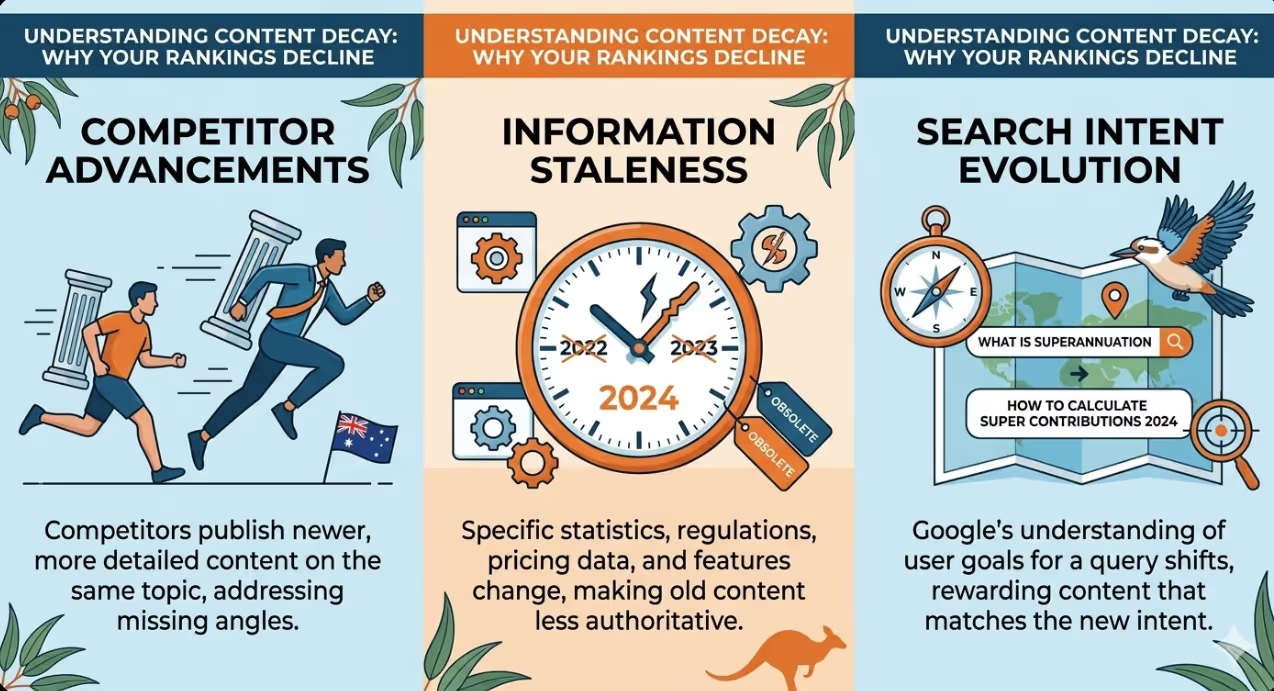
The most significant driver of content decay is the publication of newer, more comprehensive content on the same topics by competitors. When an article was first published, it may have been among the most thorough treatments of its subject available in Australian search results. Twelve months later, a competitor who has seen the article ranking well may have published a more detailed version that covers the topic from more angles, includes more recent data, and addresses questions the original did not consider. Google's quality assessment gives weight to comparative thoroughness, and the newer article progressively displaces the original.
The second major driver is information staleness. Articles that cite specific statistics, regulations, pricing data, software versions, or platform features become less authoritative as that information ages. A 2023 article about superannuation contribution limits that has not been updated contains incorrect figures. A 2022 article about Google Analytics best practice describes a platform that has been substantially replaced. An article about digital marketing benchmarks citing data that is two years old is a less credible source than a recently updated equivalent. Both readers and Google's quality systems are sensitive to outdated information, and its presence erodes rankings over time.
The third driver is the evolution of search intent. Google's understanding of what users want when they perform a specific search changes over time, and the content that best matches the current intent for a query may look different from what matched it two years ago. An article written to address one interpretation of a query that Google has since refined may no longer match the intent that the algorithm rewards for that search, regardless of how well written or thoroughly researched it was when published.
Identifying the Right Articles to Refresh
Not every article in a content library is worth refreshing. A disciplined content refresh programme begins with an audit that identifies which articles have the highest potential return from an update, so that the available effort is concentrated where it will produce the most significant ranking improvements.
The primary candidate for a content refresh is an article that is already receiving some organic traffic or ranking visibility but is performing below what its topical relevance suggests it should achieve. An article that ranks in positions four to fifteen for a commercially valuable query is a particularly strong refresh candidate. It has already demonstrated to Google that it is relevant to the query. It is close enough to the top results that a quality improvement has a realistic chance of moving it into the top three positions, where rates of clicks through to the page are substantially higher. The investment required to lift a position six article into the top three is almost always lower than the investment required to take a new article from nothing to a top three position on the same query.
Google Search Console provides the data needed to identify these candidates. The Performance report, filtered to show queries where the average position is between four and twenty, and cross referenced against the pages generating impressions on those queries, reveals articles that are generating search interest without converting it into significant traffic. These are the refresh priority candidates.
Articles that were once strong performers but have experienced a measurable traffic decline over the previous six to twelve months are the second priority category. These articles have established ranking history and existing authority that is being eroded rather than built from scratch. Refreshing them restores the competitive quality that originally drove their performance.
Articles ranking well below position twenty for their target queries represent a more complex decision. If the ranking is low because the article is genuinely thin or poor quality, a refresh may lift performance. If it is low because the domain lacks authority relative to the competitors dominating the top results, no amount of content improvement will produce a significant ranking change without parallel improvements to the domain's overall authority.
What a Genuine Content Refresh Involves
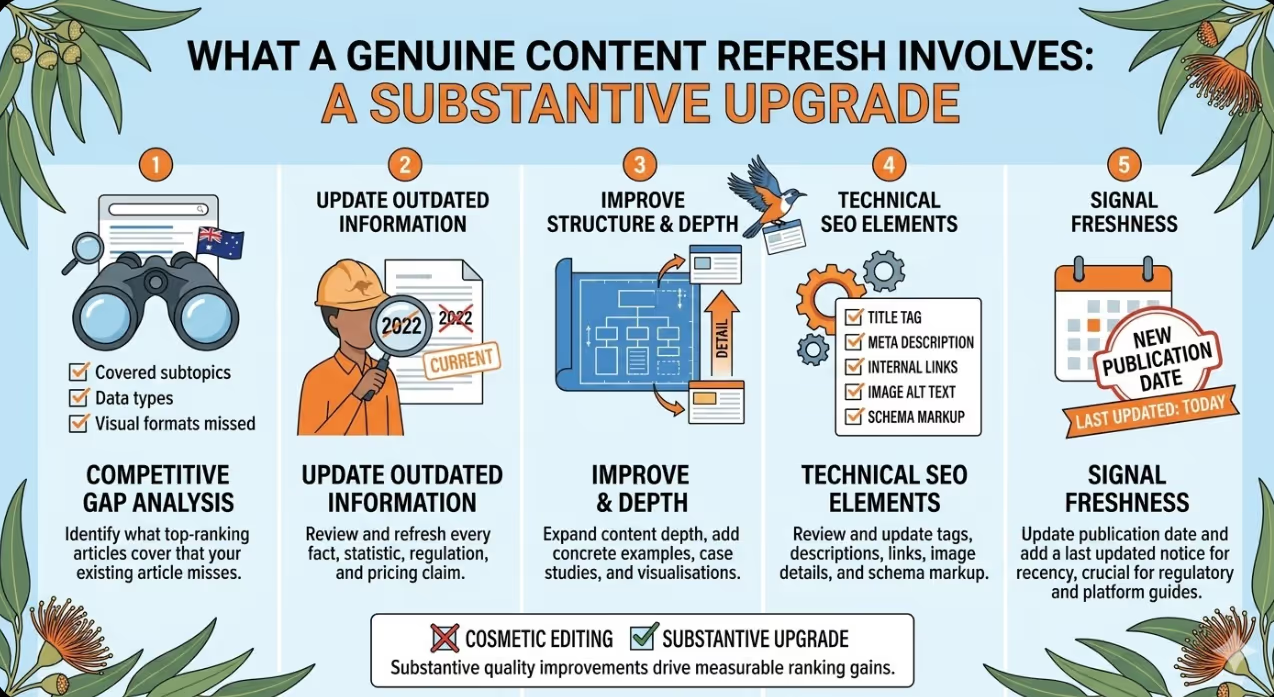
The term content refresh is sometimes used to describe minor cosmetic changes that do not meaningfully improve the quality or competitiveness of an article. Updating the publication date without improving the content does not improve rankings and may be detected by Google's quality systems as a manipulation attempt rather than a genuine update. A genuine content refresh requires substantive improvement across multiple dimensions.
Competitive content gap analysis. The refresh process begins by examining the articles currently sitting at the top of search results for the target query and identifying what they cover that the existing article does not. This gap analysis determines the specific additions and expansions needed to bring the article to a competitive standard. If the articles currently ranking at the top each address five subtopics that the existing article ignores, those subtopics need to be developed and added. If they consistently include specific data types, visual formats, or expert citations that are absent from the existing article, those elements should be incorporated.
Updating and replacing outdated information. Every factual claim, statistic, regulatory reference, software version, pricing figure, or statement that is sensitive to timing in the article needs to be assessed for currency. Outdated information should be updated to reflect the current situation, with fresh sources cited. Where the information has changed significantly enough that the article's original argument or structure is affected, the argument and structure need to be revised accordingly.
Structural and depth improvements. Competitive analysis will typically reveal that the existing article needs to be expanded to match the depth of current content currently ranking at the top. This may involve adding new sections on subtopics not covered in the original, expanding existing sections with additional detail, adding concrete examples, case studies, or data visualisations, and improving the heading structure to make the article more navigable and more clearly aligned with the search intent for the target query.
Technical SEO elements. The title tag and meta description should be reviewed against current best practice and updated if the existing versions are not competitive. Internal links should be added or updated to reflect the current state of the site's content library. Images should be assessed for format, compression, and alt text quality. Schema markup should be added where appropriate for the content type.
Publication date and last updated notice. Once the content has been substantially improved, updating the publication date and adding a visible last updated notice signals to readers and to Google that the content reflects current information. This is particularly important for topics where freshness is a significant ranking factor, such as regulatory topics, guides tied to specific platforms, and industry data.
Content Refresh vs New Content: Choosing the Right Investment
The decision between refreshing existing content and publishing new articles is not binary. A thoroughly managed content programme does both, with the allocation of effort between the two guided by the specific opportunity in the existing library and the gaps in topical coverage that new content can fill.
Content refresh produces returns more quickly than new content in most cases because it builds on existing ranking signals rather than starting from nothing. An existing article at position six with a year of ranking history behind it can realistically reach the top three within four to eight weeks of a substantive refresh. A new article targeting the same query may take six to twelve months to reach a comparable position, because it must first accumulate the indexing history, engagement signals, and incoming links that the existing article already has.
New content is the right investment when there are commercially important queries for which no existing article provides an appropriate foundation for a refresh, when the existing article on a topic is so thin or misdirected that a fresh approach would be more efficient than trying to rebuild it, and when new product launches, service expansions, or market developments create query opportunities that did not exist when the content library was originally built.
For Australian businesses with content libraries built over several years, the typical finding in a content audit is that a significant proportion of the library, often thirty to fifty percent of indexed articles, contains meaningful refresh potential that would produce better returns than an equivalent number of new articles. Addressing this inventory of underperforming existing content before investing heavily in new volume is the sequence with the highest return in most cases.
The Role of Republishing and Promotion
A refreshed article benefits from the same promotion and amplification that a new article receives, but is often overlooked for this treatment because it is not new. Treating a substantially refreshed article as a new publication event, sharing it through social media channels, including it in email newsletters, and outreaching to relevant publications and communities for links and coverage, compounds the impact of the quality improvement with renewed distribution and link acquisition.
Google's guidance on content freshness signals acknowledges that updates to existing content are interpreted as signals of freshness and relevance for queries where recency is a ranking factor. Combining a genuine quality improvement with a republication event that generates fresh engagement signals and potentially new backlinks accelerates the ranking recovery compared to a quiet update with no associated promotion.
For Australian businesses conducting guest post outreach or social media amplification as part of their broader content marketing programme, integrating refreshed content into those channels alongside new content maximises the return on the refresh investment and builds the distribution habits that produce consistent compounding results over time.
FAQs
How do you know when an article needs a refresh rather than replacement?The decision hinges on whether the existing article has anything worth building on. If the article ranks between position four and thirty for its target query, has acquired at least a modest number of referring links, and addresses a topic that is still commercially relevant, it is a refresh candidate worth preserving and improving rather than replacing. If the article ranks below position thirty, has no meaningful backlinks, covers a topic whose search intent has fundamentally changed, or was so thinly written that the effort to improve it substantially would exceed the effort to write a new article from scratch, replacement or retirement may be more efficient. The assessment should be made on a case by case basis using the article's actual performance data from Google Search Console rather than assumptions about its quality based on publication date alone.
How often should an Australian business refresh its blog content?The frequency of content refresh depends on the size of the content library, the rate of change in the industry, and the resource available for refresh work. A practical approach for most Australian businesses is to conduct a full content audit once per year, identifying all articles with refresh potential and prioritising them by expected return. During the year, the articles with the highest priority are refreshed on a rolling basis, typically covering two to four refreshes per month for a business with an active content programme. Industries where information changes rapidly, such as technology, finance, and regulatory sectors, benefit from more frequent refresh cycles because content staleness accumulates more quickly. For any article that ranks in the top ten for a commercially important query, reviewing it every six months for currency and competitive adequacy is a worthwhile discipline regardless of whether a full refresh is needed.
Does refreshing old content affect the existing backlinks pointing to it?No. Backlinks point to the URL of an article, not to a specific version of its content. Refreshing the content at an existing URL preserves all existing backlinks and the domain authority they contribute. This is one of the most significant advantages of refreshing over replacing: a new URL must rebuild its backlink profile from scratch, while a refreshed article at the same URL retains every link that pointed to the original. The only scenario where backlinks are affected is if the URL itself changes as part of the refresh, which should be avoided. If a URL must change, a 301 redirect from the old URL to the new one preserves most of the link equity, but the change still introduces friction and should be approached carefully.
The Content You Have Already Paid For Is Often Your Fastest Path to Better Rankings
A new article requires investment in research, writing, editing, and promotion before it begins contributing to organic performance. A refreshed article draws on infrastructure that already exists: the indexed URL, the ranking history, the backlinks, and the topical authority the site has already demonstrated on the subject. For Australian businesses looking for the fastest route to improved organic search performance within a constrained content budget, a systematic content refresh programme is consistently one of the strongest available options.
Maven Marketing Co conducts content audits and delivers content refresh programmes for Australian businesses, identifying the highest return opportunities in existing libraries and executing the updates that translate into measurable ranking improvements.
Talk to the team at Maven Marketing Co →

Table of contents
read more blogs

How to Choose the Right Digital Marketing Channels for Your Business
Choosing digital marketing channels is one of the easiest places for businesses to lose clarity. There are more options than ever, every platform promises reach and results, and it is easy to assume that the best strategy is simply to be everywhere. In reality, most businesses do better when they choose channels with intention rather than spreading budget and effort too thinly.The right channel mix depends on where your audience spends time, how they search or discover solutions, what your business is trying to achieve and how much resource you actually have to support execution properly. A channel is only useful if it helps move the right people towards a commercial outcome that matters to the business.This is why strong digital marketing strategy is not really about finding one perfect platform. It is about understanding the role each channel can play across awareness, demand capture, conversion and retention. SEO might build long-term visibility, Google Ads might capture active intent, social media might support familiarity and reach, while email may help nurture prospects and strengthen customer value over time.This guide explains what digital marketing channels are, how to assess them properly and how to build a balanced channel mix for your business. The focus is practical. Rather than chasing every new platform, the goal is to help you choose the channels that fit your audience, goals, budget and internal capability.

How to Build a Customer Journey Map for Your Digital Marketing Strategy
A strong digital marketing strategy is not just about channels, creative or traffic. It is about understanding how real people move from first awareness through to enquiry, purchase and ongoing loyalty. That is exactly why customer journey mapping matters.Without a clear view of the journey, businesses often optimise in fragments. They improve the website without thinking about the ad that drove the visit, produce content without considering where the audience is in the decision process, or judge conversion performance without understanding the friction points that sit earlier in the experience.A customer journey map helps you step back and see the bigger picture. It shows the stages people move through, the touchpoints they interact with, the questions they ask, the barriers they face and the moments where your marketing can either help or lose them.This guide explains how to build a practical customer journey map for your digital marketing strategy, what information to include, how to use the map to improve performance and which common mistakes to avoid. The goal is not to create a pretty workshop artefact that gets forgotten. It is to build a working tool that improves messaging, user experience, channel decisions and conversion outcomes.

Why Your Google Ads Campaign Is Not Getting Results: Common Mistakes and Solutions
If your Google Ads campaign is getting impressions or clicks but not producing enough enquiries, sales, or qualified leads, the problem is usually not Google Ads itself. It is more often a strategy, tracking, or conversion issue somewhere in the system.That matters because paid search can look busy without being commercially effective. You can have traffic coming in, a reasonable click-through rate and money leaving the account every day, yet still have very little to show for it if your keywords are weak, your ad copy is misaligned, your landing pages do not convert or your tracking is incomplete.A strong campaign works as one connected chain. Search intent, keyword targeting, ad relevance, bidding, landing-page experience, and conversion tracking all need to support the same commercial outcome. If one link breaks, results usually suffer quickly.This guide explains the most common reasons a Google Ads campaign is not getting results, what those issues normally look like in practice and how to fix them without relying on guesswork. The focus is not on vanity metrics. It is on improving lead quality, conversion rate, and return on spend.