.svg)


%201.svg)

Key Takeaways
- A 90-day planning horizon is long enough to build meaningful topical architecture and establish publishing consistency, and short enough to remain responsive to market changes, seasonal opportunities, and evolving business priorities.
- The content calendar development process begins with a business and audience brief that establishes the commercial goals the content programme is meant to serve, the audience segments it must reach, and the competitive landscape it must operate within.
- Keyword research for a quarterly content plan focuses on three categories: queries with strong commercial value where the business wants to build authority, informational queries that attract the target audience early in their decision journey, and topical clusters that support overall domain authority in the core subject areas.
- The 90-day calendar is structured in phases, with the first month establishing foundational topic coverage, the second month building depth on the strongest performing or most commercially important topics, and the third month addressing seasonal, opportunities specific to the quarter that are driven by seasonal timing, industry events, or emerging topics.
- Each calendar entry includes the target keyword, the intended search intent, the recommended word count, the content type, the assigned writer, the draft deadline, the publish date, and the primary call to action for the piece.
- A content calendar is a living document, not a fixed contract. It should be reviewed at the midpoint of each quarter and adjusted to reflect any significant changes in business priorities, search landscape developments, or performance data from the articles already published.
- The calendar development process for a new client typically takes two to three weeks from initial brief to finalised schedule, with the research, competitive analysis, and strategic planning phases requiring the greatest investment of time.
Why 90 Days Is the Right Planning Horizon
Content planning horizons range from weekly schedules, which provide little strategic coherence and require constant re-planning effort, to annual calendars, which are strategically ambitious but become outdated quickly in a dynamic search landscape. The 90-day horizon sits at the right point in that range for most Australian businesses for reasons that are both strategic and practical.
Strategically, 90 days is sufficient time to build recognisable topical depth. A content programme publishing eight articles per month over a quarter produces 24 pieces by the end of the period. When those 24 pieces are planned with a coherent topical architecture in mind, covering a subject area from multiple angles at different levels of depth and for different audience segments, the domain begins to accumulate genuine topical authority in a way that a random selection of 24 articles on loosely related subjects would not. Google's quality systems reward this kind of structured depth, and the compounding effect on rankings for the relevant topic cluster becomes measurable within the quarter.
Practically, 90 days aligns with the quarterly business planning cycles that most Australian companies use to set priorities, assess performance, and allocate resources. Content planning that follows the same rhythm as business planning integrates more naturally into the marketing function, gets reviewed by the right stakeholders at the right moments, and stays connected to the commercial priorities that determine whether the content programme is generating return.
A 90-day calendar also preserves enough flexibility to respond to significant changes in the search landscape or business environment without requiring a complete restart. If a major industry development occurs in week six, the remaining seven weeks of the quarter can be adjusted to address it without abandoning the topical architecture already established in the first month. An annual calendar cannot be adjusted with the same agility.
Phase One: The Business and Audience Brief
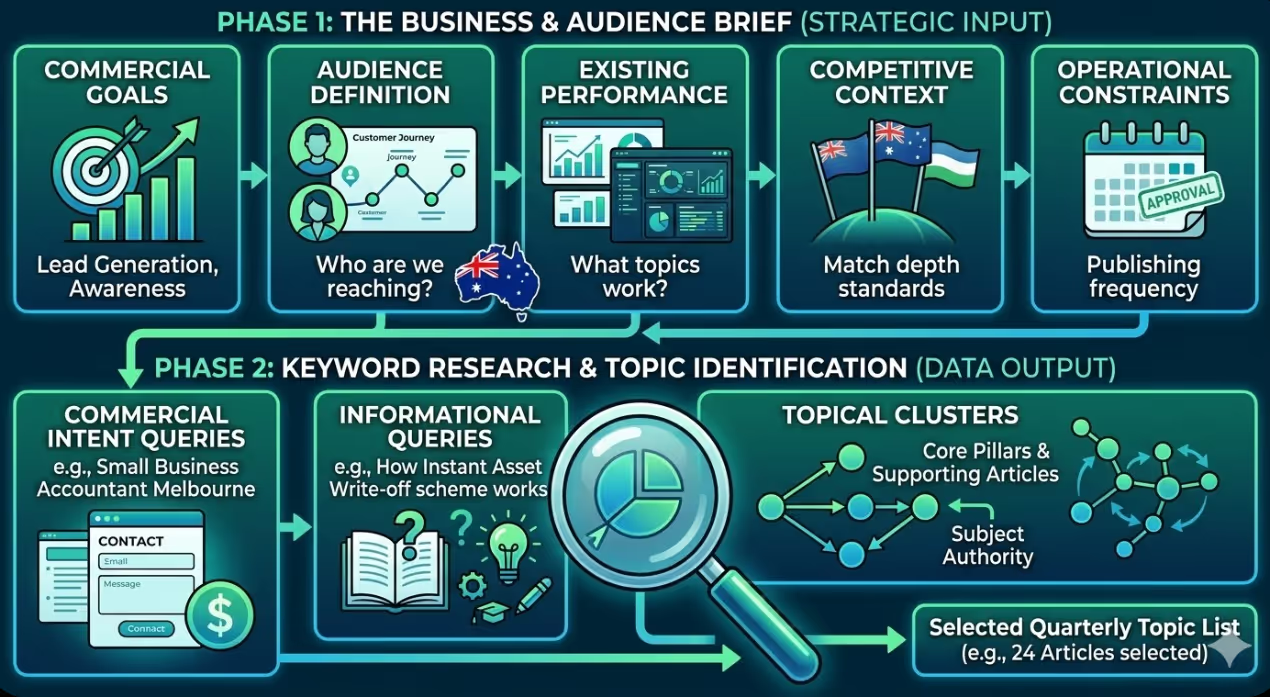
Before any keyword research is conducted, the content calendar development process begins with a structured brief that establishes the commercial context the content plan must serve. This phase is the most consequential of the entire process and the one most frequently compressed by agencies eager to move quickly to deliverables. Compressing it produces a content calendar that is thoroughly researched but commercially misaligned.
The brief covers five areas. The first is commercial goals: what outcomes does the business need the content programme to contribute to over the next 90 days? These goals might include generating enquiries from a specific service category, building awareness among a new audience segment, supporting a product launch or promotion, or improving organic visibility in a specific geographic market. Without clarity on these goals, there is no basis for making the trade offs that arise when prioritising one set of topics over another.
The second area is audience definition. Whose decisions is the content trying to influence, and where are those people in the decision process when the content is most likely to reach them? For an Australian B2B technology company, the relevant audience might be IT managers researching solutions to a specific operational problem, with content reaching them during the research and shortlisting phases of a purchasing cycle that takes three to six months. For an Australian ecommerce retailer, the relevant audience might be consumers in the consideration phase, comparing options across a category with a purchase decision timeline measured in days rather than months.
The third area is existing content performance. A new client with an established content library brings with it data on which topics, formats, and angles have previously generated the most organic traffic, engagement, and commercial outcomes. This performance history shapes the strategy for the new quarter, identifying what to build on and what to replace or retire.
The fourth area is competitive context. Which competitors are consistently producing content that ranks above the client's existing pages for commercially important queries? What topics, formats, and depth standards are those competitors establishing that the client's content programme must match or exceed?
The fifth area is operational constraints: what is the publishing frequency the business can realistically sustain over 90 days, what is the approval and review process for content before publication, and are there any topics, claims, or formats that require legal, regulatory, or executive review before they can be published?
Phase Two: Keyword Research and Topic Identification
With the brief established, the keyword research phase builds the raw material from which the quarterly topic list is drawn. The research covers three distinct categories of keyword opportunity that correspond to different stages of the audience's decision journey and different commercial objectives for the content.
Commercial intent queries are those where the searcher is actively evaluating a product, service, or provider. For an Australian accounting firm, these might include queries such as "small business accountant Melbourne" or "tax planning services for Australian companies". Content targeting these queries sits at the bottom of the marketing funnel and is most directly connected to lead generation. A content calendar for most Australian service businesses should include at least one commercially intent-aligned piece per month.
Informational queries are those where the searcher is learning about a topic, problem, or category rather than actively evaluating a purchase. For the same accounting firm, informational queries might include topics such as how the instant asset write-off scheme works, what triggers a tax audit, or how to structure a small business for tax efficiency. Content targeting these queries attracts the target audience earlier in their decision journey and builds the authority that supports rankings for more commercially valuable queries over time.
Topical cluster queries are those that define the subject areas where the brand wants to build deep domain authority. A content calendar developed around topical clusters assigns a core pillar topic to each cluster and builds a set of supporting articles that address subtopics, related questions, and adjacent areas within the same subject. The internal linking structure that connects the pillar article to its supporting pieces signals topical depth to Google's indexing systems and improves the performance of the entire cluster over time.
For a 90-day calendar at a publishing frequency of eight articles per month, the keyword research phase typically identifies 30 to 40 topic candidates, from which the final 24 are selected based on commercial priority, competitive feasibility, and strategic fit with the topical architecture being built.
Phase Three: Competitive Analysis and Depth Benchmarking
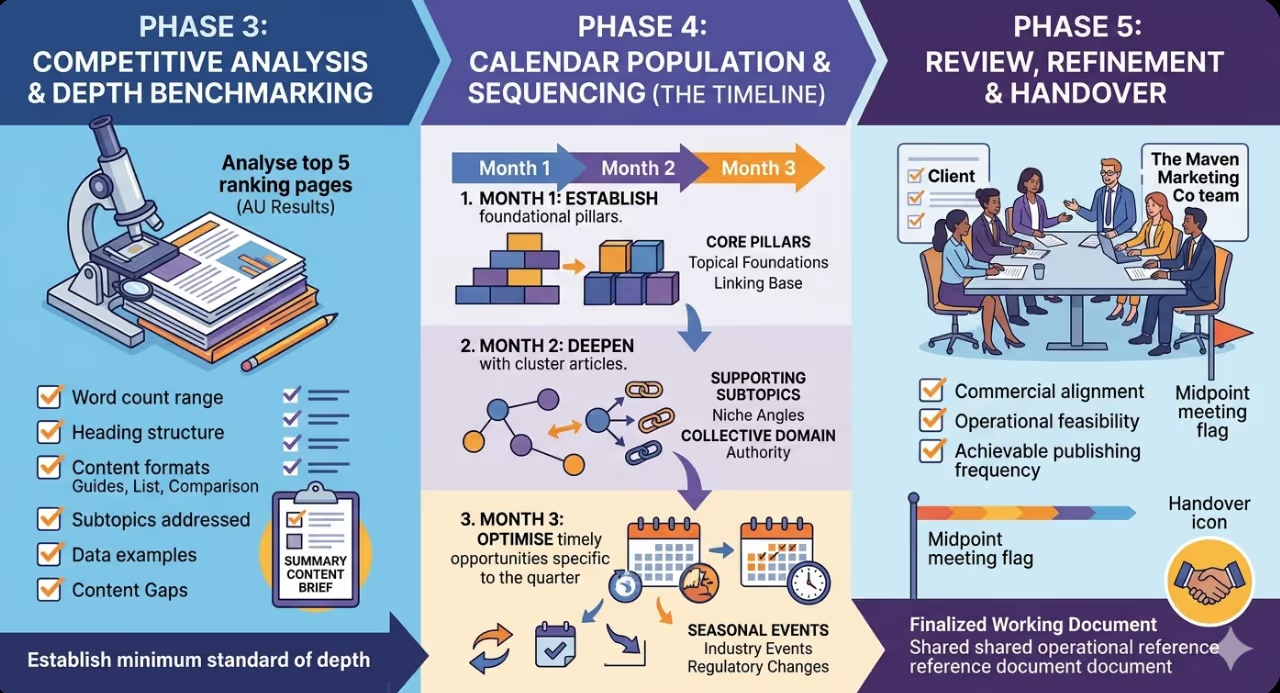
For each shortlisted topic, a competitive analysis establishes what the content produced for that query needs to look like to rank competitively in Australian search results. This is not a licence to copy competitor structures. It is a research process that establishes the minimum standard of depth, the content types that perform well for each query category, and the specific angles or subtopics that are underrepresented in existing results and therefore represent differentiation opportunities.
The competitive analysis for each topic examines the top five ranking pages on the query in Australian Google results, assessing their word count range, heading structure, content format (guide, list, comparison, case study), the subtopics they consistently address, the data or examples they use, and any clear gaps in their coverage. This assessment produces a content brief for each calendar entry that specifies the scope and depth the article needs to achieve to be competitive, not merely adequate.
Depth benchmarking also informs the recommended word count for each calendar entry. Rather than assigning a standard word count to all articles, the calendar specifies the word count range that competitive analysis indicates is appropriate for each specific query. An article targeting a complex informational query in a technical category may require 2,500 words to match competitive depth. An article targeting a specific, clearly defined query with a clear and narrow intent may be most effectively served by 900 to 1,200 words of focused, content of genuine quality.
Phase Four: Calendar Population and Sequencing
With topics identified, analysed, and scoped, the calendar is populated with the full set of planned articles and sequenced to build topical architecture progressively through the quarter.
The sequencing logic follows a principle of establishing before deepening. In the first month of the quarter, the calendar prioritises articles that establish the brand's coverage of the core topics in each cluster. These are the articles that serve as the topical pillar or the most commercially important informational pieces in each subject area. They create the foundation that later articles in the quarter can link back to, and they establish the topical signal in the domain before the supporting content amplifies it.
In the second month, the calendar shifts toward depth and differentiation. The articles planned for this period address the subtopics, specific questions, and niche angles within each cluster that the first month's foundational content did not cover. Some of these pieces will have lower individual search volume than the foundational articles, but their collective contribution to the topical authority of the domain is significant, and the best performers will often be surprised by articles that initially appeared to be supporting content rather than headline pieces.
The third month addresses the seasonal, driven by events, and timely topics specific to the quarter: content tied to industry events, regulatory change dates, tax deadlines, seasonal commercial cycles, or other opportunities tied to specific time windows that would not be appropriate to publish outside the relevant window.
Each calendar entry is populated with the following fields: the article title and target keyword, the content type (blog article, guide, case study, comparison), the intended search intent, the recommended word count, the assigned writer or writing brief status, the draft due date, the review and approval deadline, the target publish date, and the primary call to action to be included in the piece.
Phase Five: Review, Refinement, and Handover
The completed calendar draft is reviewed with the client before being finalised, with particular attention to commercial alignment, operational feasibility, and any business context the research phase may not have fully captured. This review session is the moment to surface any topics that are sensitive for legal or competitive reasons, to adjust the sequencing if business events in the quarter make certain topics more or less timely, and to confirm that the publishing frequency is genuinely achievable given the available resources.
After the review, the finalised calendar is handed over as a working document that the client's team and Maven Marketing Co use as the shared operational reference for the quarter. At the midpoint of the quarter, a brief review meeting covers the performance of articles already published, assesses any search landscape changes that warrant adjusting the remaining planned topics, and confirms the publishing schedule for the second half of the quarter remains on track.
FAQs
How does the 90-day content calendar process handle topics that are already covered in the client's existing content library?The content audit that precedes keyword research for a new quarterly calendar identifies all existing articles in the client's library and flags those that cover the same or similar ground as proposed new topics. In those cases, one of three approaches is recommended. Where the existing article ranks between position four and fifteen for its target query and the quality gap to current competitors is bridgeable, a content refresh of the existing piece is added to the calendar instead of a new article. Where the existing article ranks below position twenty and the quality gap is significant, a new article targeting the same query is planned with a strategy to consolidate the old page into the new one or retire it after the new article establishes ranking traction. Where the existing article is performing strongly, it is noted as an asset to link to from new content rather than replicated.
What publishing frequency does Maven Marketing Co recommend for a 90-day content calendar?The recommended publishing frequency depends on the client's competitive landscape, available budget, and the size of the topical territory they are trying to establish authority in. For most Australian businesses in moderately competitive categories, a frequency of six to eight articles per month is the minimum needed to build meaningful topical depth within a quarter while also generating enough content volume to see organic performance patterns in the data. Businesses in highly competitive national categories, such as financial services, legal, and real estate, typically need a higher frequency of ten to twelve articles per month to make a measurable impression in a 90-day window. Businesses in less competitive local or niche categories can often achieve strong results at four to six articles per month, particularly when those articles are tightly targeted to a specific geographic or topical niche. The calendar planning process confirms the appropriate frequency for each client based on the competitive analysis before the publishing schedule is set.
Can a 90-day content calendar be developed for a brand new website with no existing content history?Yes, and in some respects the planning process is more straightforward for a new site because there are no legacy content decisions to navigate. The absence of an existing content library means the entire keyword and topic research is focused on building from scratch, and the sequencing can be designed entirely around the optimal topical architecture rather than working around what already exists. The primary adjustment for a brand new domain is in expectation management: new sites take longer to accumulate the domain authority needed to rank for competitive queries, and the first 90-day calendar for a new site should be weighted toward narrower informational queries where the site can begin accumulating ranking history and engagement signals before tackling more competitive topics. The compounding effect of consistent publishing on a new domain is real and significant, but the visible results typically lag the publishing effort by four to six months.
A Plan Is the Difference Between a Content Library and a Content Programme
Australian businesses that publish content without a plan accumulate articles. Those that publish content from a structured 90-day calendar build programmes. The difference is measurable in topical authority, organic ranking breadth, and the commercial outcomes that consistent, strategically sequenced content generates over time. The planning investment at the start of each quarter is the work that makes the writing investment at the end of each quarter compound rather than simply accumulate.
Maven Marketing Co develops 90-day content calendars for Australian businesses across all major industries, from the initial brief through to a fully populated, commercially aligned editorial schedule ready for production.
Talk to the team at Maven Marketing Co →

Table of contents
read more blogs

How to Choose the Right Digital Marketing Channels for Your Business
Choosing digital marketing channels is one of the easiest places for businesses to lose clarity. There are more options than ever, every platform promises reach and results, and it is easy to assume that the best strategy is simply to be everywhere. In reality, most businesses do better when they choose channels with intention rather than spreading budget and effort too thinly.The right channel mix depends on where your audience spends time, how they search or discover solutions, what your business is trying to achieve and how much resource you actually have to support execution properly. A channel is only useful if it helps move the right people towards a commercial outcome that matters to the business.This is why strong digital marketing strategy is not really about finding one perfect platform. It is about understanding the role each channel can play across awareness, demand capture, conversion and retention. SEO might build long-term visibility, Google Ads might capture active intent, social media might support familiarity and reach, while email may help nurture prospects and strengthen customer value over time.This guide explains what digital marketing channels are, how to assess them properly and how to build a balanced channel mix for your business. The focus is practical. Rather than chasing every new platform, the goal is to help you choose the channels that fit your audience, goals, budget and internal capability.

How to Build a Customer Journey Map for Your Digital Marketing Strategy
A strong digital marketing strategy is not just about channels, creative or traffic. It is about understanding how real people move from first awareness through to enquiry, purchase and ongoing loyalty. That is exactly why customer journey mapping matters.Without a clear view of the journey, businesses often optimise in fragments. They improve the website without thinking about the ad that drove the visit, produce content without considering where the audience is in the decision process, or judge conversion performance without understanding the friction points that sit earlier in the experience.A customer journey map helps you step back and see the bigger picture. It shows the stages people move through, the touchpoints they interact with, the questions they ask, the barriers they face and the moments where your marketing can either help or lose them.This guide explains how to build a practical customer journey map for your digital marketing strategy, what information to include, how to use the map to improve performance and which common mistakes to avoid. The goal is not to create a pretty workshop artefact that gets forgotten. It is to build a working tool that improves messaging, user experience, channel decisions and conversion outcomes.

Why Your Google Ads Campaign Is Not Getting Results: Common Mistakes and Solutions
If your Google Ads campaign is getting impressions or clicks but not producing enough enquiries, sales, or qualified leads, the problem is usually not Google Ads itself. It is more often a strategy, tracking, or conversion issue somewhere in the system.That matters because paid search can look busy without being commercially effective. You can have traffic coming in, a reasonable click-through rate and money leaving the account every day, yet still have very little to show for it if your keywords are weak, your ad copy is misaligned, your landing pages do not convert or your tracking is incomplete.A strong campaign works as one connected chain. Search intent, keyword targeting, ad relevance, bidding, landing-page experience, and conversion tracking all need to support the same commercial outcome. If one link breaks, results usually suffer quickly.This guide explains the most common reasons a Google Ads campaign is not getting results, what those issues normally look like in practice and how to fix them without relying on guesswork. The focus is not on vanity metrics. It is on improving lead quality, conversion rate, and return on spend.