
.svg)


%201.svg)
Key Takeaways
- Effective 2026 blog SEO begins with strategic keyword research identifying queries with genuine traffic potential, manageable competition, and clear alignment with target audience intent rather than simply targeting high-volume terms
- On-page optimisation ensures search engines correctly understand content through strategic keyword placement, semantic coverage, heading structure, meta information, and internal linking that collectively signal topical relevance
- Google's E-E-A-T (Experience, Expertise, Authoritativeness, Trustworthiness) framework increasingly influences rankings—demonstrating genuine expertise through credentials, citations, original insights, and accurate information builds algorithmic trust
- Technical SEO foundations including page speed, mobile responsiveness, Core Web Vitals, structured data, and secure HTTPS ensure search engines can access, index, and evaluate content without technical barriers reducing visibility
- Post-publication optimisation through performance monitoring, content updates, link building, and strategic promotion compounds initial optimisation efforts into sustained ranking improvements over time
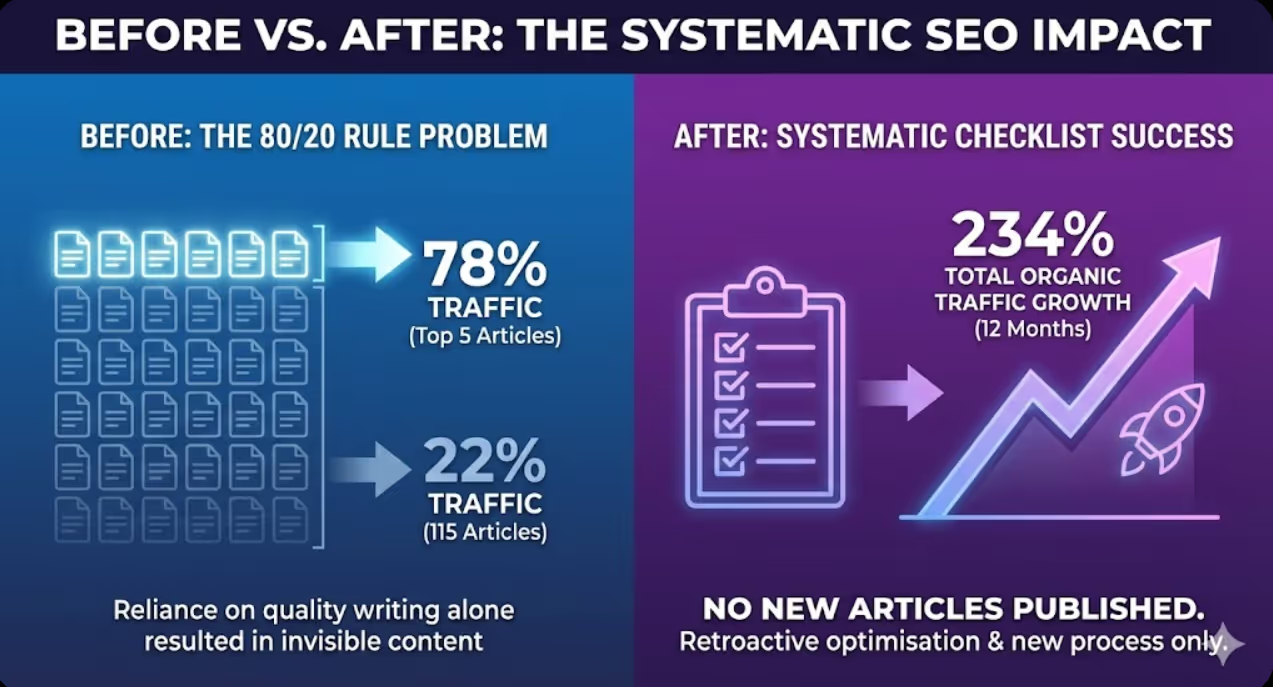
A Brisbane marketing agency published 120 blog articles over two years. Analytics revealed a familiar pattern: the top five articles generated 78% of all organic traffic whilst the remaining 115 articles collectively produced 22%. Investigation revealed the successful articles shared common characteristics—thorough keyword research, clear search intent alignment, comprehensive topic coverage, and systematic optimisation. The underperforming majority had been published without consistent SEO process, relying on quality writing alone to attract search visibility.
Rather than continuing to publish new content into the underperforming majority, they implemented systematic SEO checklist for all new publications and began retroactively optimising existing underperformers. New articles following the complete checklist achieved first-page rankings for target keywords within 90 days in 68% of cases. Retroactively optimised articles improved average rankings by 14 positions. Total organic traffic grew 234% within 12 months without publishing a single additional article—purely through systematic optimisation of existing and new content.
Systematic process, not writing talent, separated high-performing from invisible content.
According to research from Ahrefs, 90.63% of all web pages receive zero organic traffic from Google, demonstrating that publication without optimisation virtually guarantees invisibility regardless of content quality.
Pre-Writing SEO Research and Planning
Effective blog SEO begins before writing commences, with strategic research establishing foundations that influence every subsequent optimisation decision.
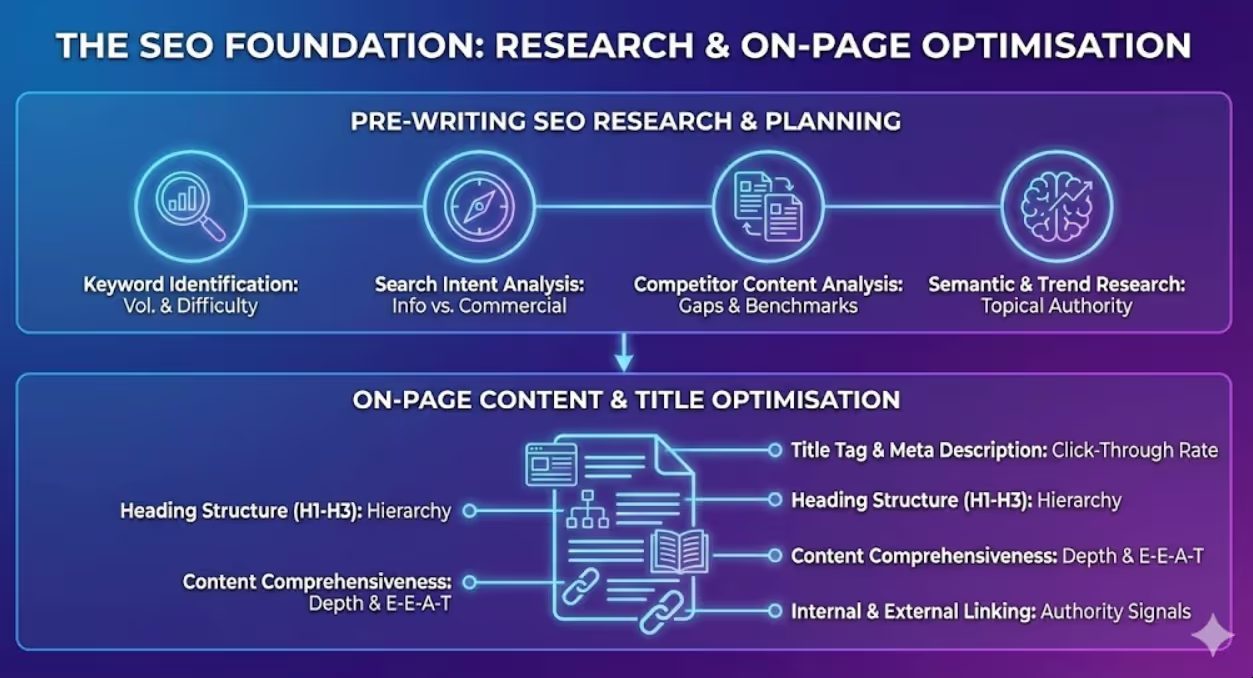
Primary keyword identification targets the specific query your article should rank for. Use keyword research tools including Google Keyword Planner, Ahrefs, SEMrush, or Ubersuggest to identify keywords with genuine monthly search volume (minimum 100 monthly searches for niche topics, 500+ for broader subjects), manageable keyword difficulty based on your site's current authority, and clear commercial or informational relevance to your target audience. Avoid targeting keywords with zero search volume based on assumptions about what prospects might search—data-driven keyword selection prevents optimising articles for queries nobody actually uses.
Search intent analysis ensures article format and content matches what searchers actually want. Google classifies search intent as informational (seeking knowledge), navigational (finding specific sites), commercial (researching purchases), or transactional (ready to buy). Analyse top-ranking results for your target keyword—do they feature comprehensive guides, product pages, listicles, or tool comparisons? Content format misalignment with dominant search intent produces poor rankings regardless of optimisation quality. An in-depth essay won't rank for a query where searchers clearly want a quick checklist, regardless of SEO technical excellence.
Semantic keyword research identifies related terms strengthening topical authority signals. Beyond primary keyword, identify semantic variations (different phrasings of same concept), related subtopics establishing comprehensive coverage, questions people ask around your topic (Google's People Also Ask section provides valuable research), and long-tail keyword variations capturing specific queries within broader topic areas. Semantic keyword integration demonstrates topic depth to search engines whilst capturing diverse query variations within single comprehensive articles.
Competitor content analysis reveals ranking benchmarks your article must exceed. Analyse top three to five ranking articles for your target keyword, assess their word count and content depth, identify subtopics they cover thoroughly, note content gaps your article could fill, and evaluate their backlink profiles providing realistic ranking difficulty context. Your article needs to be meaningfully better than existing top-ranking content—marginally improved versions of well-established articles rarely displace them. Identify genuine differentiation opportunities before writing rather than discovering competitive disadvantages post-publication.
Search volume trend analysis distinguishes growing from declining query popularity. Google Trends reveals whether target keywords are gaining or losing search volume over time, enabling strategic focus on emerging queries before competition intensifies. Australian-specific trend filtering within Google Trends ensures relevance to local search behaviour rather than global patterns potentially diverging from Australian audience behaviour. Targeting growing query trends positions articles advantageously as search volume compounds over time.
Featured snippet opportunity identification targets position zero rankings for qualified queries. Analyse whether target keywords trigger featured snippets (paragraph snippets, list snippets, table snippets) in search results. Featured snippet positions attract substantially higher click-through rates than standard first position results. Structure content specifically to win featured snippet positions through clear direct answers to specific questions, structured lists matching list snippet formats, and table formats for comparative data triggering table snippets.
Title Tag and Meta Description Optimisation
Title tags and meta descriptions directly influence click-through rates from search results, making their optimisation essential for converting rankings into actual traffic.
Title tag formulation balances keyword inclusion with compelling click appeal. Include primary keyword naturally within title (ideally toward beginning), keep total length within 50-60 characters preventing truncation in search results, communicate clear value proposition explaining what readers gain, and avoid keyword stuffing that appears unnatural and reduces click-through rates. Effective title formulas include numbered lists ("7 Proven Strategies for..."), definitive guides ("The Complete Guide to..."), year-specific relevance ("...in 2026"), and question formats directly addressing search intent. Test multiple title variations using search impression data identifying highest click-through performers.
Meta description crafting influences click-through rates without directly affecting rankings. Write meta descriptions of 150-160 characters summarising article value proposition, including primary keyword (Google bolds matching terms in snippets increasing visual prominence), and incorporating clear benefit statement explaining why searchers should click your result over competitors. Avoid generic descriptions that could apply to any article—specific, benefit-focused meta descriptions outperform generic summaries through differentiating your result in competitive search landscapes.
URL structure optimisation creates clean, descriptive addresses supporting both SEO and user comprehension. Include primary keyword in URL slug, keep URLs short (ideally 3-5 words), use hyphens between words (not underscores), remove stop words (the, a, an, in, of) reducing URL length without removing meaning, and avoid dates in URLs enabling content updates without URL changes that lose accumulated link equity. Consistent URL structure across your blog demonstrates site architecture organisation that search engine crawlers navigate efficiently.
On-Page Content Optimisation
On-page optimisation ensures search engines correctly understand content relevance whilst maintaining genuinely helpful writing for human readers.
Introduction optimisation includes primary keyword within first 100 words naturally, establishes clear article topic immediately rather than building slowly, and signals relevance to search engines evaluating topical alignment early in content crawling. Introductions serving both search engine signals and reader engagement requirements demonstrate that SEO optimisation and quality writing aren't mutually exclusive—clear, keyword-inclusive introductions serve both objectives simultaneously.
Heading structure implementation uses H1 (single, keyword-inclusive article title), H2 headings (major section headings including semantic keyword variations), and H3 headings (subsection headings providing additional granularity) creating logical hierarchical structure. Search engines use heading structure to understand content organisation and topical coverage. Screen readers and accessibility tools rely on heading hierarchy for navigation—heading optimisation serves both SEO and accessibility objectives. Avoid keyword stuffing in headings—natural, descriptive headings outperform forced keyword inclusion in both ranking signals and reader experience.
Keyword density and natural integration avoids both under-optimisation (primary keyword appearing too rarely for search engines to confidently assess relevance) and over-optimisation (unnatural keyword repetition triggering spam signals). Natural keyword integration appears in introduction, several body sections, at least one heading, conclusion, and image alt text without forced repetition that disrupts reading flow. Modern search engines understand semantic equivalents—writing naturally about your topic whilst including primary keyword reasonably throughout produces better results than obsessive density targeting.
Content comprehensiveness signals topical authority through thorough coverage. Address all significant subtopics within your primary keyword area, answer related questions prospects commonly ask, include relevant statistics and data supporting claims, provide examples illustrating abstract concepts, and cover both foundational and advanced aspects serving different knowledge levels within your target audience. Comprehensive content satisfies diverse searcher needs within single articles, reducing pogo-sticking (returning to search results indicating content didn't satisfy query) that negative ranking signals reflect.
E-E-A-T signals demonstrate Experience, Expertise, Authoritativeness, and Trustworthiness that Google's quality raters assess and algorithms increasingly recognise. Include author credentials and relevant experience within or near articles, cite reputable sources supporting factual claims, demonstrate first-hand experience through specific examples and observations, update content regularly maintaining accuracy, and link to authoritative external sources validating claims. Google's Search Quality Evaluator Guidelines explicitly identify E-E-A-T as central quality assessment framework—content demonstrating genuine expertise consistently outranks anonymously authored thin content regardless of technical optimisation.
Internal linking strategy distributes link equity and signals content relationships. Link to relevant existing articles using descriptive anchor text (specific phrase describing linked content, not generic "click here"), identify pillar content pages deserving authoritative internal links, create linking patterns connecting related content clusters, and ensure all major articles receive internal links from other site pages. Internal linking builds topical authority clusters whilst helping search engines discover and evaluate content relationships across your site.
External linking to authoritative sources builds content credibility and trust signals. Link to reputable Australian and international sources supporting factual claims, cite original research and data rather than secondary sources where possible, and avoid linking to competitors or low-quality sources diminishing content authority. External linking demonstrates research thoroughness and intellectual honesty—search engines recognise content citing quality sources as more trustworthy than isolated content making unsupported claims.
Image optimisation serves both page speed and search visibility. Compress images reducing file sizes without quality degradation using tools like TinyPNG or Squoosh, add descriptive alt text including relevant keywords for accessibility and image search visibility, use descriptive file names (brisbane-seo-checklist-2026.jpg rather than IMG_4521.jpg), implement responsive images serving appropriately sized versions for different devices, and consider next-generation formats (WebP) reducing file sizes maintaining visual quality.
Technical SEO Requirements for 2026
Technical foundations ensure search engines can access, crawl, index, and evaluate content without barriers reducing visibility regardless of content quality.
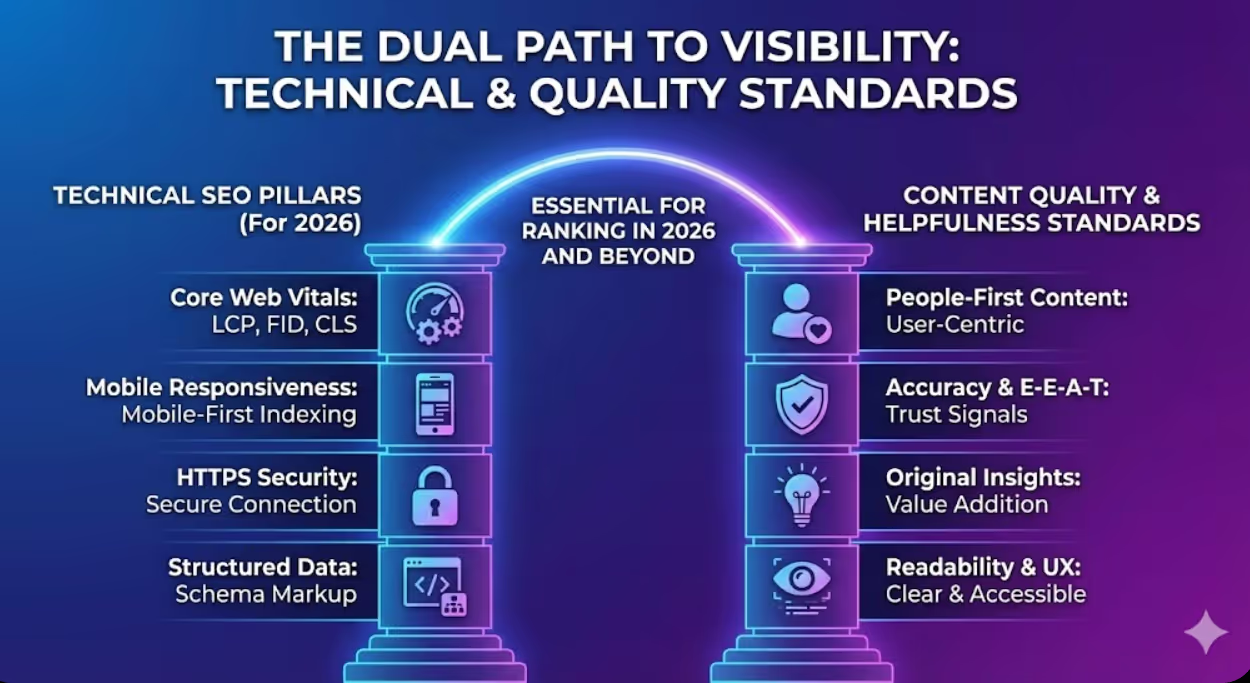
Core Web Vitals optimisation addresses Google's user experience ranking signals. Largest Contentful Paint (LCP) measuring loading performance should occur within 2.5 seconds—optimise through image compression, server response times, and render-blocking resource elimination. First Input Delay (FID) measuring interactivity should be below 100 milliseconds—minimise JavaScript execution time and remove unnecessary third-party scripts. Cumulative Layout Shift (CLS) measuring visual stability should score below 0.1—reserve space for images and ads preventing content shifting during loading. Google Search Console provides site-specific Core Web Vitals data identifying pages requiring technical improvement prioritisation.
Mobile responsiveness verification ensures content serves Australia's mobile-dominant traffic appropriately. Test all blog pages using Google's Mobile-Friendly Test, verify text remains readable without zooming on mobile screens, confirm interactive elements maintain adequate tap target sizing (minimum 44x44 pixels), ensure content doesn't require horizontal scrolling, and validate page loading performance on mobile networks (3G and 4G connections, not just WiFi). Mobile experience now represents primary ranking consideration—desktop-first content failing mobile standards underperforms regardless of other optimisation.
Page speed optimisation reduces load times maintaining engagement and rankings. Implement browser caching for static resources, enable Gzip or Brotli compression for text-based files, minimise render-blocking JavaScript and CSS resources, defer non-critical JavaScript loading until after primary content renders, and consider Content Delivery Network (CDN) implementation serving Australian visitors from geographically closer servers. Aim for sub-3-second load times on mobile connections—performance degradation beyond this threshold increases bounce rates that negative engagement signals reflect in rankings.
Structured data implementation enables rich search result features enhancing visibility. Article schema markup provides publication date, author, and article metadata to search engines. FAQ schema for question-and-answer sections enables FAQ rich snippets in search results. HowTo schema for step-by-step content enables rich result formats. BreadcrumbList schema clarifies site navigation context. Use Google's Rich Results Test validating structured data implementation before publication. Rich results improve search appearance, increasing click-through rates from equivalent ranking positions.
Canonical tag implementation prevents duplicate content issues that dilute ranking signals. Add canonical tags pointing to preferred URL versions when similar content exists across multiple URLs, implement self-referencing canonical tags on all pages even without duplication confirming preferred versions, and ensure canonical tags point to correct URLs after site migrations or URL restructuring. Duplicate content without canonical guidance forces search engines to guess preferred versions—explicit canonicalisation directs ranking signals to intended pages.
HTTPS security verification confirms secure connection that Google considers basic ranking requirement. Verify SSL certificate is valid and not expired, ensure all internal links use HTTPS rather than HTTP, check that all resources (images, scripts, stylesheets) load securely without mixed content warnings, and implement HSTS (HTTP Strict Transport Security) headers signalling permanent HTTPS preference. Insecure HTTP sites receive ranking disadvantages and browser security warnings that destroy user trust before content is even evaluated.
XML sitemap currency ensures search engines know about all published content. Verify blog posts appear in XML sitemap within 24-48 hours of publication, ensure sitemap is submitted to Google Search Console and Bing Webmaster Tools, remove outdated or deleted URLs from sitemap, and check that sitemap doesn't include noindexed pages. Current sitemaps accelerate content indexation particularly for newer or lower-authority sites where organic crawl discovery may be slower.
Content Quality and Helpful Content Standards
Google's helpful content system increasingly influences rankings based on whether content primarily serves people or search engines, requiring genuine user-first content creation approaches.
People-first content principles require creating content satisfying the actual query comprehensively without unnecessary padding. Avoid creating content primarily to attract search engine traffic rather than genuinely help specific audiences. Ensure content demonstrates first-hand knowledge or genuine expertise rather than synthesising what others have written without adding original value. Provide complete satisfying answers rather than teasing information requiring additional searches. Write for your specific intended audience rather than generic internet users with varying knowledge levels and needs.
Content depth versus padding distinction requires providing genuine comprehensive coverage without length inflation. Every paragraph should advance reader understanding, provide new information, or address related questions genuinely relevant to the topic. Identify and remove sections that repeat information already covered, state the obvious without adding insight, or exist primarily to increase word count. Search engines increasingly evaluate content efficiency—shorter, genuinely comprehensive articles often outperform padded long-form content that says the same things repeatedly.
Accuracy and fact-checking requirements address trust signals increasingly important for ranking. Verify all statistics and claims before publication, link to primary sources rather than secondary citations where possible, update inaccurate information promptly when errors are identified, and avoid publishing claims you can't verify through reputable sources. Australian audiences specifically expect localised accuracy—international statistics presented as Australian data without contextualisation damages trust when readers recognise the discrepancy.
Original insights and value addition differentiates high-ranking from average content. Include genuine perspectives from direct experience, provide analysis going beyond surface-level topic coverage, offer frameworks or approaches not available in existing top-ranking content, and share specific examples or case studies illustrating principles. Original value creation is increasingly essential as AI-generated generic content floods search results—human expertise and genuine insight become more valuable as generic AI output becomes more prevalent.
Readability optimisation serves both human engagement and search engine evaluation. Use short paragraphs (3-5 sentences maximum), vary sentence length preventing monotonous rhythm, employ transition phrases connecting sections logically, define technical terms when writing for mixed-knowledge audiences, and use active voice maintaining energy and clarity. Readability tools (Hemingway Editor, Yoast readability analysis) identify improvement opportunities—content scoring at or below Grade 9 reading level typically performs better across diverse Australian audiences than highly complex writing.
Post-Publication Optimisation and Monitoring
SEO optimisation continues after publication through monitoring, updating, and promotion that compounds initial ranking investments.
Google Search Console monitoring tracks search performance revealing optimisation opportunities. Monitor impressions and click-through rates for target keywords identifying title and meta description improvement opportunities, track average position trends revealing ranking trajectory, identify queries generating impressions without clicks suggesting content or title misalignment, and use Coverage reports identifying indexing issues preventing content from appearing in search results. Weekly Search Console review enables rapid identification and resolution of emerging ranking issues.
Content performance benchmarking establishes success baselines for ongoing evaluation. Document initial rankings for target keywords within 2-4 weeks of publication (indexation period), set 90-day and 180-day ranking improvement targets, track organic traffic growth trends attributable to specific optimisation activities, and compare performance against competitor content ranking for same keywords. Benchmarking transforms optimisation from hope into managed process with measurable outcomes.
Content refresh and update strategy maintains rankings against freshness-rewarding algorithms. Schedule annual reviews of all significant blog content, update statistics and examples with current data, add new sections addressing topics that have emerged since original publication, refresh meta information incorporating updated keyword research, and republish with updated dates where substantial updates justify signalling freshness. Consistently refreshed content maintains rankings that stagnant published-and-forgotten content gradually loses to competitors investing in content maintenance.
Link building integration amplifies on-page optimisation through authority signals. Identify authoritative Australian websites that might link to your content, develop targeted outreach explaining specific value for their audiences, create genuinely link-worthy content elements (original research, comprehensive frameworks, unique data visualisations) attracting natural links, and monitor new backlinks celebrating wins whilst identifying patterns in successful link acquisition. According to Ahrefs research, pages with more backlinks from authoritative sites consistently rank higher for competitive keywords—link building remains essential despite frequent predictions of its decline.
Social amplification for indexation acceleration improves content discovery speed. Share new content across relevant social platforms immediately post-publication, encourage email subscribers to read and share new articles, engage with initial commenters and sharers building early engagement signals, and consider modest paid amplification for high-priority articles accelerating initial audience reach. Social signals don't directly influence rankings, but social amplification accelerates discovery, generates initial traffic, and increases backlink acquisition probability through broader content exposure.
Frequently Asked Questions
How has Google's AI Overviews feature changed blog SEO strategy for Australian content marketers in 2026, and should businesses still invest in blog content given AI-generated answers appearing at the top of search results?
AI Overviews have reduced click-through rates for some informational queries where AI summaries satisfy basic information needs, but haven't eliminated blog content value for Australian businesses. Content requiring genuine depth, specific local context, personal experience, or actionable implementation guidance continues attracting engaged audiences that AI summaries serve poorly. Adapt strategy by focusing on content demonstrating genuine first-hand expertise, providing specific Australian context AI summaries lack, covering complex topics requiring human judgement beyond AI synthesis, and targeting commercial and transactional queries where AI Overviews appear less frequently. Blog content appearing as cited sources within AI Overviews gains visibility even without traditional click-through, making authoritative comprehensive content valuable for brand visibility within AI-influenced search results.
What's the ideal blog post length for SEO in 2026, and does longer content consistently outrank shorter alternatives for Australian search queries?
Optimal length depends entirely on query intent and competitive landscape rather than universal length recommendations. Comprehensive informational queries ("complete guide to...," "how to...") typically warrant 1,500-3,000 words to cover topics thoroughly. Quick answer queries ("what is...," "definition of...") may rank best at 500-800 words providing direct answers without padding. Competitive queries require length at least matching top-ranking competitors whilst providing genuine additional value. The consistent principle is covering the topic comprehensively without padding—search engines increasingly distinguish genuine comprehensive coverage from word count inflation. Audit top-ranking content for your specific target keywords determining competitive length benchmarks rather than applying universal length rules regardless of topic context.
How important are backlinks compared to on-page optimisation for ranking Australian blog content in 2026, and where should businesses focus their limited SEO resources?
Both factors remain important with relative influence depending on keyword competitiveness. For lower-competition keywords (long-tail queries with modest search volumes), excellent on-page optimisation often achieves first-page rankings without significant backlink investment—technical excellence and comprehensive content satisfy ranking requirements. For competitive keywords attracting substantial search volume and numerous well-optimised competitors, backlinks from authoritative Australian and international websites provide essential differentiation that on-page optimisation alone cannot overcome. Budget-constrained Australian businesses should prioritise on-page optimisation establishing strong foundations before investing in link building, focusing initial content on genuinely achievable rankings without significant link acquisition before tackling competitive keywords requiring sustained link building programmes.
How should Australian businesses handle keyword research for topics where search volumes appear low but commercial value is high?
Low search volume doesn't necessarily mean low commercial value—many high-value B2B queries attract fewer than 100 monthly searches whilst representing substantial revenue opportunities when converted. Evaluate commercial value through conversion potential (what's a converted visitor worth?), buyer intent signals (does the query indicate purchase readiness?), and sales cycle position (does the query represent bottom-funnel consideration?). A keyword generating 50 monthly searches but converting at 10% for $10,000 services represents $500,000 monthly revenue potential—substantially more valuable than high-volume informational keywords generating thousands of traffic but negligible conversion. Focus keyword strategy on commercial intent alignment and conversion value rather than volume metrics alone for commercially-focused Australian content programmes.
What are the most common on-page SEO mistakes Australian bloggers make that prevent content from ranking despite strong writing quality?
Most common preventable mistakes include targeting keywords without search volume based on assumptions rather than data, mismatching content format with search intent (comprehensive essays for queries where searchers want quick answers), neglecting meta information optimisation reducing click-through rates from achieved rankings, publishing thin content (under 500 words) for queries where searchers clearly expect comprehensive treatment, failing to include primary keywords in critical positions (title, first paragraph, H2 headings), ignoring internal linking leaving articles isolated from site authority, and publishing without mobile and page speed testing ensuring technical barriers don't undermine content quality. Systematic pre-publication checklists prevent these recurring mistakes more reliably than attempting to remember optimisation requirements during writing under deadline pressure.
How should Australian businesses approach blog SEO for highly competitive industries where established competitors with strong domain authority seem impossible to displace from top rankings?
Competing against high-authority established competitors requires strategic differentiation rather than direct frontal assault on their strongest keywords. Identify long-tail keyword variations with lower competition but genuine commercial value that established competitors haven't specifically targeted. Find content gaps where competitors have inadequate coverage, outdated information, or poor user experience creating opportunity for superior content. Target geographic modifiers (Brisbane, Queensland, Australian) narrowing competition to local focus where local authority may exceed national competitors. Build authority progressively—publish consistently on lower-competition queries establishing domain credibility before targeting more competitive terms. Partner with complementary businesses for guest posting opportunities building backlinks from relevant Australian sites. Patience and strategic targeting consistently outperform attempting to rank immediately for competitive terms requiring years of authority building.
How does E-E-A-T affect SEO for Australian small businesses and sole traders who lack the credentials and institutional authority of larger organisations?
E-E-A-T advantages don't exclusively favour large organisations—small businesses and sole traders often demonstrate genuine Experience and Expertise more authentically than corporate content produced by marketing teams without direct subject expertise. Build personal E-E-A-T through detailed author profiles documenting relevant qualifications, years of experience, and professional credentials, consistently attributing content to named experts rather than anonymous corporate voices, including specific first-hand examples demonstrating lived experience rather than theoretical knowledge, collecting and featuring client testimonials providing third-party trustworthiness signals, and building external citations through media mentions, speaking engagements, and industry participation creating authority signals beyond self-published content. Authentic expertise consistently demonstrated through specific, accurate, experience-based content outperforms credential-heavy but generic content from larger competitors lacking genuine subject matter investment.
Systematic SEO Transforms Blog Visibility
Blog SEO success in 2026 requires systematic application of research-driven, technically sound, genuinely helpful content principles rather than hoping quality writing alone attracts organic visibility. Australian businesses implementing consistent SEO checklists transform content from invisible to discoverable, compounding organic traffic advantages through sustained optimisation discipline.
The checklist frameworks outlined in this guide—pre-writing research, on-page optimisation, technical foundations, content quality standards, and post-publication monitoring—provide comprehensive optimisation process ensuring every published article has genuine opportunity to rank competitively for target keywords serving Australian audiences.
Organisations treating SEO as checklist discipline rather than optional enhancement consistently outperform competitors relying on writing quality alone, building sustainable organic search advantages that compound into significant business development assets over sustained content programmes.
Ready to implement systematic blog SEO that drives search visibility for your Australian business? Maven Marketing Co. provides comprehensive SEO content strategy, optimisation audits, and ongoing content performance management ensuring your Australian blog content ranks competitively and drives measurable business results. Let's build search visibility that compounds into sustainable organic growth.

Table of contents
read more blogs
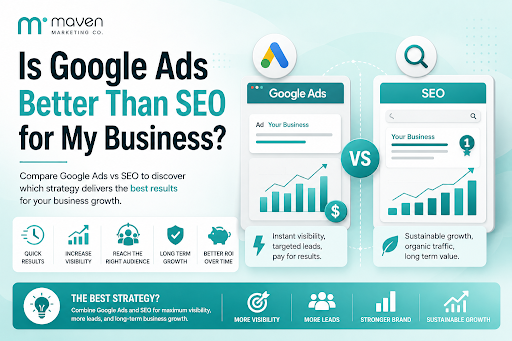
Is Google Ads Better Than SEO for My Business
One of the biggest questions business owners ask when they are planning online growth is whether they should invest in Google Ads or SEO. Both are strong marketing plays that help your company show up in Google search results, but they do things in separate lanes. Google Ads gives quicker visibility and can bring in leads fast, whereas SEO more or less focuses on slow, steady organic traffic that tends to grow the longer you keep building it. Picking the right direction depends on what you want to achieve, how much money you can spend, how crowded the market is, and how quickly you need results, like sooner rather than later. The good news is you don’t always have to choose one or the other; it’s not exactly a black-and-white situation. If you take time to understand the strongest points of both, you can put together a more sensible digital marketing plan that supports consistent expansion. In this guide, we’ll compare Google Ads vs SEO, explain the main differences, and help you figure out what option makes the most sense for your business.

When Should I Hire a Digital Marketing Agency
Growing a business today takes more than just having a website or throwing a post on social media; customers usually search around online, compare providers, skim reviews, and basically expect the brand to show up with a solid digital presence before they even think about buying. Many businesses try to run their marketing themselves, but there comes a point when “doing it all in-house” becomes clunky and hard to manage, all at once. Knowing when to hire a digital marketing agency can end up making a big, real difference for your growth. If you’re not getting enough leads, or your online visibility feels stuck, or sales are just not moving, the right agency can bring the know-how, plus a clear plan, to help you get noticeably better outcomes. In this guide, we’ll dig into what a digital marketing agency actually does, the usual signs it’s time to bring one on, and how picking the right marketing partner can help your business move forward at a faster pace.
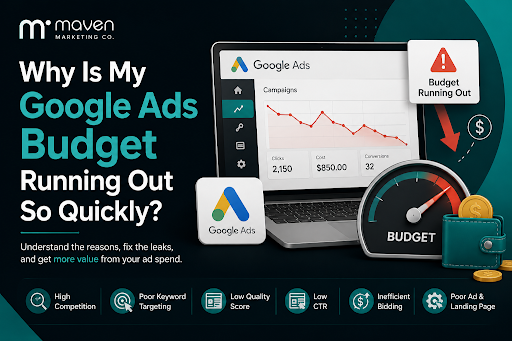
Why Is My Google Ads Budget Running Out So Quickly
Running a successful Google Ads budget isn’t only about throwing more money at it. It’s more like making every dollar, doing a bit extra. A lot of businesses start a Google Ads campaign with big hopes, then find out their daily budget is gone within a few hours, and that feels weird, right? After that, your ads stop showing effectively, new leads slip away, and your return on investment dips. So if your Google Ads budget is running out too fast, don’t stress. It’s a fairly common issue, and in most situations, it can be repaired with the right approach. There are multiple little things that can drain your advertising money quicker than you expected, from costly keywords to audience targeting that just doesn’t quite fit. In this guide, we’ll walk through why your budget disappears so quickly, how to cut wasteful spend, and the most reliable ways to boost your Google Ads ROI, even if your budget stays the same.


