.svg)


%201.svg)

Key Takeaways
- Post frequency and word count are independent variables that together determine the overall output and impact of a blog content programme. Choosing one without considering the other produces a strategy that is incomplete.
- Publishing consistently at a sustainable frequency is more valuable for SEO growth over the long term than publishing intensively for a short period and then stopping. Consistency signals are meaningful to search engines over time.
- Longer articles between 1,500 and 2,500 words tend to outperform shorter articles in competitive search queries because they cover topics more thoroughly, attract more referring links, and satisfy search intent more completely.
- The appropriate post frequency for an Australian business depends on competitive intensity, topical breadth, available budget, and whether the primary goal is rapid market entry or sustainable authority building over the long term.
- Low-competition industries and niche service businesses can achieve meaningful SEO results with two to four posts per month at 1,500 words or more, provided each post targets a clearly defined search query.
- High-competition industries such as finance, property, legal services, and ecommerce require higher frequency and longer word counts to compete effectively, with four to eight posts per month at 1,800 to 2,500 words being a common baseline for meaningful traction.
- A content package should be evaluated not only by volume but by quality consistency: every article should meet the same standard for research, structure, keyword integration, and editorial quality regardless of how many are published per month.
Why Frequency and Word Count Both Matter
Frequency and word count are often discussed as if they are interchangeable levers, and sometimes treated as if one is more important than the other by default. In practice, they are independent variables that address different aspects of content performance, and optimising one without considering the other produces an incomplete strategy.
Post frequency determines the rate at which a website accumulates topical coverage. A site that publishes two articles per month is building its library of indexed content at a rate of 24 articles per year. A site publishing eight articles per month adds 96. Over two years, the difference between these frequencies is not merely four times more content. It is the difference between a content library that covers the major queries in a niche and one that covers them thoroughly enough to rank across the full range of questions a target audience asks. Search engines assess topical authority in part by the breadth and depth of content a site has published on a subject over time, and frequency is the primary variable that determines how quickly that authority accumulates.
Word count determines how thoroughly any individual article covers its subject. A 600-word article on a topic that search intent and competition data suggest requires 1,800 words will not satisfy the depth of coverage that Google's ranking systems associate with authoritative content on that query. The search results for competitive queries in Australian industries are dominated by thorough, thoroughly researched articles that address multiple angles of the topic, answer questions that follow naturally, and provide genuine value beyond a surface treatment. A thin article competing against this standard is not competitive regardless of how well its optimisation is configured at the page level.
The ideal content programme balances both variables in a way that is sustainable for the business and competitive for the industry.
Understanding Search Intent and the Word Count Relationship
Word count is not arbitrary. The appropriate length for a given blog article is determined by the complexity of the topic, the competitive landscape, and the search intent that the article is meant to satisfy.
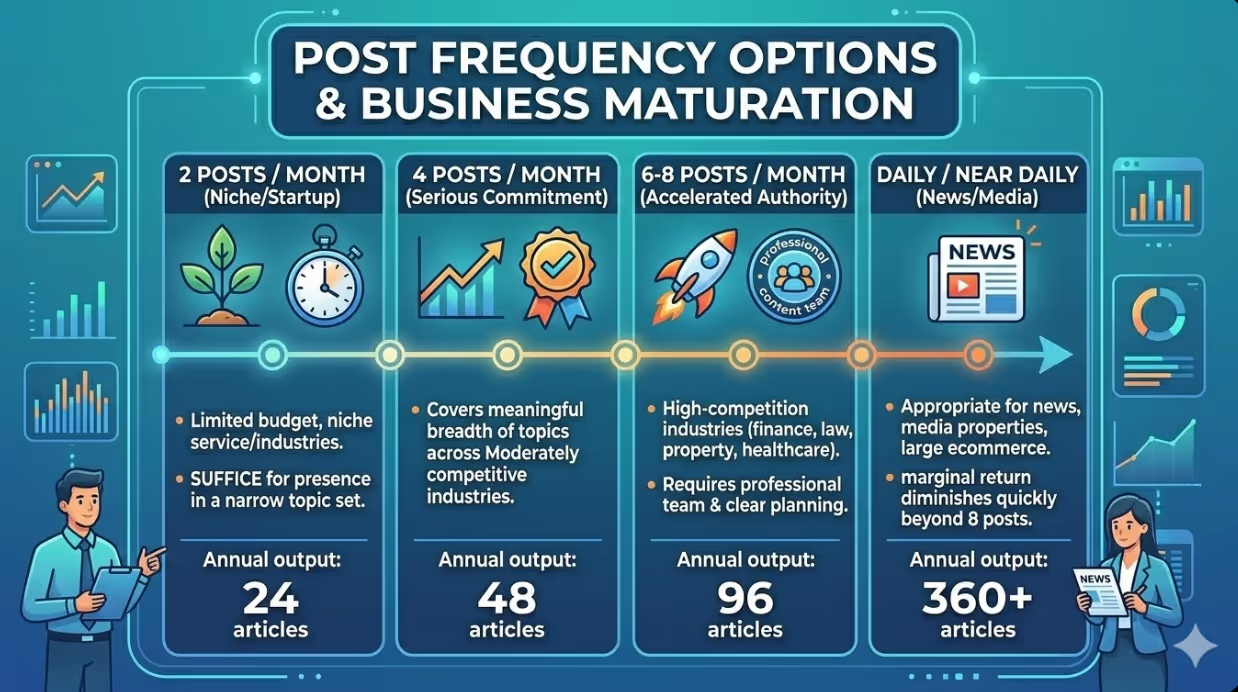
Search intent describes the underlying goal of a user performing a search query. Informational intent queries, such as "how does superannuation work" or "what is the best way to waterproof a deck", are answered by thorough explanatory articles that cover the topic end to end. These queries reward longer, more comprehensive articles because the user's need is to understand something fully, and a complete answer requires space to develop.
Commercial investigation queries, such as "best accounting software for small business Australia" or "Melbourne conveyancing solicitor", are answered by articles that compare options, explain tradeoffs, and provide the information that supports the decision a prospective buyer needs. These also reward thorough treatment because the user is evaluating before committing, and a shallow comparison is not a sufficient answer.
The correlation between word count and ranking performance in competitive Australian search queries is not a coincidence. It reflects the genuine relationship between content depth and the ability to satisfy the full range of questions a user has about a topic. A research analysis by Semrush examining thousands of articles across industries found that longer content consistently generates more organic traffic and attracts more referring links than shorter content covering the same topics. The relationship is not strictly linear, as there is a point beyond which additional length produces diminishing returns, but for most commercially valuable queries in the Australian market, articles between 1,500 and 2,500 words sit in the range where depth and ranking performance are well matched.
Post Frequency Options: A Practical Guide
The right posting frequency for an Australian business is not the maximum the budget allows. It is the maximum that can be maintained at a consistent quality standard. Publishing eight articles per month for three months and then dropping to one because the team is exhausted or the budget is strained produces a worse outcome over the long term than publishing four articles per month consistently over twelve months.
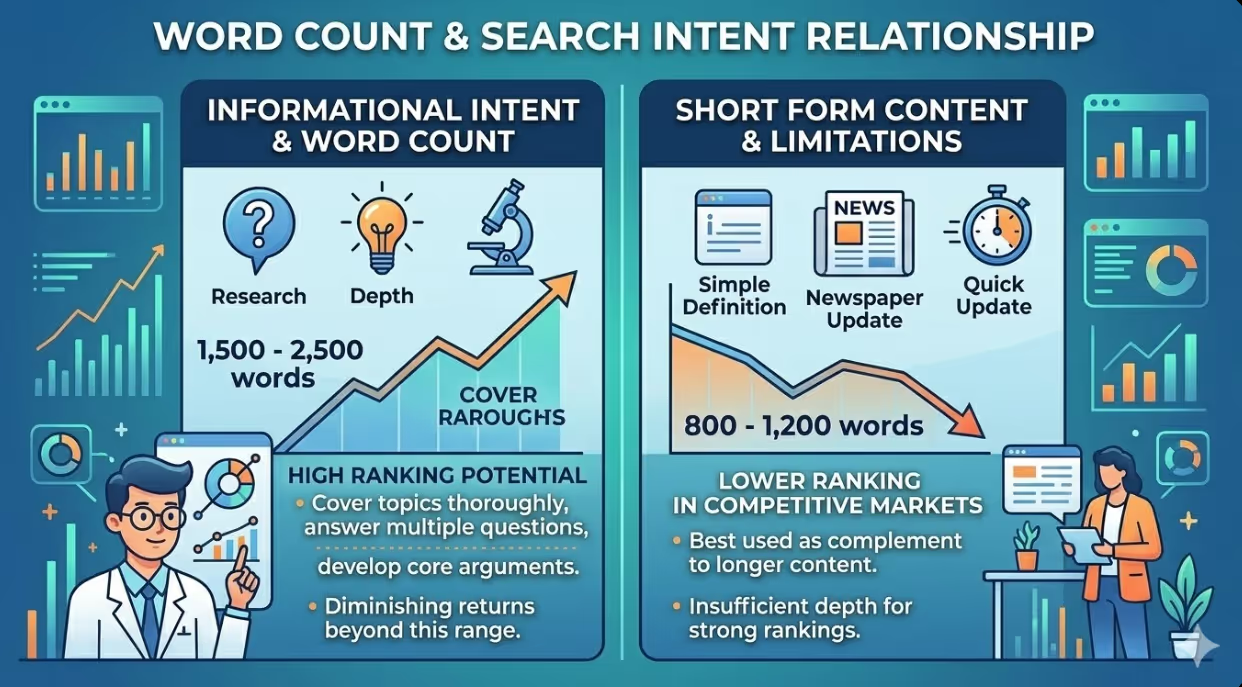
Two posts per month. This frequency suits businesses that are new to content marketing, those with limited budget, or those in genuinely niche industries where search results are not dominated by frequent publishers. At two posts per month, annual content library growth is 24 articles. This is sufficient to establish a presence in a niche with fewer than fifty meaningful search queries, but insufficient to compete across a broad topic set in a contested industry. Two posts per month is a starting point, not a strategy for the long term for businesses with significant SEO ambitions.
Four posts per month. This is the most common frequency for Australian small and medium businesses with a serious commitment to SEO driven by content growth. At four posts per month, the annual output is 48 articles, which covers a meaningful breadth of topics across most industry niches within twelve to eighteen months. For businesses in moderately competitive industries such as professional services, home and garden, health and wellness, and local services, four posts per month at 1,500 to 2,000 words is a reliable foundation for sustained organic growth.
Six to eight posts per month. This frequency is appropriate for businesses in highly competitive industries, those pursuing rapid content market entry, or those with established sites looking to accelerate topical coverage. At eight posts per month, annual output reaches 96 articles, creating sufficient volume to cover broad topic sets, target multiple audience segments, and build the kind of topical authority that search engines associate with genuinely expert sites. This frequency requires a professional content team or agency, clear editorial planning, and a quality control process capable of maintaining standards at volume.
Daily or publishing at a near daily rate. Daily publishing is generally appropriate for news sites, media properties, and large ecommerce businesses with dedicated content teams. For most Australian service businesses and brands, daily publishing is neither achievable at quality nor necessary for strong organic performance. The resources required to produce thirty or more quality articles per month are substantial, and the marginal return diminishes quickly beyond eight posts per month for most business types.
Word Count Options and When to Use Them
Word count targets should be matched to the topic, the competitive environment, and the search intent the article is targeting. A prescriptive word count applied uniformly to every article regardless of topic is a formula for either padding short topics or shortchanging complex ones.
800 to 1,200 words. Short-form content in this range is appropriate for definitional articles covering simple topics, news and update posts, and commentary on recent industry developments. For most organic search queries in competitive Australian markets, this length is insufficient to achieve strong rankings because competing content is longer and more thorough. Short-form content works best as a complement to a programme that includes longer cornerstone content, not as the primary vehicle for competitive keyword targeting.
1,500 to 2,000 words. This is the recommended starting range for most blog articles targeting informational and commercial investigation queries in moderately competitive Australian industries. Content at this length has sufficient space to introduce the topic, develop the core arguments or explanations, address questions that follow naturally, and provide specific, actionable information. It is long enough to be competitive in most search results without requiring so much content that quality becomes difficult to maintain at volume.
2,000 to 2,500 words. Longer articles in this range are appropriate for complex topics, highly competitive queries, and cornerstone content that is intended to serve as the authoritative resource on a subject within the site's topical cluster. This length allows for thorough treatment of nuanced topics, extensive use of examples, data, and case studies, and the kind of depth that earns referring links and social sharing. For Australian businesses in finance, legal, medical, or property sectors, this length is often the baseline for competitive content rather than a stretch target.
2,500 words and above. Very long content is appropriate for comprehensive guides, articles grounded in research, and pillar pages that anchor a topical cluster. Not every article in a content programme should be this length, but having cornerstone content at this depth signals topical authority and often performs strongly for broad, queries with high competition. At this length, strong editorial structure with clear headings, scannable sections, and a logical flow becomes especially important to maintain readability.
Matching Package to Business Type
Different business types benefit from different combinations of frequency and word count, and the right package reflects the specific competitive and commercial context of the business.
Local service businesses such as plumbers, electricians, legal firms, and healthcare practices typically operate in geographic niches where competition for specific query sets is moderate rather than intense. Two to four posts per month at 1,500 to 2,000 words, targeting queries specific to the service and the geographic area, is generally sufficient to build strong local organic visibility over twelve to eighteen months.
Ecommerce businesses with broad product catalogues benefit from higher frequency publishing because they have a wider range of commercially valuable queries to target. Category-level editorial content, buying guides, comparison articles, and product use cases all serve organic search goals simultaneously. Four to eight posts per month at 1,500 to 2,000 words is a suitable range for Australian ecommerce businesses competing across multiple product categories.
B2B service businesses benefit from longer, more authoritative content that demonstrates expertise to an audience making considered, decisions involving significant investment. Four posts per month at 2,000 to 2,500 words, each thoroughly researched and professionally structured, builds the credibility signals that influence both search rankings and the trust of prospective clients who find the content through organic search.
National or brands competing across multiple markets competing across broad topic sets in contested industries typically require the highest frequency and longest content to build and maintain organic visibility. Six to eight posts per month at 2,000 words or above, supported by a clear topical cluster strategy, is the appropriate starting point for brands with significant SEO investment and competitive ambitions in the Australian market.
FAQs
How long does it take to see results from a blog content package?
Organic search results from blog content take time to accumulate. For a new domain or a site with limited existing authority, meaningful organic traffic from blog content typically takes six to twelve months to develop, reflecting the time Google takes to crawl, index, and assess the authority of newly published content. For established Australian websites with existing domain authority and a history of indexed content, new articles in a thoroughly structured content programme can begin generating organic traffic within four to eight weeks of publication. The compounding nature of SEO driven by content means that the return grows over time rather than stabilising at a fixed level. An article published in month three of a content programme may generate more traffic in month eighteen than it does in month four, as its ranking position improves and it accumulates referring links and engagement signals. Setting realistic expectations about the timeline is essential when assessing whether a content package is delivering the expected return.
Should blog articles be updated after they are published, or is new content always better?
Both updating existing content and publishing new content are valuable, and the right balance depends on the state of the existing content library. For Australian websites with a substantial back catalogue of articles covering competitive queries, updating and improving existing content to reflect current information, add greater depth, and strengthen keyword targeting often delivers a faster ranking improvement than publishing new articles on the same topics. For websites building their content library from scratch or covering topics not yet addressed, new content is the priority. A content programme that combines new article publication with periodic review and updating of the existing library produces better performance over the long term than one focused exclusively on new content volume. As a general guide, articles that were published more than twelve months ago and are ranking in positions four to fifteen for their target queries are strong candidates for a content refresh that could push them into the top three positions.
Is it better to publish one long article per week or two shorter articles?
For most Australian businesses targeting competitive organic search queries, one longer article per week outperforms two shorter articles per week in terms of ranking potential and organic traffic over the long term generation. A single 2,000-word article has more opportunity to cover a topic thoroughly, satisfy diverse search intents within the same query space, and earn referring links than two 800-word articles covering adjacent topics. The exception is when the two shorter articles target distinct, specific queries that each warrant dedicated coverage. In that case, two focused articles each optimised for their specific query can outperform one longer article attempting to cover both. The decision should be made at the individual article level based on the target query, the search intent, and the competitive landscape, rather than applying a blanket rule about article length.
Consistent, Quality Content: The Only Strategy That Compounds
There is no shortcut in blog content marketing. The businesses achieving the strongest organic results in Australian search in 2026 are those that have been publishing consistently, at quality, for eighteen months or more. The right content package is the one that a business can sustain at quality for that duration and beyond, whether that is two posts per month at 1,500 words or eight posts per month at 2,000 words. The compounding effect of consistent, well structured blog content on organic search visibility, brand authority, and inbound lead generation is one of the most powerful and most durable commercial investments a business can make.
Maven Marketing Co provides professionally written blog content packages for Australian businesses, tailored to the industry, competitive landscape, and SEO goals of each client.
Talk to the team at Maven Marketing Co →

Table of contents
read more blogs

How to Choose the Right Digital Marketing Channels for Your Business
Choosing digital marketing channels is one of the easiest places for businesses to lose clarity. There are more options than ever, every platform promises reach and results, and it is easy to assume that the best strategy is simply to be everywhere. In reality, most businesses do better when they choose channels with intention rather than spreading budget and effort too thinly.The right channel mix depends on where your audience spends time, how they search or discover solutions, what your business is trying to achieve and how much resource you actually have to support execution properly. A channel is only useful if it helps move the right people towards a commercial outcome that matters to the business.This is why strong digital marketing strategy is not really about finding one perfect platform. It is about understanding the role each channel can play across awareness, demand capture, conversion and retention. SEO might build long-term visibility, Google Ads might capture active intent, social media might support familiarity and reach, while email may help nurture prospects and strengthen customer value over time.This guide explains what digital marketing channels are, how to assess them properly and how to build a balanced channel mix for your business. The focus is practical. Rather than chasing every new platform, the goal is to help you choose the channels that fit your audience, goals, budget and internal capability.

How to Build a Customer Journey Map for Your Digital Marketing Strategy
A strong digital marketing strategy is not just about channels, creative or traffic. It is about understanding how real people move from first awareness through to enquiry, purchase and ongoing loyalty. That is exactly why customer journey mapping matters.Without a clear view of the journey, businesses often optimise in fragments. They improve the website without thinking about the ad that drove the visit, produce content without considering where the audience is in the decision process, or judge conversion performance without understanding the friction points that sit earlier in the experience.A customer journey map helps you step back and see the bigger picture. It shows the stages people move through, the touchpoints they interact with, the questions they ask, the barriers they face and the moments where your marketing can either help or lose them.This guide explains how to build a practical customer journey map for your digital marketing strategy, what information to include, how to use the map to improve performance and which common mistakes to avoid. The goal is not to create a pretty workshop artefact that gets forgotten. It is to build a working tool that improves messaging, user experience, channel decisions and conversion outcomes.

Why Your Google Ads Campaign Is Not Getting Results: Common Mistakes and Solutions
If your Google Ads campaign is getting impressions or clicks but not producing enough enquiries, sales, or qualified leads, the problem is usually not Google Ads itself. It is more often a strategy, tracking, or conversion issue somewhere in the system.That matters because paid search can look busy without being commercially effective. You can have traffic coming in, a reasonable click-through rate and money leaving the account every day, yet still have very little to show for it if your keywords are weak, your ad copy is misaligned, your landing pages do not convert or your tracking is incomplete.A strong campaign works as one connected chain. Search intent, keyword targeting, ad relevance, bidding, landing-page experience, and conversion tracking all need to support the same commercial outcome. If one link breaks, results usually suffer quickly.This guide explains the most common reasons a Google Ads campaign is not getting results, what those issues normally look like in practice and how to fix them without relying on guesswork. The focus is not on vanity metrics. It is on improving lead quality, conversion rate, and return on spend.