.svg)


%201.svg)
.png)
Key Takeaways
- App installs are a vanity metric without a strategy to convert users into active, paying customers inside the app.
- App Campaigns for Action let you optimise for specific events inside the app such as purchases, bookings, and sign-ups rather than just downloads.
- Campaigns targeting lapsed users to bring them back often deliver better ROI than pure acquisition campaigns for established apps.
- First party data is the backbone of effective app campaign targeting, especially as third party tracking becomes increasingly restricted.
- App Store Optimisation and paid app campaigns work best when treated as complementary rather than competing strategies.
- Clear conversion tracking setup is essential. Without it, your campaigns are optimising for the wrong signals entirely.
- Australian mobile usage patterns favour specific times, platforms, and content formats that should inform your creative strategy.
Beyond the Install: Where App Marketing Really Begins
There is a moment that every app marketer knows too well. The install numbers look great. The cost per install is sitting comfortably within budget. The dashboard is green. And then someone asks the harder question. How many of those users actually did anything inside the app?
For many Australian businesses, the honest answer is uncomfortable. Industry data from AppsFlyer's State of App Marketing report consistently shows that a significant proportion of users who install an app never return after the first session. For shopping apps, the churn rate in the first 30 days can be staggering. For utility and service apps, the numbers are only marginally better.
This is not an indictment of app marketing as a discipline. It is an indictment of stopping at the install. The businesses extracting genuine revenue from their mobile apps are the ones that have moved their entire marketing mindset from acquisition to activation, and from activation to retention.
App Campaigns for Action are Google's response to exactly this problem. They are designed not to fill your app with passive downloaders but to bring in users who are primed and likely to complete the specific actions your business values most.
What Are App Campaigns for Action?
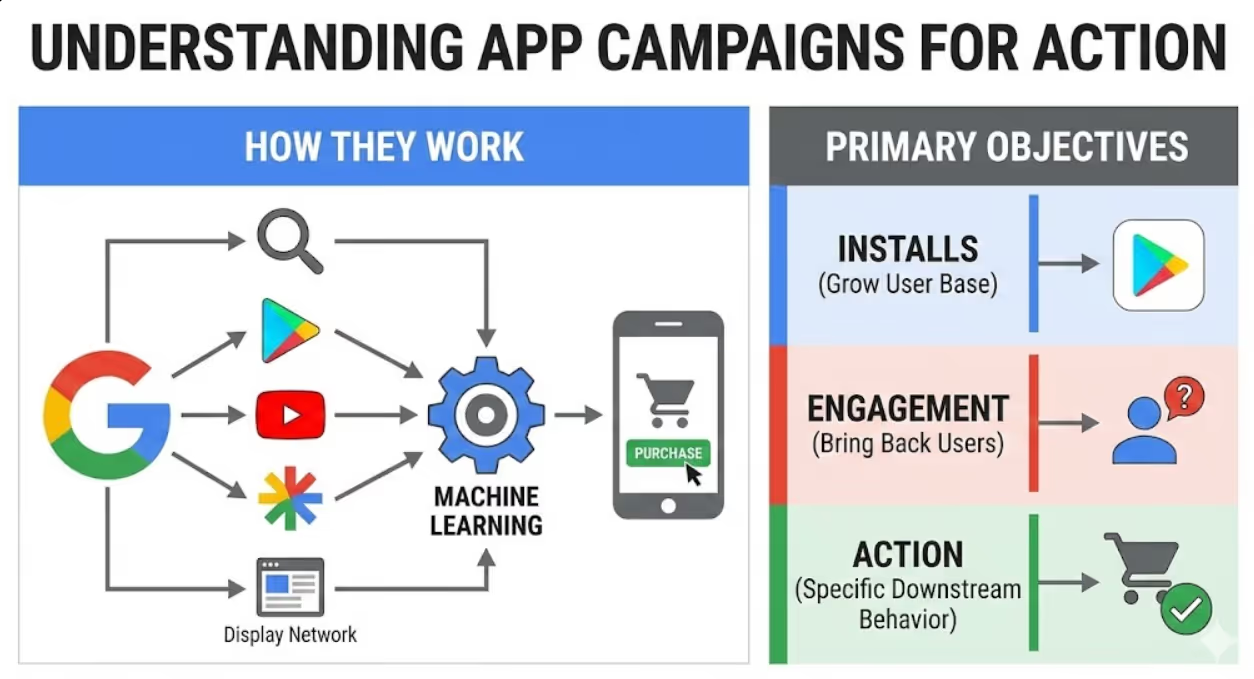
Google's App Campaigns run across Search, Play, YouTube, Discover, and the Display Network simultaneously, using machine learning to serve ads to people most likely to take a defined action. Unlike standard display or search campaigns where you manually select placements and keywords, App Campaigns automate the distribution entirely. They feed off your creative assets, your conversion data, and your targeting inputs to find the right people at the right moment.
App Campaigns come in three primary objectives. App Campaigns for Installs focus on growing your user base. App Campaigns for Engagement bring back users who already have your app installed. And App Campaigns for Action, the focus here, optimise for conversions from users who may or may not have your app yet. The goal is a specific downstream behaviour rather than the download itself.
Google's own guidance on App Campaigns makes clear that for Action campaigns to perform, they need sufficient conversion data to work with. The algorithm needs signal to optimise, and that signal comes from properly configured event tracking inside the app.
This is where many Australian businesses stumble. The campaign setup is fine. The creative is decent. But the conversion events either are not being tracked, are tracked incorrectly, or are too high in the funnel to give the machine learning anything useful to learn from. Getting the tracking right is not a technicality. It is the entire foundation of an effective App Campaign for Action.
Setting Up Your Events the Right Way
Before you spend a dollar on an Action campaign, your Firebase or third party measurement partner such as Adjust, AppsFlyer, or Branch needs to be logging the specific events that represent value to your business.
The most common mistake is tracking only the obvious final conversion, being the purchase, the booking, or the subscription, without tracking the smaller conversions that lead to it. The problem with only tracking the final event is that it leaves the algorithm without enough data to optimise. Google recommends a minimum of 50 conversions per month for campaign optimisation to function effectively, and for many businesses the final purchase event alone will not hit that threshold.
The solution is to track a funnel of events. For an ecommerce app, that might look like: product view, add to cart, begin checkout, purchase. For a service app: search performed, service selected, booking initiated, booking confirmed. Each of these events can be reported to Google as a conversion with different values assigned based on their proximity to revenue, giving the campaign algorithm far more signal to work with.
Once that event structure is in place, you move to tROAS (target return on ad spend) or tCPA (target cost per action) bidding, telling the system exactly what you are willing to pay to achieve each conversion. This shifts your campaign from a spend based model to a performance based model, which is where App Campaigns for Action genuinely earn their keep.

Winning Back Users: The Most Overlooked Campaign Type in Australia
If App Campaigns for Action are underutilised by Australian marketers, App Campaigns for Engagement are almost entirely invisible. That is a significant missed opportunity.
Winback campaigns target users who already have your app on their device but have gone quiet. These are people who showed enough interest to download, completed some level of onboarding, and then drifted. They already know your brand. They already accepted the friction of installing. Getting them active again costs a fraction of acquiring a new user, and they convert at a substantially higher rate.
For Australian businesses with an established app and a database of lapsed users, a winback campaign running in parallel with an acquisition campaign will almost always generate stronger ROI per dollar. The targeting works through deep links, which are ads that open directly to a relevant screen inside the app rather than to the home page. This dramatically reduces the friction between clicking an ad and taking action.
The creative strategy for winback is also different. Rather than selling the app itself, you are selling a reason to return. A new feature, a limited time offer, a personalised product recommendation, or simply a reminder of value the user has not accessed in a while. The message needs to feel relevant to where that user is in their lifecycle with your product. Not generic, not promotional in a vacuum, but specific enough to earn their attention again.
Creative That Converts: What Works for Australian App Audiences
Google's machine learning will test and optimise your creative assets automatically, but it can only work with what you give it. Feeding the campaign weak or generic creative limits performance regardless of how well everything else is set up.
For Australian audiences, a few creative principles consistently outperform the generic approach.
Video assets are essential. YouTube and Google Discover are major placements within App Campaigns, and video assets that demonstrate actual app functionality by showing the experience rather than describing it outperform static creative significantly. Keep these under 30 seconds. Get to the value proposition within the first five seconds. Do not assume the viewer has sound on.
Localisation matters even within Australia. An ad creative that references summer in December will resonate in Sydney and fall flat running in June. Seasonal relevance, Australian colloquialisms, and familiar visual contexts all signal to users that this app was built for them and not just adapted from a global template.
Multiple asset variations are essential. The campaign will automatically test combinations of your headlines, descriptions, images, and videos. Providing at least three to five variations of each asset type gives the algorithm meaningful choices and prevents creative fatigue from setting in too quickly.
First Party Data: Your Competitive Advantage
The broader digital marketing landscape is shifting rapidly away from third party cookies and cross app tracking. Apple's ATT (App Tracking Transparency) framework has already curtailed tracking on iOS devices, and further restrictions are expected across platforms. For Australian app marketers, this makes first party data the most valuable asset in your marketing stack. First party data is the information users willingly share through your app and owned channels, and it is increasingly irreplaceable.
Building first party data starts inside the app experience itself. Incentivised account creation, loyalty programmes, preferences and wishlists, and push notification opt-ins each generate consented data that you own and can activate in your campaigns. Customer match lists allow you to upload hashed email addresses from your CRM into Google Ads to target or exclude specific audiences in your App Campaigns.
The businesses building robust first party data infrastructure now will have a substantial targeting advantage over those who have relied entirely on third party signals. This is not a future consideration. The shift is already underway, and its impact on app campaign performance is measurable today.
Measuring What Actually Matters
App campaign reporting can be misleading if you are looking at the wrong metrics. Installs, impressions, and click through rates are easy to pull and easy to present but they are directional indicators at best. They become vanity metrics the moment they are not connected to downstream revenue events.
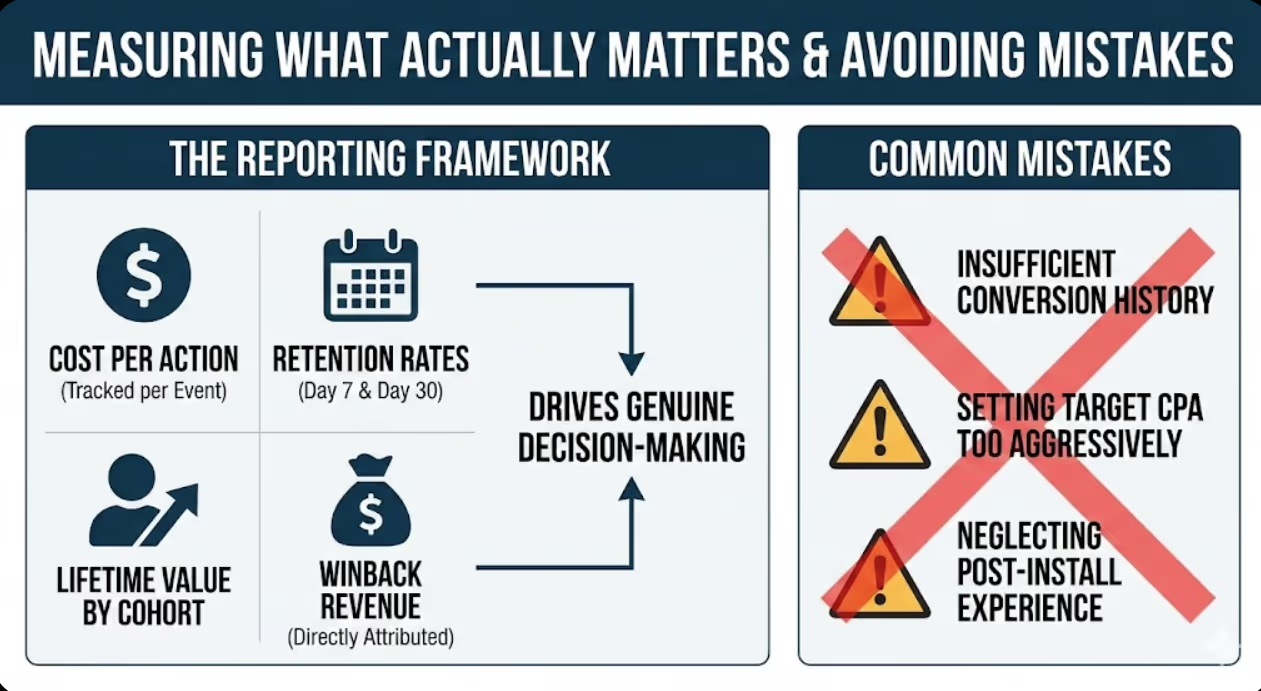
The reporting framework that drives genuine decision-making for App Campaigns for Action should centre on these measures.
Cost per action inside the app, tracked against each event in your conversion funnel. This tells you what you are paying to acquire users who actually do something valuable, not just users who downloaded and disappeared.
Day 7 and Day 30 retention rates, segmented by campaign source. If your Action campaign is bringing in users with significantly better retention than your Install campaign, that should directly influence budget allocation.
Lifetime value by cohort. Which acquisition channels are bringing in users who spend more, more often, over a longer period? This data should inform your bidding strategy and your audience targeting more than any other single input.
Revenue directly attributed to winback campaigns. This is often completely absent from reporting for businesses running these campaigns without proper attribution in place, which means they are almost certainly undervaluing the channel and under-investing in it.
Common Mistakes That Kill App Campaign Performance
Even well resourced marketing teams make avoidable errors with App Campaigns for Action. The most common include the following.
Launching Action campaigns without sufficient conversion history. The machine learning needs data to optimise. Running an Action campaign on a new app with no prior conversion tracking is asking the algorithm to guess, and it will do so expensively.
Setting target CPA too aggressively from the start. If your historical cost per conversion inside the app is $40 and you set a target CPA of $15, the campaign will either underspend dramatically or fail to exit the learning phase. Start within 20 percent of your historical CPA and adjust gradually as the campaign accumulates data.
Neglecting the experience after installation. No amount of campaign optimisation will fix a poor onboarding flow. If users are installing and then encountering friction, confusion, or a weak value proposition in those critical first few minutes, the campaign will continue to underperform regardless of how well targeted it is.
Using the same creative for winback and acquisition campaigns. The audience context is fundamentally different. Users seeing your ad for the first time need to understand what your app does. Users who have already installed it need a reason to return. The same message will not serve both.
FAQs
How much conversion data do I need before launching an App Campaign for Action?Google recommends a minimum of 50 conversion events per month for the campaign algorithm to optimise effectively. If your app is not yet hitting that threshold on the target conversion event, consider optimising for a higher funnel event first such as add to cart rather than purchase. This builds sufficient signal before shifting the optimisation goal downstream.
What is the difference between App Campaigns for Installs and App Campaigns for Action?App Campaigns for Installs optimise for volume of downloads, targeting users most likely to install your app. App Campaigns for Action go a step further, optimising for a specific behaviour inside the app after installation such as a purchase, booking, or subscription. Action campaigns require more conversion data to run effectively but consistently deliver stronger business outcomes for apps with an established user base.
Should I run App Campaigns alongside App Store Optimisation?Absolutely, and treating them as separate disciplines is a mistake. ASO improves your organic visibility and conversion rate on the App Store or Google Play, which directly impacts the quality of users your paid campaigns drive. A thoroughly optimised store listing reduces your cost per install, improves engagement rates after installation, and strengthens the overall performance of every app campaign you run.
Turn Your App Into a Revenue Engine
Getting downloads is the easy part. Building an app marketing strategy that drives consistent revenue inside the app, wins back lapsed users, and compounds in value over time is a different discipline entirely. It is also one that most Australian businesses have not yet fully invested in.
Maven Marketing Co works with Australian brands to build and manage app marketing strategies that go well beyond installs. From campaign structure and conversion tracking through to creative strategy and ongoing optimisation, we help you extract genuine commercial value from your mobile app.
Start the conversation with Maven Marketing Co →

Table of contents
read more blogs

How to Build a Brand Positioning Strategy That Sets Your Business Apart
Most businesses can explain what they sell. Far fewer can explain, in a sentence or two, why the right customer should choose them instead of another credible option. That gap is where brand positioning matters.A strong brand positioning strategy gives your business a clear place in the market and a clear place in the customer's mind. It helps your team decide who you are speaking to, what you want to be known for, which benefits deserve the most attention and how your marketing should sound and look across every channel.It is not a slogan exercise and it is not something reserved for large consumer brands. For an Australian service business, e-commerce brand, professional firm, or growing B2B company, positioning can make everyday decisions easier, from website copy and campaign messaging to pricing, sales conversations, and brand identity. The goal is not to look different for the sake of it. The goal is to be meaningfully different in a way the right customers understand and value.

The Role of Digital PR in Long Term SEO Growth
Building a solid online presence is basically more than just posting content now and then or sprinkling keywords across your website. Search engines such as Google tend to point users toward businesses that feel trustworthy, useful, and backed up by others online, even if it’s not always obvious at first. When a company puts together a well-thought-out digital PR strategy, it can bring in solid media mentions, earning high-quality backlinks and stronger brand awareness, all of which feed long-term SEO progress. Rather than obsessing solely over rankings, digital PR helps you build credibility plus authority, so your site looks more appealing to search engines and also to real people who might become customers. In this guide, we’ll walk through how digital PR supports SEO, what makes it such a key part of modern marketing, and the most effective approaches for sustainable growth in search results.

Is Google Ads Better Than SEO for My Business
One of the biggest questions business owners ask when they are planning online growth is whether they should invest in Google Ads or SEO. Both are strong marketing plays that help your company show up in Google search results, but they do things in separate lanes. Google Ads gives quicker visibility and can bring in leads fast, whereas SEO more or less focuses on slow, steady organic traffic that tends to grow the longer you keep building it. Picking the right direction depends on what you want to achieve, how much money you can spend, how crowded the market is, and how quickly you need results, like sooner rather than later. The good news is you don’t always have to choose one or the other; it’s not exactly a black-and-white situation. If you take time to understand the strongest points of both, you can put together a more sensible digital marketing plan that supports consistent expansion. In this guide, we’ll compare Google Ads vs SEO, explain the main differences, and help you figure out what option makes the most sense for your business.