.svg)


%201.svg)

Quick Answers
Can AI-generated content rank well in Google, and what are the risks for Australian businesses?
Yes, AI-generated content can rank well in Google, but only when it meets specific quality standards and provides genuine value. Google's position is clear: they don't penalize AI content simply for being AI-generated, but they do penalize content that lacks expertise, experience, authority, and trustworthiness (E-E-A-T). The critical distinction is between AI-assisted content that enhances human expertise and purely automated content created without human oversight. Australian businesses successfully using AI content follow a hybrid approach: AI handles research, outlines, and initial drafts, while human experts add industry-specific insights, verify accuracy, and inject authentic voice. The risks of unedited AI content are substantial—Google's spam detection algorithms identify patterns like repetitive phrasing, generic statements, and lack of original research. Sites caught publishing mass AI content without human refinement face ranking drops, reduced visibility, and in severe cases, manual actions. The key is treating AI as a powerful assistant rather than a replacement for human expertise and editorial judgment.
What's the most effective workflow for combining AI content generation with human authenticity?
The most effective AI content workflow for Australian businesses follows a structured five-stage process that maximizes efficiency while ensuring quality and authenticity. First, use AI for comprehensive research and competitive analysis—tools like ChatGPT and Claude excel at summarizing competitor content, identifying content gaps, and suggesting angles your competitors haven't covered. Second, leverage AI to generate detailed outlines with section headers, key points, and content structure based on top-ranking articles. Third, use AI to create initial drafts that provide foundational content, but never publish this raw output. Fourth, and most critically, have subject matter experts substantially edit the content, adding unique insights from actual experience, incorporating brand voice, inserting original data or case studies, and removing generic AI phrases. Fifth, implement human fact-checking to verify all statistics, claims, and recommendations, particularly important for Australian-specific information about regulations, markets, and business practices. This workflow reduces content creation time by approximately 60% while maintaining the authenticity and expertise that Google rewards. The businesses seeing the best results spend roughly 40% of their content creation time on AI generation and 60% on human refinement and enhancement.
The AI Content Revolution Australian Businesses Can't Ignore
Australian businesses are navigating uncharted territory in content marketing. AI writing tools have democratized content creation, enabling small businesses to produce volumes of content that would have required entire teams just three years ago. ChatGPT, Claude, Jasper, and dozens of specialized AI writing tools can generate blog posts, product descriptions, email campaigns, and social media content in minutes rather than hours.
The statistics are compelling. According to recent surveys, over 73% of Australian marketing professionals now use AI tools for content creation in some capacity. The efficiency gains are remarkable—businesses report reducing content creation time by 50-70% when incorporating AI into their workflows.
However, this efficiency comes with a critical caveat. Google's algorithm updates throughout 2025 and into 2026 have become extraordinarily sophisticated at identifying content that lacks genuine expertise and value, regardless of how well-optimized it might be technically. The businesses that rushed to replace human writers entirely with AI tools have discovered their rankings collapsing as Google's systems recognize the patterns and limitations of purely automated content.
The path forward isn't rejecting AI content tools—they're too powerful and efficient to ignore. Instead, Australian businesses need to master the balance between leveraging AI's capabilities while maintaining the authenticity, expertise, and unique perspective that only humans can provide.

Understanding Google's Stance on AI Content
Google's official position on AI-generated content is often misunderstood. Contrary to popular belief, Google doesn't automatically penalize content simply because it was created with AI assistance. In fact, Google has explicitly stated that content creation method isn't the determining factor for rankings.
What Google actually evaluates is whether content demonstrates Experience, Expertise, Authoritativeness, and Trustworthiness—the E-E-A-T framework that's become central to their quality assessment. AI-generated content can meet these standards, but only when it's properly refined, fact-checked, and enhanced with genuine human expertise.
The challenge is that pure AI output, without human intervention, consistently falls short on these criteria. AI language models generate content based on patterns in their training data, which means they excel at producing text that sounds authoritative but may lack actual expertise, original insights, or current accuracy. They can't draw from personal experience, access proprietary business data, or understand nuanced industry contexts specific to Australian markets.
Google's spam detection systems have become remarkably adept at identifying content that exhibits typical AI characteristics: repetitive phrasing patterns, generic statements lacking specificity, absence of original data or research, superficial coverage that rehashes existing content without adding value, and inconsistent or outdated information that hasn't been fact-checked.
When sites publish large volumes of this type of content, Google's algorithms increasingly classify them as low-quality, resulting in dramatic ranking drops. Several high-profile cases in 2025 saw websites lose 70-90% of their organic traffic after Google updates specifically targeted sites using unedited AI content at scale.
The Real Risks of Pure AI Content for Australian Businesses

Australian businesses that have adopted an "AI-only" content strategy are discovering significant consequences that extend beyond just search rankings. Understanding these risks is crucial for developing an effective content strategy.
The most immediate risk is algorithmic devaluation. When Google's systems detect patterns consistent with mass AI content generation—particularly content that provides no unique value beyond what's already available—those pages lose visibility. Unlike manual penalties that notify you through Google Search Console, algorithmic devaluation happens silently. Your content simply stops ranking, and recovery requires substantial content improvement across the affected pages.
For Australian e-commerce businesses, AI-generated product descriptions present particular challenges. When hundreds of products have descriptions that follow identical structures with only product names and specifications swapped, Google recognizes this pattern. More critically, potential customers recognize generic, unhelpful descriptions that could apply to any product. The result is poor engagement metrics that further signal low quality to Google's algorithms.
Brand reputation damage is another substantial risk. When your content sounds identical to your competitors because you're all using similar AI prompts and tools, you lose brand differentiation. Australian consumers are increasingly savvy about detecting AI-generated content, and businesses publishing obvious AI content without human polish risk appearing unprofessional or inauthentic.
Legal and accuracy risks are particularly concerning for specific industries. AI models occasionally generate plausible-sounding but entirely incorrect information—so-called "hallucinations." For Australian businesses in regulated industries like finance, healthcare, or legal services, publishing AI-generated content without rigorous fact-checking could result in providing incorrect advice, violating industry regulations, or facing liability issues.
The competitive disadvantage compounds over time. While you might save resources in the short term by publishing unedited AI content, competitors who invest in high-quality, expert-enhanced content will increasingly dominate search results and capture market share. The cost savings from pure AI content become losses when your visibility disappears.
The Hybrid Approach: Where AI Enhances Rather Than Replaces
The businesses achieving the best results with AI content have adopted what's known as the hybrid approach—using AI as a powerful tool that amplifies human expertise rather than replacing it. This approach delivers the efficiency benefits of AI while maintaining the quality and authenticity Google rewards.
The hybrid model recognizes that AI and humans have complementary strengths. AI excels at rapid research, synthesizing information from multiple sources, generating content structure and outlines, producing initial drafts, identifying content gaps, and analyzing competitor content. Humans excel at providing genuine expertise from experience, adding unique insights and proprietary knowledge, ensuring factual accuracy, injecting authentic brand voice, understanding nuanced contexts, and making strategic editorial decisions.
Melbourne-based digital agency Boost Digital implemented a hybrid content workflow in early 2025. Their content team uses AI to research topics, analyze top-ranking competitor content, and generate comprehensive outlines. AI then produces initial drafts that their subject matter experts substantially revise, adding client-specific insights, Australian market context, original data from their campaigns, and authentic case studies. Their content production efficiency improved by 65%, but more importantly, their clients' average organic traffic increased by 43% over six months because the content quality actually improved compared to their fully manual process.
Sydney e-commerce retailer Outdoor Essentials Australia faced declining rankings after initially publishing AI-generated product descriptions across their 800-product catalog. After recognizing the issue, they implemented a hybrid approach: AI generates initial descriptions incorporating technical specifications and features, then category specialists add unique perspectives on product use cases, incorporate customer feedback and questions, and add Australia-specific context about shipping, regulations, or seasonal considerations. Their organic traffic recovered within four months and exceeded previous levels by 28%.
The key to the hybrid approach is establishing clear rules about where AI ends and human contribution begins. The most successful implementations treat AI drafts as no more than 40-50% of the final product, with substantial human enhancement comprising the remainder.

Building an Effective AI-Human Content Workflow
Creating a systematic workflow that properly balances AI efficiency with human authenticity requires careful planning and clear processes. The following framework has proven effective for Australian businesses across various industries.
Stage One: Strategic Planning and Research
Before AI generates anything, humans should define the content strategy. Identify topics based on keyword research, audience needs, and business goals. Determine what unique value your content will provide that existing content doesn't. Define the target audience and their specific pain points. For Australian businesses, this stage should explicitly consider local market context, Australian search behavior, and regional variations in terminology or preferences.
Use AI at this stage to analyze competitor content, identifying what's already ranking and where gaps exist. Tools like ChatGPT or Claude can quickly summarize the key points from top-ranking articles, helping you understand what you need to match and what opportunities exist to differentiate.
Stage Two: Outlining and Structure
AI excels at creating comprehensive content outlines. Provide your AI tool with your topic, target keywords, and the competitive analysis from Stage One. Request a detailed outline with section headers, subheadings, and key points to cover in each section. Review this outline critically—does it follow the same structure as every other article on the topic, or does it include unique angles based on your strategic planning?
Human editorial judgment is crucial here. Reorder sections for better flow, add sections covering your unique insights or proprietary data, remove generic sections that won't provide real value, and adjust the outline to match your brand's content style.
Stage Three: Initial Draft Generation
With a refined outline, use AI to generate initial draft content for each section. This is where AI's efficiency truly shines—it can produce substantial content quickly. However, treat this output as raw material, not finished content. The AI draft should never be your final product.
Provide the AI with context about your business, brand voice, and target audience. The more specific your prompts, the better the initial output will be. For example, instead of "write about SEO benefits," prompt with "write for Australian small business owners who understand basic SEO but need to understand how schema markup specifically benefits local businesses."

Stage Four: Human Enhancement and Authenticity
This is the most critical stage where human expertise transforms generic AI content into valuable, authentic material. Subject matter experts should substantially revise every section, adding specific examples from real experience, incorporating original research or proprietary data, inserting case studies or client results, removing generic or repetitive AI phrases, adding personality and brand voice, and including Australian-specific context where relevant.
For Brisbane accounting firm Precision Partners, this stage involves their CPAs adding specific insights about Australian tax regulations, real client scenarios (anonymized), and practical advice based on their years of experience with Australian small businesses. The AI provides the structure and basic information, but the CPAs' expertise makes the content genuinely valuable.
Stage Five: Fact-Checking and Quality Assurance
Never trust AI-generated facts without verification. Assign someone to verify all statistics, claims, and recommendations, confirm links go to appropriate, authoritative sources, check that Australian-specific information is current and accurate, ensure consistency across the content, and validate that the content genuinely answers the target query comprehensively.
This stage is particularly important for Australian businesses because AI models are primarily trained on US content and may not accurately reflect Australian regulations, business practices, market conditions, or terminology. A human familiar with Australian context must review and correct these elements.
Stage Six: Optimization and Publishing
With authentic, expert-enhanced content complete, apply final SEO optimization: ensure target keywords appear naturally throughout, optimize title tags and meta descriptions, add relevant internal links to other content, ensure proper heading hierarchy, and include images with descriptive alt text. Even at this stage, avoid over-optimization or keyword stuffing that makes content read unnaturally—Google's algorithms penalize this regardless of whether content is AI or human-generated.
Tools and Technologies for the Hybrid Approach
Australian businesses have access to an extensive ecosystem of AI content tools, each with different strengths for various aspects of the content creation process. Understanding which tools to use for which purposes enhances efficiency while maintaining quality.
For general content writing, ChatGPT and Claude are the most capable general-purpose AI writing assistants, excelling at research, outlining, and initial drafts across diverse topics. Jasper and Copy.ai are specialized content generation platforms with templates for specific content types and easier integration with marketing workflows. Writesonic and Rytr offer affordable options for businesses with smaller budgets.
For SEO-specific content optimization, Clearscope and MarketMuse analyze top-ranking content and provide recommendations for topics and terms to include. Surfer SEO combines AI content generation with real-time optimization suggestions based on competitor analysis. Frase generates content briefs and creates AI content specifically optimized for target keywords.
For content editing and enhancement, Grammarly and ProWritingAid catch grammatical errors and improve clarity, essential for polishing AI drafts. Hemingway Editor highlights complex sentences and readability issues common in AI content. Originality.AI and Copyleaks detect AI-generated content and check for plagiarism, useful for quality assurance.
For Australian businesses, the ideal tool stack typically includes one general AI writing tool for initial drafts, one SEO content optimization tool for competitive analysis and optimization recommendations, editing tools for polish and readability, and human subject matter experts who know Australian markets, regulations, and customer needs.
The cost of this tool stack is typically $100-300 per month for small businesses, a fraction of the cost of hiring full-time content writers, while still delivering higher quality than pure AI approaches when combined with proper human oversight.
Identifying and Eliminating AI Content Red Flags

Even with a hybrid approach, certain AI content patterns can slip through if you're not vigilant. Learning to identify and eliminate these red flags ensures your content maintains authenticity and avoids Google's quality filters.
Repetitive phrasing patterns are perhaps the most obvious AI tell. AI models tend to favor certain transitional phrases and sentence structures. Watch for repeated use of phrases like "in today's digital landscape," "it's important to note," "moreover," "furthermore," or "in conclusion." When every section starts with similar transitions or follows identical structural patterns, it signals AI generation. Humans naturally vary their language more.
Generic, non-specific statements are another hallmark of unedited AI content. AI tends to make broad, obvious statements that sound authoritative but provide no real value. For example, "Customer service is important for business success" or "Social media marketing can help businesses reach their target audience." These statements aren't wrong, but they're so generic they could apply to any business anywhere. Replace them with specific insights: "After analyzing 50 Australian retail businesses, we found that those responding to customer inquiries within 2 hours saw 34% higher repeat purchase rates."
Lack of concrete examples or data indicates content that hasn't been properly enhanced by humans. AI drafts often make claims without supporting them with specific numbers, case studies, or real-world examples. Every significant claim in your content should be supported by either proprietary data, cited statistics from authoritative sources, specific examples from your business experience, or detailed case studies.
Overly formal or academic tone in inappropriate contexts suggests AI content. While AI can be prompted to adjust tone, default outputs often sound like academic writing even when discussing practical business topics. Australian audiences generally prefer more conversational, straightforward language. If your content about local SEO sounds like a research paper, it needs humanization.
Factual inconsistencies or outdated information are red flags that content hasn't been properly fact-checked. AI models have training data cutoffs and can confidently state information that's outdated or simply wrong. This is especially problematic for Australian-specific content about regulations, market conditions, or business practices that have changed.
Missing Australian context is a specific red flag for Australian businesses. AI models trained primarily on US content will default to American terminology, examples, regulations, and assumptions unless specifically prompted otherwise. Content mentioning "states" when discussing government without clarifying US vs. Australian states, referencing US regulations or business practices as universal, using American spelling or terminology, or lacking any Australia-specific context when it should be relevant all signal content that hasn't been properly localized by an Australian human editor.
Measuring the Balance: Quality Metrics That Matter

To ensure your AI-human content balance is effective, you need to track metrics that indicate both efficiency gains and quality maintenance. Australian businesses should monitor several key indicators.
Content performance metrics tell you whether your hybrid approach is working from an SEO and engagement perspective. Track organic traffic growth over time, average position for target keywords, click-through rates from search results, time on page and engagement metrics, social shares and backlinks earned, and conversion rates for commercial content. If these metrics decline after implementing AI in your workflow, you're likely skewing too heavily toward AI without sufficient human enhancement.
Efficiency metrics measure whether you're actually gaining the productivity benefits that justify using AI tools. Monitor time per article from brief to publication, cost per content piece including tool subscriptions and human time, content output volume compared to previous periods, and revision cycles required to reach publishable quality. The goal is reducing time and cost while maintaining or improving quality metrics.
Quality assessment metrics should include both automated and human evaluation. Use tools like Originality.AI to check AI detection scores—if your content scores above 80% AI, it needs more human enhancement. Run readability scores through tools like Hemingway Editor, tracking complexity and grade level. Conduct periodic human content audits where team members review published content against quality criteria, including factual accuracy, unique insights present, authentic brand voice, Australian context appropriate, and value beyond existing content on the topic.
Competitive benchmarking helps you understand whether your hybrid approach is delivering competitive advantage. Compare your content's ranking positions to competitors for shared target keywords, analyze backlink acquisition rates, track domain authority progression, and monitor share of voice in your industry within Australia. If competitors using different content creation approaches are consistently outperforming you, reassess your balance between AI and human contribution.
Sydney-based marketing agency Growth Labs implemented a comprehensive measurement framework when they adopted AI-assisted content creation. They discovered that content with less than 30% human enhancement (measured by time spent and changes made from AI draft) consistently underperformed in both rankings and engagement. Content with 50-70% human enhancement performed best, achieving 2.1x more organic traffic on average than their previous fully manual content, while requiring 45% less total creation time.
The Future of AI Content: What Australian Businesses Should Prepare For

The AI content landscape is evolving rapidly, and Australian businesses need to anticipate coming changes to stay ahead rather than constantly reacting. Several clear trends are emerging that will shape the next phase of content marketing.
AI detection is becoming more sophisticated on both sides. As AI tools improve, so do detection methods. Google has explicitly stated they're focused on quality signals rather than detection per se, but their algorithms are increasingly capable of identifying low-quality AI content patterns. Simultaneously, AI tools are improving at generating more natural-sounding, varied content. This arms race means the quality bar continually rises—what passed as acceptable AI-enhanced content in 2024 may not meet standards in 2027.
Personalization and customization will become the next frontier. The businesses that will stand out aren't just publishing good content—they're publishing content specifically tailored to defined audience segments. AI tools are increasingly capable of generating variations of content for different audiences, but the strategic decisions about what to customize and how require human insight into your specific customer base and Australian market segments.
Multimodal AI integration is expanding beyond just text. AI tools are now generating images, videos, audio, and interactive content. The principles of the hybrid approach apply across these formats—AI-generated visuals, podcasts, or videos still need human oversight to ensure quality, accuracy, brand consistency, and genuine value. Australian businesses should begin experimenting with these formats while maintaining the same commitment to human enhancement that applies to text content.
Regulatory scrutiny is likely to increase around AI-generated content, particularly for regulated industries. While Australia hasn't implemented specific regulations around AI content disclosure as of early 2026, this could change. Businesses in finance, healthcare, legal services, and other regulated sectors should prepare for potential requirements to disclose AI usage and maintain higher standards for factual accuracy and liability.
The premium on genuine expertise will only grow. As AI makes basic content creation nearly effortless, the content that will succeed is that which demonstrates undeniable expertise and unique insight that can't be AI-generated. Australian businesses should focus on creating content that showcases proprietary research, original data and analysis, expert commentary on industry developments, detailed case studies from real client work, and authentic perspectives based on years of experience. This content can be AI-assisted in its creation, but the core value must be genuinely human.
Practical Implementation: Getting Started This Week
For Australian businesses ready to implement a balanced AI-human content approach, the following action plan provides a concrete starting point that can be initiated immediately.
This week, establish your hybrid content guidelines. Document how your organization will use AI tools—what they can and cannot do, what percentage of final content should be human contribution, who has final editorial authority, and what fact-checking processes are required. Create specific prompts and templates for your AI tools that include your brand voice, target audience characteristics, and requirements for Australian context. Define roles clearly: who creates AI drafts, who enhances them with expertise, who performs quality checks.
Select and set up your initial tool stack. Start with one general AI writing tool (ChatGPT Plus or Claude Pro are excellent starting points for $20-30/month), one SEO optimization tool if budget allows (Surfer SEO or Clearscope, approximately $100-200/month), and leverage free tools like Grammarly's basic plan and Hemingway Editor for editing. Don't overwhelm yourself with too many tools initially—master one AI writing tool first, then expand.
Pilot the process with three test articles. Choose three upcoming content pieces to create using your new hybrid workflow. Use AI to research and outline, generate initial drafts, then have your subject matter expert substantially revise, fact-check thoroughly, and optimize for SEO. Track time spent at each stage and measure initial performance once published. This pilot phase helps you refine your process before scaling.
Train your team explicitly on the principles of effective AI content use. Everyone involved in content creation should understand why pure AI content fails, what Google's quality standards actually require, how to identify AI content red flags, what level of human enhancement is expected, and how to add authentic expertise to AI drafts. Consider this as important as any other professional development—the businesses that excel in this new environment are those that invest in developing these skills.
Create content audit and improvement processes for existing content. If you've already published AI content that wasn't properly enhanced, create a prioritization system based on traffic importance, ranking position, and conversion value. Systematically improve your highest-value content first, adding human expertise, original insights, and Australian context that was missing from AI drafts.
The Competitive Advantage of Getting This Right

Australian businesses that master the balance between AI efficiency and human authenticity aren't just avoiding penalties—they're building substantial competitive advantages that compound over time.
The efficiency advantage is clear and immediate. Businesses using the hybrid approach effectively report 50-70% reductions in content creation time while maintaining or improving quality. This means you can publish more high-quality content with the same resources, capturing more keywords, answering more audience questions, and building authority faster than competitors still using purely manual processes or those struggling with pure AI approaches.
The quality advantage becomes more pronounced over time. As AI content tools become ubiquitous, the content that rises to the top is that which demonstrates genuine expertise and provides unique value. By investing in human enhancement of AI-generated drafts, you're creating content that's both efficient to produce and genuinely valuable—a combination your competitors are struggling to achieve.
The sustainability advantage protects you from algorithm volatility. Google's increasing sophistication at identifying low-quality content means businesses relying on unedited AI content face ongoing risk of sudden ranking drops. The hybrid approach, focused on quality and expertise, aligns with Google's fundamental commitment to rewarding helpful, reliable content. Your content is less vulnerable to algorithmic updates because it meets the quality standards Google is optimizing toward.
The brand authority advantage builds your reputation as an industry leader. Consistently publishing expert-level content that provides genuine insights positions your business as authoritative within your industry. This drives not just organic traffic but also direct traffic from people seeking your expertise, backlinks from other sites referencing your insights, and industry recognition that creates business opportunities beyond just search visibility.
Brisbane-based SaaS company Workflow Solutions implemented the hybrid approach in mid-2025 and provides a compelling case study. In their first six months, they published 47 expert-enhanced blog posts, compared to 23 in the previous six months using purely manual creation. Their organic traffic increased 156%, but more significantly, they saw a 73% increase in qualified demo requests attributed to organic content, and began receiving speaking invitations at Australian industry conferences based on the expertise demonstrated in their content. The founder attributes this to "being able to create more content without sacrificing the expertise and insights our team brings from actually building and supporting SaaS products for Australian businesses."
Take Action: Transform Your Content Strategy Today
The window to gain competitive advantage through effective AI-human content balance is open now, but it won't remain uncrowded forever. As more Australian businesses recognize the opportunity and implement proper hybrid approaches, the advantage diminishes. The time to act is while the majority of your competitors are either avoiding AI entirely or using it incorrectly.
The choice isn't between efficiency and authenticity—it's whether you'll learn to combine both effectively or fall behind competitors who master this balance before you do. Every month you delay is another month of lost visibility, missed opportunities, and competitors building advantages you'll need to overcome later.
Ready to implement a content strategy that delivers both AI efficiency and human authenticity? Contact Maven Marketing for a comprehensive content audit and AI-human workflow implementation plan. We'll analyze your current content performance, identify opportunities for improvement, and design a custom hybrid content process that matches your resources, expertise, and business goals. Don't gamble your search visibility on pure AI content, and don't miss the efficiency gains of proper AI integration. Get in touch today and transform your content strategy for the AI era while maintaining the authenticity Google rewards and your Australian audience demands.

Table of contents
read more blogs
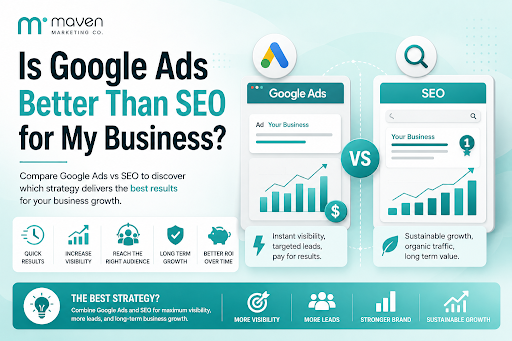
Is Google Ads Better Than SEO for My Business
One of the biggest questions business owners ask when they are planning online growth is whether they should invest in Google Ads or SEO. Both are strong marketing plays that help your company show up in Google search results, but they do things in separate lanes. Google Ads gives quicker visibility and can bring in leads fast, whereas SEO more or less focuses on slow, steady organic traffic that tends to grow the longer you keep building it. Picking the right direction depends on what you want to achieve, how much money you can spend, how crowded the market is, and how quickly you need results, like sooner rather than later. The good news is you don’t always have to choose one or the other; it’s not exactly a black-and-white situation. If you take time to understand the strongest points of both, you can put together a more sensible digital marketing plan that supports consistent expansion. In this guide, we’ll compare Google Ads vs SEO, explain the main differences, and help you figure out what option makes the most sense for your business.

When Should I Hire a Digital Marketing Agency
Growing a business today takes more than just having a website or throwing a post on social media; customers usually search around online, compare providers, skim reviews, and basically expect the brand to show up with a solid digital presence before they even think about buying. Many businesses try to run their marketing themselves, but there comes a point when “doing it all in-house” becomes clunky and hard to manage, all at once. Knowing when to hire a digital marketing agency can end up making a big, real difference for your growth. If you’re not getting enough leads, or your online visibility feels stuck, or sales are just not moving, the right agency can bring the know-how, plus a clear plan, to help you get noticeably better outcomes. In this guide, we’ll dig into what a digital marketing agency actually does, the usual signs it’s time to bring one on, and how picking the right marketing partner can help your business move forward at a faster pace.
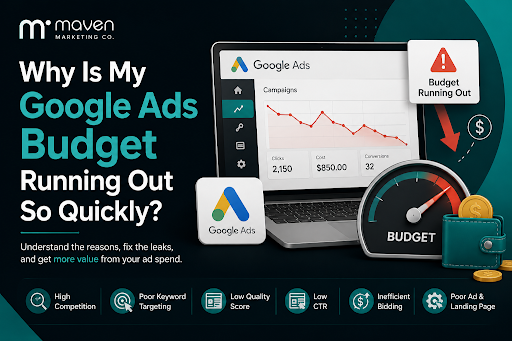
Why Is My Google Ads Budget Running Out So Quickly
Running a successful Google Ads budget isn’t only about throwing more money at it. It’s more like making every dollar, doing a bit extra. A lot of businesses start a Google Ads campaign with big hopes, then find out their daily budget is gone within a few hours, and that feels weird, right? After that, your ads stop showing effectively, new leads slip away, and your return on investment dips. So if your Google Ads budget is running out too fast, don’t stress. It’s a fairly common issue, and in most situations, it can be repaired with the right approach. There are multiple little things that can drain your advertising money quicker than you expected, from costly keywords to audience targeting that just doesn’t quite fit. In this guide, we’ll walk through why your budget disappears so quickly, how to cut wasteful spend, and the most reliable ways to boost your Google Ads ROI, even if your budget stays the same.