.svg)


%201.svg)

ChatGPT-5 is not GPT-4 with a minor upgrade. It represents a fundamental shift in how AI processes your requests, and if you are still prompting it the way you did six months ago, you are leaving serious capability on the table.
Since its August 2025 launch, ChatGPT-5 has delivered unprecedented performance across mathematics, coding, and reasoning tasks. The model achieved over 94% accuracy on advanced mathematics competitions and 74.9% on real-world coding benchmarks. Yet most Australian businesses are not seeing these results because they have not adapted their prompting strategies to match the model's new architecture.
The problem is not the AI. It is how you are talking to it.
Understanding ChatGPT-5's Invisible Router
Here is what changed that nobody tells you about. ChatGPT-5 uses an invisible router that automatically selects which model variant handles your request. If your prompt appears simple or vague, the router defaults to faster, less powerful processing to conserve computing resources. This means lower-quality responses, not because the capability is not there, but because your prompt did not trigger the advanced reasoning you needed.
This router determines whether your query gets handled by the instant model for quick responses or the thinking model for deep reasoning. Understanding this mechanism is the first secret to better results.

1. Be Ruthlessly Specific About Your Desired Outcome
Vague requests produce vague results. ChatGPT-5's router interprets ambiguity as simplicity, routing your query to basic processing.
Instead of "Write something about our new product," try "Write a 300-word product announcement for LinkedIn targeting Australian marketing managers aged 35 to 50, emphasising time savings and ROI. Use a professional but approachable tone and include a clear call to action."
The specificity signals complexity to the router whilst giving the model clear parameters for success.
2. Structure Complex Prompts with XML Tags
Using XML tags to organise different components of your prompt is highly effective for GPT-5's precision requirements. Rather than presenting walls of text, you explicitly label each element.
Structure your prompts like this:
<TASK>
Analyse this customer feedback and identify the top three pain points.
</TASK>

<FEEDBACK>
[Insert customer comments here]
</FEEDBACK>

<OUTPUT_FORMAT>
Present findings as a bullet list with supporting quotes.
</OUTPUT_FORMAT>
This structured approach helps ChatGPT-5 parse your requirements accurately, particularly for complex multi-part requests.
3. Leverage Chain-of-Thought Reasoning
Chain-of-thought prompting enables complex reasoning capabilities through intermediate reasoning steps. Instead of asking for immediate answers, you instruct the model to show its working.
Add phrases like "Let's think step by step" or "Explain your reasoning process" to prompts requiring analysis, calculation, or logical deduction. This technique forces the model into deeper processing mode, activating its advanced reasoning capabilities.
For strategic planning, competitive analysis, or complex problem solving, chain-of-thought prompting dramatically improves output quality. The model breaks down problems into manageable components, reducing errors and improving logical consistency.

4. Assign Expert Roles for Focused Responses
Role assignment shapes how ChatGPT-5 approaches your task. Tell the model exactly whose perspective and expertise you need.
"Act as an experienced email marketing strategist with 15 years in B2B SaaS" produces fundamentally different outputs than a generic request. The role assignment activates specific knowledge domains and communication styles.
For Australian businesses, be explicit about local context. "Act as a Sydney-based marketing consultant familiar with Australian Privacy Principles and local consumer behaviour" ensures outputs align with your regulatory environment and market conditions.
5. Provide Examples of What You Want
Few-shot prompting works brilliantly with ChatGPT-5. Show the model examples of your desired output format, tone, or structure before asking it to create something new.
If you want social media posts in your brand voice, provide two or three examples from your best-performing content. The model learns the pattern and replicates it with remarkable consistency.
This approach is particularly powerful for maintaining brand consistency across content creation, ensuring every output matches your established style.
6. Set Clear Constraints and Boundaries
What you exclude matters as much as what you include. Tell ChatGPT-5 explicitly what to avoid.
"Do not use marketing jargon or buzzwords. Avoid passive voice. Never exceed 150 words per section" gives the model firm boundaries. These negative instructions prevent common AI writing problems like overly promotional language or verbose explanations.
For Australian businesses, specify regional requirements. "Use Australian English spelling and reference ACCC guidelines where relevant" ensures outputs meet local standards.

7. Use the Meta-Prompt Technique
You can use a meta-prompt directly in ChatGPT-5 to have it optimise your initial prompt. This is prompting about prompting.
Ask ChatGPT-5: "I want to create a prompt that will generate high-quality email sequences for abandoned cart recovery. Review my initial prompt and suggest improvements for clarity, specificity, and effectiveness."
The model restructures your prompt using best practices, often revealing gaps in your original request you had not considered.
8. Demand Internal Quality Checks
Force ChatGPT-5 to self-evaluate before presenting final outputs. Add this universal prompt: "Before you respond, create an internal rubric for what defines a world-class answer to my request, then internally iterate on your work until it scores 10 out of 10 against that rubric".
This instruction triggers multiple internal revision cycles. The model generates output, evaluates it against quality criteria, revises, and repeats until meeting its own high standards. The result is dramatically improved quality without additional prompting from you.
9. Exploit the Extended Context Window
ChatGPT-5 offers up to 400,000 tokens of context memory, allowing you to include massive amounts of reference material in single prompts.
Upload your entire brand guidelines document, product specifications, and competitor analysis simultaneously. Ask ChatGPT-5 to cross-reference all three when creating marketing materials. The model maintains coherence across enormous context spans, something previous versions could not manage.
For Australian businesses, this means including your complete style guide, compliance requirements, and market research in one prompt, ensuring every output aligns with all your parameters.

10. Iterate Within Conversations, Not Across Them
ChatGPT-5 maintains conversation context brilliantly. Rather than starting fresh prompts for revisions, build iteratively within the same conversation thread.
After receiving initial output, respond with "Good start. Now make it more conversational and add specific examples from Australian retail." The model adjusts whilst retaining everything from previous exchanges.
This conversational refinement produces better results than trying to craft the perfect single prompt. Think dialogue, not dictation.
11. Specify Your Audience Explicitly
Who will read this output? ChatGPT-5 adjusts complexity, terminology, and examples based on your specified audience.
"Write this for C-suite executives with limited technical knowledge" produces drastically different content than "Write this for junior developers." The model calibrates explanation depth, jargon usage, and assumed background knowledge accordingly.
For Australian businesses targeting specific demographics, include relevant details. "Target Brisbane small business owners aged 45 to 60 without university degrees" helps ChatGPT-5 select appropriate language and references.
12. Request Multiple Options for Better Selection
Rather than accepting the first output, ask for variations. "Provide three different approaches to this email subject line, ranging from conservative to bold."
ChatGPT-5 generates diverse options, giving you genuine choice. This technique is particularly valuable for creative work where personal preference matters. You select the direction that resonates, then refine from there.
13. Use Temperature Control Through Language
Whilst you cannot directly adjust temperature settings in the ChatGPT interface, you can influence output randomness through prompt language.
For factual, consistent outputs, use phrases like "Provide the definitive answer" or "Give me the standard approach." For creative exploration, try "Brainstorm unexpected angles" or "Think outside conventional wisdom."
The model interprets these cues as implicit temperature adjustments, balancing creativity against reliability based on your indicated preference.

14. Combine Multiple Techniques for Complex Tasks
The most powerful prompts stack several techniques together. For a complex marketing strategy prompt, you might combine role assignment, XML structure, chain-of-thought reasoning, examples, constraints, and audience specification.
This layered approach works because each technique addresses different aspects of output quality. Role assignment shapes perspective, structure organises complexity, chain-of-thought improves reasoning, examples provide patterns, constraints prevent errors, and audience targeting ensures relevance.
These tips are not mutually exclusive and can be stacked on top of each other for even better results.
15. Give ChatGPT-5 Permission to Ask Questions
End complex prompts with "If you need any clarification or additional information to provide the best possible response, ask me before proceeding."
This invitation transforms the interaction from one-way instruction to collaborative problem solving. ChatGPT-5 identifies gaps in your requirements, potential ambiguities, or missing context that would improve final output quality.
For strategic business applications, this dialogue approach prevents wasted effort on outputs that miss the mark because of unstated assumptions.
The Reality About ChatGPT-5 and Australian Business
Effective prompt engineering has become a systematic method for producing precise and trustworthy results from large language models. As these systems advance, the best prompt engineers are moving beyond simple phrasing to apply structure, logic, and reasoning scaffolds.
For Australian businesses, this matters because ChatGPT-5 is not a magic solution that automatically understands your needs. It is a remarkably capable tool that responds to how well you communicate requirements. The difference between disappointing results and genuinely useful outputs usually comes down to prompt quality, not model limitations.
Your competitors are learning these techniques. Marketing teams at forward-thinking Australian companies are already using structured prompting to generate months of content in hours, analyse customer feedback at scale, and develop strategic plans with AI assistance. The competitive advantage goes to businesses that master the communication layer between human intent and AI capability.
Common Mistakes That Kill Your Results

Even with these secrets, certain mistakes will sabotage your ChatGPT-5 outputs. Avoid these traps:
Being too polite or conversational undermines clarity. ChatGPT-5 does not need social niceties. It needs precise instructions.
Asking for too much in a single prompt creates confusion. Break complex projects into sequential prompts, building on previous outputs.
Failing to verify factual claims remains crucial. ChatGPT-5 is significantly less likely to hallucinate than previous models, with responses containing approximately 45% fewer factual errors than GPT-4o. However, "less likely" does not mean "never." Always verify important facts, particularly for business-critical decisions.
Ignoring the context window limits creates problems. Whilst 400,000 tokens is massive, it is not infinite. Monitor token usage for extremely long conversations.
Implementing These Secrets in Your Workflow
Knowledge means nothing without implementation. Here is how to actually use these techniques:
Start with one technique per week. Master XML structuring first, then add chain-of-thought reasoning, then role assignment. Gradual adoption beats overwhelming yourself with fifteen simultaneous changes.
Create a prompt library for your common tasks. When you craft a particularly effective prompt for email marketing, save it. Build templates for recurring needs like social media content, customer responses, or strategic analysis.
Best practices for prompt engineering suggest an iterative approach. Start with an initial prompt, review the response, and refine based on output quality. Each interaction teaches you how the model responds to different instruction types.
Track what works for your specific use cases. A prompt structure that works brilliantly for content creation might fail for data analysis. Experiment systematically and document your findings.
Share successful prompts with your team. When someone discovers a particularly effective approach for your industry or business type, distribute it company-wide. Collective learning accelerates everyone's results.
The Future of Prompting is Already Here
ChatGPT-5 represents where AI is heading. Future models will be even more capable, even more nuanced, and even more demanding of quality prompts. The prompting techniques that work in 2026 focus on clarity, controlled output, and repeatable success.
Australian businesses that invest time now in mastering prompt engineering build a competitive moat. This skill transfers across AI models and platforms. The fundamentals of clear communication, structured thinking, and iterative refinement apply whether you are using ChatGPT, Claude, Gemini, or whatever emerges next.
The businesses winning with AI are not those with the most expensive subscriptions or the latest tools. They are the ones who understand how to extract maximum value from the capabilities already available. That comes down to communication skill, not technology access.
%20(1).avif)
Your Next Move
Stop accepting mediocre AI outputs. You now have fifteen specific techniques that measurably improve ChatGPT-5 results. Each technique addresses a different dimension of prompt quality, and stacking them creates compounding improvements.
Start today with one technique. Tomorrow, add another. Within two weeks, you will be generating outputs that make your previous attempts look amateurish. Within a month, ChatGPT-5 becomes a legitimate business asset rather than a frustrating experiment.
The AI revolution is not coming. It arrived in August 2025 with ChatGPT-5's launch. The only question is whether your business will harness it effectively or struggle with outdated approaches whilst competitors surge ahead.
Ready to transform your marketing with AI that actually delivers results? The team at Maven Marketing Co. specialises in implementing AI-powered marketing strategies for Australian businesses. We do not just teach you about ChatGPT-5—we build custom prompting frameworks, create branded AI workflows, and train your team to extract maximum value from AI tools. Book a consultation today and discover how proper AI integration can double your content output whilst maintaining quality, consistency, and your unique brand voice.

Table of contents
read more blogs
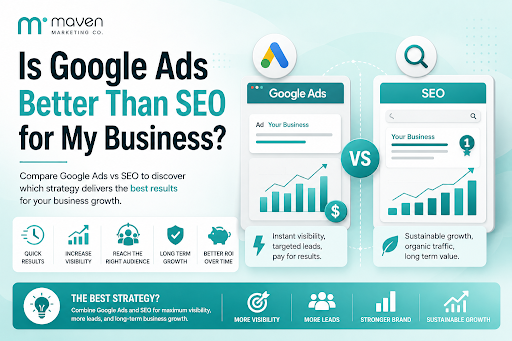
Is Google Ads Better Than SEO for My Business
One of the biggest questions business owners ask when they are planning online growth is whether they should invest in Google Ads or SEO. Both are strong marketing plays that help your company show up in Google search results, but they do things in separate lanes. Google Ads gives quicker visibility and can bring in leads fast, whereas SEO more or less focuses on slow, steady organic traffic that tends to grow the longer you keep building it. Picking the right direction depends on what you want to achieve, how much money you can spend, how crowded the market is, and how quickly you need results, like sooner rather than later. The good news is you don’t always have to choose one or the other; it’s not exactly a black-and-white situation. If you take time to understand the strongest points of both, you can put together a more sensible digital marketing plan that supports consistent expansion. In this guide, we’ll compare Google Ads vs SEO, explain the main differences, and help you figure out what option makes the most sense for your business.

When Should I Hire a Digital Marketing Agency
Growing a business today takes more than just having a website or throwing a post on social media; customers usually search around online, compare providers, skim reviews, and basically expect the brand to show up with a solid digital presence before they even think about buying. Many businesses try to run their marketing themselves, but there comes a point when “doing it all in-house” becomes clunky and hard to manage, all at once. Knowing when to hire a digital marketing agency can end up making a big, real difference for your growth. If you’re not getting enough leads, or your online visibility feels stuck, or sales are just not moving, the right agency can bring the know-how, plus a clear plan, to help you get noticeably better outcomes. In this guide, we’ll dig into what a digital marketing agency actually does, the usual signs it’s time to bring one on, and how picking the right marketing partner can help your business move forward at a faster pace.
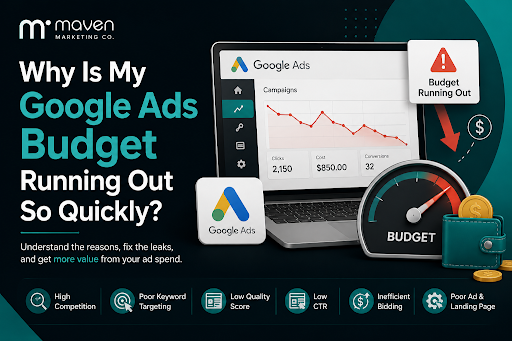
Why Is My Google Ads Budget Running Out So Quickly
Running a successful Google Ads budget isn’t only about throwing more money at it. It’s more like making every dollar, doing a bit extra. A lot of businesses start a Google Ads campaign with big hopes, then find out their daily budget is gone within a few hours, and that feels weird, right? After that, your ads stop showing effectively, new leads slip away, and your return on investment dips. So if your Google Ads budget is running out too fast, don’t stress. It’s a fairly common issue, and in most situations, it can be repaired with the right approach. There are multiple little things that can drain your advertising money quicker than you expected, from costly keywords to audience targeting that just doesn’t quite fit. In this guide, we’ll walk through why your budget disappears so quickly, how to cut wasteful spend, and the most reliable ways to boost your Google Ads ROI, even if your budget stays the same.