.svg)


%201.svg)
.avif)
Key Takeaways
- Website accessibility benefits 1 in 5 Australians living with disability whilst improving experiences for all users through clearer content, better navigation, flexible interfaces, and robust functionality across devices and contexts
- WCAG 2.1 Level AA represents international accessibility standard and Australian legal baseline, with Level AAA recommended for government and essential services requiring highest accessibility commitment
- Business benefits of accessibility include reaching $55 billion disability market, improved search rankings through semantic HTML and structured content, reduced legal risk, and enhanced brand reputation
- Inclusive design principles embed accessibility from project inception through user research with people with disabilities, semantic HTML, keyboard navigation, sufficient colour contrast, and alternative text for images
- Accessibility is ongoing commitment requiring regular audits, user testing with assistive technologies, team training, and continuous improvement rather than one-time compliance project
.avif)
A Brisbane university implemented basic WCAG compliance on their website—adding alt text, ensuring colour contrast, and enabling keyboard navigation. Technically compliant, legally protected. Yet blind students using screen readers struggled with complex navigation, hearing every menu item before reaching content. Students with motor impairments found forms frustrating despite meeting guidelines. The university satisfied compliance requirements whilst creating suboptimal experiences.
They engaged students with disabilities in usability testing. Discoveries revealed that compliant navigation patterns confused screen reader users, compliant forms lacked helpful error messaging, and compliant content used technically correct but practically unhelpful alt text. Acting on feedback, they reorganised navigation for screen reader efficiency, enhanced form instructions and error messages beyond minimum requirements, and rewrote alt text descriptively rather than literally.
Accessibility improved dramatically. Student satisfaction increased. Complaints ceased. Unexpectedly, all students benefited—clearer navigation helped everyone, better error messages reduced support requests, and descriptive alt text improved SEO. This illustrates accessibility's dual nature: legal obligation and opportunity for excellence.
According to the Australian Network on Disability, people with disabilities and their families represent combined spending power exceeding $55 billion annually in Australia. Organisations creating genuinely accessible digital experiences access this market whilst competitors settle for minimum compliance.
Understanding Australian Accessibility Legal Framework
Australian organisations face legal obligations requiring website accessibility, with understanding the framework essential for strategic compliance and risk management.
Disability Discrimination Act 1992 prohibits discrimination based on disability, including digital discrimination. Websites and digital services must be accessible to people with disabilities. Whilst the Act doesn't specify technical standards, courts reference international standards like WCAG when evaluating accessibility. Organisations can face complaints, legal action, and reputation damage from inaccessible websites.
WCAG (Web Content Accessibility Guidelines) provides technical standards for accessibility. WCAG 2.1 represents current international standard with three conformance levels: Level A (minimum accessibility), Level AA (recommended standard for most organisations), and Level AAA (highest accessibility, required for specialised contexts). Australian organisations typically target Level AA as reasonable accessibility standard balancing comprehensive accessibility with practical implementation.
Australian Government requirements mandate WCAG 2.1 Level AA for government websites under Digital Service Standard. Government agencies must demonstrate accessibility compliance, conduct accessibility testing, and provide accessibility statements. Whilst requirements formally apply to government, they establish precedent influencing expectations for all organisations.
Legal precedent from accessibility complaints informs organisational obligations. Complaints to the Australian Human Rights Commission have established that inaccessible websites constitute discrimination, organisations cannot claim ignorance of accessibility requirements, and reasonable adjustments must be made to enable equal access. Cases have resulted in financial settlements, mandatory remediation, and reputation damage.
Industry-specific regulations add accessibility requirements for certain sectors. Financial services, healthcare, education, and telecommunications face heightened accessibility expectations given service importance. Universities must ensure accessibility under education access obligations. Healthcare providers must enable accessible appointment booking and patient portals. Financial institutions need accessible banking services.
Procurement and funding requirements increasingly mandate accessibility. Government grants and contracts often require accessibility compliance. Organisations receiving government funding may face accessibility obligations as funding conditions. Procurement processes prioritise accessible solutions when evaluating vendors.
Proactive compliance benefits exceed reactive response costs. Implementing accessibility during development costs substantially less than retrofitting inaccessible websites. Proactive accessibility prevents complaints, demonstrates social responsibility, and creates better user experiences. Organisations treating accessibility as design requirement rather than legal burden achieve better outcomes at lower cost.
.avif)
WCAG 2.1 Principles and Success Criteria
WCAG organises accessibility requirements around four principles—Perceivable, Operable, Understandable, and Robust—each containing specific success criteria organisations must meet.
Perceivable principle ensures information and user interfaces can be perceived by all users. Text alternatives provide equivalents for non-text content (images, videos, audio) enabling people using screen readers, braille displays, or text-to-speech to access information. Time-based media requires captions for deaf users and audio descriptions for blind users. Adaptable content maintains meaning when presentation changes (different screen sizes, assistive technologies, user preferences). Distinguishable content uses sufficient colour contrast, doesn't rely solely on colour for meaning, and provides user control over audio and text presentation.
Operable principle ensures interface components and navigation can be operated by all users. Keyboard accessible functionality works without mouse, accommodating people with motor impairments or who use alternative input devices. Sufficient time allows users to read and use content at their own pace without arbitrary time limits. Seizure prevention avoids flashing content that could trigger seizures (nothing flashes more than 3 times per second). Navigable structure provides clear navigation, descriptive headings, meaningful link text, and multiple ways to find content. Input modalities support various interaction methods beyond touch and mouse.
Understandable principle ensures information and user interface operation can be understood. Readable text uses clear language, defines unusual words, and specifies content language for proper text-to-speech pronunciation. Predictable interfaces behave consistently without surprising users with unexpected changes. Input assistance helps users avoid and correct mistakes through clear labels, error identification, suggestions for correction, and error prevention for legal or financial transactions.
Robust principle ensures content works reliably across user agents including assistive technologies. Compatible markup uses valid HTML, provides complete start and end tags, uses elements according to specifications, and includes proper attributes. Status messages communicate dynamic updates to assistive technologies, ensuring screen reader users receive important notifications without losing context.
Level AA success criteria Australian organisations should prioritise include minimum 4.5:1 colour contrast ratio for normal text (larger text can use 3:1), meaningful sequence independent of CSS presentation, resizable text up to 200% without loss of functionality, multiple ways to navigate (menus, search, sitemap), descriptive headings and labels, keyboard-accessible interactive elements, and error identification with correction suggestions. These Level AA criteria create substantially accessible experiences for most users.
Testing success criteria requires combination of automated tools and manual evaluation. Automated scanners like WAVE, axe DevTools, or Lighthouse identify many violations but miss context-dependent issues. Manual testing with keyboard navigation, screen readers, and other assistive technologies validates real-world accessibility. User testing with people with disabilities provides definitive accessibility assessment.
.avif)
Business and Market Benefits Beyond Compliance
Accessibility delivers measurable business value beyond avoiding legal complaints, creating competitive advantages and market opportunities.
Market expansion reaches underserved disability market. People with disabilities represent 18.3% of Australian population (approximately 4.4 million people) according to Australian Bureau of Statistics. Their families and carers expand the influenced market substantially. Organisations creating accessible digital experiences access spending power that competitors excluding people with disabilities miss. Research from Return on Disability shows the global disability market represents $13 trillion in disposable income—Australian organisations capturing local market share gain significant revenue opportunities.
SEO benefits emerge from accessibility practices that align with search engine optimisation. Semantic HTML structure using proper heading hierarchy, descriptive alt text for images, transcripts for videos, and clear link text all improve SEO whilst serving accessibility. Search engines essentially operate like blind users, relying on text content and semantic structure rather than visual presentation. Accessible websites typically rank better because they're easier for search engines to understand and index.
Improved usability for all users results from accessibility features benefiting everyone. Captions help people watching videos in noisy environments or quiet offices. Clear navigation helps all users find content efficiently. Keyboard navigation benefits power users who prefer keyboards over mice. Readable text helps people with temporary impairments (eye fatigue, bright sunlight on screens), situational limitations (one hand occupied), or just ageing-related vision changes affecting many older Australians.
Mobile accessibility overlaps substantially with general accessibility. Touch target sizing, simplified navigation, readable text sizes, and good colour contrast all serve both mobile optimisation and accessibility. Organisations implementing accessibility often discover mobile experience improvements as beneficial side effect.
Reduced maintenance costs from accessible semantic HTML create cleaner, more maintainable codebases. Semantic HTML is easier to update, works across devices without extensive customisation, and integrates more readily with new technologies. Short-term accessibility investment creates long-term maintenance efficiency.
Brand reputation enhancement demonstrates social responsibility that resonates with socially conscious consumers. Organisations prioritising accessibility signal values alignment, inclusive culture, and ethical business practices. Particularly important for B2B organisations where procurement increasingly evaluates suppliers' social responsibility commitments.
Legal risk mitigation prevents costly complaints and remediation. Proactive accessibility implementation costs substantially less than reactive fixes after complaints. Legal fees, settlement costs, mandatory audits, and reputation damage from accessibility complaints often exceed 10x the proactive implementation cost.
Innovation catalyst often emerges from accessibility constraints. Solving accessibility challenges sometimes produces innovative solutions benefiting all users. Voice interfaces developed for blind users now serve mainstream markets. Captions originally for deaf users now enable video consumption in sound-sensitive contexts. Accessibility-driven innovation creates unexpected competitive advantages.
.avif)
Implementing Inclusive Design Processes
Moving beyond compliance requires embedding accessibility throughout design and development processes rather than treating it as testing phase addition.
User research with people with disabilities provides genuine insights into accessibility needs. Include people with diverse disabilities (vision, hearing, motor, cognitive) in user research, conduct usability testing with assistive technologies, observe real users navigating your websites, and incorporate feedback into design decisions. Lived experience of disability provides insights that guidelines alone cannot capture.
Accessibility persona development helps teams design for diverse users. Create personas representing users with different disabilities (blind user with screen reader, deaf user relying on captions, motor impairment user using keyboard only, cognitive disability user needing clear language). Reference these personas during design reviews ensuring decisions consider diverse access needs.
Early accessibility integration prevents costly retrofitting. Include accessibility requirements in project briefs, involve accessibility expertise during wireframing and design, conduct accessibility reviews before development begins, and use accessible component libraries as development starting points. Accessibility addressed early costs 1/10th of retrofitting inaccessible completed websites.
Semantic HTML foundation creates accessible structure. Use proper heading hierarchy (h1, h2, h3), employ landmark elements (header, nav, main, footer), apply ARIA labels when HTML semantics insufficient, structure forms with label elements, and organise content logically independent of visual presentation. Semantic HTML provides foundation all other accessibility builds upon.
Keyboard navigation implementation ensures functionality without mouse. All interactive elements must be keyboard accessible, tab order follows logical sequence, focus indicators are clearly visible, keyboard shortcuts don't conflict with assistive technology shortcuts, and users can escape from all interactive components. Test every page and interaction using only keyboard to verify accessibility.
Colour and contrast strategy ensures visibility for colour blind and low vision users. Meet minimum 4.5:1 contrast ratio for text, don't rely solely on colour to convey information (use text labels, patterns, or icons in addition to colour), test with colour blindness simulators, and allow users to customise colour schemes when possible. Research from WebAIM shows colour contrast represents one of the most common accessibility failures—addressing it dramatically improves accessibility.
Alternative text writing provides meaningful descriptions. Describe image content and context rather than just identifying image subject, avoid redundant phrases like "image of" or "picture of", keep alt text concise (typically 125 characters or less), and mark decorative images as presentation only (empty alt attribute). Well-written alt text serves both accessibility and SEO.
Form accessibility creates usable data entry. Associate labels with form fields using label elements, provide clear instructions before users enter data, validate input and provide specific error messages, indicate required fields clearly, and group related form fields logically. Forms represent critical conversion points—accessibility here directly impacts business outcomes.
Testing with assistive technologies validates real-world accessibility. Test with screen readers (JAWS, NVDA, VoiceOver), keyboard navigation, speech recognition software, screen magnifiers, and browser reading modes. Automated tools catch many issues but assistive technology testing reveals usability problems tools miss.
Common Accessibility Barriers and Solutions
Understanding frequent accessibility failures helps Australian organisations avoid these pitfalls and implement effective solutions.
Missing or poor alternative text prevents screen reader users from understanding images. Solution: Write descriptive alt text conveying image meaning and context. For complex images (charts, diagrams), provide both brief alt text and detailed long descriptions. Mark decorative images as presentation-only using empty alt attributes. For functional images (buttons, links), describe action rather than appearance.
Insufficient colour contrast makes text unreadable for low vision users and difficult for everyone in poor lighting. Solution: Use contrast checking tools during design ensuring 4.5:1 ratio minimum for normal text, 3:1 for large text. Don't rely solely on colour to convey meaning—supplement with text, patterns, or icons. Provide high-contrast mode option for users needing maximum visibility.
Keyboard accessibility failures trap keyboard users or prevent accessing functionality. Solution: Ensure all interactive elements (links, buttons, form fields, custom widgets) are keyboard accessible. Implement logical tab order. Provide clear focus indicators showing current keyboard position. Test entire site using only keyboard verifying full functionality.
Unclear link text confuses screen reader users who navigate by link lists. Solution: Use descriptive link text conveying destination or action ("Read our accessibility policy" not "Click here"). Ensure links make sense out of context. Avoid repetitive link text (multiple "Read more" links without additional context).
Form accessibility issues include unlabelled fields, unclear error messages, and inaccessible custom controls. Solution: Use label elements associating labels with fields. Provide instructions before form. Indicate required fields clearly. Validate inputs and provide specific correction guidance. Ensure custom form controls (date pickers, autocomplete) work with keyboards and screen readers.
Missing captions and transcripts exclude deaf users from video content. Solution: Provide synchronised captions for all videos. Offer transcripts for audio content. Ensure captions are accurate, properly synchronised, and include speaker identification and sound effects when relevant. Consider audio descriptions for visually complex videos serving blind users.
Complex or inconsistent navigation confuses all users but particularly impacts screen reader and keyboard users. Solution: Use consistent navigation across site. Provide multiple navigation methods (main menu, search, breadcrumbs, sitemap). Use proper heading hierarchy for page structure. Implement skip links allowing keyboard users to bypass repeated navigation blocks.
Inaccessible PDFs represent common barrier given PDF prevalence. Solution: Create accessible PDFs from source documents (not scanned images). Use proper PDF structure with tags, headings, and reading order. Provide text alternatives for images within PDFs. Consider providing HTML versions of important documents as more reliably accessible alternative.
Automatic content changes disorient users when pages update without notification. Solution: Avoid automatic refreshes or redirects. If automatic updates occur (live data, notifications), announce changes to assistive technologies using ARIA live regions. Provide user control over timing when possible.
Overly complex language creates barriers for cognitive disabilities and non-native speakers. Solution: Use plain language principles—short sentences, common words, clear structure. Define technical terms. Organise content logically with descriptive headings. Consider offering simplified versions of complex content.
Accessibility Testing and Auditing Strategies
Systematic testing identifies accessibility barriers and validates remediation, requiring combination of automated tools, manual evaluation, and user testing.
Automated scanning tools catch many common issues efficiently. WAVE (Web Accessibility Evaluation Tool) provides visual feedback overlaying pages with accessibility information. axe DevTools (browser extension) identifies WCAG violations with detailed explanations. Google Lighthouse (built into Chrome DevTools) includes accessibility auditing. Siteimprove offers enterprise accessibility monitoring. However, automated tools catch only 30-40% of accessibility issues—manual testing is essential.
Manual testing procedures validate context-dependent accessibility. Keyboard navigation testing ensures all functionality works without mouse. Screen reader testing (NVDA for Windows, VoiceOver for Mac/iOS, TalkBack for Android) validates content is perceivable and understandable. Colour contrast checking tools verify text visibility. Browser zoom testing ensures content remains usable at 200% magnification. Reading level analysis checks content complexity.
Structured accessibility audits provide comprehensive assessments. WCAG conformance reviews evaluate compliance against success criteria. Page sampling ensures testing covers representative content types. Priority ranking identifies critical issues versus minor improvements. Detailed reports document findings with remediation recommendations and priority levels. Many Australian organisations conduct annual accessibility audits ensuring ongoing compliance.
User testing with people with disabilities provides definitive accessibility validation. Recruit testers with diverse disabilities (visual, auditory, motor, cognitive). Observe natural interaction with assistive technologies. Note difficulties, confusion points, and abandonment triggers. Incorporate feedback into remediation priorities. Lived experience reveals issues automated and manual testing miss.
Continuous monitoring maintains accessibility as websites evolve. Automated monitoring services track accessibility over time alerting to new issues. Regression testing ensures new features and content maintain accessibility. Accessibility checklists guide content editors and developers. Regular reviews prevent accessibility degradation from accumulating changes.
Browser and assistive technology compatibility testing ensures broad accessibility. Test with major screen readers (JAWS, NVDA, VoiceOver, TalkBack), multiple browsers (Chrome, Firefox, Safari, Edge), various devices (desktop, tablet, mobile), and different operating systems (Windows, macOS, iOS, Android). Compatibility testing reveals device or platform-specific issues.
Testing prioritisation focuses resources on highest-impact areas. Test critical user paths first (homepage, navigation, forms, checkout), prioritise pages receiving most traffic, and address failures affecting largest user groups. Document testing methodology ensuring repeatable comprehensive audits.
.avif)
Maintaining and Improving Accessibility Over Time
Accessibility requires ongoing commitment rather than one-time compliance project, with organisational processes ensuring sustained accessibility excellence.
Accessibility governance establishes accountability and processes. Assign accessibility responsibility (accessibility coordinator or team), establish accessibility standards and guidelines, implement review processes for new features and content, and allocate budget for accessibility testing and remediation. Governance structures prevent accessibility becoming nobody's responsibility.
Training and education build organisational accessibility capability. Train developers in accessible coding practices, educate designers on inclusive design principles, teach content editors accessible content creation, and provide executives accessibility business case understanding. Training creates culture where everyone understands their accessibility role.
Accessibility in procurement extends commitment to third-party tools. Require accessibility conformance from vendors, evaluate third-party components for accessibility before purchasing, include accessibility requirements in contracts, and request VPAT (Voluntary Product Accessibility Template) documentation from software vendors. Procurement standards prevent introducing accessibility barriers through third-party tools.
Content management system accessibility enables content creators to maintain accessibility. Choose CMS platforms with accessibility features (alt text fields, heading structure tools, link text guidance), implement accessible templates content editors work within, provide content accessibility guidelines and training, and monitor content compliance through periodic reviews.
Regular accessibility reviews catch degradation before it accumulates. Quarterly accessibility scans identify new issues, annual comprehensive audits assess overall compliance, user testing sessions validate real-world accessibility, and peer reviews of new features check accessibility before deployment.
Accessibility statement demonstrates commitment and provides user assistance. Publish accessibility conformance level you've achieved, document known limitations and workarounds, provide contact information for accessibility feedback, explain ongoing accessibility improvement commitment, and update statement regularly reflecting current status.
Feedback mechanisms enable users to report accessibility barriers. Provide clear accessibility feedback channel, respond promptly to accessibility reports, track and remediate reported issues, and thank users for feedback improving accessibility for all. User-reported issues often identify barriers testing missed.
Continuous improvement mindset treats accessibility as ongoing journey. Set accessibility improvement goals, celebrate accessibility achievements, share accessibility learnings across organisation, and stay current with evolving accessibility standards and best practices. Organisations committed to genuine accessibility continually enhance experiences rather than settling for minimum compliance.
Frequently Asked Questions
What are the most cost-effective strategies for Australian small businesses to improve website accessibility when budgets are limited, and should they prioritise certain accessibility improvements over others?
Small businesses can significantly improve accessibility through strategic prioritisation and phased implementation rather than attempting comprehensive accessibility simultaneously. Start with highest-impact, lowest-cost improvements creating maximum accessibility benefit with minimal investment. Critical priorities include ensuring keyboard accessibility for all interactive elements (typically free if addressed during development, moderate cost if retrofitting), adding descriptive alternative text for images (time investment in writing good alt text, minimal technical cost), implementing proper heading structure (semantic HTML, minimal cost), ensuring sufficient colour contrast (design adjustment, minimal development cost), and labelling form fields properly (straightforward implementation). These foundational improvements address common barriers affecting largest user groups at relatively low cost.
How can Australian organisations balance accessibility requirements with modern design trends and interactive features, particularly when cutting-edge designs sometimes conflict with accessibility best practices?
Modern design and accessibility are compatible when approached thoughtfully, with perceived conflicts often resulting from misunderstanding accessibility principles rather than inherent incompatibility. The key is implementing modern design patterns accessibly rather than choosing between aesthetics and accessibility. Many modern design trends align well with accessibility. Minimalist design reducing visual clutter benefits all users including those with cognitive disabilities. Large typography improves readability for low vision users whilst serving contemporary aesthetics. Generous whitespace aids focus and comprehension. High-contrast design elements popular in modern interfaces often exceed accessibility contrast requirements.
What ongoing accessibility responsibilities do Australian organisations have after achieving initial WCAG compliance, and how should they maintain and improve accessibility as websites evolve and new content is added?
WCAG compliance represents starting point rather than final destination, with ongoing responsibilities ensuring sustained accessibility as websites, technologies, and user needs evolve. Post-compliance responsibilities include monitoring and maintaining existing accessibility through regular automated scans (monthly minimum) catching regressions from updates or changes, quarterly manual testing validating real-world accessibility, and annual comprehensive audits assessing overall compliance and identifying improvement opportunities. Content governance ensures new content maintains accessibility. Provide content creator training on accessible content practices, implement accessible content templates, establish review processes catching accessibility issues before publication, and monitor published content for accessibility compliance.
What are the most reliable indicators that a WordPress plugin is high-quality, regularly maintained, and won't create security vulnerabilities or performance problems, particularly when evaluating plugins available in the WordPress repository?
Evaluating plugin quality requires examining multiple indicators rather than relying on single metric. Start with update and maintenance signals including recent updates within past 3-6 months (demonstrates active development), regular update history over past year (indicates ongoing commitment, not one-off release), detailed changelog documenting what changed in each version (professional development practice), and WordPress version compatibility testing with recent releases. However, interpret update frequency contextually—mature, stable plugins may update less frequently than actively developed plugins adding features, and seasonal plugins (event calendars, holiday features) might have periodic update patterns.
How should Australian businesses approach replacing bloated or problematic plugins with better alternatives without breaking their WordPress sites or losing important data and functionality during the transition?
Safe plugin replacement requires methodical approach preventing data loss or site breakage. Begin with comprehensive preparation including full site backup (database and files) before any changes, staging environment creation for testing if possible, documentation of current plugin settings and configuration, export of data from plugin being replaced (where applicable—forms, user data, custom post types), and screenshots of current functionality for comparison. This preparation enables rollback if replacement fails. Research replacement plugin thoroughly before installation by reading documentation confirming it handles your use cases, reviewing migration guides if plugin offers migration tools from specific competitors, checking compatibility with your WordPress version, theme, and essential other plugins, and reviewing case studies or tutorials from others who've made same switch.
What database optimisation tasks can be safely automated through plugins or cron jobs versus requiring manual intervention and expert oversight?
Safe automated tasks include basic table optimisation (OPTIMIZE TABLE commands), expired transient deletion, old revision removal (keeping recent revisions), auto-draft deletion, rubbish emptying (for content older than 30 days), and spam comment permanent deletion. These operations are reversible through backups and carry minimal risk. Manual intervention is advisable for orphaned table deletion (requires plugin identification), database structure modifications (adding indexes, changing column types), query optimisation (requires code analysis), plugin conflict resolution, and database repairs (corrupted tables). Automation handles routine maintenance excellently, whilst experts address complex optimisations and problems.
How do database optimisation requirements differ for WooCommerce stores or other complex WordPress sites compared to simple blog or business websites?
E-commerce and complex sites accumulate database bloat faster through customer orders, product variations, session data, transactional records, and extensive metadata, requiring more frequent optimisation (weekly versus monthly for simple sites). WooCommerce specifically generates substantial transient data from cart sessions and price calculations, requires careful order data preservation (never delete order records during cleanup), benefits from specialised plugins understanding e-commerce table structures, and needs optimisation scheduling during low-traffic periods to avoid locking order processing. Complex sites also benefit more from query optimisation and caching since higher database interaction means optimisation delivers proportionally greater performance gains.
Can database optimisation help WordPress sites experiencing hosting resource limit problems or frequent crashes, or are these issues better solved through hosting upgrades?
Database optimisation often resolves hosting resource issues caused by inefficient queries consuming excessive CPU or memory, bloated databases forcing servers to process unnecessary data, and poorly indexed queries scanning entire tables. Optimise databases before upgrading hosting—many apparent hosting inadequacies result from database bloat rather than insufficient resources. However, legitimate resource needs from high traffic, complex functionality, or large media libraries require hosting upgrades regardless of database optimisation. Optimal approach combines database optimisation with appropriately sized hosting—neither excessive hosting compensating for poor database maintenance nor minimal hosting struggling under optimised but resource-intensive sites.
Accessibility Creates Inclusive Digital Experiences
Website accessibility represents both legal obligation and business opportunity for Australian organisations. Moving beyond compliance minimum toward genuine accessibility creates digital experiences serving diverse users excellently whilst capturing business benefits from expanded markets to improved SEO.
The strategies outlined in this guide—implementing WCAG standards, embedding inclusive design processes, conducting systematic testing, and maintaining accessibility over time—provide roadmap for Australian organisations building truly accessible digital presence serving all Australians.
Accessibility isn't constraint limiting design or functionality—it's framework ensuring digital experiences work excellently for everyone regardless of ability, creating competitive advantage through superior usability and demonstrated social responsibility.
Ready to move beyond compliance toward genuine accessibility for your Australian organisation? Maven Marketing Co. provides comprehensive accessibility services including WCAG audits, remediation, training, and ongoing accessibility support ensuring your digital presence serves all users excellently. Let's create accessible digital experiences that demonstrate your commitment to inclusion.

Table of contents
read more blogs
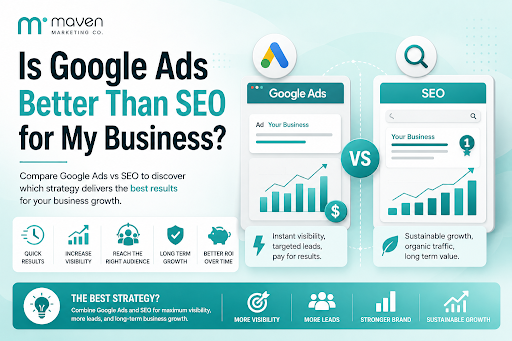
Is Google Ads Better Than SEO for My Business
One of the biggest questions business owners ask when they are planning online growth is whether they should invest in Google Ads or SEO. Both are strong marketing plays that help your company show up in Google search results, but they do things in separate lanes. Google Ads gives quicker visibility and can bring in leads fast, whereas SEO more or less focuses on slow, steady organic traffic that tends to grow the longer you keep building it. Picking the right direction depends on what you want to achieve, how much money you can spend, how crowded the market is, and how quickly you need results, like sooner rather than later. The good news is you don’t always have to choose one or the other; it’s not exactly a black-and-white situation. If you take time to understand the strongest points of both, you can put together a more sensible digital marketing plan that supports consistent expansion. In this guide, we’ll compare Google Ads vs SEO, explain the main differences, and help you figure out what option makes the most sense for your business.

When Should I Hire a Digital Marketing Agency
Growing a business today takes more than just having a website or throwing a post on social media; customers usually search around online, compare providers, skim reviews, and basically expect the brand to show up with a solid digital presence before they even think about buying. Many businesses try to run their marketing themselves, but there comes a point when “doing it all in-house” becomes clunky and hard to manage, all at once. Knowing when to hire a digital marketing agency can end up making a big, real difference for your growth. If you’re not getting enough leads, or your online visibility feels stuck, or sales are just not moving, the right agency can bring the know-how, plus a clear plan, to help you get noticeably better outcomes. In this guide, we’ll dig into what a digital marketing agency actually does, the usual signs it’s time to bring one on, and how picking the right marketing partner can help your business move forward at a faster pace.
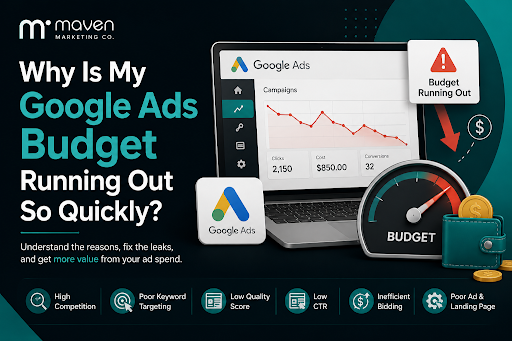
Why Is My Google Ads Budget Running Out So Quickly
Running a successful Google Ads budget isn’t only about throwing more money at it. It’s more like making every dollar, doing a bit extra. A lot of businesses start a Google Ads campaign with big hopes, then find out their daily budget is gone within a few hours, and that feels weird, right? After that, your ads stop showing effectively, new leads slip away, and your return on investment dips. So if your Google Ads budget is running out too fast, don’t stress. It’s a fairly common issue, and in most situations, it can be repaired with the right approach. There are multiple little things that can drain your advertising money quicker than you expected, from costly keywords to audience targeting that just doesn’t quite fit. In this guide, we’ll walk through why your budget disappears so quickly, how to cut wasteful spend, and the most reliable ways to boost your Google Ads ROI, even if your budget stays the same.